Bitcoin is the world's first and most popular cryptocurrency. The token dominates the cryptocurrency market, shaping the entire digital asset industry. Its decentralized nature and limited supply of 21 million coins make it unique, ensuring long-term demand among traders and investors.
This article examines the current fundamental factors that have influenced Bitcoin's growth, its history of creation, and reviews expert forecasts and in-depth technical analysis.
The article covers the following subjects:
- Major Takeaways
- BTC Real-Time Market Status
- Weekly Elliott Wave Bitcoin Analysis as of 08.06.2026
- Technical Analysis and Outlook for BTC Price in 2026
- Analysts' BTC Price Projections for 2027
- Analysts' BTC Price Projections for 2028
- Analysts' BTC Price Projections for 2029
- Analysts' BTC Price Projections for 2030
- Analysts' BTC Price Projections until 2050
- BTC (Bitcoin) Market Sentiment on Social Media
- BTC Price History
- BTC Fundamental Analysis
- More Facts About BTC
- How We Make Forecasts
- Conclusion: Is BTC a Good Investment?
- BTC Price Prediction FAQ
Major Takeaways
- The current BTC price is $61 784.79 as of 09.06.2026.
- The BTC price reached its all-time high of $126073.42 on 06.10.2025. The cryptocurrency hit its all-time low of $0.00099 on 18.02.2012.
- Many analytical agencies predict that the BTCUSD pair will rise in the second half of 2026, reaching $78,138.34–$78,448. However, some predict the price may settle at $68,766.68.
- Projections for 2027 suggest that Bitcoin's price may reach around $82,558.13. Some experts anticipate the asset will range from $58,046 to $67,360.34.
- Most analysts expect BTC to increase between 2028 and 2030. According to some estimates, the value of the digital asset may reach $209,555.19 by the end of 2030. Some experts forecast even more significant gains, up to $297,128.80.
- Long-term forecasts for 2030–2050 are approximate and are subject to frequent revisions. Some analysts expect the price to climb to $1,407,606.11–$1,450,000 by 2040–2050, respectively. Others predict a greater increase toward $1,760,163.57.
- BTCUSD: According to the Elliott wave analysis, the BTCUSD pair is expected to surge within a minor correction this week. Consider buying BTC at the current level, setting a take-profit order at 64,800.00.
BTC Real-Time Market Status
The BTC crypto is trading at $61 784.79 as of 09.06.2026.
The following are key indicators and metrics that are crucial for tracking the BTC market:
- Market capitalization. This indicator reflects the total value of all issued coins in the market and allows you to assess the BTC share in the crypto industry.
- Trading volume over the last 24 hours. High trading volume signals growing investor interest, leading to increased liquidity and volatility of the asset.
- Price change over the last 12 months. This is important for assessing the volatility of the asset and understanding its long-term performance.
- Volume to market cap ratio. It is used to assess the liquidity of the market. A high ratio can signal the strong interest of traders and the presence of strong movements in the market.
- Circulating supply. It helps gain an insight into how many coins are available in the market and how this affects the asset's value.
- The maximum supply is 21 million BTC. This limit creates conditions for further growth in the asset's price.
Indicator | Value |
Market cap | $1.34 trillion |
Trading volume over the last 24 hours | $58.1 billion |
Volume to market cap ratio | 4.3% |
All-time high | $126073.42 |
Circulating supply | 20.04 million BTC |
Maximum supply | 21,000,000 BTC |
Weekly Elliott Wave Bitcoin Analysis as of 08.06.2026
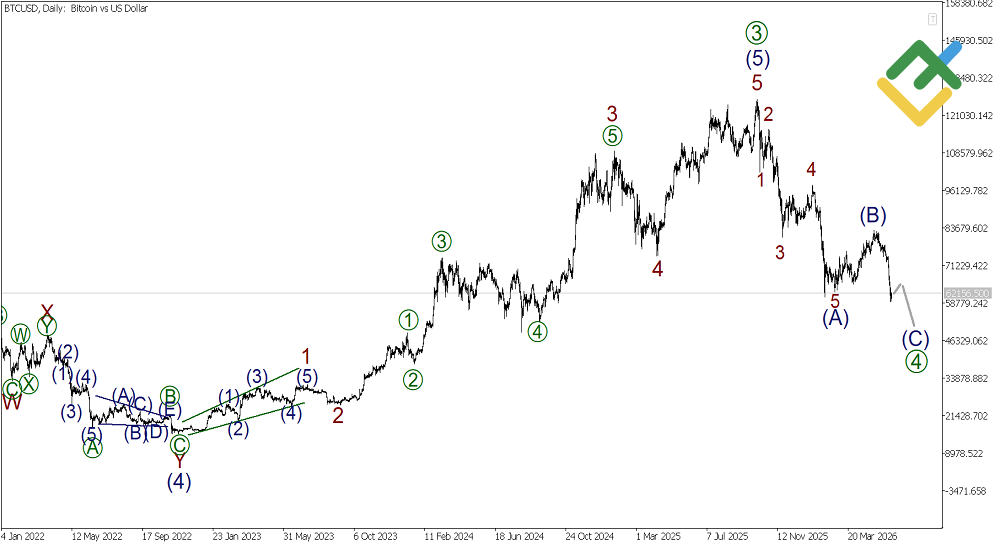
A global impulse [1]-[2]-[3]-[4]-[5] is continuing to form on the BTCUSD chart. Three parts of this pattern have been completed, and correction [4] is underway as a standard zigzag (A)-(B)-(C). The first impulse sub-wave (A) and correction (B) are complete, and the price is trading within the last sub-wave (C).
The final wave (C) may end as an impulse. Its sub-waves 1 and 2 terminated, and the price is sliding sharply in impulse sub-wave 3. BTC may recover slightly in correction [4] of 3 to 64,800.00. At this level, correction [4] will retrace 38.2% of wave [3]. After that, the price is projected to decline.
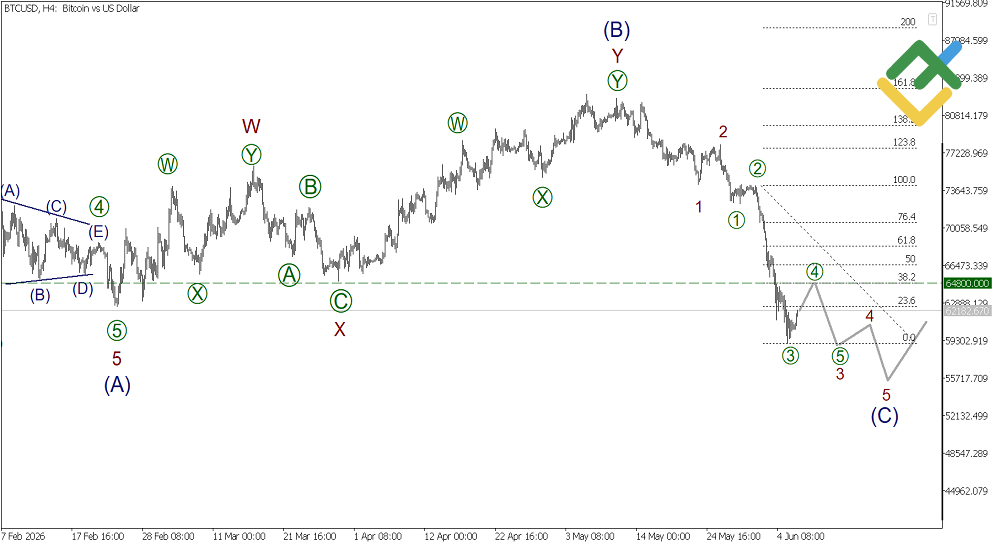
Weekly BTCUSD Trading Plan:
Buy 62,182.67, TP 64,800.00.
BTC/USD Elliott wave analysis is presented by an independent analyst, Roman Onegin.
Technical Analysis and Outlook for BTC Price in 2026
Let's perform a technical analysis of the weekly Bitcoin (BTC) chart to forecast the pair's potential movement for the coming year.
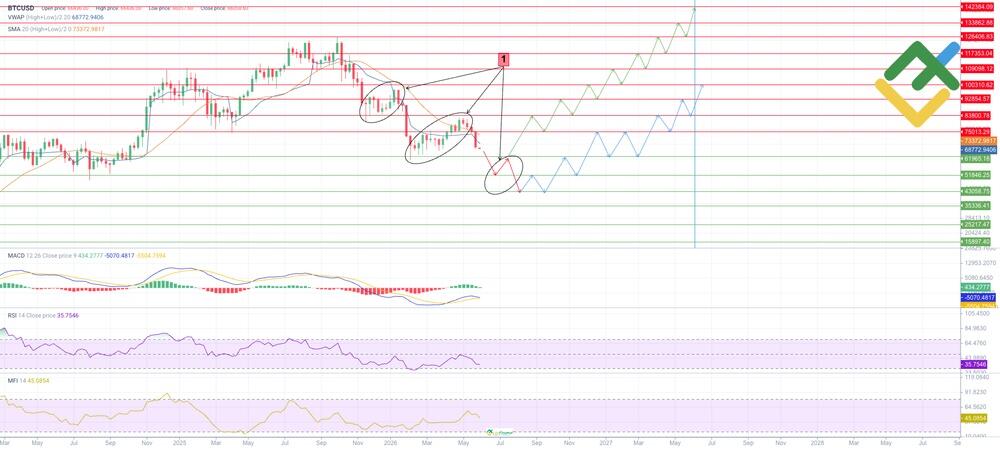
Since early May 2026, Bitcoin's price has been declining from $83,800.78. Technical indicators and candlestick patterns are primarily giving bearish signals:
- A Falling Three Methods chart pattern (1) is forming, with its third phase currently taking shape. The price may fall to $51,846.25–$43,058.75 and then reverse upward.
- MACD is declining in positive territory and approaching the zero line, indicating strengthening bearish momentum.
- The RSI value is holding at 35 and may fall even lower. A correction is possible.
- The MFI is also declining, showing a gradual outflow of liquidity from the asset.
- The VWAP and the SMA20 are both above the market price, indicating that bears continue to control the market.
The table below shows the forecast for the Bitcoin price over the next 12 months.
Month | Minimum, $ | Average, $ | Maximum, $ |
June 2026 | 51,579.96 | 60,766.89 | 69,953.82 |
July 2026 | 50,514.89 | 55,308.03 | 60,101.17 |
August 2026 | 41,993.60 | 51,846.25 | 61,698.90 |
September 2026 | 41,194.74 | 46,520.49 | 51,846.25 |
October 2026 | 45,455.34 | 52,778.25 | 60,101.17 |
November 2026 | 51,846.25 | 57,438.29 | 63,030.34 |
December 2026 | 57,172.00 | 65,959.50 | 74,747.00 |
January 2027 | 60,633.75 | 68,622.38 | 76,611.01 |
February 2027 | 61,432.61 | 68,755.52 | 76,078.44 |
March 2027 | 60,900.03 | 71,950.98 | 83,001.93 |
April 2027 | 74,480.71 | 79,939.61 | 85,398.51 |
May 2027 | 73,948.13 | 83,135.06 | 92,321.99 |
Long-Term Trading Plan for BTCUSD for 2026
The technical analysis has revealed key support and resistance levels that can be used for creating a trading strategy for the coming year.
Trading Plan for the Year
- The price is expected to slide toward the $51,846.25–$43,058.75 range in the near future.
- Key support levels: $61,965.18, $51,846.25, $43,058.75, $35,336.41, $25,217.47, and $15,897.40.
- Key resistance levels: $75,013.29, $83,800.78, $92,854.57, $100,310.62, $109,098.12, $117,353.04, $126,406.83, $133,862.88, and $142,384.09.
- Main scenario: Open short trades below the key support level of $61,965.18 on increased volume, targeting $51,846.25–$35,336.41.
- Alternative scenario: Open long trades above the key resistance level of $75,013.29 or when the price reverses from the $43,058.75 level on increased volume, targeting $83,800.78–$142,384.09.
Analysts' BTC Price Projections for 2026
Analysts are divided on what Bitcoin's price will be in 2026. Some experts believe the upward trend will continue amid institutional demand and falling inflation, while others anticipate a correction. BTC is expected to trade between $68,766.68 and $92,500.
CoinCodex
Price range: $72,734–$92,500.
According to CoinCodex, volatility will remain high throughout the year. The average price is expected to hit $83,722 by the end of June, rise to $85,469 in Q3, and then gradually decline, reaching $78,448 in December.
Month | Minimum, $ | Average, $ | Maximum, $ |
June | 72,734 | 83,722 | 92,500 |
July | 88,838 | 89,921 | 91,190 |
August | 88,974 | 89,927 | 90,578 |
September | 81,050 | 85,469 | 89,428 |
October | 76,444 | 78,344 | 81,207 |
November | 75,177 | 76,620 | 78,409 |
December | 78,405 | 78,448 | 78,491 |
DigitalCoinPrice
Price range: $68,766.68–$83,455.92.
DigitalCoinPrice estimates that the average price of BTC may reach $72,930.73 by mid-year. In Q3, the trajectory is predicted to be mixed, with the price settling at $75,181.18. By year-end, the asset is anticipated to fall to $68,766.68.
Month | Minimum, $ | Average, $ | Maximum, $ |
June | 70,615.03 | 72,930.73 | 75,246.43 |
July | 72,548.66 | 73,909.15 | 75,269.65 |
August | 77,626.48 | 80,541.20 | 83,455.92 |
September | 75,181.18 | 75,181.18 | 75,181.18 |
October | 69,721.20 | 72,754.53 | 75,787.86 |
November | 74,513.52 | 74,832.92 | 75,152.32 |
December | 68,766.68 | 68,766.68 | 68,766.68 |
Changelly
Price range: $69,699.50–$83,296.24.
Changelly predicts that Bitcoin will continue to increase in the second half of the year. The average price is expected to reach $75,056.30 by the end of June, $79,737.54 by Q3, and $78,138.34 by December.
Month | Minimum, $ | Average, $ | Maximum, $ |
June | 69,699.50 | 75,056.30 | 80,413.10 |
July | 72,978.82 | 73,090.12 | 73,201.41 |
August | 78,295.77 | 79,720.80 | 81,145.82 |
September | 78,009.50 | 79,737.54 | 81,465.58 |
October | 73,157.39 | 75,525.13 | 77,892.86 |
November | 72,805.13 | 75,142.69 | 77,480.25 |
December | 72,980.43 | 78,138.34 | 83,296.24 |
Analysts' BTC Price Projections for 2027
Forecasts for 2027 are mixed. Bitcoin's performance will likely depend on the evolution of the ETF market, further cryptocurrency adoption within the global financial system, and broader economic conditions. However, tighter regulations and weaker investor demand could limit gains. By year-end, Bitcoin is expected to trade between $58,046 and $82,558.13.
Note: The price ranges reflect the asset's expected volatility throughout the year. Lows and highs may not be shown in the summary tables.
CoinCodex
Price range: $55,590–$89,265.
According to CoinCodex, the average price may reach $82,477 in Q1 and drop to $67,037 by summer. In the second half of the year, the bearish trend may accelerate, pushing the price down to a low of $55,590 by December.
Quarter | Minimum, $ | Average, $ | Maximum, $ |
Q1 | 78,125 | 82,477 | 89,265 |
Q2 | 62,964 | 67,037 | 85,806 |
Q3 | 57,936 | 59,263 | 67,362 |
Q4 | 55,590 | 58,046 | 60,026 |
DigitalCoinPrice
Price range: $74,493.94–$108,558.81.
DigitalCoinPrice predicts that Bitcoin's price will range between $74,493.94 and $81,569.85 at the start of the year, averaging at $101,199.64 in Q2. The asset is projected to reach a high of $108,558.81 in Q3 and then pull back. By December, the price is expected to stabilize at $82,558.13.
Quarter | Minimum, $ | Average, $ | Maximum, $ |
Q1 | 74,493.94 | 81,569.85 | 81,569.85 |
Q2 | 83,560.35 | 101,199.64 | 101,199.64 |
Q3 | 80,036.72 | 86,291.40 | 108,558.81 |
Q4 | 80,361.74 | 82,558.13 | 84,910.38 |
Changelly
Price range: $55,590.11–$91,077.47.
Changelly offers a more cautious forecast, predicting that the average price will reach $72,980.39 by June. In the second half of the year, the downward pressure is expected to continue, with prices potentially plummeting to a low of $55,590.11 by December.
Quarter | Minimum, $ | Average, $ | Maximum, $ |
Q1 | 68,501.38 | 75,790.41 | 81,585.71 |
Q2 | 64,197.62 | 72,980.39 | 84,749.63 |
Q3 | 59,893.87 | 70,170.36 | 87,913.55 |
Q4 | 55,590.11 | 67,360.34 | 91,077.47 |
Analysts' BTC Price Projections for 2028
The outlook for 2028 is largely positive. The next Bitcoin halving could provide additional momentum for BTC, while growing cryptocurrency adoption in high-inflation economies may further support demand. Analysts expect Bitcoin to trade between $137,291.90 and $138,590, although more conservative forecasts place the year-end price closer to $102,698.20.
CoinCodex
Price range: $56,865–$156,123.
According to CoinCodex, the average price may jump to $103,255 in Q1 and decline to $99,353 in Q2. After that, the price is expected to rise, potentially reaching a high of $156,123 by December.
Quarter | Minimum, $ | Average, $ | Maximum, $ |
Q1 | 56,865 | 103,255 | 118,998 |
Q2 | 97,429 | 99,353 | 116,273 |
Q3 | 98,451 | 109,343 | 115,728 |
Q4 | 112,508 | 138,590 | 156,123 |
DigitalCoinPrice
Price range: $78,711.66–$143,559.33.
According to DigitalCoinPrice, BTC will grow steadily throughout 2028. The average price is expected to reach $109,017.97 by mid-year. In December, the asset is predicted to hit a high of $143,559.33.
Quarter | Minimum, $ | Average, $ | Maximum, $ |
Q1 | 78,711.66 | 92,583.41 | 93,955.24 |
Q2 | 94,313.91 | 109,017.97 | 111,334.40 |
Q3 | 110,232.93 | 124,992 | 129,274.74 |
Q4 | 125,137.39 | 137,291.90 | 143,559.33 |
Changelly
Price range: $55,696.32–$156,123.26.
Changelly anticipates high volatility. The average price is estimated to reach $85,935.60 by mid-year. By December, the asset is projected to hit a high of $156,123.26.
Quarter | Minimum, $ | Average, $ | Maximum, $ |
Q1 | 55,696.32 | 77,554.30 | 105,979.42 |
Q2 | 56,014.95 | 85,935.60 | 122,694.03 |
Q3 | 56,333.57 | 94,316.90 | 139,408.65 |
Q4 | 56,652.19 | 102,698.20 | 156,123.26 |
Analysts' BTC Price Projections for 2029
The outlook for 2029 is mostly optimistic. Continued financial digitalization, growing institutional adoption, and Bitcoin's role as a hedge against inflation could spur further gains. However, regulatory changes and weaker macroeconomic conditions may trigger periods of volatility. Analysts expect BTC to trade between $149,311.59 and $205,566.
CoinCodex
Price range: $125,033–$305,028.
CoinCodex forecasts Bitcoin to grow steadily in the first half of the year. The average price is predicted to reach $250,375 by June. In the second half of the year, a correction may occur, with the asset likely settling at $205,566 by December.
Quarter | Minimum, $ | Average, $ | Maximum, $ |
Q1 | 125,033 | 167,741 | 176,338 |
Q2 | 140,645 | 250,375 | 305,028 |
Q3 | 206,269 | 218,861 | 291,890 |
Q4 | 163,513 | 205,566 | 217,352 |
DigitalCoinPrice
Price range: $115,599.17–$150,684.10.
According to DigitalCoinPrice, following a strong start to the year, the market may enter a correction phase. The average price is projected to decrease to $130,143.98 in Q3. However, by the end of the year, the price is expected to reach a high of $150,684.10.
Quarter | Minimum, $ | Average, $ | Maximum, $ |
Q1 | 141,352.16 | 141,352.61 | 144,798.63 |
Q2 | 124,619.88 | 127,364.46 | 134,240.27 |
Q3 | 115,599.17 | 130,143.98 | 130,143.98 |
Q4 | 124,728.40 | 149,311.59 | 150,684.10 |
Changelly
Price range: $62,545.35–$305,028.
Changelly expects Bitcoin to strengthen gradually. The average price is anticipated to climb from $126,230.19 in Q1 to $196,826.15 by year-end. Volatility is projected to be high.
Quarter | Minimum, $ | Average, $ | Maximum, $ |
Q1 | 62,545.35 | 126,230.19 | 193,349.44 |
Q2 | 79,587.57 | 149,762.18 | 230,575.63 |
Q3 | 96,629.79 | 173,294.17 | 267,801.81 |
Q4 | 113,672.02 | 196,826.15 | 305,028.00 |
Analysts' BTC Price Projections for 2030
The outlook for 2030 is favorable. Increased institutional demand and the possibility of BTC being recognized as a reserve asset may strengthen its position in the market. Although volatility is expected to persist, forecasts generally range from $173,585.95 to $209,555.19, with the potential for a rise to $297,128.80.
CoinCodex
Price range: $153,552–$210,238.
CoinCodex suggests the average price may reach $164,876 in Q1. A correction is likely in Q2 and Q3. Subsequently, the asset is expected to continue rising, with the average price settling at $174,842 by December.
Quarter | Minimum, $ | Average, $ | Maximum, $ |
Q1 | 161,960 | 164,876 | 210,238 |
Q2 | 172,378 | 182,979 | 196,498 |
Q3 | 154,675 | 158,422 | 181,256 |
Q4 | 153,552 | 174,842 | 178,798 |
DigitalCoinPrice
Price range: $152,076.65–$215,127.56.
DigitalCoinPrice forecasts a progressive increase in the asset's value. Following a correction in Q2, the average price is expected to advance. By December, Bitcoin is projected to reach a high of $215,127.56.
Quarter | Minimum, $ | Average, $ | Maximum, $ |
Q1 | 152,076.65 | 172,047.19 | 172,047.19 |
Q2 | 166,564.23 | 166,564.23 | 174,598.71 |
Q3 | 162,710.18 | 185,327.27 | 186,874.32 |
Q4 | 183,278.96 | 209,555.19 | 215,127.56 |
Changelly
Price range: $127,410.08–$297,128.80.
According to Changelly, the Bitcoin price will slowly go down in the first half of the year. By summer, the average price may reach $185,206.05. By Q3, the asset is expected to hit a high of $249,733.59. After that, a correction may happen, bringing the average price down to $173,585.95 by December.
Quarter | Minimum, $ | Average, $ | Maximum, $ |
Q1 | 127,410.08 | 191,016.10 | 297,128.80 |
Q2 | 134,539.83 | 185,206.05 | 273,431.20 |
Q3 | 141,669.58 | 179,396.00 | 249,733.59 |
Q4 | 148,799.32 | 173,585.95 | 226,035.99 |
Analysts' BTC Price Projections until 2050
Long-term forecasts for Bitcoin remain highly uncertain. The cryptocurrency can be affected by regulatory changes, advancements in blockchain technology, the proliferation of central bank digital currencies, and the overall state of the global economy. Any projections spanning 15 to 25 years should be viewed solely as rough estimates.
According to CoinCodex, the price of BTC may reach $1,030,000 by 2040 and surge to $1,450,000 by 2050.
DigitalCoinPrice forecasts an increase to $272,366.33 by 2033 and to $1,407,606.11 by 2050.
Changelly presents the most upbeat scenario, predicting the Bitcoin price will hit $1,760,163.57 by 2050.
Year | CoinCodex, $ | DigitalCoinPrice, $ | Changelly, $ |
2033 | - | 272,366.33 | 334,717.27 |
2040 | 1,030,000 | 431,843.74 | 730,366.57 |
2050 | 1,450,000 | 1,407,606.11 | 1,760,163.57 |
BTC (Bitcoin) Market Sentiment on Social Media
Media sentiment reflects the mood of crypto market participants and can influence BTC's short-term price movements. Positive news regarding cryptocurrency adoption, the launch of new ETFs, or rising institutional demand can bolster the uptrend. Negative news, on the other hand, can increase volatility and trigger a correction.
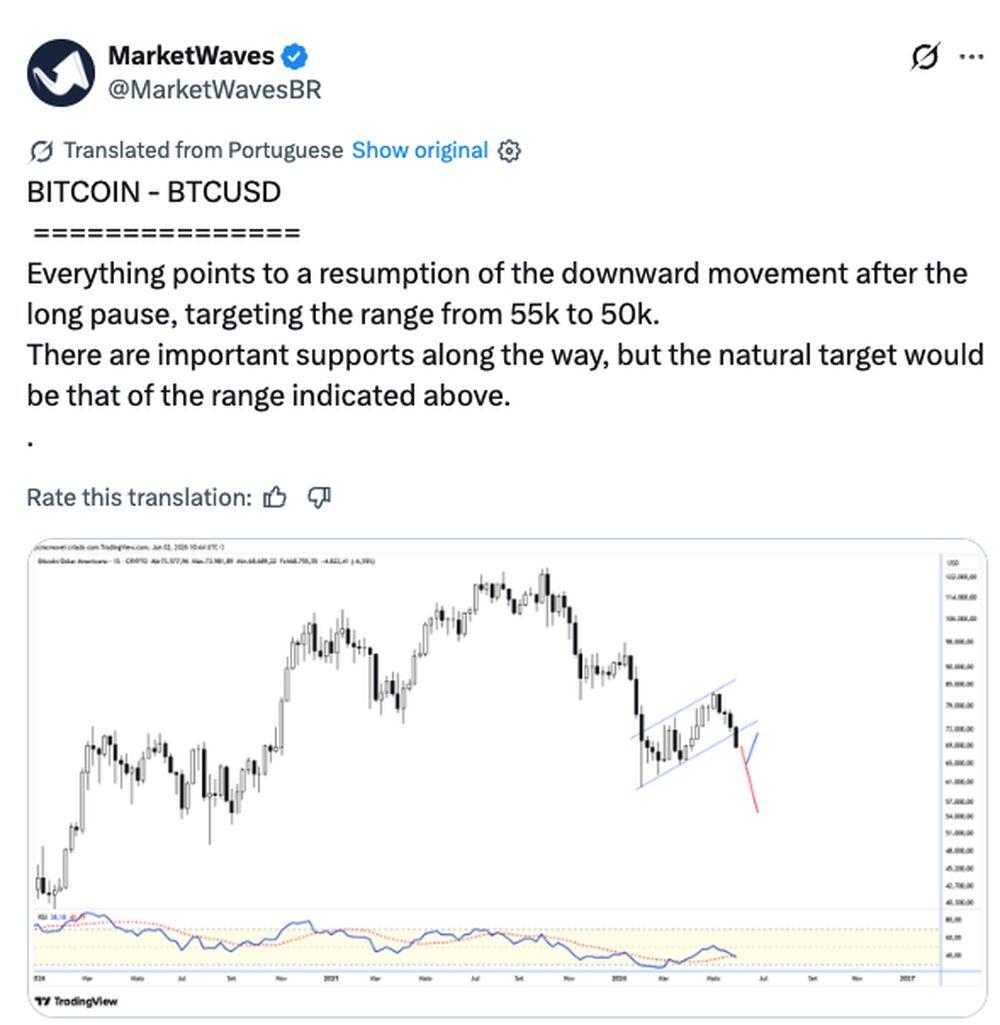
User @MarketWavesBR expects the BTC price to drop to $50,000–$55,000 in the near future.
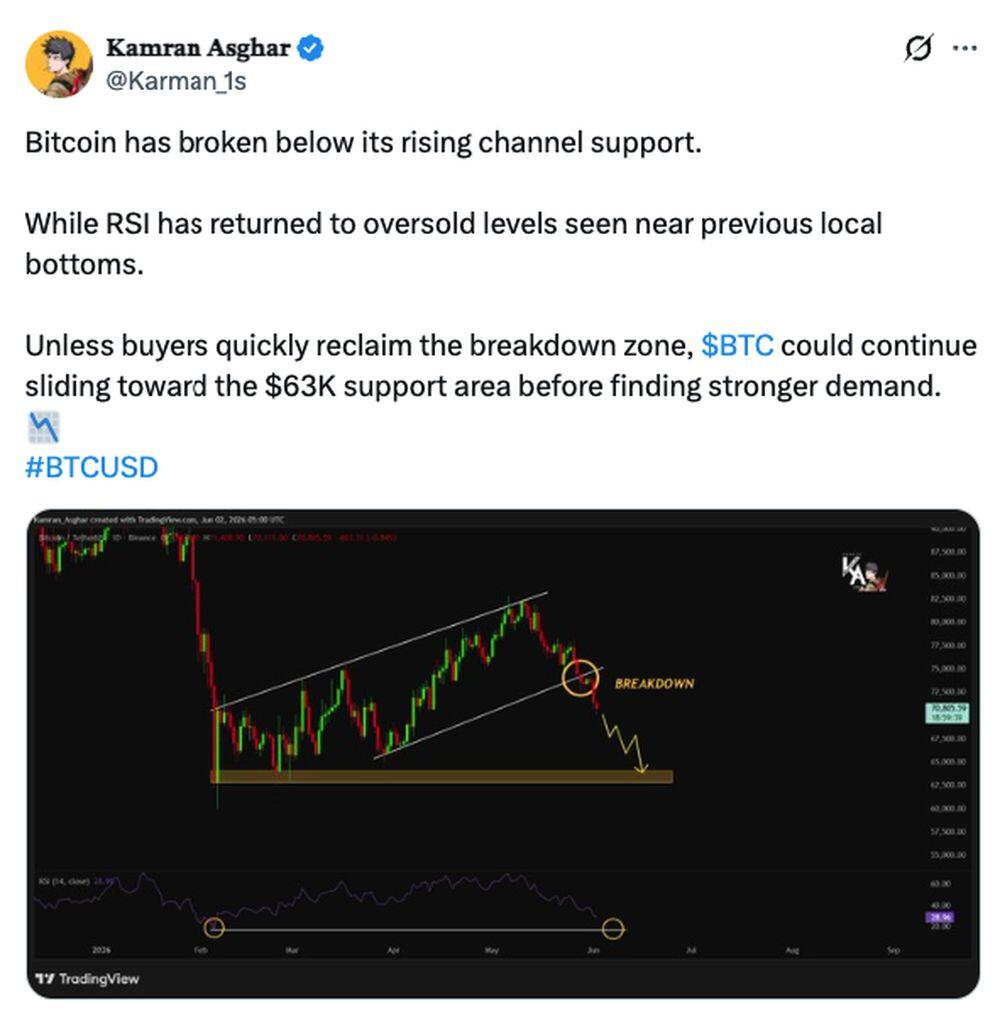
Independent analyst @Karman_1s also predicts that the BTC price will decline to $63,000 in the short term.

Independent trader @X_Four_iv anticipates BTC to retreat to $56,000 in the coming weeks.
Most investors and traders expect Bitcoin prices to decline in the short term. However, the actual price will depend on macroeconomic and geopolitical factors. It is crucial to conduct technical and fundamental analysis and review the latest expert insights before making any trading or investment decisions.
BTC Price History
Bitcoin (BTC) reached its all-time high of $126073.42 on 06.10.2025.
The lowest price of Bitcoin (BTC) was recorded on 18.02.2012 when the coin declined to $0.00099.
Below is the chart of the BTCUSD pair. It is crucial to evaluate historical data to make our forecasts as accurate as possible.
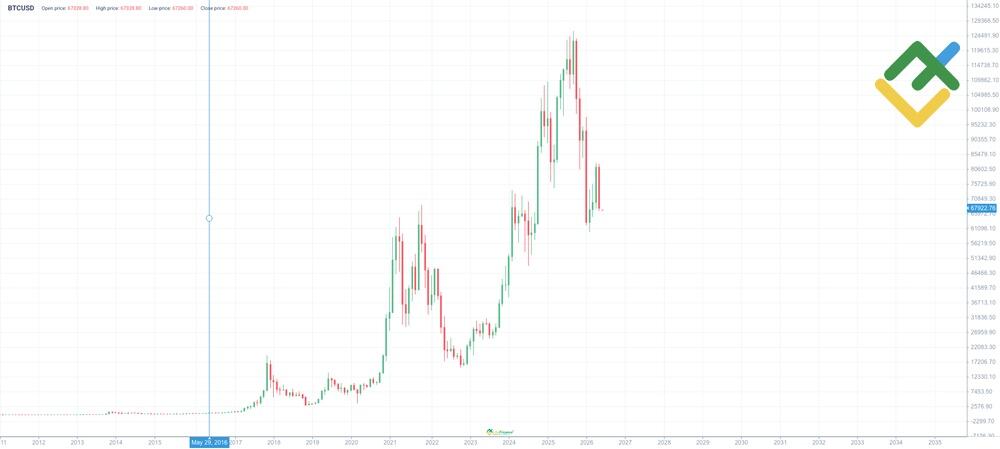
- End of 2017 – early 2018. BTC surged above $19,000 amid the ICO boom and widespread hype. By early 2018, however, the bubble burst, triggering a prolonged decline.
- 2020 – early 2021. A new bullish cycle began: the pandemic and an influx of institutional investment pushed the price above $60,000.
- Summer 2021. China's mining ban caused a sharp drop in hashrate and a deep correction, with the price falling by nearly half.
- 2022. The collapse of Terra and the bankruptcies of Celsius, 3AC, and FTX resulted in a bearish year, with BTC sliding back below $20,000.
- 2023–2024. Market revival amid expectations of the halving and the launch of ETFs. The price began to rise rapidly.
- 2025. The price reached a new high of $125,000 in October. After that, a bearish correction started, bringing the price down to $80,600. At the end of the year, the asset settled at $91,000.
- In January and early February 2026, Bitcoin prices dropped, reaching $60,000. From mid-February through April, the price climbed to $82,849.66. However, it started to fall in early May, settling at $67,076 by the end of the month.
BTC Fundamental Analysis
Bitcoin is the world's leading cryptocurrency, exerting a significant influence on the digital asset market. A fundamental analysis of BTC provides insight into the key factors that determine its price and attractiveness among investors.
What Factors Affect the BTC Price?
- Supply and demand. The limited number of coins (21 million BTC) and halvings that reduce the reward for BTC mining lead to a lower supply. Demand for BTC is driven by interest among investors.
- Macroeconomic factors. Economic conditions in developed countries, inflation rates, and central bank monetary policies can influence the price of Bitcoin. Many investors view BTC as a hedge against inflation, especially during periods of economic instability. However, this strategy comes with high risks.
- Regulatory changes. The value of Bitcoin is significantly influenced by the regulatory environment surrounding cryptocurrencies. The adoption or prohibition of cryptocurrencies in various countries can lead to fluctuations in the exchange rate.
- Technological development. Updates to blockchain technology and improvements to network infrastructure are key factors. For instance, the deployment of scaling technologies, such as the Lightning Network, has the potential to drive greater adoption of Bitcoin, which could boost its exchange rate.
- Institutional investment. The interest of major firms and institutional investors is a significant factor influencing the price of Bitcoin. Investments from companies such as Tesla and MicroStrategy increase confidence in BTC and attract new investors to the market.
- Security issues. Any news about cyberattacks on cryptocurrency platforms or blockchain vulnerabilities can push the price of BTC lower. Investors value Bitcoin's resilience to hacking attacks and its decentralized nature.
- Social media sentiment. Social media sentiment, influencer mentions, and news events can rapidly shift investor perceptions and impact the BTC price. For instance, Elon Musk's statements have frequently triggered significant crypto market shifts.
More Facts About BTC
Bitcoin (BTC) is the world's first decentralized cryptocurrency, created in 2009 by an individual or group of people operating under the alias Satoshi Nakamoto. It employs blockchain technology, which enables transparent and secure record-keeping of transactions. The increase in the value of Bitcoin is linked to its limited issuance. The maximum supply of BTC is 21 million coins. The gradual decrease in the reward for mining, known as halving, also contributes to a decrease in supply, which increases scarcity and stimulates price growth.
Traders choose Bitcoin due to its significant volatility, allowing them to generate profits on price swings. In addition, BTC acts as an alternative to traditional assets during economic downturns. Its accessibility, high liquidity, and the ability to store on cold wallets attract both institutional investors and retail traders.
Bitcoin has become a symbol of freedom from the traditional banking system, appealing to users who value financial independence and decentralization.
Advantages and Disadvantages of Investing in BTC
Investing in Bitcoin comes with both benefits and risks.
Advantages:
- High growth potential. Since its inception, Bitcoin has demonstrated remarkable growth.
- Decentralization and independence. Bitcoin is a decentralized currency, which means that it is not controlled by the government or financial institutions. This makes it an attractive option for investors seeking independence from traditional banking systems.
- High liquidity. Bitcoin is one of the most liquid crypto assets, meaning it can be quickly and easily exchanged for fiat currencies or other cryptocurrencies without significant loss in value.
- Transparency and security. Blockchain technology, the backbone of Bitcoin, offers a high level of transparency and security, reducing fraud risks and attracting new investors.
Disadvantages:
- High volatility. The price of Bitcoin is subject to significant fluctuations, which can result in substantial gains or substantial losses. For those seeking a conservative investment option, Bitcoin is not a suitable choice.
- Regulatory risks. Cryptocurrencies, including Bitcoin, must comply with the standards set forth by financial regulators. The introduction of new legislation or restrictions by governments in different countries may affect the price and availability of the asset.
- Limited adoption. Despite the growing popularity of Bitcoin, it has yet to gain global acceptance as a means of payment. The majority of companies do not accept BTC, which limits its potential economic value.
- Technological risks. The security of Bitcoin depends on the stability of the blockchain. While the technology is highly secure, investors could suffer significant losses in the event of a cyberattack or vulnerability in the technology.
- Energy consumption. Bitcoin mining requires exorbitant electricity consumption, which has led to criticism from environmentalists and could potentially affect public perception of the cryptocurrency. Against this backdrop, the value of BTC may decline.
How We Make Forecasts
In order to ensure the most accurate forecasts, we employ a comprehensive methodology that encompasses both technical and fundamental analysis.
- Short-term forecasts. Our analysis includes an evaluation of current market sentiment and technical indicators such as the RSI, MACD, moving averages, and trading volume. In addition, we consider volatility and key support and resistance levels.
- Medium-term forecast. We consider fundamental factors such as blockchain network updates, regulatory changes, and major events in the cryptocurrency industry, as well as historical data, to identify chart patterns and trends.
- Long-term forecasts are based on an analysis of global economic trends and developments in blockchain technology. Furthermore, we leverage insights from top analysts to assess the potential for infrastructure and significant partnerships within the industry.
Conclusion: Is BTC a Good Investment?
Bitcoin remains a high-risk but potentially lucrative asset, given its limited supply and growing institutional interest. Over the past 10 years, its average annual return has exceeded 200%, though there have been drops of 70–80%.
BTC can be part of a diversified portfolio with an allocation of no more than 5–10% and a holding period of five years or longer. However, short-term speculation is risky, as crypto winters can lead to capital losses. It is also important to consider regulatory risks and competition from central bank digital currencies.
Although Bitcoin is an investment in the future of decentralization, it is no guarantee of getting rich. A sensible approach is to invest only disposable income and lock in profits regularly.
BTC Price Prediction FAQ
The current BTC price is $61 784.79 as of 09.06.2026.
The BTC price depends on market supply and demand, investor sentiment, regulatory actions, the macroeconomic situation, and cryptocurrency adoption.
Historically, crypto winters have pushed Bitcoin down 70–85% from its peak. Based on the current all-time high of around $125,000, that would imply a potential decline to $18,000–$36,000. However, each market cycle has established higher long-term support levels, making such a deep decline less likely. A more realistic bottom in the next crypto winter could be in the $40,000–$50,000 range.
Many investors view Bitcoin as a viable hedge against inflation, citing its limited supply of 21 million coins. However, the asset's volatility and sensitivity to market sentiment challenge this assumption.
History shows that Bitcoin halving, an event when the reward for mining is halved, has always boosted the coin's price. The next halving is expected in 2028 and could lead to another rally.
In 2026, the Bitcoin price may drop to $60,000–$70,000 if regulatory pressure intensifies and economic challenges arise. The asset may fall by an average of 30–40%. However, many experts predict that the price will rise to $78,138.34–$78,448 by the end of the year.
In 2027, BTC is expected to trade between $58,046 and $82,558.13, according to the consensus forecast. The optimistic scenario suggests the price will climb to $108,558.81, fueled by increased institutional investment and falling inflation. A negative forecast calls for a decline to $58,046.
By 2030, the price may increase by 200–300% from current levels, reaching $173,585.95–$209,555.19. The key drivers of this growth will be Bitcoin's widespread adoption as a store of value and a hedge against US dollar depreciation.
By 2040, the BTC price is estimated to range between $431,843.74 and $1,030,000, provided it remains the dominant cryptocurrency. However, the asset may eventually lose its relevance as other payment methods gain traction.
Bitcoin remains one of the most popular cryptocurrencies with huge growth potential. However, investors should carefully weigh the risks and be prepared for significant price swings due to the asset's high volatility and regulatory uncertainty.
Your income will depend on the Bitcoin price in the future. The higher the BTC rate soars, the higher your profit will be. However, the cryptocurrency can be subject to significant fluctuations, so it is essential to determine the market entry point accurately.
Some experts believe that Bitcoin will reach $200,000 if it continues to grow steadily and gains more traction among investors. However, for now, such an increase remains questionable given the cryptocurrency market's volatility.
The token's price may reach $1 million by 2035–2040 if fiat currencies collapse, Bitcoin gains global adoption, and its supply remains limited. However, this is unlikely without a global economic crisis.
Bitcoin's growth depends on many factors, such as economic crises, blockchain implementation, and the adoption of cryptocurrencies in global systems. Theoretically, Bitcoin can rise to $1,000,000 or higher in the long term.
Bitcoin has good prospects, given its status as the first and most popular cryptocurrency. With the number of users growing every year and institutional investment in cryptocurrencies continuing to increase, the BTC exchange rate has a rosy future ahead.
Over the next 10 years, Bitcoin's average price could reach $272,366.33–$229,013.89. If it maintains an annual growth rate of 30%, well below its historical average, it could potentially soar to $1,030,000. However, such long-term forecasts remain highly uncertain due to Bitcoin's volatility.
Price chart of BTCUSD in real time mode

The content of this article reflects the author’s opinion and does not necessarily reflect the official position of LiteFinance broker. The material published on this page is provided for informational purposes only and should not be considered as the provision of investment advice for the purposes of Directive 2014/65/EU.
According to copyright law, this article is considered intellectual property, which includes a prohibition on copying and distributing it without consent.