EOS Review, EOS competitors and EOS prospects
EOS is a young but ambitious project. Founded just over a year ago, it’s already on the TOP 5 best capitalizations list. Even if this platform hasn’t been fully launched, it still can be a serious competitor for Ethereum. Find out what EOS is like, what its advantages and drawbacks are, where to buy and store it, whether it can be mined, who the main competitors are and what its prospects are. Read on and join LiteFinance’s successful cryptocurrency traders!
EOS is a serious competitor for Ethereum
Not long ago, some new instruments were added to LiteFinance’s arsenal of cryptocurrencies and cryptocurrency pairs. The multi-purpose decentralized platform EOS is among them. The prospects of this instrument are quite promising. It’s worth mentioning that the cryptocurrency was ranked 10th or something like that on CoinMarketCap’s list as late as in spring 2018, yielding to its nearest competitor NEO. But after the market’s summer correction, NEO (the Chinese analogue of Ethereum) was left far behind whereas EOS broke into TOP 5. The competitors are on the alert, so we don’t know if the currency will stay there for long, but it will be hard to knock it out from the TOP 10 list. Read on to learn what EOS is like, what its advantages and drawbacks are, and what its prospects are.
EOS is a multi-task platform for development of startups
In essence, EOS (eosio) is similar to Ethereum, which is a decentralized platform for the development of applications. It’s based on asynchronous contracts executed in parallel, which allows reaching the information processing rate of 1 million transactions per second. There are no fees in the network. The developers of EOS promise a safer environment for the execution of smart contracts as compared with Ethereum.
Benefits of EOS:
- Free transmission of information for all participants;
- Opportunity to restore user accounts under the base protocol. Backups for BTC and ETH are executed using a complicated scheme of multisignatures. For EOS, all is simpler: if a user has lost or forgotten the password, the cryptocurrency can be easily restored;
- Short addresses easily transferred from one application to another, while BTC and can’t boast this feature.
The total emission of tokens is 1 billion coins issued gradually within 1 year, which provoked some scepticism around the project (no decentralization was meant). Now, a bit more than 900 million coins are in free circulation, 10% of coins being held by the developers.
Where to buy and how to store EOS
1. Exchanges
Once EOS worked its way into TOP 5 best capitalizations, the distribution of its trading volumes on cryptocurrency exchanges became much better. The main volume (50%) used to be traded at South Korea’s exchange Bithumb (bithumb.com) where the currency could be bought only for the national won (KRW). Now, the distribution is more diversified:
- Huobi is the leader in terms of volume (24-26%). Tokens can be bought for ВТС and USDT, which is quite convenient;
- OKEx accounts for 16%-18% of the trading volume. The cryptocurrency is sold for ВТС and USDT here too. ЕТН accounts for a small share of about 1%;
- Binance: approximately 10%-12% of the trading volume (for ВТС and USDT);
- Bitfinex and Bithumb account for 11-13%.
True, this distribution may change at any moment. One would hardly believe EOS could be delisted on this or that cryptocurrency exchange, but the share can change. According to CoinMarketCap, the currency is available on more than 120 exchanges, but really tradable on 50-60 out of them only. Out of exotic currency pairs, let’s mention the pairs including CNY (the Chinese Yuan) and CK USD (Canadian exchange’s token). Kraken is one of the few exchanges that sell EOS for USD and EUR.
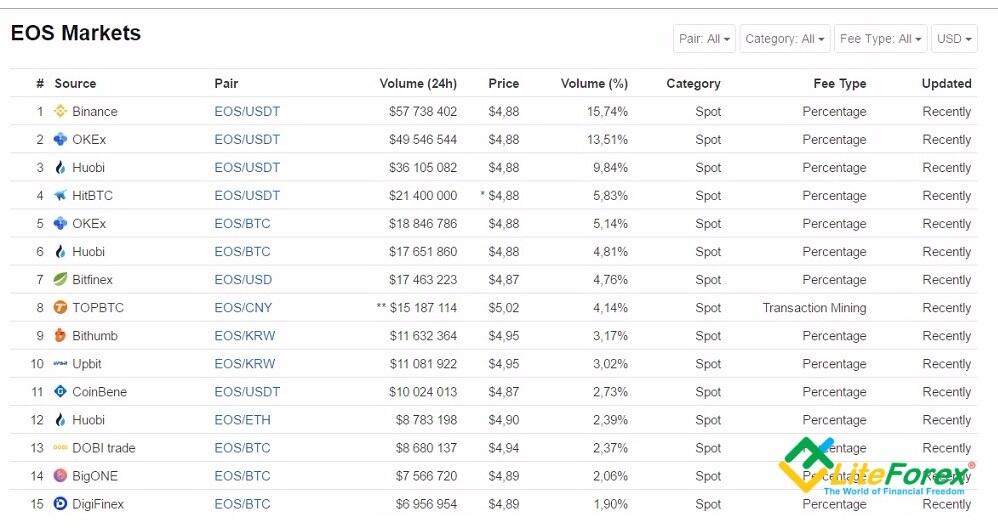
An interesting fact: in terms of capitalization, EOS yields to Ripple and Bitcoin Cash, but in terms of trading volume, it yields only to ВТС and ЕТН. The situation is almost the same at OKEx, where EOS has outperformed ЕТН. Even if it’s most likely a temporary victory, EOS’s leadership in trading volumes means the platform isn’t going to lose ground and may reach the fourth or the third capitalization soon.
2. Wallets
Cryptocurrency exchanges have never been considered to be a reliable way to store cryptocurrencies. Often hacked and non-regulated, they are mostly intended for intraday trading. Those who expect that quotes will be rising in the long term may be interested in wallets, where the cryptocurrency is transferred after being bought on a cryptocurrency exchange.
The platform didn’t have its own wallet up to June 1, 2018, so coins could be stored in any wallet which uses the ERC-20 Ethereum standard. On 1 June 2018, a full version of the EOSIO v1.0 wallet was launched on the site of the platform.
- Attention: a EOS wallet has to be synchronized with a key on the site. Those who failed to do so before the end of ICO lost their coins stored in wallets. The information on how synchronisation is performed can be found on narrow-purpose forums (you’ll have to go deep into the basics of programming). There’s a simpler option - just follow the instruction on the site.
The currency used to be supported by some other popular wallets, such as Exodus and Jaxx, but the developers ask to use the wallet provided on the site of the platform.
3. Mining
There’s no mining as such. The developers of the crypto-currency decided immediately to give up the PoW consensus algorithm and choose DPoS instead. It’s an analogue of PoS where the holders of tokens get an interest for holding tokens, just like it happens with bank deposits. The difference is that DPoS is a delegated protocol under which a limited number of token holders chosen by the rest of network participants can make decisions in the network. That’s why the only way of getting tokens is buying them on a cryptocurrency exchange. Or trading their CFDs at Forex.
EOS investment prospects
EOS’s co-founder is Daniel Larimer. Although he’s less famous than Vitalik Buterin, some facts which don’t characterize him well became known by the public. EOS isn’t his first public project. First, he was a co-developer of the BitShares exchange, but abandoned it as soon as the start-up faced some technical problems which affected its popularity. Next, he launched the Steemit social network (analogue of Reddit), but again, he had to leave the project because of disagreements with other participants. The network itself was often criticized by users too. EOS is his next project and there’s no guarantee that Larimer won’t quit it if any problems occur. Even if much doesn’t depend solely on him, it will hardly have a positive impact on the platform.
Here’s the moment for mentioning EOS’s numerous competitors (decentralized platforms for startups are the second popular direction of startup development after payment systems):
- Ethereum. An inaccessible competitor so far. However, it’s less developed technically. What is at issue here is first and foremost safety which is compromised by the out-of-date consensus algorithm PoW. The announced transition to PoS has been delayed so far and its exact date remains unknown. ETH’s leadership is mostly based on the authority of Vitalik Buterin.
- Cardano. Another serious competitor that is stably on the TOP 10 list. The platform boasts a solid support team, but there are a few factors that prevent the price from growing: first, the peculiarities of its programming languages (a new language Haskell (1990) and its own language Plutus), both of them being quite inconvenient. Second, the platform is now being developed and it hasn’t been fully launched. Thus, it’s impossible to assess it in practice.
- NEO. The platform is called the Chinese analogue of Ethereum, but it lost ground and is no longer on the TOP 10 list. One of the reasons is a structural code problem which leads to application failures. EOS hasn’t had such problems so far.
- Lisk. Quite a serious competitor that also uses the DPoS consensus algorithm. The platform is on the Top 20 list of most capitalised platforms and may draw a big interest of application developers. Besides, it uses the popular JavaScript language. The platform has been already used and various startups run on its basis.
- Expanse. Should we consider a platform ranked below the 500th place? Sure, we should as it has many advantages. The question is whether the developers will be able to implement them in real life.
Thus, we may make some conclusions about the problems of the EOS platform:
- The startup is young and hasn’t been launched to the full extent. So, there’s no guarantee that developers of applications based on this platform won’t face troubles in future.
- The information on the developers is provided rather for advertising purposes.
- The price is much affected by marketing.
The last point is confirmed by the situation which took place in April 2018.
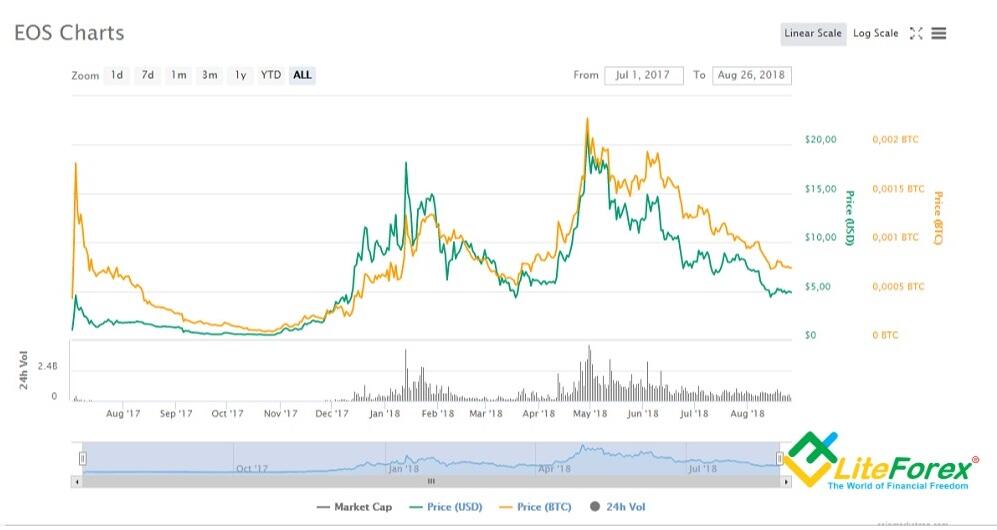
Despite the stagnation of the market (capitalisation had fallen two times down to 412 bullion usd), EOS, conversely, reached its historical peak in late April (weekly growth reaching 79%). There were 2 releases which contributed to that: the information on founding the EOS Global venture fund worth 200 billion for promoting the project in the Asian region and the intention to move from the ERC 20 standard to its own blockchain at the beginning of summer. True, the price collapsed soon after, which speaks of news speculation.
On June 1, 2018, the first 1-year long stage of ICO ended and the promised transition to its own blockchain was realized. Based on the total invested sum ($4 billion), the startup became the leader, but the news didn’t influence the price. Besides, the end of ICO allowed cancelling the distribution of tokens within the network. According to Ethereum World News, almost half of the tokens (49.67%) are stored in 10 wallets. It’s a serious reason for thinking about the cryptocurrency’s decentralization and the possibility of manipulating the price.
Right after the launch of its own blockchain, at the beginning of June, the specialists of the Chinese research company Qihoo reported a series of vulnerabilities which could help hackers to take control over EOS network nods. However, they hadn’t spoken much of the platform’s vulnerability throughout the first year of its existence, so it’s could be just an attempt to cut the price. As for safety, the EOS platform can be considered as reliable.
In mid-August, EOS developers launched a new system - Alliance - where network participants can discuss the platform’s further vectors of development. It’s a kind of a chat for joint decision-making and exchange of information within the community. The system is controlled by 7 presidents, 2 out of them being chosen by the community. True, the mechanism of voting and the principles of the system’s operation aren’t fully understandable.
Conclusion. The EOS cryptocurrency is a young project and its prospects haven’t been completely clear so far. Many investors believe in it, thinking that its leading position in terms of capitalisation reached just within 1 year is a serious claim. It’s only a question of the developers’ ambitions. We can say that EOS is a better version of Ethereum at the moment, but it would hardly outdo it. Also, the price of EOS is mainly dependent on general market trends: if the market continues falling, EOS will be cheaper too. However, another interesting scenario suggests itself: the consolidation of several similar platforms. Why not consider such a probability, even if such things have never taken place yet?
And while the EOS price is fluctuating in both directions and the cryptocurrency market hasn’t touched the bottom yet, I recommend considering LiteFinance’s cryptocurrency pairs to earn from both growing and falling prices. Feel free to comment on the strategies you’re using yourself! Good trades, everyone!
P.S. Did you like my article? Share it in social networks: it will be the best "thank you" :)
Useful links:
- I recommend trying to trade with a reliable broker here. The system allows you to trade by yourself or copy successful traders from all across the globe.
- Use my promo code BLOG to get a 50% deposit bonus on the LiteFinance platform. Simply enter this code in the appropriate field when funding your trading account.
- Telegram chat for traders: https://t.me/litefinancebrokerchat. We are sharing the signals and trading experience.
- Telegram channel with high-quality analytics, Forex reviews, training articles, and other useful things for traders https://t.me/litefinance
The content of this article reflects the author’s opinion and does not necessarily reflect the official position of LiteFinance broker. The material published on this page is provided for informational purposes only and should not be considered as the provision of investment advice for the purposes of Directive 2014/65/EU.
According to copyright law, this article is considered intellectual property, which includes a prohibition on copying and distributing it without consent.