What are forks and how do they affect crypto currencies through the example of ethereum. Reasons for the appearance of ETC and a brief review of Metropolis (ETN). What should the investors do before the next fork?
On December 12, investors expect the fork of Ethereum Classic. The fork of Ethereum called Metropolis, whose first stage of Byzantium took place a month ago, is already underway. Forks are updates and segregations of crypto currencies, but they are not always useful. A striking example is the emergence of the ETC after the DAO hack, which you will read more about in this review. Also in the article you will learn what a fork is, what effect the second part of the ETH Constantinople fork will have and whether you should trust crypto currencies.
ETH and ETC forks: changes of the crypto currencies
A few months ago the word fork was if not scary, then certainly alarming due to its unpredictability. Nobody could accurately predict what would follow the fork of bitcoin or ethereum: should we wait for growth or a drawdown? Maybe fork will lead to the collapse of the crypto currency market altogether?
Today the forks are no longer surprising. Following the appearance of Bitcoin Cash in August, Bitcoin Gold (BTG) appeared. Moreover, if BCH is indeed a branch of BTC within the implementation of Segwit's hard fork, the appearance of BTG is called an artificial project that was needed to realize the goals of a certain group of people. November 24, the new Bitcoin Diamond hard fork took place, which was supported by 28 crypto-exchange exchanges. Meanwhile, a large-scale Ethereum fork called Metropolis is in full swing, and the oldest ETH fork, Ethereum Classic, will also be updated December 12.
The following questions arise:
- what is a fork and why some forks mean the separation of crypto currencies, and others do not;
- how investors should react to the forthcoming forks and what are their risks;
- are crypto currencies really so reliable?
I will try to answer these questions in this review.
What is a crypto currency fork in simple words?
At the dawn of the appearance of blockchain projects, few people understood how they would develop. At first, everyone was happy with everything: the miners were satisfied with the speed of coin creation, participants in the projects - by the speed of transactions, reliability, security, etc. But the more people and companies got involved in this, the more often the gaps in the system began to appear. The projects similar to bitcoin should have eliminated these problems, but in practice everything turned out to be even more complicated. There was a need to amend the existing protocols, i.e. the need for forks.
Fork is a modification of the source code of the crypto currency. This is a separation of the path which leaves two projects after the code change: one - a project with a modified code, the second - a project with the old code. And the second project can both continue to function separately, or cease to exist, depending the its support of users and exchanges. In other words, the fork is a change in the rules by which the block in the blockchain is recognized as genuine.
Types of forks:
- soft fork. The changes in the rules do not require software updates. When switched to the new rules, the nodes remaining under the old rules will be able to interact with the nodes that work under the new rules;
- hard fork. After the fork, two independent chains appear that do not interact with each other.
The main purpose of forks is to ensure the security of the system (protection against hacking), and simplify the interaction (transactions, information exchange).
THE DAO - Mt Gox 2.0: how the blockchain principles are tumbling down
Bitcoin is a kind of payment system, a project based on blockchain. Ethereum is a decentralized system that allows you to create thousands of similar startups on the basis of blockchain. One of the first such programs (projects, startups) was the DAO, a decentralized distributed autonomous system that uses Ethereum smart contracts to expand the functionality of the blockchain. This was a sort of crowdfunding platform allowing investors to invest the collected ethereum (ETH) in specific startups created in Ethereum. DAO performed three tasks:
- aggregated the ETH of investors and allowed them to exchange it for DAO;
- allowed to invest ETH in projects selected on the basis of investor voting results;
- paid dividends to holders of DAO tokens.
It was one of the first startups created on the basis of Ethereum. The attractiveness of the project was that information about the terms of investment through the crowdfunding site was open to investors. Transparency of blockchain operations provided a guarantee to all transaction participants. In the first days, the project was able to raise $150 million, having accumulated about 12% of the total ETH in circulation.
It took hackers only 2 months after the project was launched to find the vulnerability in the code and to transfer more than $53 million in a few minutes. According to the protocol, the hacker could have used the money only a few weeks after the transfer (hacking occurred on June 17, 2016), so the developers of the project, which pulled Ethereum to the bottom too, had time to make a decision. Such an unsuccessful start could lead to an irreparable loss of the reputation of Vitalik Buterin's network, so in 3 days an unprecedented crypto currency solution was adopted: to save DAO by the first ethereum soft fork - separation that would cancel the transactions that led to the leakage of DAO tokens with the subsequent return of money to their owners.
It was this tough decision that divided the crypto currency community into two camps:
- fork supporters argued interference in the blockchain with the fact that this case is exceptional and unique. The soft fork will save reputations of both DAO and ETH;
- opponents of the fork considered the creation of a precedent unacceptable.
One of the basic points of the philosophy of blockchain is non-interference in its operation. A rollback for the sake of saving investors even once casts doubt on the transparency and reliability of crypto currencies. After all, after one precedent, others can follow. For example, in case of confiscation of money by law enforcement agencies or the state. The precedent raises the question: where is the line that separates acceptable intervention in the work of the blockchain from unacceptable one?
The decision about the fork is taken by the miners, not by the developers, and so the soft fork still took place. The majority supported the need for intervention, thereby jeopardizing the fundamental principles of the existence of the crypto currency. The new branch continued its existence under the old name Ethereum.
Supporters of maintaining the old code stood by the second branch. So there was a new project Ethereum Classic (ETC). The situation has clearly demonstrated several facts:
- crypto currencies do not have sufficient protection against hacking, and their reliability is a myth;
- no project is protected. There is no guarantee that the DAO developers did not make a mistake in the code intentionally. The bankruptcy of the platform was immediately dubbed the second Mt Gox, where the situation with the theft of crypto currency was very shady;
- blockchain may be changed in favor of interested parties.
Are all forks equally good?
For the first time, talk about the need to make changes to the Ethereum network started back in 2015. But the lack of understanding of how the fork would work restrained it. Forced hard fork of June 20, 2016, as a result of which ETC appeared, showed that further forks are not only harmless, but also vital. In the spring of 2017, a series of conferences devoted to fork issues took place, as a result of which Segwit (bitcoin) and Metropolis (ethereum) were activated.
One of the problems of the ethereum is the growing complexity and cost of mining. Metropolis should become the fifth fork of Ethereum and one of the most serious updates of the network. Fork is divided into two parts:
1. Byzantium (took palce September 18 - October 16). Its main results:
- the “difficulty bomb” was delayed for 18 months - an algorithm that would make the mining of the ethereum extremely difficult and unprofitable;
- the reward for a block is reduced from 5 to 3 ETH;
- block confirmation rate is increased;
- zk-SNARKs cryptographic tools are added, which during transactions will hide the amount and participants (confidentiality items).
2. Constantinople. Its essence and date are still unknown. Presumably it will be held next year.
Investors reacted negatively to Byzantium:
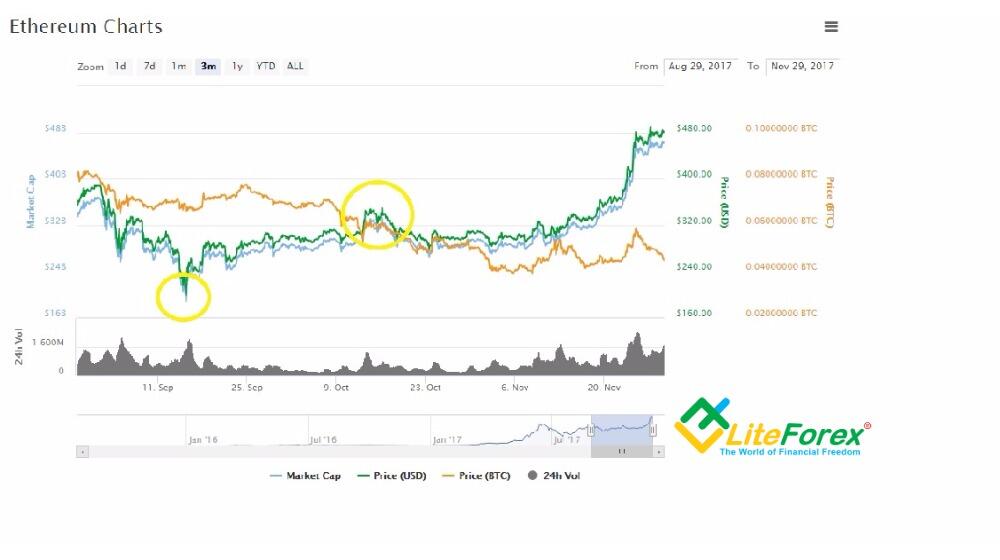
Unlike bitcoin, where the price of the crypto currency was steadily growing on the eve of Segwit on August 1, Ethereum, on the contrary, sank at the moment of launch and rose at the moment of the end of the fork. It seems that investors still remember June 20, 2016.
Casper the happy ghost
On November 21, an initial version of Casper, the protocol for improving Ethereum, was published, within which the transition from the existing Proof-of-Work mining model to the Proof-of-Stake model is envisaged. The purpose of the existing PoW protocol is to protect against attacks that overload the computing resources of the system. But at the same time it uses a lot of power, so for miners it is considered difficult, time- and energy-consuming.
The planned transition to the PoS algorithm will make attacks and mining unprofitable (one of Vitalik Buterin’ steps toward the transition to a limited emission model similar to BTC). Miners will be able to earn only on commissions for transactions, the need for greater capacity is eliminated. Analysts believe that the slowdown in mining will reduce interest, and therefore the price of Ethereum, but there is no clear forecast.
December 12, Ethereum Classic is to have a fork too, however, there is no detailed information about it. We only know that the changes will concern monetary policy. The general offer of the crypto currency will be limited to 210 million ETC (the Ethereum emission is not limited yet), the reward of the miners will be reduced by 20% in every 5 million blocks extracted.
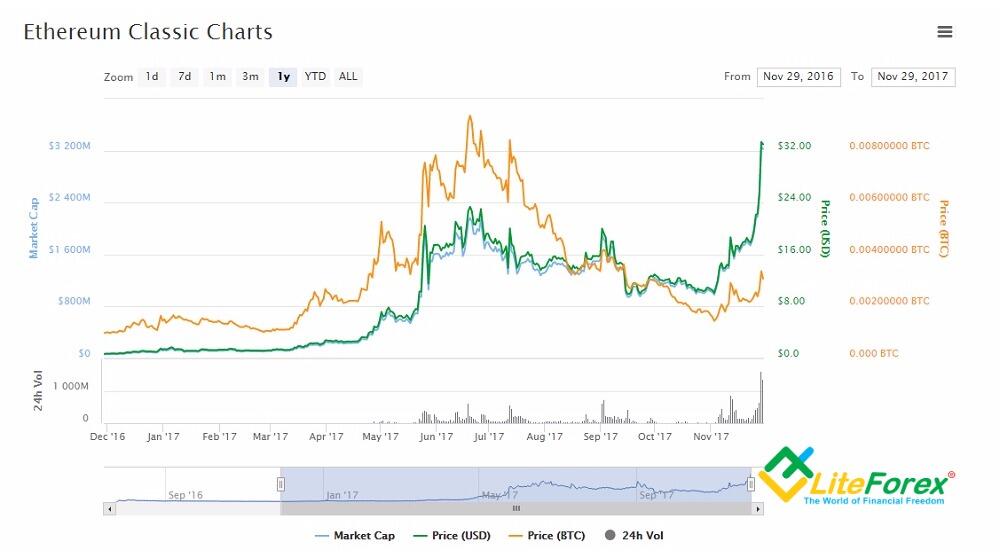
After a successful weekend for crypto currencies on November 25-26 (in 2 days the capitalization of the crypto currencies increased by 40 billion US dollars), the ETS rose 30% (84% over the last 7 days), entering the TOP-10. However, a day later, Ethereum Classic gave up a few positions. More than half of the total volume of the crypto currencies is traded on Bithumb (39.85%) and Coinone (16,83%).
Conclusion:
Despite the fact that the number of forks for various crypto currency is growing, investors are still in no hurry to trust them. On the one hand, forks are aimed at strengthening the positions of the crypto currencies and their security. On the other hand, investors cannot know for sure whose interests these changes serve.
Recommendations for investors:
● Be cautious and invest in crypto currencies for a short time. Bitcoin has already broken a psychological level of 10 thousand dollars with no fundamental reasons. And this gave another reason to say that there are signs of a bubble in this market;
● Do not trust the reliability of crypto currencies. In case of interest, tokens can instantly become someone else's property, and transactions can be cancelled. ETC is an example of this;
● Do not invest in crypto currencies through exchanges or purses that can be hacked. Investing in speculative trading through a broker is still a more reliable option.
Be careful, and let the profit from your investments grow every day!
P.S. Did you like my article? Share it in social networks: it will be the best "thank you" :)
Useful links:
- I recommend trying to trade with a reliable broker here. The system allows you to trade by yourself or copy successful traders from all across the globe.
- Use my promo code BLOG to get a 50% deposit bonus on the LiteFinance platform. Simply enter this code in the appropriate field when funding your trading account.
- Telegram chat for traders: https://t.me/litefinancebrokerchat. We are sharing the signals and trading experience.
- Telegram channel with high-quality analytics, Forex reviews, training articles, and other useful things for traders https://t.me/litefinance

The content of this article reflects the author’s opinion and does not necessarily reflect the official position of LiteFinance broker. The material published on this page is provided for informational purposes only and should not be considered as the provision of investment advice for the purposes of Directive 2014/65/EU.
According to copyright law, this article is considered intellectual property, which includes a prohibition on copying and distributing it without consent.