Breaking down stablecoins: differences from other cryptocurrencies, examples, mechanisms of price stabilization. Advantages and disadvantages of stablecoins, traps for investors.
In late 2018, a new class of cryptocurrencies appeared, stablecoins. In November, the stablecoins turnover was 1032% up, compared to September, increasing by $5 billion. Stablecoins have much more fixed values than normal cryptocurrencies. This is because their values are pegged to other assets such as the US dollar or gold. Compared to the tremendous volatility of common cryptocurrencies, the idea of stablecoins looks quite promising. However, with a more detailed study, you’ll many pitfalls. In this review, you will know what basically stablecoins are, what examples currently exist, how the price of this virtual currency is stabilized. You will also learn in what way stablecoins may be a trap for investors.
Stablecoins - a new cryptocurrency scam?
Can you trust in an instrument, whose price can change over 5% daily, or which can crash by 80% in a year, having feature over 1000% of profit in the prior year? For risk-taking investors, the question is essential, just like for all of those who treat cryptocurrency as a payment means for goods and services. However, the answers will be opposite.
And, amid such high risks and volatility, the “rescuers” appeared who offered a new class of cryptocurrencies - stablecoins (StableCoin), coins with a stable, almost constant price, pegged to physical asset. The information hype and massive launch of startups came in autumn, 2018, although the first analogues appeared a few years ago.
At first glance, it seems that the price-stabilized virtual currency, backed by real assets, is a real alternative to volatile tokens. And the stability of the currency is the stability of the platform itself, on which the tokens are based. But what lies behind this guaranteed stability? If you go a little deeper, it becomes clear that only one side of the coin is covered in the media. And in fact, stablecoins are a new kind of cryptocurrency scam. Why? Read all about stablecoins in this review.
What are stablecoins and how do they differ from normal cryptocurrencies? Theory
According to the analytical resource Diar, compared to September, 2018, in November the turnover only for the 4th top stablecoins (USDC, TUSD, PAX, GUSD) increased by 1032%, reaching $ 2.3 billion in money terms. In general, the turnover amounted to about $5 billion for 3 months. By the beginning of 2019, 23 startups, which somehow can be associated with stablecoins, were created; another 34 platforms are going to be launch. It is assumed that in 2019, about 50 such coins will be launched.
Cryptocurrencies were originally designed as a decentralized means of payment, which had nothing to do with traditional payment systems. But the need for an equivalent did not allow complete separation from the fiat money. At the same time, it became clear that not only the US dollar could be a single freely convertible currency. If there is a kind of calculation standard in the world of fiat money, then why the same standard cannot be developed in the cryptocurrency world, being backed by fiat money? This is how the concept appeared, which formed the basis of the first stablecoin, Tether, which appeared in 2015.
In theory, stablecoin is a cryptocurrency that has a stable value, irrespective of demand and offer volume, and pegged to a real asset. It may be the U.S. dollar (for example, Tether is pegged to 1:1 ratio with USD, that is why the price for the coin is always stable, 1 U.S. dollar for 1 token). There have been attempts to peg some coins to the euro, or the Japanese yen. Hypothetically, even the assets, corresponding to sharia, can serve as underlying assets.
Developing of this class of aimed at two major goals:
- Stability of calculations within the system. If today a token costs $100, and tomorrow $20, this creates challenges to those who operates with the platform functionality. Stablecoins are the same payment systems, but with a stable token price. However, the problem is solved only for platforms that are engaged in money transfer. How to deal with sites like Augur (virtual prediction service) is unknown.
- Saving money within the system. Stablecoin is a temporary asset, employing it, you can wait through exchange rate fluctuations without withdrawing money.
It makes no sense to use stablecoins as an investment instrument, their price can little deviate from the fixed one, and only in short periods of strong market swings. But this is in theory.
The list of stablecoins includes dozens of coins, but most of them are outside the TOP-300. The most famous coins of this class (apart from Tether) are:
- USD Coin (USDC) is the biggest stablecoin from the pack, currently occupying 23rd place by the market cap. The coin, appeared in October, 2018, is pegged at 1:1 ratio with the U.S. dollar. It was developed by the Circle startup that also owns Poloniex exchange.
- TrueUSD (TUSD) occupies the 28th position. It was launched in spring 2018. It is also backed by the U.S. dollars, kept on the accounts in the counteragent banks. It presents itself as an open, transparent platform, accessible for audit. Tether is thought to be its major rival.
- Paxos Standard Token (PAX). It is a payment platform backed to the U.S. dollar that costs 1 USD. It is an Ethereum-based coin that was launched in autumn, 2018. It doesn’t have essential differences, however, its advantage is said to be the approval of the New York State Department of Financial Services .
- Gemini Dollar (GUSD) - 50th position. It is another Ethereum-based stablecoin launched in September 2018.
- Dai (DAI) is the 56th. It is Ethereum-based coin pegged to the US dollar with permitted deviation of 5%. It was launched in late 2017. It is not backed in fact (so-called unbacked coin). Its supply is regulated on-chain, using smart contracts.
- BitUSD (BITUSD) occupies the 363d position. It is one of the oldest coins, launched by BitShares in 2015. It is pegged to the USD but is not backed by it. Its value is collateralized by BTS tokens (similar tokens of the developer).
One of the Japan’s biggest Internet corporations, GMO Internet Group, has announced a yen backed stablecoin. Another gold backed stablecoin, Ekon, will be launched in 2019. The developer is Eidoo startup. There are also have been attempts to peg coins’ value to oil and other commodities.
Advantages of stablecoins
- Relative stability of the tokens value pegged to the US dollar
- They are backed by real assets
Drawbacks of stablecoins
- The problem when assets other than the US dollar are used to back the token
- Volatility problem. As experience proves, backing doesn’t help at the time of a sharp change of the market capitalization.
- Centralization problem. Stablecoins are controlled by issuer, custodian and auditors.
- Legal problems, associated with transactions between cryptocurrencies and real assets.
- The hack risk is doubled. Both the cryptocurrency and the underlying assets can be stolen.
And the most important problem is that things are much more different in practice than in theory. You will learn about this in the next section.
A remarkable fact. Stablecoins are also appealing to hackers, though the profit, compared to other cryptocurrencies, is rather questionable. For example, on December 21, 2017, as a result on the Bitfinex exchange hack, 31 million USDT were missing. However, the story is a dark one, considering that more than 30% of Tether is owned by Bitfinex.
From theory to practice: basics, advantages and drawbacks of stablecoins
In theory, stablecoins are basically a clear asset. This is a price-stabilized virtual currency to make money transfers inside the cryptocurrency world with potential subsequent use to pay for goods and services in the physical world. In practice, everything is a little different.
How it works
A remarkable fact. In almost every source that I found at the top of Google search (and I typed different queries), I’ve failed see a detailed description of the mechanism that allows to keep the stable value of stablecoins. The occasional single explanations that I saw didn’t look logic. But I still would like to share them. Perhaps, I just do not understand something and we will be able to figure it out together in the comments.
1. Customer psychology. It seems to be the most ridiculous explanation that I’ve seen on the Internet. According to BitMEX Research, the price stability lies in a kind of market logic, “Why should a coin have a different value?” Researchers who analyzed the BitUSD stablecoin admit that there is no special mechanism to ensure the coin stable value. Investors just think, “Why don't I exchange it just for $1? ”, thus maintaining stability.
My opinion. Market is driven by offer and demand. If the demand exceeds the offer, then the value increases. If the offer is higher, the value goes down. In a free market, the price is subject to economic laws, rather than to the psychology of the customer, who for some reason decides that the actual price is exactly 1 USD. The explanation of the mechanism seems to be a nonsense.
2. Stablecoins are backed by real assets. The most common version on the Internet. The logic is like this: a cryptocurrency has a stable value, expressed in the value of the underlying asset. If the US dollar is used to back A coin, then it will always cost 1 USD. It is explained by the following mechanism. To issue 100 stablecoins, they need to back them by 100 USD (200 USD is better). If a stablecoin price goes lower than the collateral value (that is, lower than 1 USD), the coin is liquidated and the holder receives the backing, i.e. 1 USD. Unfortunately, I’ve failed to find a more detailed description.
My opinion. This explanation looks very strange.
- The first question is how a real US dollar can be returned on the cryptocurrency exchange? After all, there were situations when stablecoins fell on volatility down to 0.75-0.8 USD and nobody exchanged the coins at $1. And if it happened, then the price wouldn’t be below $ 1.
- The second question is how to provide a stable value for a gold-backed stablecoin, if the major calculation unit is USD. It turns out that, in dollar terms, the coin value will be going down, following gold depreciation. Then it can’t be called a stable coin.
- And, finally, question number 3. What does the term backing itself mean in relation to the value stability? There is an asset, say Tether. Now it costs 1 USD. Demand is rising. That is, 5 people are willing to buy a coin and only 2 people want to sell it. It is logical that 2 people will raise the price, expressed in US dollars. How will backing impact here?
3. The regulation mechanism is similar to the way the central banks regulate the exchange rate. The supply of the stablecoins is regulated on-chain, using smart contracts (most stablecoins are Ethereum based). These are so-called algorithmic stablecoins where smart contracts automatically issue more coins or, on the contrary, remove the surplus of tokens to provide the stable value.
My opinion. This, most likely from the logical view-point, arises many questions, representing showing inconsistencies and therefore putting forward doubts in the stablecoins reliability. You will learn more about this in the next section.
Unanswered questions about stablecoins
1.Is there real backing? It would seem that the most reasonable action to persuade investors is to prove actual backing available. It is surprisingly turned out to be a problem. Tether that has been around for several years, has been engaged in series of scandals, including those associated with backing. There has been yet absolutely no evidence that the amount of fiat money to back the tokens is available. There have been indirect attempts to prove, but nothing more. From the point of view of logic, a change in the capitalization amount should have increased or a decreased amount of the real US dollars serving as collateral. And such significant transactions would have to attract attention. But here there is no information. The likelihood of arresting real accounts under the pretext of illegal financial activities seems like a weak argument.
Question number 2. How is this collateral formed? It is hardly the money of the developers. It would be reasonable to assume that designers issue the coins, sell them for the USD and send the US dollar to backing. What if the currency is bought for the ETH or ВТС? How is the collateral formed technically?
2.How is the price held stable? As I already wrote above, the third option of price stabilization by issuing and removing tokens from circulation seems to me the most logical. But according to this logic, with a decline in of market capitalization, the capitalization of stablecoins should have to increase, with a rise, it should, on the contrary, decrease. When there were long term crypto market declines, almost all normal altcoins behaved in the same way. But the situation with stablecoins was different.
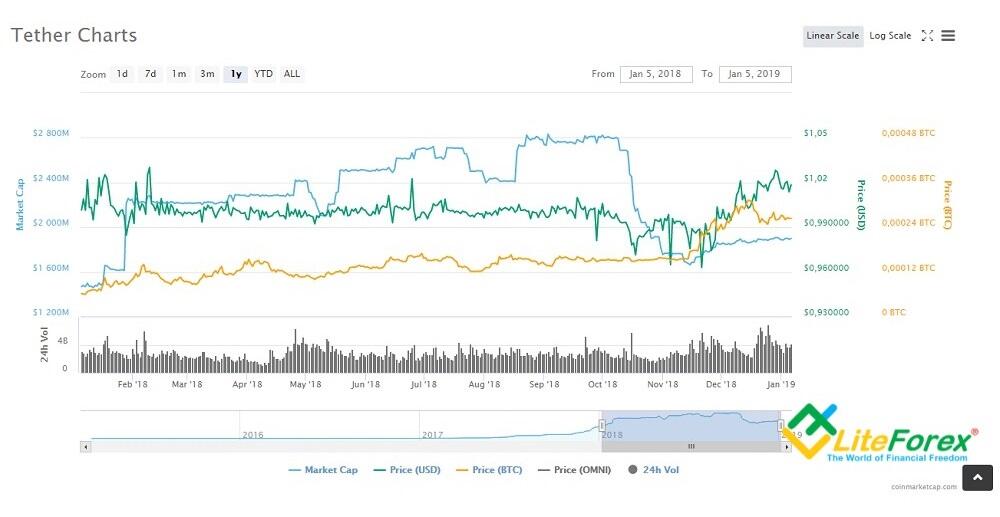
Compared to relatively smooth BTC price chart, Tether features sharp falls and rises. A sharp decline in the capitalization had occurred long before the BTC started falling in price (it is clear from the chart that the price was growing BTC in the November-December period). It could be explained by the problems with audit. I don’t see other reasons.
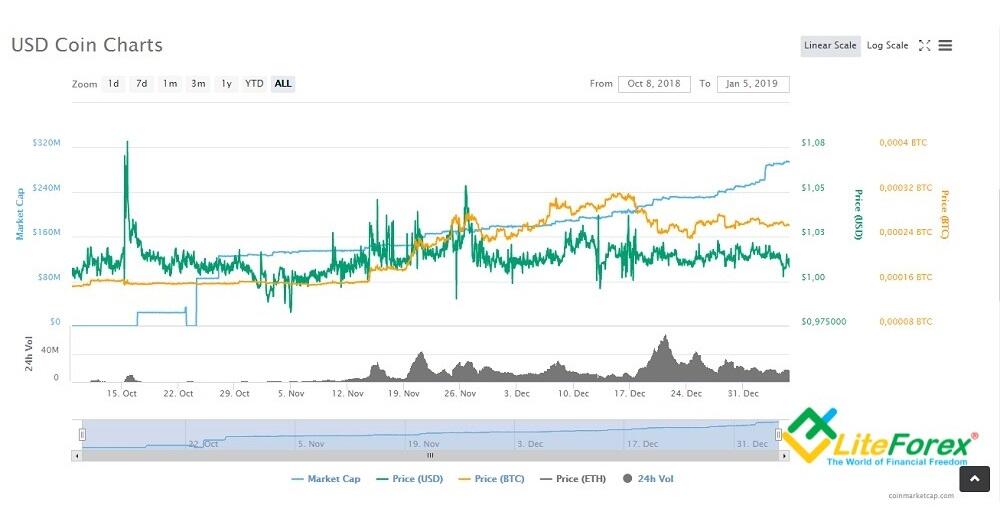
Here, the situation is more interesting. Smooth growth without any drawdowns. That is, the demand for the coin is steadily rising. Agree, when the entire cryptocurrency market is rising, and you can earn on the BTC price rise, for example, what’s the point in investing in a coin with a stable price?
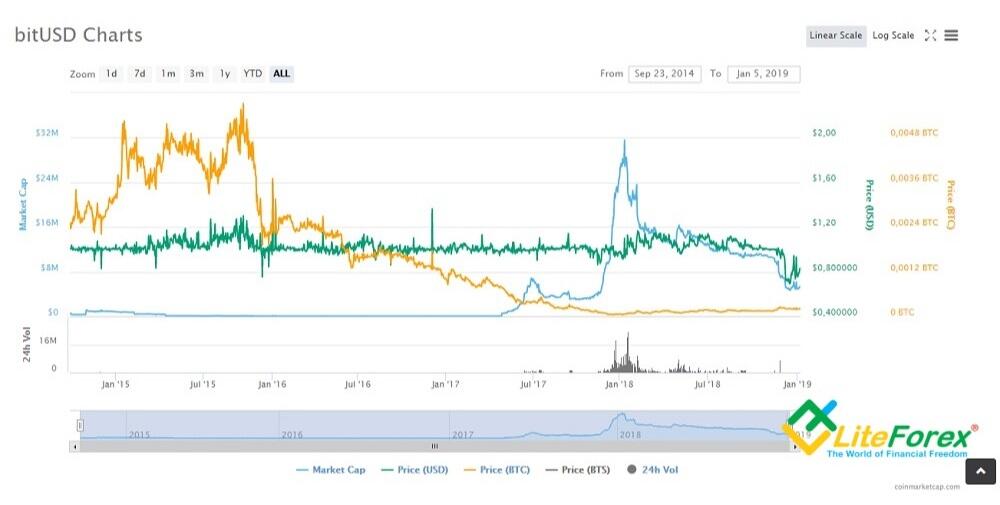
Here, nothing at all is clear. Nobody was interested in the coin in 2016, or 2017. It suddenly became popular in January, 2018 (though, at the peak of other coins’ growth, this is not logic, to say the least.) Also, a drawdown below 0.75 USD doesn’t at all meet the principles of the stable price and collateral.
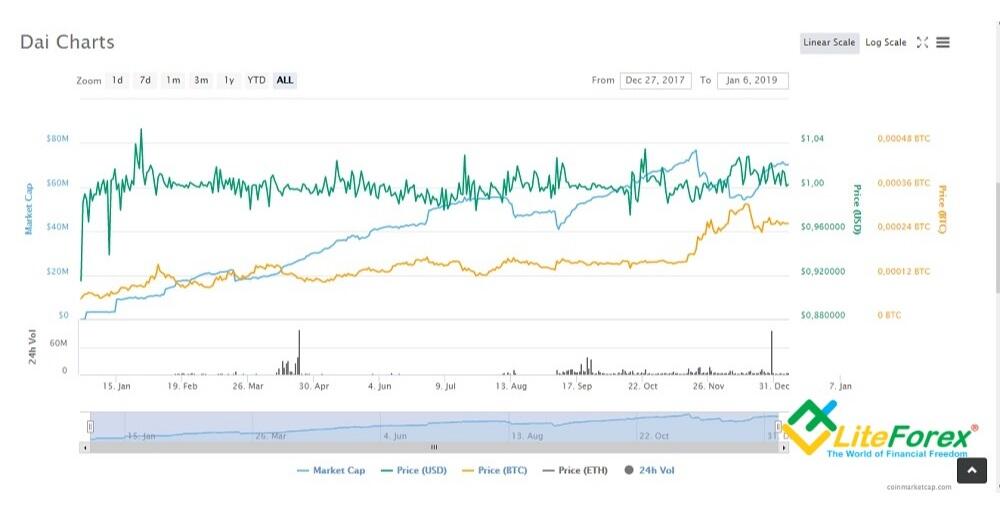
In this stablecoin chart, there is neither any relation between the price change and capitalization. The situation is different with this cryptocurrency that is a stablecoin but doesn’t have real backing. The mechanism of issue and buyout of tokens was called Seignorage Shares and it looks like a common Ponzi scheme. It is as follows: when the smart contract does not have enough money to buy tokens, it issues a kind of shares, giving the right to earn money in case of a price increase. If you are interested in the Seignorage scheme in more detail, write in the comments and I will explain. But this scheme looks even less convincing than backed tokens.
And finally, look at the chart of the already operating project, Digix. Its price is pegged to 1 gram of gold and the coin is based on the consensus algorithm Proof-of-Asset. A number of documents, which can prove the digital signature of the gold supplier, auditor and depository are kept decentralized.
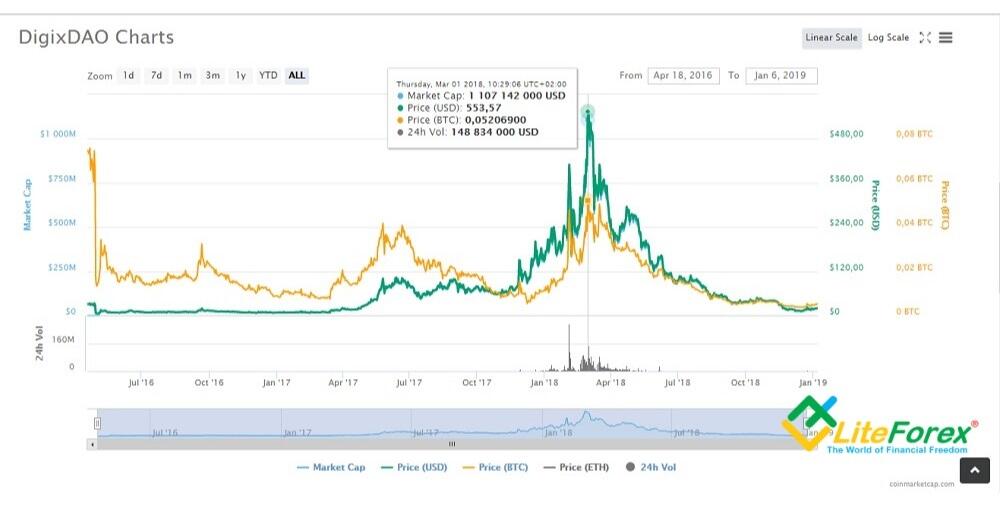
This token is deferred to stablecoins due to collateral, but is it really price-stabilized? Its volatility ranges from $553 to $20 and it does not correspond to the price fluctuations of gold for the year. A little different, but still rather unclear is the situation with the Zrcoin token, whose value is pegged to zirconium price.
3. Interest of developers. I haven’t found any information on this on the Internet. Everything that happens is not by chance. The launch of ICO, including the marketing component can cost about 100-500 thousand US dollars. and more. And the developers should somehow return this money, not to mention the cost of maintaining the platform. With normal cryptocurrencies, everything is clear: a part of the cryptocurrency is held by investors. If we consider that the growth of capitalization in 2017 amounted to more than 1000%, then there are no questions with the payback of startups. And what about stablecoins?
We may assume that the developers charge a kind of commission in the system, but there is no information on the Internet as well. We may also assume that developers earn on the issuance; they may, for example, issue extra token and sell them for US dollars. But there is also a discrepancy. Logically, as mentioned above, this money should go into backing. That is, in this case, the developers are again left with nothing. The conclusion suggests one thing - there is no backing (or its amount is less), but the money still goes to the organizers of the startup.
4. Investment relevance. The figures, presented in the introduction, are explained by the analysts in the following way: the popularity of price-stabilized cryptocurrencies started increasing in spring, 2018, when it became clear that capitalization wouldn’t grow. In November, 2018, when there was another crash, following the BCH fork, investors started massively withdrawing the money from all altcoins, converting it into stablecoins.
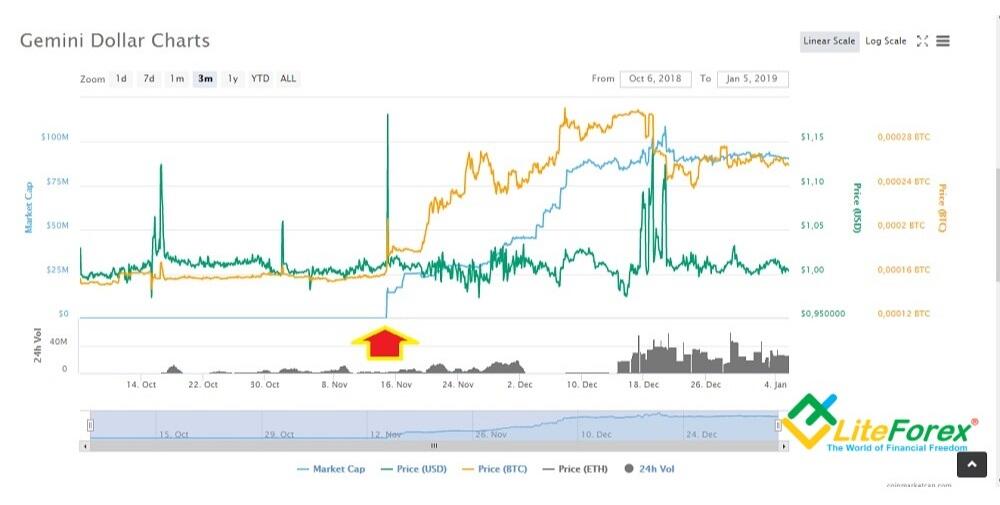
Pay attention that a sharp increase in capitalization occurred when the market crashed. This partly confirms the mechanism of additional issuance with an increase in demand. Sharp price swings of the USD, which do not coincide with the BTC price, are also remarkable. I would explain them with a surge in demand a large investor who entered the market with dollars. As you can see, there were three such surges and the last two coincide with the increase in capitalization.
There are still many questions about the chart unanswered. For example, why was capitalization growing without visible price spikes in early December? It is remarkable that the price charts of other stablecoins look different. USDC has a smooth growth of capitalization without sharp swings, PAX sharp surge somehow turned out to be 2 weeks late. Alas, there are no explanations for these facts (neither logical nor fundamental). And that is not to the advantage of stablecoins.
And finally, one more question: why do investors at all convert the money into stablecoins, if they neither win nor lose? They can’t make money on the changes in exchange rates. Dollars in cash seem to be much safer than intangible, unregulated, nontransparent stablecoins. I can see only a single logical explanation; it is the commission. Those, who no longer believe in the cryptocurrencies, have already converted their investments into fiat money. Those, who are willing to wait through another fall, prefer to save up- it is cheaper to convert one cryptocurrency into another than to convert a cryptocurrency into the dollar and back. Although, it is the same as changing normal coins into the USD, holding it on the wallet. Anyway, there are a lot of questions left.
Do stablecoins have any advantages?
I haven’t found any, taking multiple risks into account. As an argument for, they present the opportunity to keep the money into a stable currency people, who live in the countries, where there is the Internet, but you can’t buy the USD in cash.
Tell me if you know such countries, where there is the Internet, you can top up the wallet, use payment systems (that is banking operates), but you can’t buy cash. I don’t. Stablecoins can become a trap for investors. Indeed, in fact, their course is based on one thing: on the faith of investors. Faith in:
- Provided backing (though, few know how it can be rally checked)
- Audit (and that it was conducted at all)
- Mechanism of price stabilization (few understand how it works, but they believe in beautiful words)
- Stability (it is excellent that we are offered an asset, which we can invest in when the entire marked is sliding down)
- In the cryptocurrency market in general (that is the most innovative technologies
The price of the coins is stable not because investors believe in stablecoins, it it is rather because the developers need for some time. The media help in this relation, active promotion of stablecoins supported them during the market drawdown in November. But what if there is no backing? Or what will be when investors start cashing out their cryptocurrencies into fiat money? It will be hard to restore the damaged trust. Although, the developers may come up with a new idea of a Ponzi scheme by that time.
What investors should do:
- Don’t blindly trust in everything that the media write. Ask more questions at least yourself, try to understand the market mechanisms, to avoid another bubble.
- Diversify the risks
- Be prepared for losses and don’t be sure in anything
I am, personally, rather skeptic about stablecoins. At least until their operating principles will be clearly explained. That is why I would recommend normal cryptocurrencies and the instruments which provide an opportunity to earn on short positions as well. Forex brokers, where you can trade currencies, cryptocurrencies, CFDs for global stock indexes, oil, metals and so on, look in this regard much more appealing. At least, they are relatively transparent.
Conclusion.
The fuss around the crazy rally of cryptocurrencies has faded out, but the struggle for investors’ capitals goes on. As long as the developers have imagination, they will continue pumping out investors’ money. They can no longer make money on sharp price surges, the ICO scam is also not relevant (investors no longer trust every new startup emerging), and the pumps have already faded. And then, they’ve got a new idea, stablecoins, which were being actively promoted in the media in late 2018.
I have a feeling that someone knew in advance about the November collapse of the market and set the stage for the stablecoins as a “safe haven”. And judging by the turnover statistics, the idea was very successful. There are a lot of questions for stablecoins and it is surprising why there are hardly any answers in the media. It seems to me that this is another bubble, whose time is still ahead. I am eager to learn the opinion of blog readers and professional investors is interesting! Please, do write your comments!
P.S. Did you like my article? Share it in social networks: it will be the best "thank you" :)
Useful links:
- I recommend trying to trade with a reliable broker here. The system allows you to trade by yourself or copy successful traders from all across the globe.
- Use my promo code BLOG to get a 50% deposit bonus on the LiteFinance platform. Simply enter this code in the appropriate field when funding your trading account.
- Telegram chat for traders: https://t.me/litefinancebrokerchat. We are sharing the signals and trading experience.
- Telegram channel with high-quality analytics, Forex reviews, training articles, and other useful things for traders https://t.me/litefinance

The content of this article reflects the author’s opinion and does not necessarily reflect the official position of LiteFinance broker. The material published on this page is provided for informational purposes only and should not be considered as the provision of investment advice for the purposes of Directive 2014/65/EU.
According to copyright law, this article is considered intellectual property, which includes a prohibition on copying and distributing it without consent.