Buying shares of quantum computing companies is a long-term investment, particularly when dealing with businesses focused on developing quantum computers. The technology is still young industry, and mass production of such systems, even for corporate clients, has not yet begun.
Major companies such as Microsoft, Amazon, IBM, and Nvidia — the largest by market cap — are already working on quantum computing hardware. This means that investing in quantum computing today is essentially a diversified way to invest in the broader technology sector.
This overview introduces the core of quantum technology, the existing developments, and the best quantum computing stocks to invest in, along with their long-term prospects.
The article covers the following subjects:
Major Takeaways
- At the heart of quantum algorithms lies a system where, instead of binary logic, the principle of superposition is applied.
- Superposition is a property of quantum bits (qubits) that allows them to exist in two states (0 and 1) simultaneously.
- So far, most quantum computers and quantum processors exist as single experimental models for research purposes. However, attempts to create commercially scalable models are already underway.
- Key quantum computing stocks include IBM, NVDA, MSFT, GOOG, and Fujitsu (6702). Promising quantum companies with a narrower specialization include Rigetti Computing (RGTI), D-Wave Quantum (QBTS), and IonQ (IONQ).
- The development of quantum technology could become a major growth driver for the entire technology market. However, it also carries the major risk of a new "dot-com bubble.''
What Are Quantum Computing Stocks: Key Metrics to Evaluate
So-called quantum companies develop and apply technologies based on the laws of quantum physics. While traditional computers operate with bits — zeros and ones — quantum computers use quantum bits (qubits), which can exist as both 0 and 1 simultaneously. This phenomenon is known as superposition. Thanks to this property, quantum processors can perform multiple calculations in parallel, making them potentially far more powerful than classical computers.
Qubits can be either physical or logical.
- A physical qubit is a real, measurable particle, such as an ion, photon, or superconducting circuit. However, it is unstable and prone to errors caused by minor changes in sound, temperature, or electromagnetic fields.
- A logical qubit consists of dozens or even hundreds of physical qubits combined to improve stability and reduce computational errors.
Key metrics for evaluating quantum computing stocks fall into two main categories — technical and financial. Technical metrics include:
- Quantum hardware performance: the basic measure of a quantum processor's power, expressed in qubits; the error rate (the lower it is, the more stable the computation); coherence time, or how long qubits can maintain their quantum state.
- The company's patent portfolio: the number and quality of patents related to quantum computing technology.
- Supply chain dependence. Producing quantum hardware often requires international cooperation, with components sourced from various countries. The main competitors in this segment are Japan, China, and the United States.
Financial metrics include:
- The share of spending on research and development. For most quantum companies, it usually accounts for 30–50% of total revenue. A higher percentage often signals weaker short-term financial results, as these companies invest heavily in projects with uncertain payoffs.
- Government contracts and grants. Governments in China, the EU, and the United States are among the most active in subsidizing quantum computing.
- Business diversification. Quantum companies with a narrow focus face a major risk of deep drawdowns, as limited diversification makes their balance sheet and financial stability more vulnerable.
- The rate of revenue generation as the technology becomes commercialized.
- The level of debt relative to capital.
It should also be kept in mind that a sharp, short-term rise in a quantum company's stock does not guarantee that the price will not fall just as quickly.
Why Invest in Quantum Stocks in 2026
Quantum physics remains a mystery not only to ordinary users and individual investors but also to developers themselves. The idea of quantum computers emerged back in the 1980s, but it took nearly forty years to move from theory to practice. Mass production of such machines still does not exist. The current models are mostly one-of-a-kind prototypes used for research purposes.
A major breakthrough in the development of quantum computing occurred between 2022 and 2025.
In 2021, Google announced that its 53-qubit computer, Sycamore, could complete a task that would take the world's most powerful classical computer 10,000 years.
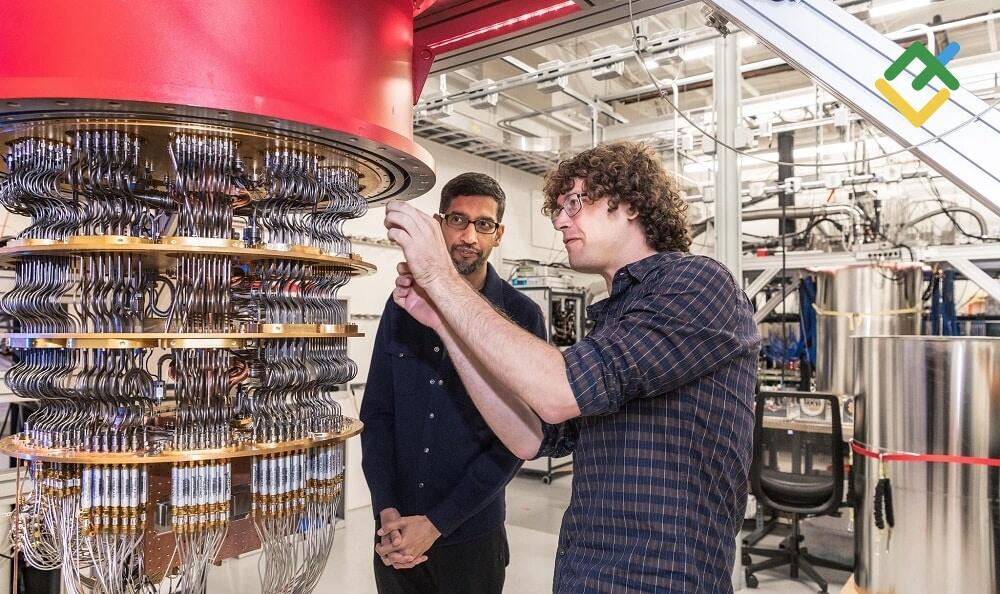
- In 2022, IBM introduced the most powerful quantum computer of its time, with 433 qubits.
- In 2025, the most powerful quantum computer is the Japanese ABCI-Q, running on NVIDIA graphics processors.
- In the summer of 2025, Japan launched two major projects: a fully domestic quantum computer (shown in the photo below) based on superconducting qubits, and one of the world's largest 256-qubit superconducting quantum computers, developed jointly by RIKEN and Fujitsu.
- In August 2025, the Chinese company QBoson announced the start of construction of the world's first factory for the mass production of photonic quantum computers.
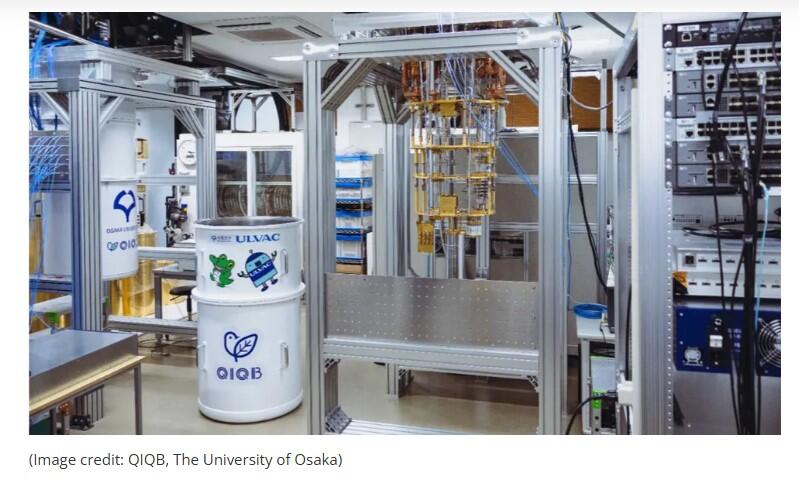
Between 2023 and 2025, the United States, Taiwan, and China also announced the creation of portable quantum computers. In Japan, a small 2-qubit model weighing just fourteen kilograms and priced at 8,700 USD was unveiled. However, mass production is still far from reality.
So, why invest in quantum technology stocks? Although it took decades to produce the first quantum computer, technological progress today moves much faster. The start of commercial quantum computing hardware production could trigger a price rally comparable to the surge that followed the global rise of artificial intelligence.
Best Quantum Computing Stocks to Buy Now
The undisputed leaders are the top technology companies competing across multiple sectors. Among them are Nvidia, Microsoft, Alphabet (Google), IBM, and Amazon. Almost all of them rank among the world's largest by market cap and have been repeatedly featured on the LiteFinance blog, so they will not appear in this ranking. However, their stocks should certainly be part of any well-balanced investment portfolio.
Instead, we will focus on a selection of top quantum stocks based on the following criteria:
- A real portfolio of quantum computing developments already tested and publicly demonstrated.
- Positive returns over the past one and five years. A sharp price rise over the past year may suggest a short-term impulse rather than sustainable growth; stable performance over five years reflects consistent investor optimism and confidence in the company's fundamentals.
Below is a list of the best quantum computing stocks to buy now, representing the best-performing quantum computing stocks to consider for long-term quantum computing investment. Each company-specific stock shows five-year and one-year stock advisor returns, offering investors a helpful reference for picking winners among today's perceived winners in the quantum computing space.
Company | 1-year return, % | 5-year return, % | 1-year dividend yield, % |
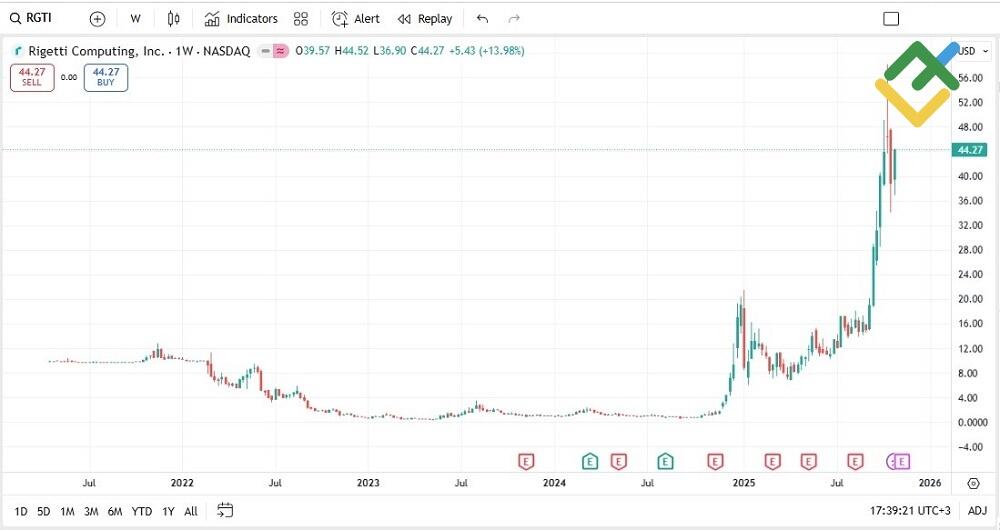
Rigetti Computing Inc (RGTI) | 3,817.70 | 346.72 | – |
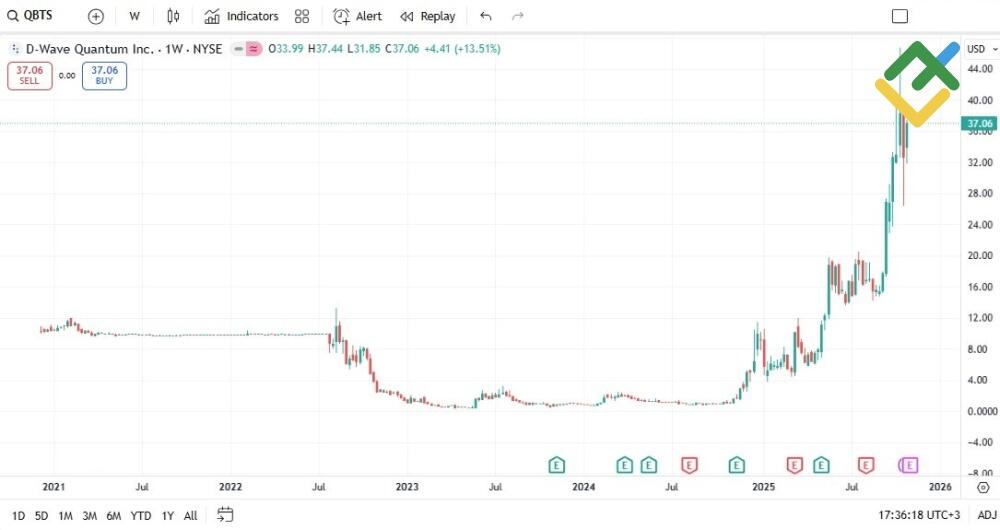
D-Wave Quantum (QBTS) | 3,606.00 | 241.25 | – |
Quantum Computing Inc (QUBT) | 1,374.30 | 333.53 | – |
IonQ (IONQ) | 334.10 | 466.58 | – |
Fujitsu (6702) | 50.58 | 203.08 | 0.69 |
Defiance Quantum ETF (QTUM) | 84.12 | 216.85 | 0.64 |
Rigetti Computing Inc. (RGTI)
Rigetti Computing Inc. develops and manufactures superconducting quantum integrated circuits and quantum computers. The company also provides access to its quantum technology through the Quantum Cloud Services platform for use in cloud environments.
Country: USA.
Market Cap: $14.35 billion.
1-Year Return: 3,817.70%.
5-Year Return: 346.72%.
Dividend Yield: none.
D-Wave Quantum (QBTS)
D-Wave Quantum is considered the world's first commercial quantum computing company and remains one of the most recognized names in the quantum computing investment space. It specializes in quantum annealing technology while also developing universal quantum computers. Currently, the company's systems are tailored to a limited set of optimization problems and real-world use cases.
D-Wave Quantum cooperates with Google, Lockheed Martin, Volkswagen, Mastercard, and even NASA. Despite this, many analysts believe the current stock rally may be temporary.
Country: Canada
Market Cap: $12.68 billion.
1-Year Return: 3,606.00%.
5-Year Return: 241.25%.
Dividend Yield: none.
Key D-Wave Quantum milestones include expanding partnerships and diversifying into hybrid computing solutions — a major advantage compared to early competitors.
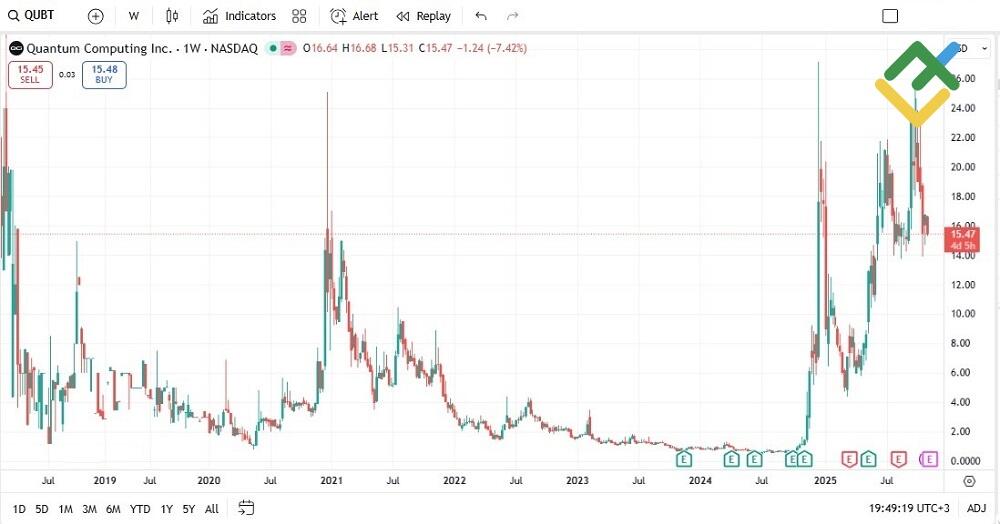
Quantum Computing Inc. (QUBT)
Quantum Computing Inc. focuses on developing software solutions and integrating quantum computing into classical IT systems. Its main product, Qatalyst, allows users with no background in quantum programming to apply quantum algorithms to optimization problems, logistics, and materials simulation. The company works with U.S. government institutions, including the Department of Energy and NASA.
Country: USA.
Market Cap: $3.46 billion.
1-Year Return: 1,374.30%.
5-Year Return: 333.53%.
Dividend Yield: none.
IonQ (IONQ)
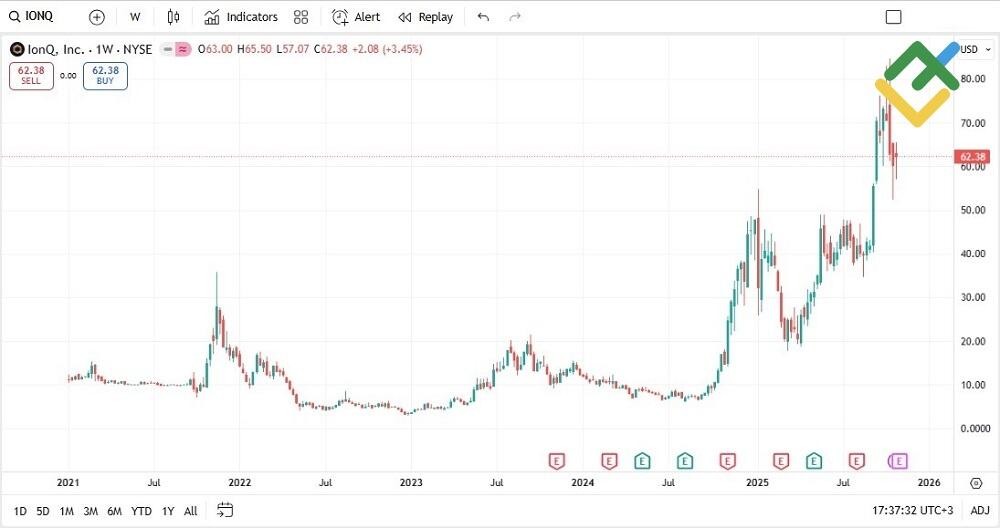
The company develops ion-trap-based quantum computers and related software. IonQ systems are integrated into cloud computing platforms such as AWS, Microsoft Azure, and Google Cloud. Partners include Amazon, Hyundai, Airbus, and Nvidia, which use IonQ solutions for materials science simulations and optimization problems.
Experts note a recent slowdown in stock performance, making this one stock a potential buying opportunity on a correction.
Country: USA.
Market Cap: $21.67 billion.
1-Year Return: 334.10%.
5-Year Return: 466.58%.
Dividend Yield: none.
Fujitsu (6702)
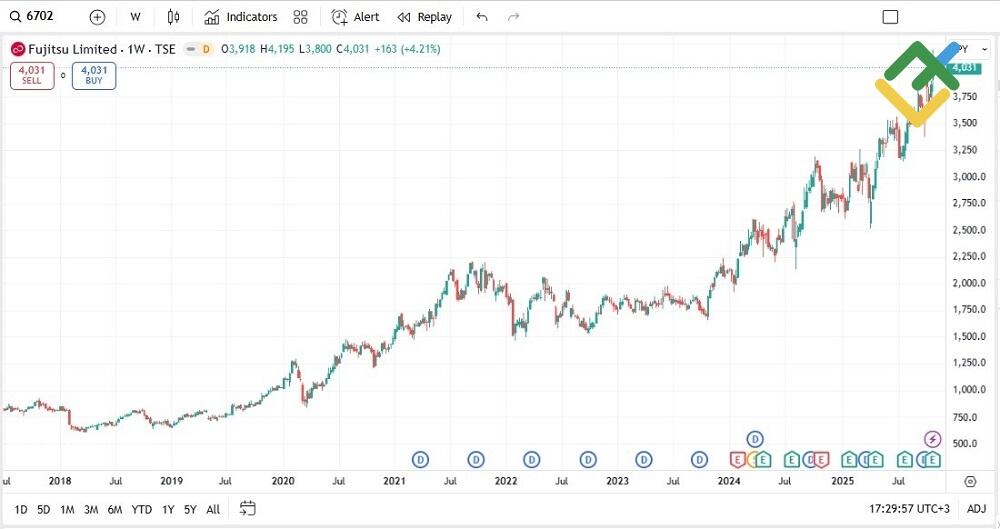
Fujitsu is a diversified technology holding specializing in integrated IT services and solutions, including enterprise systems, cloud platforms, network infrastructures, and AI-based services.
The company recently received an order from the National Institute of Advanced Industrial Science and Technology (AIST) to deliver a commercial superconducting quantum computing system. Plans include developing a quantum computer with 10,000 physical and 250 logical qubits by 2030.
Advantages include business diversification and a strong position with stable long-term stock growth and minimal volatility.
Country: Japan.
Market Cap: ¥8.35 trillion.
1-Year Return: 50.58%.
5-Year Return: 203.08%.
Dividend Yield: 0.69% or ¥27.80 per share.
Defiance Quantum ETF (QTUM)
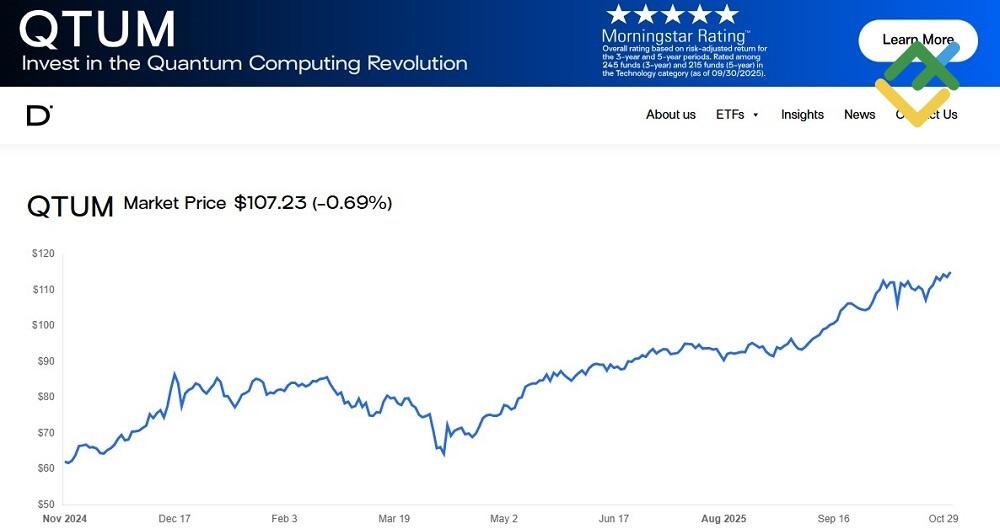
The sixth in our list of best quantum computing stocks to invest is the Defiance Quantum ETF, launched in 2018. Defiance Quantum targets companies operating in quantum computing, machine learning, and related technologies.
Its key advantages include stable price performance over the past five years, impressive gains in quantum computing, and a steady dividend yield. Since its launch, the ETF has delivered monster returns of about 344%, averaging around 49% per year.
This instrument is ideal for long-term, diversified quantum computing investment strategies.
Number of assets in the portfolio: | 79 |
Net assets: | $3.205 billion |
Top 5 holdings: | RGTI (Rigetti Computing Inc.) — 3.87%, QBTS (D-Wave Quantum Inc.) — 2.22%, AMD (Advanced Micro Devices Inc.) — 2.10%, IONQ (IonQ Inc.) — 2.09%, TER (Teradyne) — 2.08%. |
Expense ratio (investor commission): | 0.40% |
Country: USA.
1-Year Return: 84.12%.
5-Year Return: 216.85%.
Dividend Yield: 0.64% or $0.74 per share.
The ETF maintains operating funds backed by net cash, ensuring liquidity even during market downturns. Net cash puts it in a strong position to handle volatility while keeping revenue coming from high-performing assets.
Best Strategies to Invest in Quantum Computing Stocks
The main challenge of the quantum computing sector is its speculative nature. The quantum technology industry is still in its early stages, and many companies focused exclusively on quantum computing have yet to demonstrate real profitability or consistent performance. Something similar happened in the early 2000s, when the investing community poured funds into dot-com ventures that failed to deliver.
For this reason, any quantum computing investment strategy should focus primarily on companies with diversified businesses — the large technology giants. On the other hand, niche-focused quantum companies may show far greater quantum computing gains, especially once revenue generation begins.
Investment strategy options in quantum computing:
- Conservative: buying shares of large tech corporations with a strong position in quantum computing and artificial intelligence.
- High-risk: investing in one stock of a specialized quantum company whose business is still unprofitable due to high R&D costs. However, if partnerships with major corporations are in place, commercialization may not be far off — an important milestone that can quickly boost valuation.
- Speculative: trading on news. For example, if a company announces the development of a 1,000-qubit quantum processor, investors may buy and then sell after the market reaction. Such moves can sometimes produce monster returns, but also carry a major risk of sharp correction during a market downturn.
- Diversified: investing in ETFs such as the Defiance Quantum ETF (QTUM), which includes companies involved in quantum computing, AI, and semiconductors.
- Venture: investing in private quantum startups such as PsiQuantum. These stocks are not publicly traded, and while the risk is high, potential returns can exceed ten times the initial investment.
As an alternative, investors may also consider indirect quantum computing investments by supporting the ecosystem — for instance, companies involved in producing cryogenic quantum hardware (such as Oxford Instruments) or providers of quantum cloud computing, related services, and API infrastructure.
Such an approach, favored by the investing community focused on deep-tech innovation, provides exposure to real-world use cases while maintaining diversification and long-term potential.
Conclusion
Quantum computing stocks are high-risk assets with significant volatility. The shares of individual quantum companies can gain more than 3,000% in a single year, only to decline just as quickly. The exception is companies with diversified businesses — the large technology giants. Their stocks are well-suited for long-term investors. For example, Nvidia's graphics processors are used in Japanese quantum computers, meaning that success in the quantum computing sector will automatically support its share price growth.
At present, the rise in the market value of most quantum computing stocks appears largely speculative, driven by investor optimism and expectations rather than consistent results. Many companies continue to investigate multiple problems, with their quantum computing hardware and materials simulation projects remaining in the testing phase. Their eventual commercial success is still uncertain. Some analysts warn that the quantum technology segment might face a similar fate to the early 2000s dot-com bubble, when many companies proved overvalued.
However, a few firms could achieve market-crushing outperformance compared to others once their products reach the commercialization stage. Some quantum computing stocks mentioned earlier could still easily retrace after a large amount of speculative growth. Investors who wish to buy stock should focus on companies with strong balance sheets and solid fundamentals, rather than on hype-driven momentum.
D-Wave stock and other quantum companies may make the most sense for those seeking exposure to the quantum computing space with calculated risk. Investing in quantum computing stocks is a risk that may ultimately pay off. And if your investment portfolio still has room — say, around 10% for venture exposure — you might consider stocks with long-term potential, such as those in the lithium mining sector.
Frequently Asked Questions about the Best Quantum Computing Stocks
Yes, probably. Demand for the technology is growing, and along with cloud, AR/VR, and artificial intelligence, it could trigger another surge in tech stocks. The risk of a speculative bubble still exists.
Prices range from a few thousand dollars for small portable models to tens of millions for industrial systems. In Japan, a two-qubit home computer has been available since 2023 for around $8,700.
Yes. Leading players include IBM, Google, Microsoft, Nvidia, and Fujitsu, which also dominate other tech sectors. Their stocks are from global blue-chip companies with stable, long-term performance.
D-Wave Quantum (QBTS) rose 3,606% in the past year, and Rigetti Computing (RGTI) gained 3,817.70%. The momentum may be over, but both delivered strong five-year performance results.
Some do. Dividend yield is usually low, about 1–1.5% annually. Stock price growth easily outweighs dividend income, making payouts a minor but pleasant bonus for investors.
Leaders include IBM, Google, Microsoft, Nvidia, and Fujitsu. They have long developed quantum computers, hardware, and software. Experimental systems by Quantinuum, D-Wave Quantum, and Japan's AIST rank among the fastest globally.

The content of this article reflects the author’s opinion and does not necessarily reflect the official position of LiteFinance broker. The material published on this page is provided for informational purposes only and should not be considered as the provision of investment advice for the purposes of Directive 2014/65/EU.
According to copyright law, this article is considered intellectual property, which includes a prohibition on copying and distributing it without consent.