Ban on cryptocurrency advertising on social media and in search engines. The reasons for the ban, objectives, the restrictions effect on the cryptocurrency market and its participants
In January, 2018, Facebook banned all advertising for cryptocurrencies, ICO and other projects, involving high financial risks. Goggle is introducing the same ban starting from June. Official narrative: creating barriers to fraudulent start-ups posing as cryptocurrencies, however, ordinary articles can be published, despite the ban on advertising. Why this anti-fraud activity is so selective? Who will benefit from this ban? How the market will respond to it? Read in the article.
Another attack on cryptocurrencies: why advertising is forbidden?
2018 started not very well for cryptocurrencies. Following an enormous surge in January, the cryptocurrency market was challenged by a trail of setbacks. First, Coincheck and Binance were hacked with a record theft. Next, more than 30 000 of BTC and BCH were dumped onto the market from the bankrupted Mt.Gox. And now, there is another low blow, the ban on advertising for cryptocurrencies and ICO from the social media and search engines.
- Why was this decision taken only almost a year after cryptocurrencies had boomed?
- Why are the leading Internet platforms so unanimous?
- Who benefits from this decision?
We will find the answers to these questions only over time, but already now we can draw some conclusions and make some assumptions. You will learn about them from this article.
Tilting at windmills or attempts to gain control?
On March 14, Google parent company, an American company Alphabet Inc. announced that starting from June, there would be introduced a ban on all forms of advertisements, associated with cryptocurrencies and initial coin offering (ICO). The same measures will be taken by Twitter as well. The official reason is preventing the spread of fraudulent schemes, posing as cryptocurrencies. In 2017, of 902 ICO-projects, tracked by Token Data, 378 failed before or after raising funding. In addition, the first class action lawsuits against Centra and Tezos are being dealt with in courts.
In the last two weeks, numerous companies have faced blocking not only advertisements but the account as well. For example, a financial start-up Laminum, dealing with blockchain, complained about limited access to Google Ads. A YouTube channel Crypto Podcast was completely blocked without any explanation. And the number of such complaints from the companies directly or indirectly related to cryptocurrencies is growing by the day.
Earlier, another two large networks acted in the same way. On January 30, Facebook released the information that the company would introduce new rules for ads placement, according to which, it will be prohibited to advertise any financial services, associated with misleading or deceptive activities. The ban affected not only cryptocurrencies and ICO, but also binary options. It strange that in the release, there is nothing about Forex, or bookmaker’s offices that often raise doubts. The same restrictions are being introduced by Instagram as well.
At first sight, this corporations’ decision doesn’t look reasonable for a few reasons:
- over just last year, Google made about $ 25 million of profits from ICO advertising. It would be strange to abandon such an income at the peak of cryptocurrencies popularity;
- the reasons of Facebook and Google are clear. But the same Facebook admitted that it is about aggressive wording, confusing people. For example, “Click here to learn more about our no-risk cryptocurrency”, and so on.
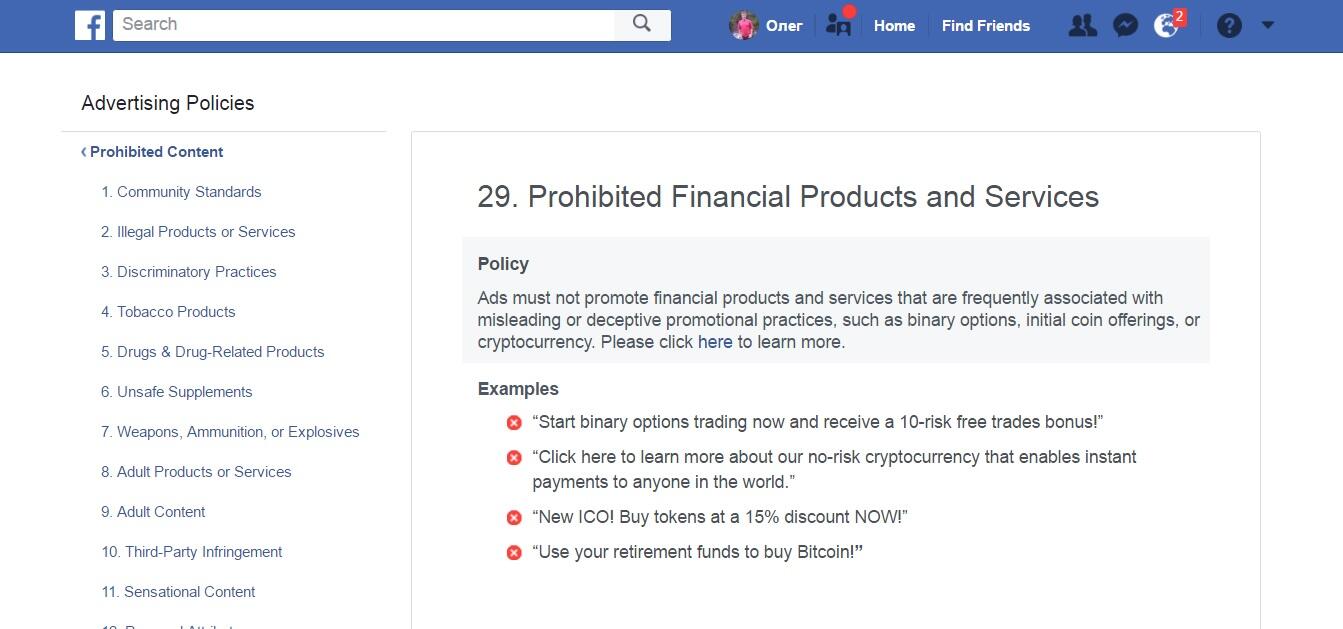
A reasonable question: why should they forbid all the ads for financial services, if they can ban only the information that misleads people? And the kind of language, displayed in the screenshot, can be used in the other services promotion. But it is not forbidden, is it?
Google somehow clarifies the situation, it provided less ambiguous comments on its decision to ban advertising. The company informed in early March that it could follow Facebook. But at that time, it was not about a total ban of advertising, but about stricter rules of ads placement. During the first twenty days of March, Google Adwords representatives were denying any bans on cryptocurrency advertising. A status "Approved (limited)" (limited in where and when they can show) was given to ads in all areas, including alcohol, gambling, healthcare.
Later, it became known that Google’s ban would be not only complete but also would apply to a wider product range. It will also affect binary options, CFD and other market instruments, involving high risks. Now, the most important: despite the ban, their promotion will be possible, provided that they are licensed by the regulators in some countries. However, the certification of exactly cryptocurrencies is not suggested. It is reasonable, considering that many countries haven’t yet defined their legal status.
Google’s representatives make it clear that they were forced to take this decision by the Canadian and the U.S. regulators, and the Fed, which consider the information in the ads to be false. A parallel could be drawn with SEC decision to license the companies, working with cryptocurrencies, as determined under securities law.
Interested motives of Google and Facebook
The market mildly responded to the corporations’ decision. Total capitalization drew down by about 15%, followed by the market’s partial recovery. In other words, the market’s reaction is rather weak compared to the previous crashes in January – March.
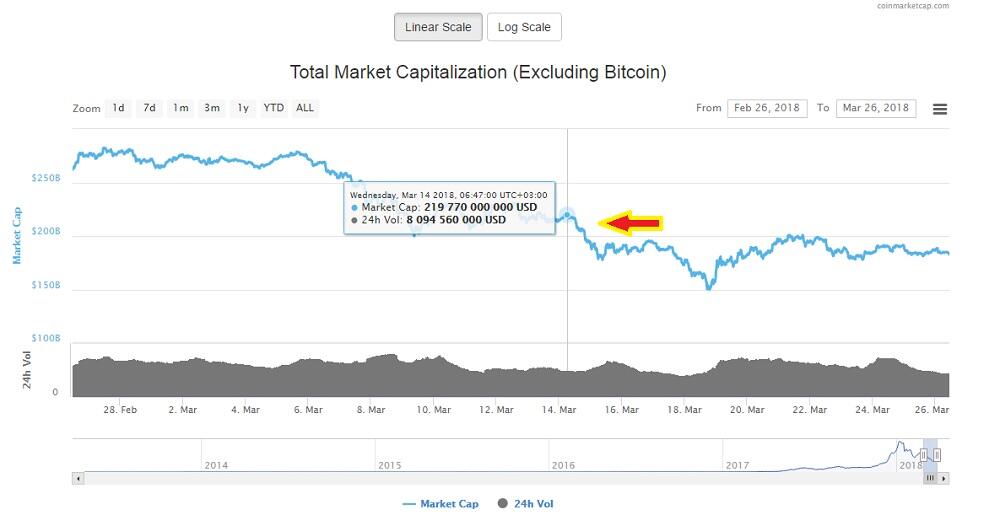
An interesting fact: the ban applies to ads, but not to the posts. But there are no parameters to assess, whether a certain text is an advertisement. That means, one can publish the posts, containing information about cryptocurrency that is not consistent with the reality. It is only forbidden to promote this post as an ad.
Facebook, one of the first to introduce the ban, exactly in January changed the algorithm for ranging the posts. Post organic reach is now about 6% of total network audience, and later, it may get lower down to 2-3%, business will have to pay more for the rest of promotion. The present ban that leaves advertising an opportunity to achieve certification seems to be a cynical wish to earn more money. Corporations shouldn’t be blamed for this desire, but why they are covering their true goals with the care for their users.
New projects, planning ICO, will suffer the most from Facebook and Google’s decisions. Experience shows, at an early stage, about 70% of the budget is spent exactly on advertising, because it determines, whether the project developers will manage to raise the necessary funding. Meanwhile, companies are looking for other places for promotion. Telegram’s audience is growing, some Facebook users have moved there. There are being considered options for creating promotion platforms, similar to Web-sites engaged in monitoring, where projects will promote themselves during ICO. Perhaps, the ways round the ban will be found, as Google blocks ads, based on certain key queries.
 Conclusion: The year 2018 opened with too dynamic moves for the cryptocurrency market. Google and Facebook’s activities suggest that the bans in no way resulted from the care for their potential clients. The USA is the most crypto-friendly nation, which makes these restrictions less comprehensible.
It appears (and it is clear from the statements of Google’s representatives) that someone (and, in particular, the regulators) just wants to get a part of the profits from the cryptocurrency market, and the promotion market providers want to benefit from the ads for the most popular services. This decision won’t strongly affect the companies themselves, which will find other Web-resources for ads placement. Moreover, the decision will have no influence on cryptocurrencies, which are more strongly affected by fundamental factors. The decision will benefit to the regulators, which will be responsible for the ads admission, of course, on a paid basis.
P.S. Did you like my article? Share it in social networks: it will be the best "thank you" :)
Useful links:
- I recommend trying to trade with a reliable broker here. The system allows you to trade by yourself or copy successful traders from all across the globe.
- Use my promo code BLOG to get a 50% deposit bonus on the LiteFinance platform. Simply enter this code in the appropriate field when funding your trading account.
- Telegram chat for traders: https://t.me/litefinancebrokerchat. We are sharing the signals and trading experience.
- Telegram channel with high-quality analytics, Forex reviews, training articles, and other useful things for traders https://t.me/litefinance

The content of this article reflects the author’s opinion and does not necessarily reflect the official position of LiteFinance broker. The material published on this page is provided for informational purposes only and should not be considered as the provision of investment advice for the purposes of Directive 2014/65/EU.
According to copyright law, this article is considered intellectual property, which includes a prohibition on copying and distributing it without consent.