The confrontation in the Middle East has turned into a battle of endurance. Where will the cracks appear first, in Iran's economy or in the global economy? The blockade of the Strait of Hormuz will provide the answer. Let's explore this further and outline a trading plan for Brent.
The article covers the following subjects:
Major Takeaways
- Iran is reducing oil output due to limited storage capacity.
- Global oil inventories are rapidly declining.
- The US is seeking ways out of the crisis.
- Buying Brent remains relevant with targets at $124 and $125.5.
Weekly Fundamental Forecast for Oil
Which side will back down first? Donald Trump has described the blockade of the Strait of Hormuz as effective and is ready to extend it for several more months, depriving Iran of $175 million in daily oil export revenue and pushing its economy toward crisis. Tehran, in turn, is betting that the global economy will crack first, forcing the US to withdraw from the Middle East. Investors remain nervous, unsure which side will give in, which leads to sharp fluctuations in Brent prices.
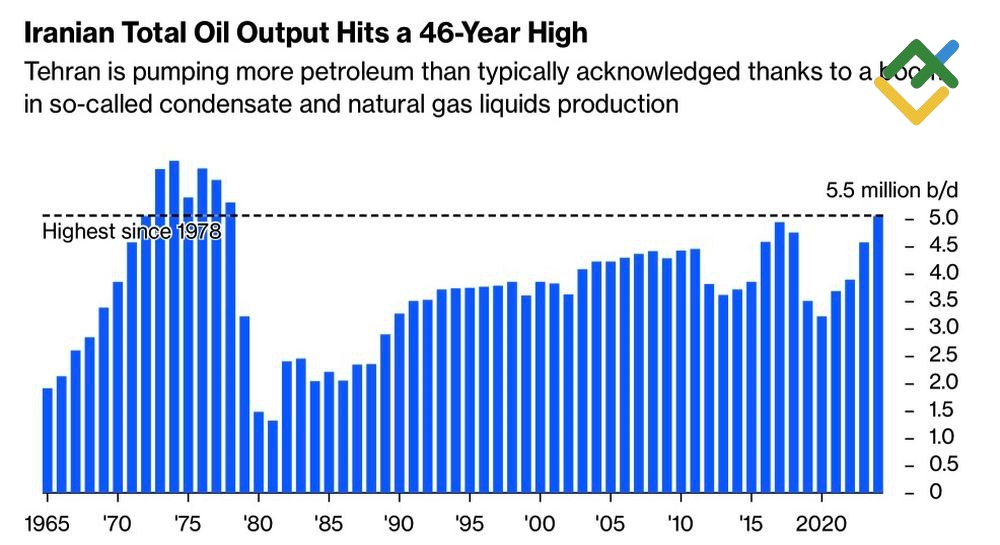
Before the conflict, Iran officially produced around 3.75 million barrels per day, with approximately 1.9 million bpd exported. The closure of the Strait of Hormuz has effectively halted exports and forced production cuts as storage facilities fill up. According to Kpler, output has already declined to 2.5 million bpd and may fall to 1.5 million bpd by mid-May. At this pace, the remaining storage capacity will be exhausted within 12–22 days.
Iran Oil Production Dynamics
Source: Bloomberg
How long can the global economy withstand this pressure? Trafigura Group estimates supply losses since the start of the Middle East conflict at around 1 million barrels per day, while Chevron puts the figure at 900 thousand bpd. So far, inventories have supported supply, but they are rapidly depleting. Therefore, the longer the Strait of Hormuz remains closed, the higher Brent and WTI prices are likely to rise. Citigroup estimates that if the blockade continues through the end of June, Brent could average $130 per barrel for the quarter, with potential peaks at $150 or higher.
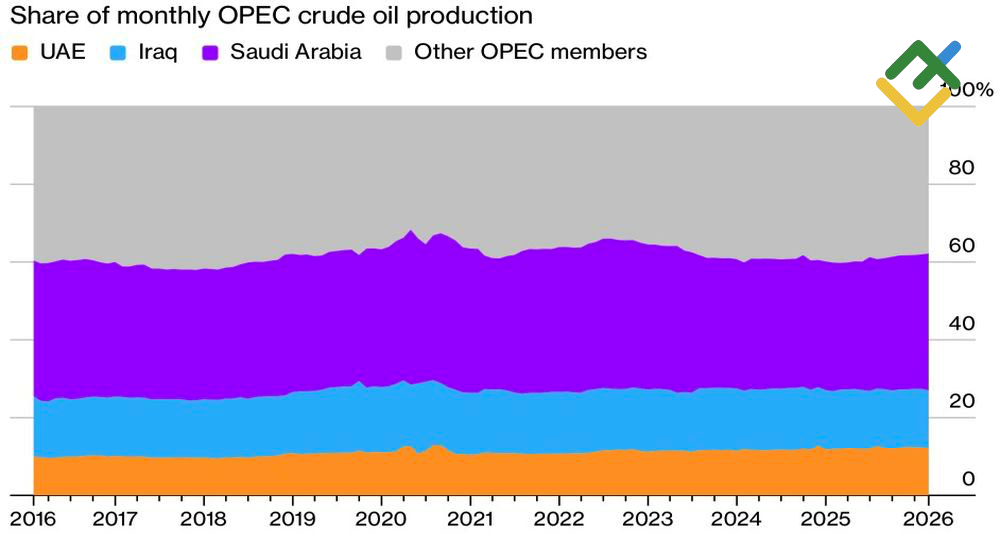
What are the risks? The main risks include accelerating global inflation and widespread monetary tightening, which could push the global economy into recession. The White House has taken several steps, including initiating oil sales from G7 strategic reserves, considering easing sanctions on Russia, urging US companies to increase production, and boosting oil exports to a record 6 million bpd. It would not be surprising if the UAE decided to exit OPEC+ with tacit US approval, as the country has the capacity to raise output from the current 3.4 million bpd to nearly 5 million bpd.
OPEC Oil Production Dynamics and Structure
Source: Bloomberg
It is also possible that the recent pullback in Brent from four-year highs was influenced by actions from the White House. The US may have taken advantage of futures expiry, when positions are rolled over or closed, boosting liquidity for sellers. However, in my view, until there is a clear plan to resolve the Middle East conflict, or at least a path toward reopening the Strait of Hormuz, oil prices are likely to continue moving higher.
Weekly Trading Plan for Brent
Under these conditions, long positions in Brent opened at $90.5 and $95.5 and built up on the breakout above $99.5 appear justified. The current pullback offers an opportunity to open new long positions targeting $124 and $125.5.
This forecast is based on the analysis of fundamental factors, including official statements from financial institutions and regulators, various geopolitical and economic developments, and statistical data. Historical market data are also considered.
Price chart of UKBRENT in real time mode
The content of this article reflects the author’s opinion and does not necessarily reflect the official position of LiteFinance broker. The material published on this page is provided for informational purposes only and should not be considered as the provision of investment advice for the purposes of Directive 2014/65/EU.
According to copyright law, this article is considered intellectual property, which includes a prohibition on copying and distributing it without consent.