The USDCAD pair is a major currency pair in the Forex market, reflecting the economic health of the United States and Canada, the two largest trading partners. The pair's fluctuations reflect not only the difference in interest rates and economic indicators of the respective countries, but also the state of the world commodity markets, especially oil, as Canada is a major exporter of energy commodities.
This article assesses the key forecasts for the coming years, provides fundamental and technical analysis, and evaluates the impact of global factors on the USDCAD exchange rate.
The article covers the following subjects:
- Major Takeaways
- USDCAD Real-Time Market Status
- USDCAD Price Forecast for 2026 Based on Technical Analysis
- Analysts' USD/CAD Price Projections for 2027
- Analysts' USDCAD Price Projections for 2028
- Analysts' USDCAD Price Projections for 2029
- Analysts' USDCAD Price Projections for 2030
- Analysts' USD/CAD Price Projections up to 2050
- USD/CAD Social Media Sentiment
- USDCAD Price History
- USDCAD Price Fundamental Analysis
- More Facts About USDCAD
- How We Make Forecasts
- Conclusion: Is USDCAD a Good Investment?
- USDCAD Price Prediction FAQs
Major Takeaways
The current price of the USDCAD pair is CA$1.40658 as of 23.09.2026.
The USDCAD pair reached its all-time high of CA$1.5848 on 27.08.1998. The pair's all-time low of CA$1.1191 was recorded on 04.11.1991.
The USDCAD rate may fluctuate due to changes in the US–Canada trade balance.
The USDCAD rate will depend on global economic growth, central bank policies, and energy prices.
Historically, the Canadian dollar has strengthened during periods of increased demand for Canadian exports.
By the end of 2026, USD/CAD could rise to 1.4100. Some analysts expect the pair to reach the 1.4300–1.4400 range.
According to many analysts, USD/CAD is expected to trade within the 1.3470–1.5400 range in 2027. More conservative forecasts suggest the pair will remain around 1.3890.
Analysts are divided on the long-term USD/CAD outlook for 2028–2030. The pair is expected to reach around 1.4428 by the end of 2030. However, a rise toward the 1.4900–1.5100 range cannot be ruled out.
Forecasting the USD/CAD exchange rate for 2050 is extremely challenging, as it is influenced by numerous factors. Long-term forecasts are speculative in nature, and the actual exchange rate may change significantly over time.
USDCAD Real-Time Market Status
The USDCAD currency pair is trading at CA$1.40658 as of 23.09.2026.
When analyzing the USDCAD pair, it is essential to consider the impact of macroeconomic indicators. Key factors include the monetary policies of the Bank of Canada and the US Federal Reserve. Inflation indicators, particularly the core consumer price index (CPI), are also crucial to monitor. In addition, historical levels of support and resistance, along with the past year's price performance, should be taken into account for a comprehensive analysis.
Metric | Value |
Bank of Canada's overnight interest rate | 2.25% |
Core inflation, YoY | 1.8% |
All-time low | CA$1.1191 |
All-time high | CA$1.5848 |
Rate change over 12 months | +1.87% |
USDCAD Price Forecast for 2026 Based on Technical Analysis
To forecast USD/CAD over the next year, we will analyze the weekly chart.
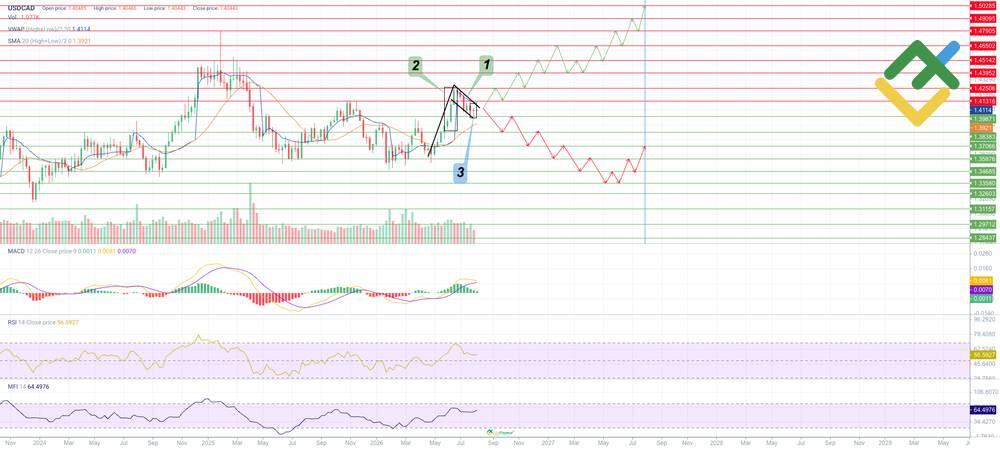
Since early July 2026, the pair has been undergoing a downward correction. Technical indicators and candlestick patterns point to a bullish outlook:
A large Bull Flag pattern (1) is forming. A breakout above 1.4131 could pave the way for a move toward the 1.4650 target. A Three White Soldiers pattern (2) has also formed within the 1.3838–1.4250 range, signaling the potential for further gains. In addition, a Spinning Top pattern (3) has formed near the key support level of 1.3987, indicating temporary consolidation ahead of a potential upward move.
MACD remains in positive territory but is declining, indicating that bullish momentum is weakening and confirming a period of temporary consolidation.
The RSI is holding at 56 and could rise further.
The Money Flow Index (MFI) is also moving sideways in the upper range, confirming that buyers continue to hold the advantage.
The market price is trading between the VWAP and SMA20 lines, which indicates a temporary balance between buyers and sellers.
Below is USD/CAD's 12-month price forecast.
Month | Minimum price, CA$ | Average price, CA$ | Maximum price, CA$ |
August 2026 | 1.3984 | 1.4084 | 1.4184 |
September 2026 | 1.4137 | 1.4209 | 1.4282 |
October 2026 | 1.4109 | 1.4228 | 1.4347 |
November 2026 | 1.4230 | 1.4325 | 1.4421 |
December 2026 | 1.4319 | 1.4428 | 1.4538 |
January 2027 | 1.4379 | 1.4514 | 1.4649 |
February 2027 | 1.4379 | 1.4530 | 1.4682 |
March 2027 | 1.4361 | 1.4447 | 1.4533 |
April 2027 | 1.4379 | 1.4507 | 1.4635 |
May 2027 | 1.4491 | 1.4630 | 1.4770 |
June 2027 | 1.4621 | 1.4754 | 1.4887 |
July 2027 | 1.4766 | 1.4884 | 1.5003 |
Long-Term Trading Plan for USDCAD for 2026
The technical analysis of the weekly USD/CAD chart has allowed us to identify key support and resistance levels that can be used in a trading strategy for the coming year.
Trading Plan for the Year
The Bull Flag pattern is highly likely to play out in the near term.
Key support levels: 1.3987; 1.3838; 1.3706; 1.3587; 1.3468; 1.3358; 1.3260; 1.3115; 1.2971; 1.2843.
Key resistance levels: 1.4131; 1.4250; 1.4395; 1.4514; 1.4650; 1.4790; 1.4909; 1.5028.
Main scenario: Consider long positions on a breakout above the key resistance level of 1.4131, supported by rising trading volume, with potential targets at 1.4250–1.5028.
Alternative scenario: Consider short positions on a breakout below the key support level of 1.3987, supported by rising trading volume, with potential targets at 1.3838–1.2843.
Analysts' USDCAD Price Projections for 2026
Analysts expect USD/CAD to continue rising in the second half of 2026. The pair's performance will likely be influenced by Federal Reserve and Bank of Canada policy decisions, oil prices, and the overall state of the global economy.
LongForecast
Price range: CA$1.3290–CA$1.4310.
According to LongForecast, USD/CAD is expected to decline during the second half of 2026 before resuming its upward trend. The pair could close August at around 1.3840 and then fall to 1.3490 by October. However, by December, USD/CAD could rise to a high of 1.4310.
Month | Opening price, CA$ | Low/High, CA$ | Closing price, CA$ |
August | 1.4010 | 1.3620-1.4220 | 1.3840 |
September | 1.3840 | 1.3460-1.4060 | 1.3670 |
October | 1.3670 | 1.3290-1.3690 | 1.3490 |
November | 1.3490 | 1.3490-1.4090 | 1.3880 |
December | 1.3880 | 1.3880-1.4310 | 1.4100 |
WalletInvestor
Price range: CA$1.3500–CA$1.4600.
According to WalletInvestor, USD/CAD is expected to trade within a wide range during the second half of the year. The average price could reach around 1.3900 in August before declining to 1.3700 in September. By November–December, the pair could climb to a high of 1.4600.
Month | Average price, CA$ | Minimum price, CA$ | Maximum price, CA$ |
August | 1.3900 | 1.3800 | 1.4200 |
September | 1.3700 | 1.3500 | 1.4100 |
October | 1.3800 | 1.3600 | 1.4000 |
November | 1.4300 | 1.4000 | 1.4600 |
December | 1.4300 | 1.4000 | 1.4600 |
CoinCodex
Price range: CA$1.3800–CA$1.4600.
According to CoinCodex, USD/CAD is expected to maintain a moderate upward trend. The average price could reach around 1.3900 in August before rising to 1.4100 by October. By the end of the year, the pair could climb to a high of 1.4600.
Month | Minimum price, CA$ | Average price, CA$ | Maximum price, CA$ |
August | 1.3800 | 1.3900 | 1.4000 |
September | 1.3800 | 1.4000 | 1.4200 |
October | 1.3900 | 1.4100 | 1.4200 |
November | 1.4000 | 1.4100 | 1.4200 |
December | 1.4200 | 1.4400 | 1.4600 |
Analysts' USD/CAD Price Projections for 2027
Most analysts expect USD/CAD to appreciate in 2027. The pair's performance will likely be influenced by central bank policies, energy prices, and economic conditions in the United States and Canada.
Note: The price ranges reflect the asset's expected volatility throughout the year. Lows and highs may not be shown in the summary tables.
LongForecast
Price range: CA$1.3470–CA$1.4300.
According to LongForecast, USD/CAD is expected to decline gradually during the first half of the year. The closing price could fall to around 1.3680 in the second quarter before the pair resumes its upward trend. By the end of the year, USD/CAD could rise to a high of 1.4300.
Quarter | Opening price, CA$ | Low/High, CA$ | Closing price, CA$ |
Q1 | 1.4100 | 1.3560-1.4280 | 1.4070 |
Q2 | 1.4070 | 1.3470-1.4170 | 1.3680 |
Q3 | 1.3680 | 1.3560-1.4160 | 1.3830 |
Q4 | 1.3830 | 1.3680-1.4300 | 1.3890 |
WalletInvestor
Price range: CA$1.3500–CA$1.5100.
According to WalletInvestor, USD/CAD is expected to trade around the 1.4400 level at the beginning of the year before declining to 1.3900 by the third quarter. However, the pair is then expected to resume its upward trend. By the end of the year, USD/CAD could reach a high of 1.5100.
Quarter | Average price, CA$ | Minimum price, CA$ | Maximum price, CA$ |
Q1 | 1.4400 | 1.3900 | 1.4700 |
Q2 | 1.4000 | 1.3500 | 1.4700 |
Q3 | 1.3900 | 1.3500 | 1.4800 |
Q4 | 1.4600 | 1.3600 | 1.5100 |
CoinCodex
Price range: CA$1.4300–CA$1.5400.
According to CoinCodex, USD/CAD is expected to trend gradually higher throughout the year. The average exchange rate could reach around 1.4500 in the first quarter and rise to 1.4800 by summer. The pair could reach a high of around 1.5400.
Quarter | Minimum price, CA$ | Average price, CA$ | Maximum price, CA$ |
Q1 | 1.4300 | 1.4500 | 1.4700 |
Q2 | 1.4300 | 1.4800 | 1.5000 |
Q3 | 1.4500 | 1.4800 | 1.5000 |
Q4 | 1.4800 | 1.5100 | 1.5400 |
Analysts' USDCAD Price Projections for 2028
Forecasts for 2028 remain mixed. Most analysts expect USD/CAD to decline. The pair may be influenced by Federal Reserve monetary policy, the state of the Canadian economy, and trends in global commodity markets.
LongForecast
Price range: CA$1.3140–CA$1.4570.
According to LongForecast, USD/CAD is expected to rise gradually. The pair could trade at around 1.3900 by summer and reach a high of 1.4570 in the third quarter. By December, the exchange rate could correct to 1.4060. High volatility is expected.
Quarter | Opening price, CA$ | Low/High, CA$ | Closing price, CA$ |
Q1 | 1.3890 | 1.3140-1.3890 | 1.3340 |
Q2 | 1.3340 | 1.3270-1.4110 | 1.3900 |
Q3 | 1.3900 | 1.3810-1.4570 | 1.4020 |
Q4 | 1.4020 | 1.3850-1.4420 | 1.4060 |
WalletInvestor
Price range: CA$1.3700–CA$1.5900.
According to WalletInvestor, the average USD/CAD exchange rate could reach 1.5200 at the beginning of the year. It may then decline to 1.4300 by the third quarter before resuming its upward trend. By December, the average exchange rate could be around 1.5000.
Quarter | Average price, CA$ | Minimum price, CA$ | Maximum price, CA$ |
Q1 | 1.5200 | 1.4200 | 1.5800 |
Q2 | 1.4800 | 1.4100 | 1.5900 |
Q3 | 1.4300 | 1.3700 | 1.5400 |
Q4 | 1.5000 | 1.4000 | 1.5700 |
CoinCodex
Price range: CA$1.3700–CA$1.5600.
According to CoinCodex, USD/CAD is expected to remain in a downtrend for most of the year. The average exchange rate could reach around 1.5200 in the first quarter before falling to 1.3900 by autumn. By December, the pair is expected to recover to around 1.4400. High volatility is expected.
Quarter | Minimum price, CA$ | Average price, CA$ | Maximum price, CA$ |
Q1 | 1.4700 | 1.5200 | 1.5300 |
Q2 | 1.4700 | 1.5000 | 1.5600 |
Q3 | 1.3700 | 1.3900 | 1.4700 |
Q4 | 1.4100 | 1.4400 | 1.4600 |
Analysts' USDCAD Price Projections for 2029
Most analysts expect USD/CAD to trade predominantly in an uptrend in 2029. The pair may be influenced by Canada's trade balance, commodity prices, and further central bank policy decisions.
LongForecast
Price range: CA$1.3750–CA$1.4900.
According to LongForecast, USD/CAD could decline to 1.3960 in the first half of 2029 before beginning to recover. The pair is expected to close the year at around 1.4300.
Quarter | Opening price, CA$ | Low/High, CA$ | Closing price, CA$ |
Q1 | 1.4060 | 1.4060-1.4640 | 1.4420 |
Q2 | 1.4420 | 1.3750-1.4840 | 1.3960 |
Q3 | 1.3960 | 1.3960-1.4900 | 1.4680 |
Q4 | 1.4680 | 1.4060-1.4840 | 1.4300 |
WalletInvestor
Price range: CA$1.4000–CA$1.6000.
According to WalletInvestor, the average USD/CAD exchange rate could reach 1.5100 in the first quarter and then decline to 1.4800 by summer. During the second half of the year, the pair is expected to trade in the 1.4900–1.5000 range.
Quarter | Average price, CA$ | Minimum price, CA$ | Maximum price, CA$ |
Q1 | 1.5100 | 1.4400 | 1.6000 |
Q2 | 1.4800 | 1.4100 | 1.5900 |
Q3 | 1.5000 | 1.4000 | 1.5800 |
Q4 | 1.4900 | 1.4100 | 1.5800 |
CoinCodex
Price range: CA$1.3900–CA$1.5400.
According to CoinCodex, the average USD/CAD exchange rate could rise from 1.4600 to 1.4900 during the first half of the year. The pair may pull back to 1.4700 in the autumn. However, the uptrend is expected to resume thereafter. By December, USD/CAD could climb to a high of 1.5400.
Quarter | Minimum price, CA$ | Average price, CA$ | Maximum price, CA$ |
Q1 | 1.3900 | 1.4600 | 1.4800 |
Q2 | 1.4200 | 1.4900 | 1.5100 |
Q3 | 1.4500 | 1.4700 | 1.5000 |
Q4 | 1.4500 | 1.5200 | 1.5400 |
Analysts' USDCAD Price Projections for 2030
Most analysts continue to expect USD/CAD to remain in a downtrend. The pair's performance will depend on the strength of the US and Canadian economies, central bank policies, and conditions in the commodity markets.
WalletInvestor
Price range: CA$1.3700–CA$1.6000.
According to WalletInvestor, the average USD/CAD exchange rate could stand at around 1.5100 at the beginning of the year before easing to 1.4800 by June. The pair is then expected to recover. By December, USD/CAD could climb to a high of 1.6000.
Quarter | Average price, CA$ | Minimum price, CA$ | Maximum price, CA$ |
Q1 | 1.5100 | 1.3700 | 1.5900 |
Q2 | 1.4800 | 1.3800 | 1.5900 |
Q3 | 1.4500 | 1.4000 | 1.5800 |
Q4 | 1.5100 | 1.4100 | 1.6000 |
CoinCodex
Price range: CA$1.4700–CA$1.5400.
According to CoinCodex, USD/CAD is expected to remain above 1.5000 for most of the year. A modest correction could occur in the fourth quarter. By December, USD/CAD is projected to trade at around 1.4900.
Quarter | Minimum price, CA$ | Average price, CA$ | Maximum price, CA$ |
Q1 | 1.4800 | 1.5100 | 1.5400 |
Q2 | 1.4800 | 1.5000 | 1.5300 |
Q3 | 1.4700 | 1.5000 | 1.5100 |
Q4 | 1.4700 | 1.4900 | 1.5100 |
Gov Capital
Price range: CA$1.2824–CA$1.6188.
According to Gov Capital, USD/CAD is expected to trend lower gradually. The pair is projected to average 1.4686 in the first quarter and decline to 1.4485 by summer. By December, the pair is expected to stabilize around 1.4428.
Quarter | Average price, CA$ | Lowest possible price, CA$ | Highest possible price, CA$ |
Q1 | 1.4686 | 1.2824 | 1.6154 |
Q2 | 1.4485 | 1.3037 | 1.6188 |
Q3 | 1.4453 | 1.2943 | 1.6092 |
Q4 | 1.4428 | 1.2844 | 1.6005 |
Analysts' USD/CAD Price Projections up to 2050
Long-term USD/CAD forecasts should be treated with caution. The exchange rate will be influenced by the pace of economic growth in the United States and Canada, inflation, interest rates, commodity prices, and geopolitical developments.
In addition, changes in the global financial system, the development of central bank digital currencies, and the transformation of international trade could have a significant impact. Geopolitical conflicts, which are inherently unpredictable, may also materially affect the exchange rate. Any long-term forecasts extending to 2050 should be regarded as indicative only.
USD/CAD Social Media Sentiment
Market sentiment reflects the overall outlook on the USD/CAD currency pair based on news, media coverage, and market commentary. For example, positive news about the US economy may push the pair higher, while negative news could increase volatility and trigger a bearish trend reversal.
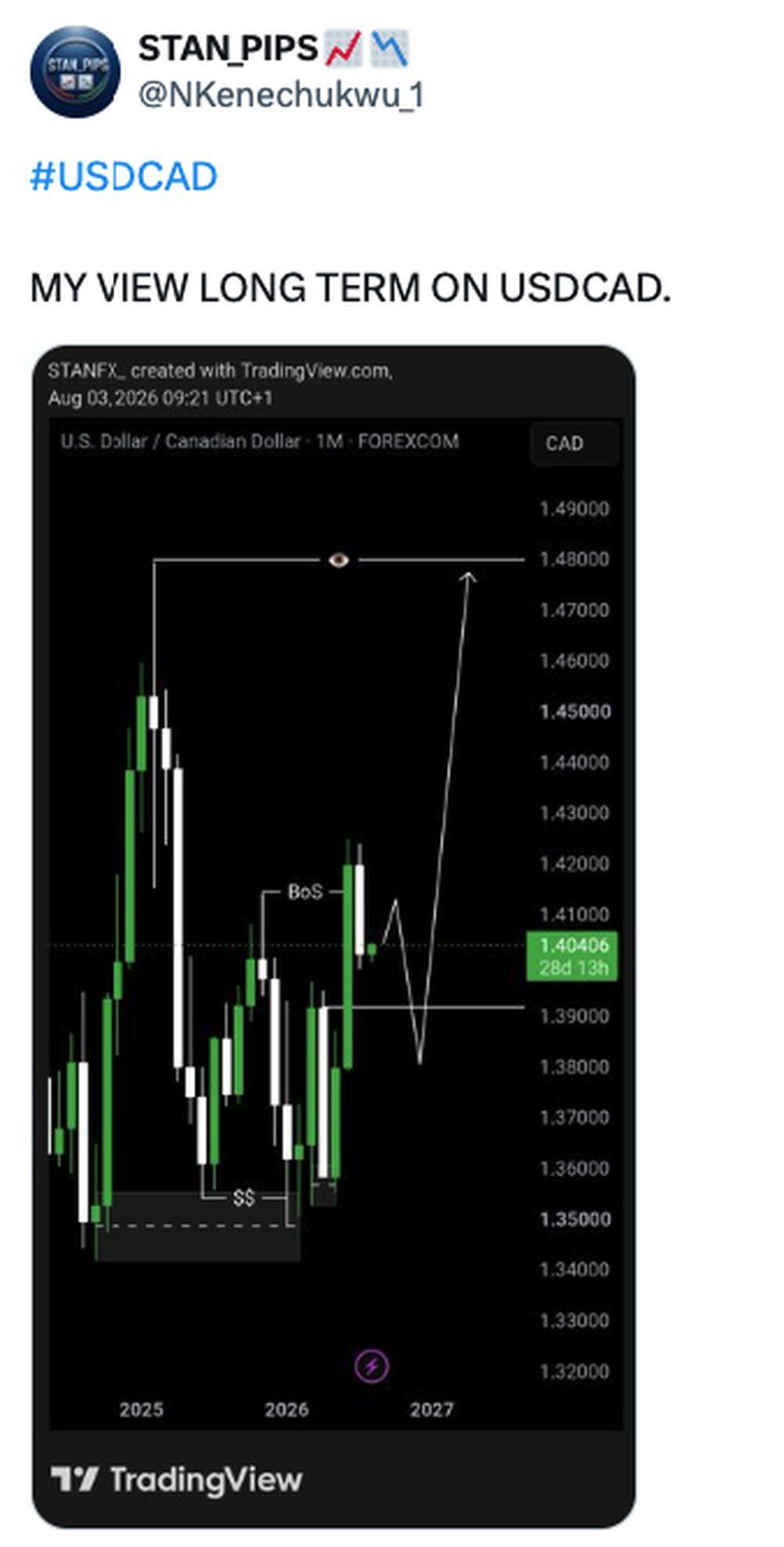
User @NKenechukwu_1 expects USD/CAD to rise to 1.4800 over the long term.
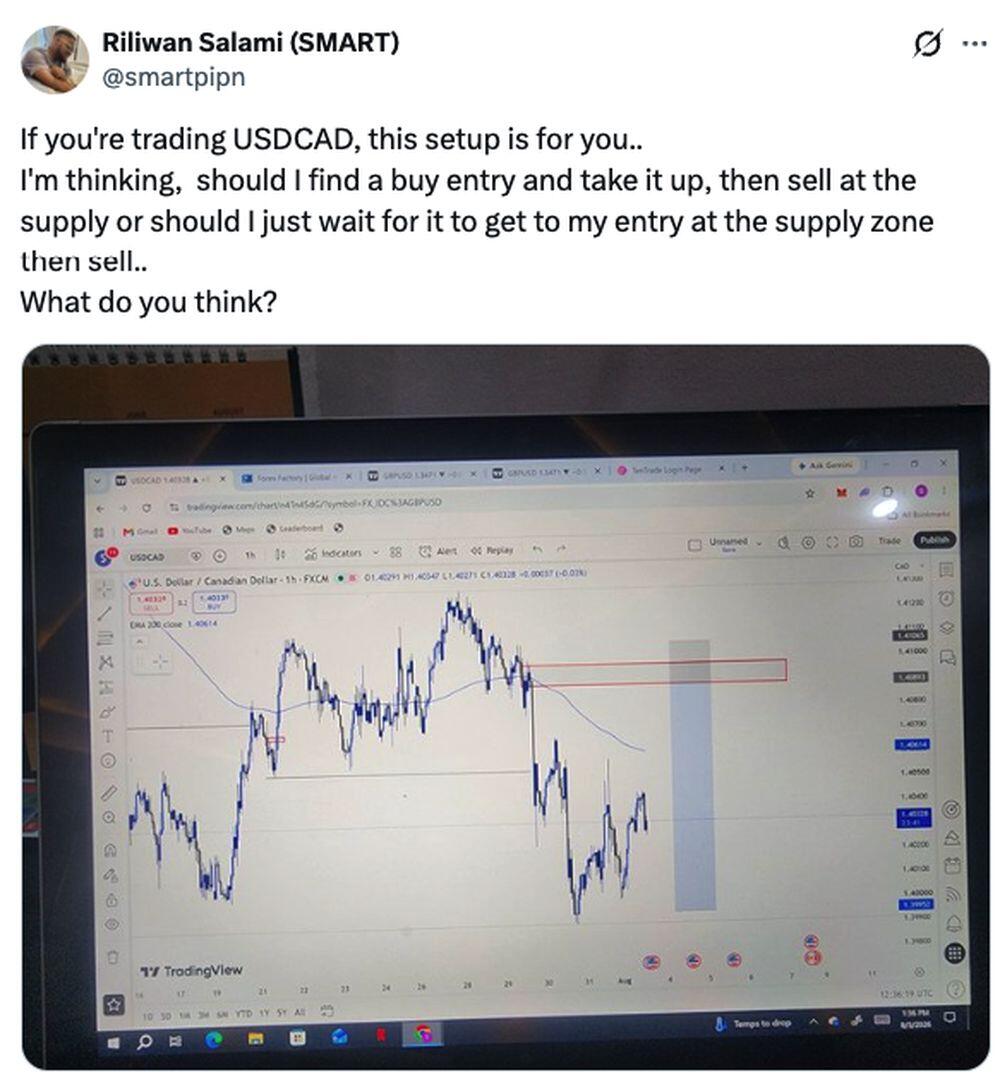
Independent analyst @smartpipn forecasts a short-term rise to 1.4100, followed by a downward reversal.
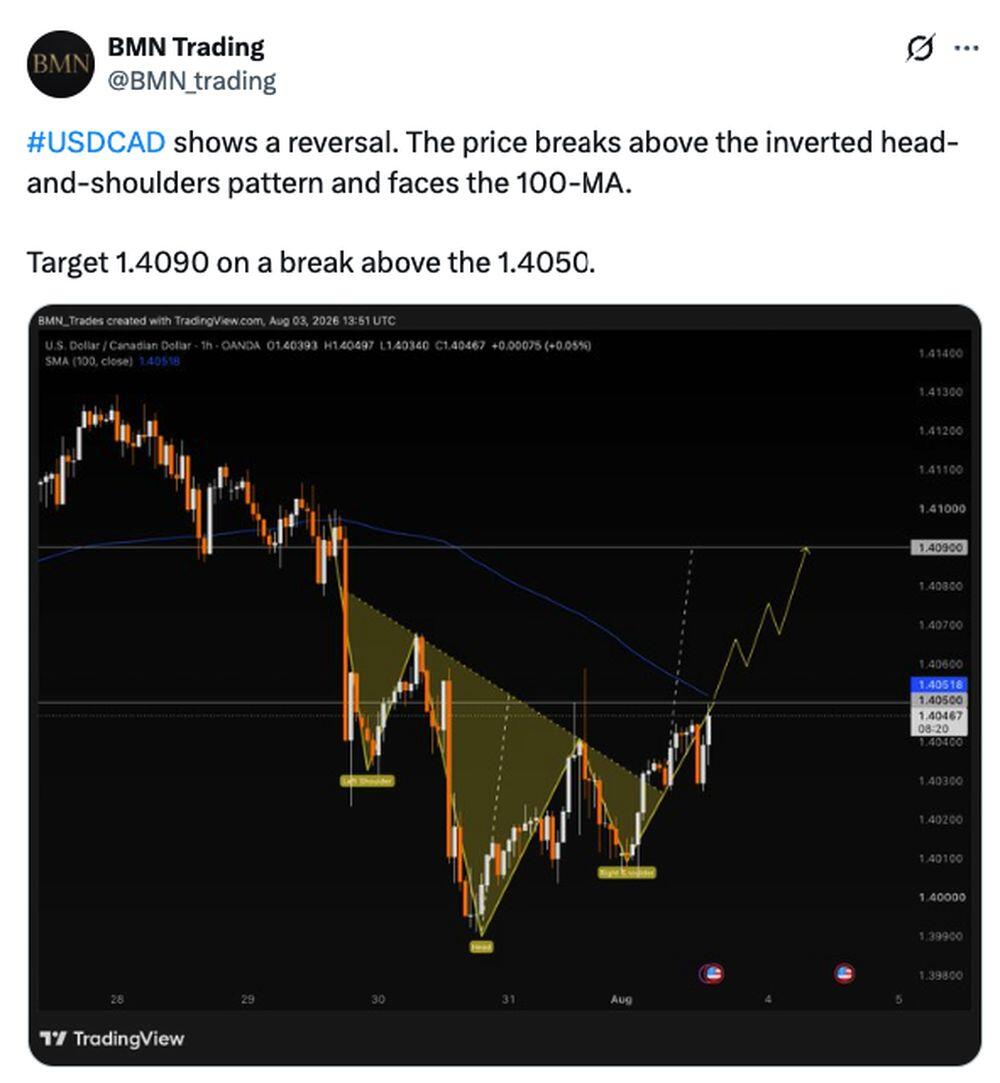
Independent trader @BMN_trading also expects USD/CAD to climb to 1.4090 if the pair consolidates above 1.4050 in the near term.
Overall, most traders and investors remain bullish on USD/CAD. However, trading and investment decisions should be based on both technical and fundamental analysis, as well as up-to-date expert research.
USDCAD Price History
The USDCAD pair reached its all-time high of CA$1.5848 on 27.08.1998.
The lowest price of the USDCAD pair was recorded on 04.11.1991 and reached CA$1.1191.
Below is a chart showing the USDCAD pair's performance over the last ten years. In this connection, it is important to evaluate historical data to make predictions as accurate as possible.
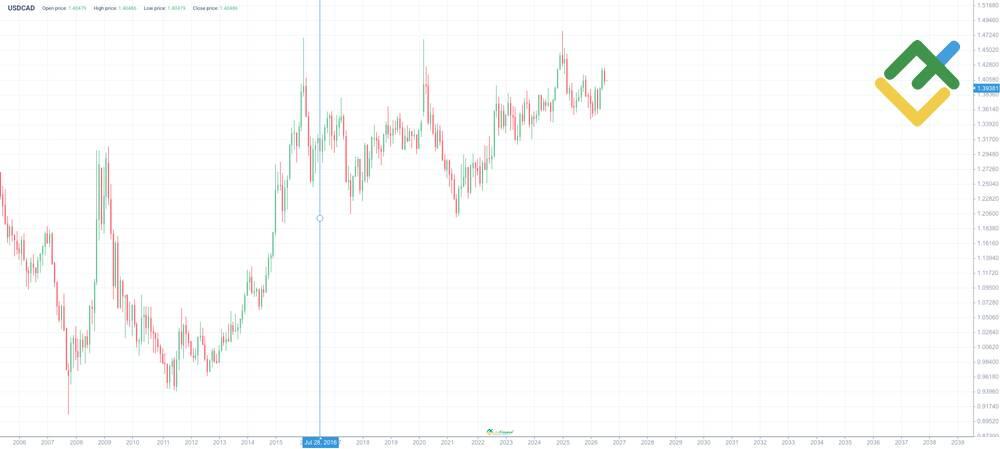
As you can see on the chart, the USDCAD currency pair has experienced significant fluctuations, reflecting changes in the US and Canadian economies. In the early 1990s, the pair traded between CA$1.15 and CA$1.40, but the Canadian dollar strengthened in 2002. The USDCAD has since declined to CA$1.10, driven by rising oil prices and a robust Canadian economy.
The global financial crisis of 2008 led to a significant shift in the investment landscape, with investors seeking out safe-haven assets. As a result, the Canadian dollar weakened significantly, and the USDCAD rate surged above CA$1.30. In the following years, the price of the pair fluctuated between CA$0.95 and CA$1.10, responding to shifts in commodity markets.
Between 2015 and 2020, USDCAD quotes rose steadily, reaching CA$1.45 amid the pandemic and falling oil prices. Between 2022 and 2023, the pair traded within the range of CA$1.32–1.40.
Between January and October 2024, the USDCAD pair fluctuated between CA$1.3287 and CA$1.3946. In November 2024, the rate began to rise, reaching CA$1.4467 by the end of the year.
In 2025, USD/CAD was highly volatile, reacting to changes in monetary policy in both countries and fluctuations in oil prices. During the first half of the year, the pair declined to CA$1.3539 as the Canadian dollar was strengthening. Bulls later attempted to regain control, pushing the price up to CA$1.4140 in November, but by the end of December, USD/CAD had fallen again to CA$1.3642.
In January 2026, the pair fell to 1.3481. By March, it had recovered to 1.3966. After declining to 1.3550 in April, USD/CAD rallied to 1.4248 by mid-June. As of early August, the pair is trading within the 1.3990–1.4248 range.
USDCAD Price Fundamental Analysis
A fundamental analysis of the USDCAD rate involves analyzing the macroeconomic factors that drive the currency pair's quotes. The primary factors influencing the rate's fluctuations include the monetary policy of the US Federal Reserve and the Bank of Canada, the economic conditions of both countries, and oil prices.
What Factors Affect the USDCAD Pair?
Fed and BoC monetary policy. Interest rate differentials affect the attractiveness of each currency.
Oil prices. Canada is a major exporter of oil, an increase in its value strengthens the CAD.
Economic data. GDP, unemployment rate, inflation, and trade balance data affect the exchange rate.
Recession risks and geopolitical factors. Economic crises and conflicts prompt investors to turn to safe-haven assets.
Bond yield spread. Investors prefer currencies with higher government bond yields.
Investor sentiment and capital flows. Investment inflows into the US or Canada have a positive effect on their currencies.
More Facts About USDCAD
USDCAD is a major currency pair in the Forex market, offering high liquidity due to the high volume of trade between the United States and Canada.
The Canadian dollar, often referred to as the "Loonie," has historically been correlated with oil prices. As Canada is one of the world's leading energy exporters, rising oil prices tend to strengthen the Canadian dollar, while falling prices often weaken it.
Investors, traders, and central banks use the USDCAD pair to assess macroeconomic trends and make monetary policy decisions. The pair is also in demand by exporters and importers of both countries and international investors seeking to hedge currency risks.
The fluctuations in the USDCAD rate are attributed to economic data, the policies of the Fed and the Bank of Canada, and global economic conditions. Due to its high volatility, this pair remains popular among traders and investors.
Advantages and Disadvantages of Investing in USDCAD
Investing in the USDCAD presents a range of opportunities for traders and investors. Its high liquidity and ease of forecasting make this pair attractive for trading. However, it is essential to remember that there are inherent risks.
Advantages
High liquidity. The USDCAD pair boasts high liquidity, making it a popular choice for traders and investors. The pair's trading volume is exceptionally high, and it is traded on one of the world's largest Forex markets, ensuring minimal spreads and fast order execution.
Predictability. The USDCAD rate is closely linked to oil prices, as well as to the monetary policy of the Fed and the BoC.
Hedging opportunities. The pair is popular among traders and investors who use it to protect against currency risks in international transactions and investments.
Accessibility. The currency pair is available on all major trading platforms, and trading costs remain low due to high liquidity.
Suitable for various strategies. The versatility of the USDCAD pair makes it suitable for a range of strategies, including day trading, scalping, and long-term investments.
Disadvantages
Dependence on oil prices. The Canadian dollar's value is closely tied to the global price of oil. Significant fluctuations in the price of oil can lead to high volatility.
Macroeconomic risks. Given that Canada has an export-oriented economy, the exchange rate is influenced by the global economy, trade agreements, and tariffs.
Volatility risk. Market news, central bank announcements, or sudden changes in oil prices may affect the exchange rate significantly.
Political factors. Trade disputes between Canada and the US, as well as geopolitical uncertainty, can also impact the major currency pair.
Interest rates. Changes in the monetary policy of the Bank of Canada and the Fed can cause sharp movements of USDCAD quotes, which can complicate long-term trading.
How We Make Forecasts
Forecasting the USDCAD rate requires a thorough analysis of short-, medium-, and long-term factors. Our approach integrates technical and fundamental analysis.
Short-term forecasts up to three months are based on technical analysis, including support and resistance levels, candlestick patterns, and indicators such as the RSI, MACD, and Bollinger Bands. In addition, we take into account news, macroeconomic statistics from the US and Canada, and oil market volatility.
Medium-term forecasts from 3 months to a year include an assessment of the monetary policy of the US Federal Reserve and the Bank of Canada, inflation rates, GDP growth, employment and trade balance data. The impact of oil prices and commodity markets is also analyzed.
Long-term forecasts extend over a period of one year or more and are based on estimates of economic growth, demographic trends, changes in trade agreements between the US and Canada, and global currency market trends.
Conclusion: Is USDCAD a Good Investment?
Whether USD/CAD is a good investment is a complex question, and the answer depends on an investor's individual goals, risk tolerance, and time horizon. For short-term speculation, the pair may be attractive due to its high volatility. However, long-term investors should carefully weigh all relevant factors before trading this instrument, including economic conditions in both countries, geopolitical risks, oil price forecasts, and central bank decisions.
Forecasts are not guarantees, and actual price movements can differ significantly. Portfolio diversification and prudent risk management are key elements of successful investing in any currency pair, including USD/CAD. Investing in USD/CAD may also form part of a hedging strategy against commodity market risks.
USDCAD Price Prediction FAQs
The current price of the USDCAD pair is CA$1.40658 as of 23.09.2026.
The Canadian dollar may weaken against the US dollar due to slowing global economic growth and volatile energy prices. USDCAD is expected to trade in the 1.4300–1.4400 range. Bearish pressure on the Canadian dollar is further reinforced by elevated inflation in Canada and declining investment inflows.
It depends on the macroeconomic situation. If the Fed continues to tighten monetary policy, the US dollar may strengthen, and one may consider USDCAD purchases. However, if oil prices rise, the Canadian dollar will strengthen, which makes the pair attractive for selling.
The Canadian dollar could strengthen if the Bank of Canada raises rates or oil prices rise, as the country's economy is highly dependent on its exports. However, if the Fed continues its aggressive monetary policy, the US dollar will remain strong, limiting the CAD's upside potential.
USDCAD quotes are influenced by several key factors, including the interest rate differential between the Fed and the BoC, oil prices, GDP, inflation, employment rates, geopolitical landscape, and global financial markets.
The pair may fluctuate following interest rate decisions by the Fed and the Bank of Canada, inflation, GDP, employment data releases, and oil price fluctuations. Additionally, the USDCAD rate is influenced by political events, such as elections or shifts in trade relations between Canada and the USA.
The USDCAD pair may drop due to rising oil prices, as the Canadian dollar strengthens when crude becomes more expensive. The decline may be caused by the Bank of Canada's tighter policy, improved economic indicators, or lower growth rates of the US economy.
Price chart of USDCAD in real time mode
The content of this article reflects the author’s opinion and does not necessarily reflect the official position of LiteFinance broker. The material published on this page is provided for informational purposes only and should not be considered as the provision of investment advice for the purposes of Directive 2014/65/EU.
According to copyright law, this article is considered intellectual property, which includes a prohibition on copying and distributing it without consent.