Technical analysis (TA) is a popular way to study the stock market and any other assets such as trading with a currency pair, cfds, etc, to determine their current position and development prospects. The stock technical analysis toolkit is vast and is provided free of charge, without installing additional software, and even without registration by such large brokers as LiteFinance and Plus500. It is very important to understand at least the basics of technical analysis of stocks to avoid childish mistakes.
The article covers the following subjects:
- What is Technical Analysis?
- 3 Key Principles of Technical Analysis
- Fundamental Analysis vs. Technical Analysis: What’s the Difference?
- Technical Analysis: Top Down vs. Bottom Up
- Types of technical analysis
- Instruments of Technical Analysis
- Charts
- Indicators
- Common Terms
- Benefits of technical analysis
- Disadvantages of technical analysis
- Conclusion
- Technical Analisys FAQ
This article will help you take the first steps towards mastering technical analysis and consider the basic concepts on which principles TA is based and how it differs from fundamental analysis. You will also learn about the methods of technical chart analysis for beginners, get acquainted with the main tools, indicators, types of charts.
What is Technical Analysis?
In simple terms, this is one of the best methods for predicting the price of any asset. This is explained by the fact that almost all financial markets are subject to the same psychological laws. Therefore, technical stock analysis uses methods to study the inner life of financial markets, their emotional state, that is, the degree of optimism and pessimism of the participants.
Unlike fundamental analysis, technical analysis does not take into account external fundamental factors that influence the value of a stock, such as competition or demand for a company's products. In their forecasts, technical analysts use tools to search for patterns on charts and perform arithmetic calculations. It is believed that the price of an asset has already included all the factors affecting the position of the issuing company. This statement is also true for any other trading instrument.
Surprisingly, the history of technical analysis began many centuries ago. Its first provisions were developed by Joseph de la Vega in the 17th century and were widely used by Dutch traders. One of the foundations of traditional technical analysis is the candlestick price chart. It was invented over 200 years ago by the Japanese rice trader Homma Munehisa.
The very first classical works describing ways of predicting investor sentiment on stock exchanges appeared in the late 19th and early 20th centuries. The books "Technical Analysis of Markets" and "Stock Market Theory" by renowned technical analysts Charles Dow and Peter Hamilton have become real bestsellers. Dow Theory has become the foundation of stock market technical analysis.
At the beginning of the 20th century, William Gunn, Richard Wyckoff, Ralph Elliott published their works. Their methods are used by thousands of analysts, traders, and investors. In 1948, a book by Robert Edwards and John Magee, "Technical Analysis of Stock Trends", was published, which is being reprinted to this day, and every trader uses the methods described in it.
Stocks technical analysis also has opponents. As a rule, these are people who consider trading to be close to a casino game. Typically, they refer to the efficient-market hypothesis and the random walk hypothesis. I will not delve into the nature of these concepts, but I can say that they do not work and are subject to significant criticism. In this regard, it is worth noting Michael Pulos, who created a technical analysis indicator called the Random Walk Index.
3 Key Principles of Technical Analysis
There are three key principles of tech analysis of stocks to help you achieve your financial objectives:
- The market reacts to everything: news, facts, economic technical indicators, emotions, investors' expectations.
- The market is inertial. If there is a bullish trend in the market, then there is a high probability that the upward price trend will continue. If bearish, the fall will continue. There may also be an absence of a trend in the market. The market is likely to continue being flat until there is a strong enough factor for developing an uptrend or a downtrend.
- The market moves and the future price movements in waves. Technical trading is often based on the effect of repeating history. Under these circumstances, many investors often make the same steps that their predecessors did days, weeks, months, and years earlier. This is the basis for such a form of technical analysis as price trend trading.
Fundamental Analysis vs. Technical Analysis: What’s the Difference?
There are two schools of market analysis: technical and fundamental. What are their differences?
In technical analysis, only the chart and price movement are taken into account. Analysts pay attention to the price level and direction, the previous price, new lows and highs, candles, the cyclicity of the movement, its angles, speed, etc.
Fundamental analysts trade on economic data factors. In the case of stocks, the calculation takes into account statements of a loss and profit target, the working capital balance, debt to creditors, etc. When trading commodities, these analysts pay attention to the level of supply and demand, the projected growth and decline in production of raw materials, logistics features, factors influencing an increase or decrease in demand.
There is also a significant difference in the time frame. Fundamental analysis is usually used when trading on large timeframes since the factors influencing the price do not have time to change in a short time. Market technical analysis can be used both on monthly price charts and on short-term 15-minute and even 5-minute candlestick charts.
Technical Analysis: Top Down vs. Bottom Up
Top-down and bottom-up methods are used by technical traders to select the most promising assets. The first one is based on the general to the particular principle, and the second one the particular to the general trading approach.
Top-Down Technical Analysis
This technique of technical analysis involves the assessment of complex factors. It suggests that the investor first gets acquainted with the overall picture, and then moves on to the market’s structure.
For example, such an analysis can consist of three stages:
- General market analysis by assessing the state of major indices such as the S&P 500, Dow Industrials, NASDAQ and NYSE.
- Sectoral analysis to identify strong and weak assets by industry or other differentiating factor.
- Analysis of individual assets to identify the most promising ones.
Bottom Up Technical Analysis
This method is simpler than the previous one, but it has several disadvantages. The bottom-up trading approach involves focusing on the performance of individual companies or sectors. That is, the investor is looking for profitable opportunities through the characteristics of individual assets in comparison with the market as a whole. According to this approach, the trader pays less attention to the general market sentiment. In the event of global changes in the future, the risk of losing trades increases.
Types of technical analysis
Understanding technical analysis includes several methods for studying price changes. Some of them are focused on the shape, length, and other characteristics of individual candles and the group analysis of bars. Others involve the use of additional tools such as oscillators, moving averages, or Elliott waves. Traders use several methods at once. This allows technical traders to more deeply assess the factors that move the price in one direction, increase the power of prediction, and extend the forecasting time frame.
Graphical analysis
Most beginners start with this type of analysis. The graphical analysis involves looking for patterns that indicate the continuation or reversal of the trend. It includes popular patterns: "triangle", "head and shoulders", "flag" and others. For more information about graphical analysis patterns, see the article "Most efficient Forex patterns: a complete guide". Having learned to determine the current price and the direction of future price movements as well as identify the chart patterns, you will be able to make short-term and long-term forecasts.
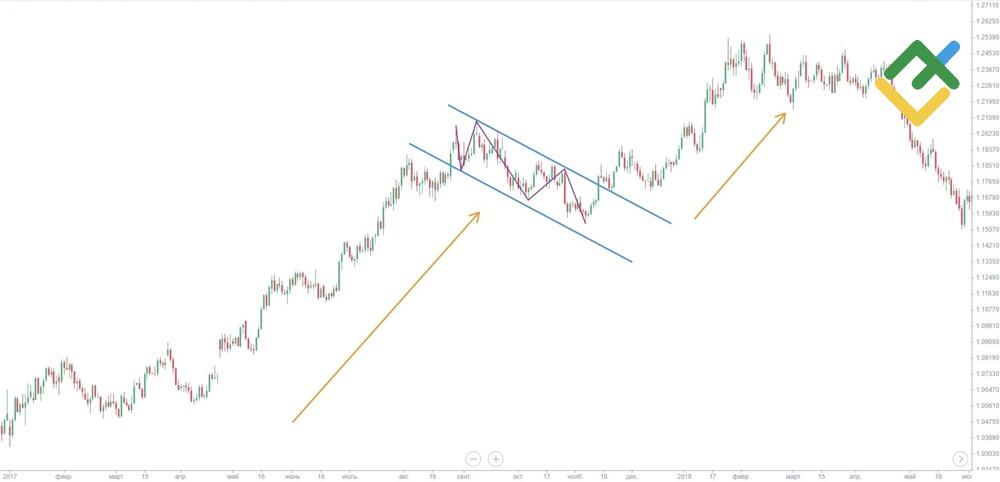
For example, the EURUSD chart shows the "Flag" pattern, indicating the trend's continuation. This short-term consolidation of the market in a narrow range temporarily replaces the main trend. After the end of the correction, the trend, as indicated by the figure, continued.
Indicator analysis
It is based on the use of various calculation methods and formulas. They can include the following parameters:
- Price levels: open, close, high and low.
- Trading volumes.
The most popular technical indicators are the Moving Average indicator, MACD, RSI and Bollinger Bands. In total, about fifty analysis tools can be attributed to classical TA, they can be divided into four main groups:
- Bill Williams indicators;
- Volumes;
- Oscillators;
- Trend.
Thanks to open-source code, technical analysis enthusiasts combine the functions of various indicators and change the source code, creating their own indicator, which is more accurate and efficient. In search of the perfect one, traders created thousands of self-written new indicators, many of which can be found in the public domain, for example, on mql5.com.
Indicator analysis involves the use of several tools at once. This allows the analyst to filter out false signals and make more accurate predictions.
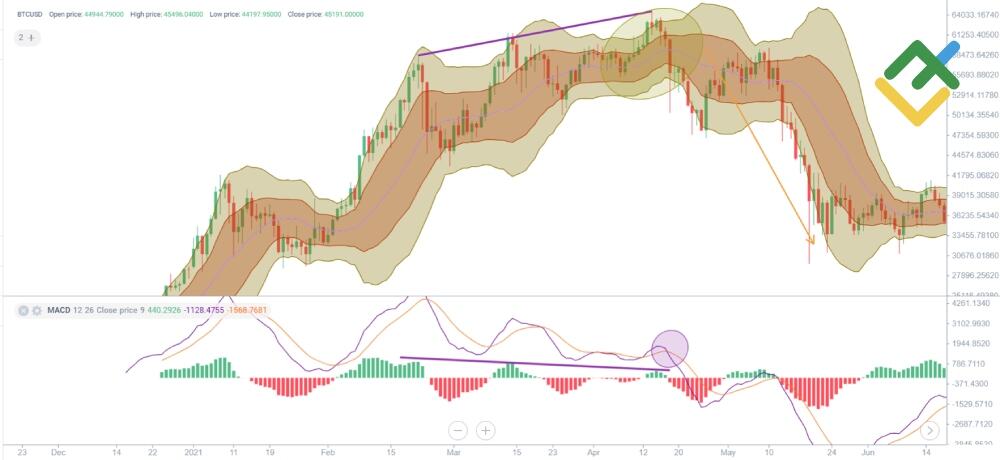
The chart above is a visual representation of the divergence of the direction of the price chart and the MACD histogram (marked with a purple line). This is a signal for an imminent reversal of the bullish trend. It is confirmed by the narrowing of the channel from the Bollinger Bands. The implementation of the bearish pattern is also shown on two candlestick charts at once:
- The price goes beyond the lower boundary of the Bollinger Bands.
- The moving average indicator crossed the MACD signal line from top to bottom.
As a result, the price really went down. MACD and Bollinger Bands effectively complement each other and are good examples of complex indicator analysis. You can learn how to use these and other indicators in trading strategies and in the real market in my blog at LiteFinance.
Get access to a demo account on an easy-to-use Forex platform without registration
Price Action
Price action or candlestick analysis is convenient for beginners due to its simplicity. Like graphical analysis, it includes a set of patterns that indicate a market reversal or trend continuation. The only difference is that the Price Action pattern consists of one or two bars or candles.
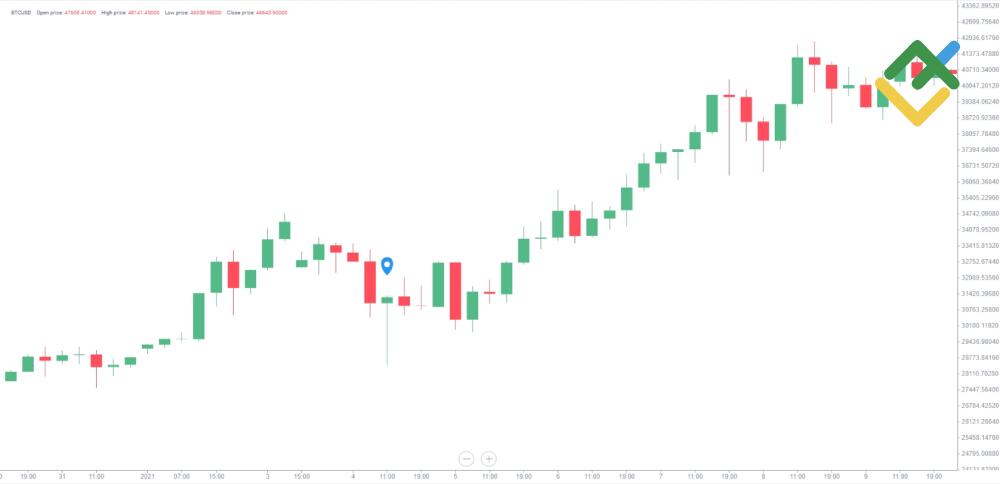
For example, in the chart above, the blue mark indicates a hammer-shaped candlestick. In understanding technical analysis based on the Price Action system, this pattern serves as a reversal signal. In our case, it indicates that the correction will end soon. As a result, the price really continued to rise.
You can talk a lot about Price Action, but the most useful article on this topic is “Candlesticks in Forex Trading & Candlestick Patterns”. It's worth reading!
Analysis of key levels
If you look closely at any chart, you will probably notice that the price seems to stop when it reaches certain levels, such as psychological levels (that usually occur when round figures are reached), or support and resistance levels. The latter occurs at the local highest and lowest price, as well as at high trading volumes.
These levels can be used to determine the relative strength of the trend. If it is below the strength of the level, which largely depends on the number of extremes in the past, then the chart will once again reverse when the prices come close to this level. A breakout is a sign of a strong trend and a high potential for its continuation.
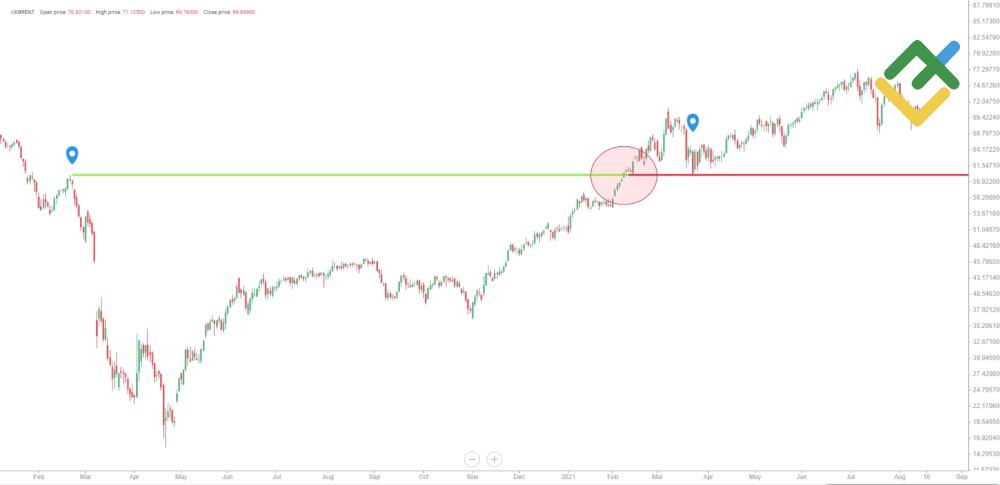
Let's examine the Brent crude oil price chart. The green line marks the resistance level formed at one of the local highs (blue mark on the left). At the moment of the formation of the bullish trend in the red circle area, the level was broken out, which indicated a great potential for an upward movement and a high probability of its continuation in the coming months. After the breakout, resistance became support. This is noticeable in the subsequent correction, which ended just at this level due to its low potential (blue mark on the right). Using only knowledge of key levels, you can start trading. A great example of a trading strategy concerning this topic is described in the article “The basics of support and resistance levels trading".
Volumes
The volumes of completed buy or sell trades make it possible to determine the interest of major traders. High or increasing activity of buyers and sellers in a bearish or bullish trend is a sign of its strength. While declining activity indicates that the trend has exhausted his potential.
Also, using volumes, traders can identify stable price levels. Suppose a price extremum is accompanied by high trading activity. In that case, it almost certainly forms a significant level of support or resistance, which will be difficult to overcome in the future.
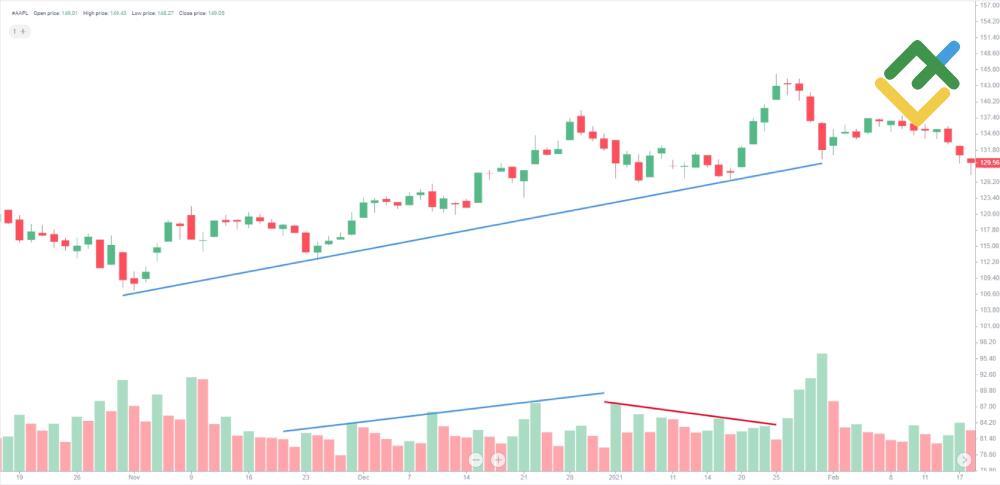
Above, on the daily Apple stock chart, the bullish trend in the first phase of its formation (marked with a blue line) is accompanied by growing trading activity. After the trend exhausted its potential and major traders lost interest in further price growth, the volume index began to fall. This means that growth will end soon. At the same time, an increase in volumes at the time of a bullish trend reversal (a fall in price) confirms a sell signal. Read more about a trading strategy using the horizontal trading volume indicator here.
The Elliott Wave Theory
The Elliott Wave Theory, developed by Ralph Nelson Elliott, is a popular technical analysis method employed by many traders. The Elliott theory is just a tool based on the cyclical nature of financial markets, recurring, fractal wave patterns. Elliott described two major types of waves, impulsive and corrective. These two types should constantly alternate with each other, forming wave patterns. According to Elliot, a five-wave pattern is an impulse, following the trend direction, while a three-wave formation A-B-C is a correction going counter the trend.
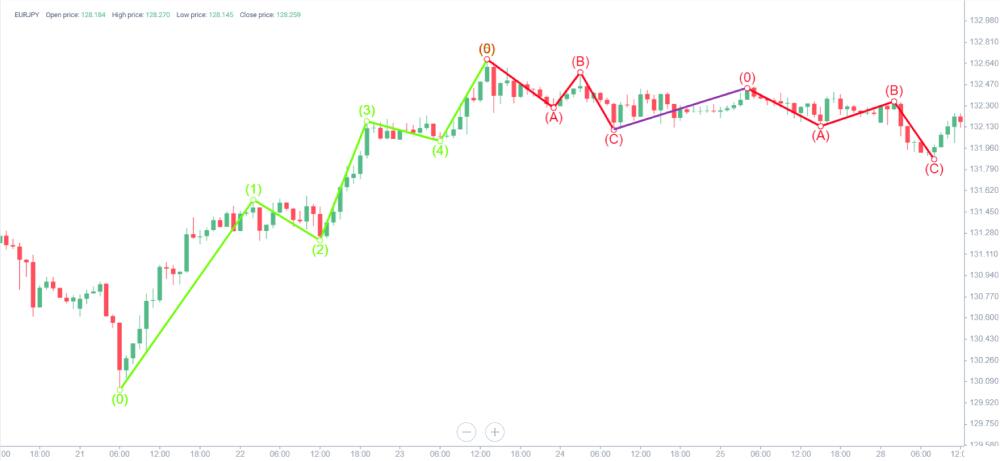
The above chart displays a five-wave bullish pattern and a double zigzag. If you mark the price chart in this way, you can anticipate the future price movement. The Fibonacci retracement levels will enable you to define potential points where the waves should start and finish. You can learn more about the Elliott Wave Theory, wave patterns, and the identification rules for each wave in the series of training articles devoted to this topic. The first article you should start with is Market Wave Theory by Robert Prechter. Part 1. Types and structure of Elliot wave patterns.
Instruments of Technical Analysis
Technical analysis employs various tools with different functions, work principles and goals. They can be divided into three groups:
- Charts: a candlestick chart, bar chart, line chart, volume chart, Heikin-Ashi, etc.
- Chart objects: Fibonacci grid and levels, trading channels, time zones, support and resistance levels, wave formations, chart patterns.
- Indicators: trend indicators, volume indicators, oscillators, Bill Williams indicators, moving averages, and thousands of other technical tools.
Charts
The most informative method to represent price changes over time in technical analysis is various price charts located along the timeline. I will describe the most popular price chart types below:
Candlestick
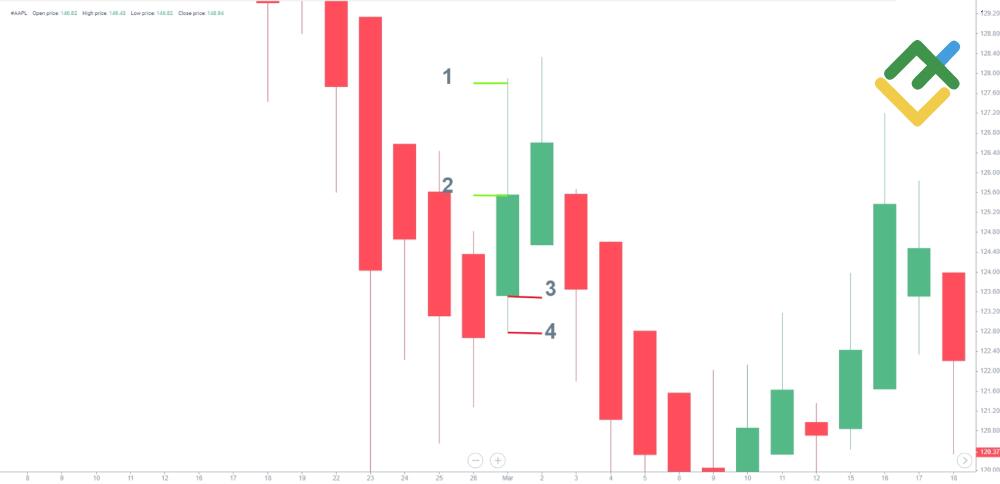
I have already written about Price Action above, but I haven’t explained the structure of the candlestick chart. It is composed of Japanese candlesticks which represent the true range trading of an asset price for a particular period, timeframe. One candlestick of the price chart represents the price change:
- over one minute for the M1 timeframe,
- over one hour for the H1 timeframe,
- over 24 hours for the D1 timeframe,
- and so on, up to the longest timeframe of 1M.
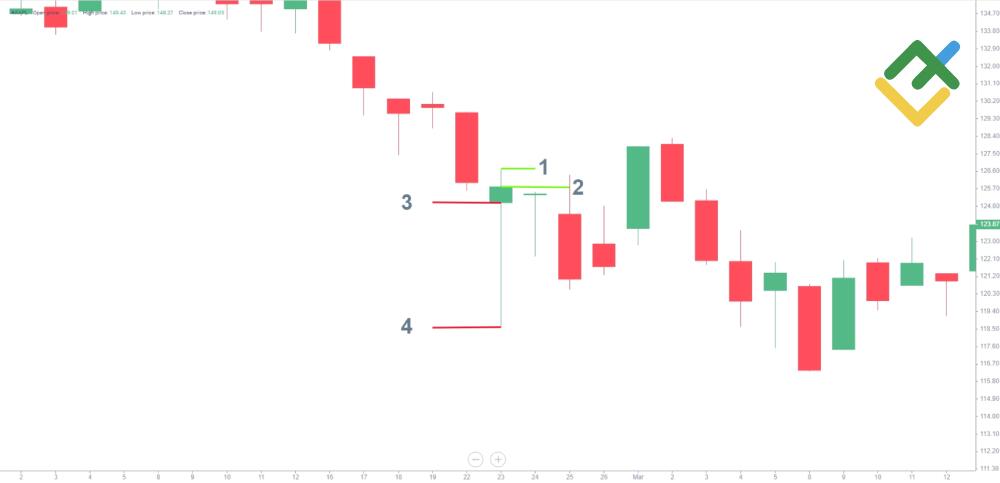
The above chart is a visual representation that displays the principle of a Japanese candlestick formation. Number 1 marks the high of the current period, 2 is the closing price, 3 is the candlestick open, number 4 is the lowest price. The closing and opening prices frame the candlestick body. Green candlesticks are bullish, they mark the price growth. Red candlesticks are bearish. The opening price is higher than the closing one for bearish candlesticks; for bullish ones, it is vice versa. So, the open and the close form the candlestick body. The highest and the lowest prices mark the candlestick shadows or wicks. The longer the candlestick body and the shorter its shadow, the stronger bulls or bears are.
Bar
A bar chart is similar to Japanese candlesticks. Each bar is a vertical line representing the price range during a specified time. Vertical lines have small horizontal lines on the right and on the left.
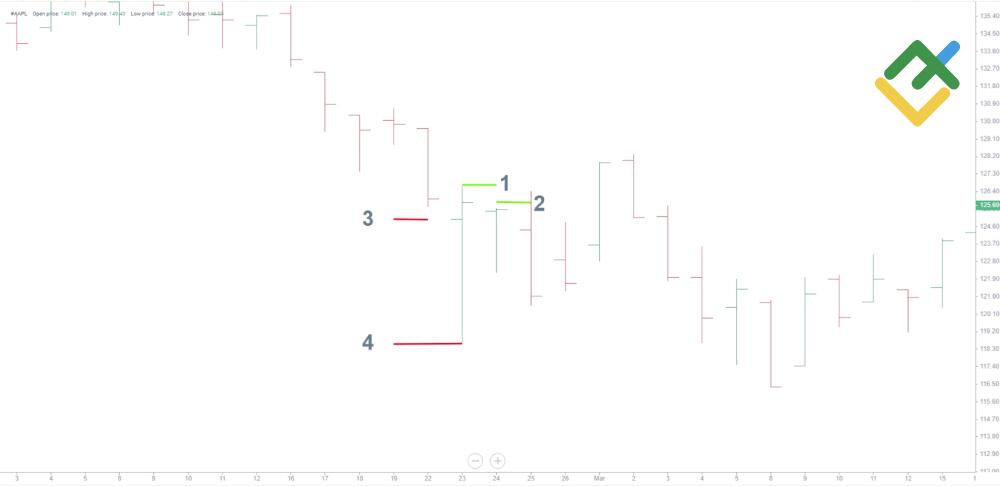
Like the upper and the lower points of the Japanese candlestick body, the left line indicates the opening price, and the right horizontal line marks the bar’s closing price. The top of the central vertical line is the highest price of the bar; the bottom of the line is the price low. In all the rest, from the point of view of technical analysis, Price Action patterns are interpreted in the bar chart in the same way as in the Japanese candlesticks.
Line
A line chart is a price chart in the form of a curved line. It is drawn by points, each of which shows the price of a certain time period. For example, points will appear every minute on a one-minute chart and on an hourly chart every hour.
The main drawback of such a chart is that it does not show price volatility over the selected time period. Only information about what price was at the last second, the last horizontal tick, is displayed. But this feature is also an advantage because such a chart contains a minimum of false information.
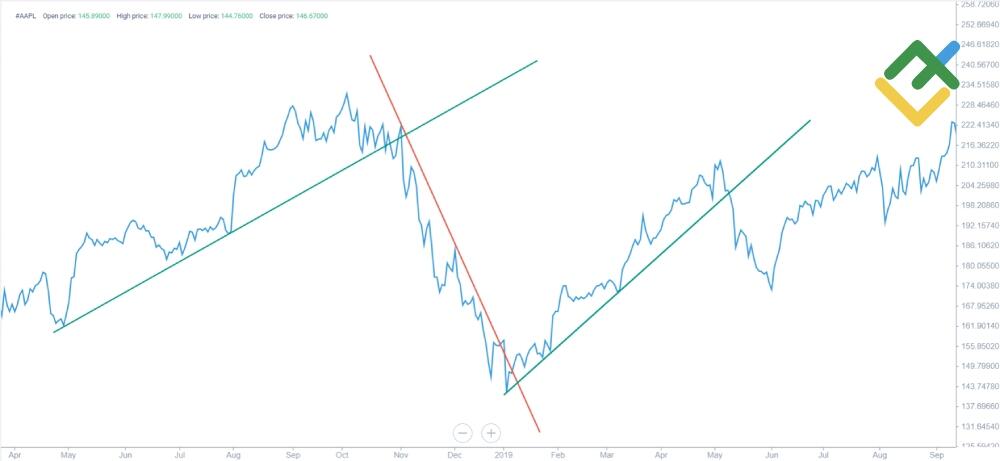
For example, there is a line chart of the Apple stock price above. Since the chart only shows the closing price level, building a trend line and conducting technical analysis is much easier. In this case, it is easier to see the moment of the trend change.
Area/Volume
An area/volume chart is visually easier to perceive than a line chart since local lows and highs can be easily identified. The volume chart can be of particular interest to scalpers who like to use charts with details up to the price tick.
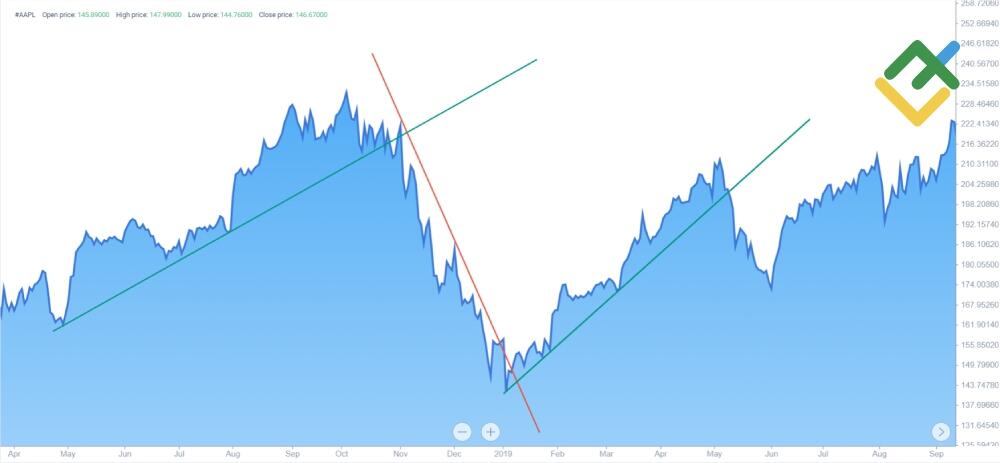
At the same time, it is more difficult to build trend lines, support and resistance levels and use other graphical tools on it. The chart above shows that they simply merge with the color markings on the chart and are difficult to read. By the principle of construction, area charts are similar to line charts.
Heiken-Ashi
The Heikin-Ashi chart is visually very similar to the usual Japanese candlesticks. However, this is a misleading impression since Heikin-Ashi is a smoothed version of a regular candlestick pattern chart. That is, it displays the average indicator true range. It is constructed by averaging the parameters:
- Open. The open and close parameters of the previous Japanese candlestick are added and the resulting amount is divided by two.
- Close. This parameter is calculated based on the same value of the current bar as soon as it closes. The opening price and the closing price of the original candle are added up and divided by four.
- Max is calculated by comparing the open, close and high of the original candlestick pattern. Then the highest value is selected.
- Min is calculated in the same way. Only the smallest point is taken.
The chart above shows the Heikin-Ashi chart. According to its interpretation, it corresponds to Japanese candlesticks. The trader should understand that a tail at a smoothed candle does not mean that the price has ever been there. Heiken Ashi is often used for technical analysis of various tickers for the Ichimoku trading strategy, scalping, and other trading methods. If you want to study Heiken-Ashi in detail, I recommend reading my tutorial article Heikin-Ashi Candles.
Start trading with a trustworthy broker
Indicators
Technical analysis indicators are algorithms using which traders receive trading signals using information about past prices. Many investors often use these tools. This is due to both the simplicity of receiving signals and the possibility of using them simultaneously with chart analysis, as well as a relatively high level of forecast accuracy.
Price-based
This is the most extensive group of indicators. They are used to determine the direction of future price movements, the rate of change in the value of an asset, the potential of the trend and convenient times for entry and exit points. All calculations of price indicators are based on price parameters and price dynamics.
The most popular ones are listed below:
- ADX (Average Directional Index) is used to determine the momentum or strength of a directional movement. High values indicate a strong trend, regardless of its direction.
- ADXR (Average Directional Movement Index Rating) is a smoothed version of ADX. They are typically used to assess the validity of the original indicator signals.
- CCI (Commodity Channel Index) shows the current change in the ticker rate relative to its average indicator change. This indicator can be used to identify divergences and convergences, entry points or as a filter for signals from other instruments.
- Coppock Curve is based on an algorithm for analyzing the smoothed sum of securities returns. This is a tool for identifying market price fluctuations, which, thanks to flexible settings, can be used in a trending market and during consolidation.
- MA (Moving Average) displays the average price value for the selected period.
- MACD (Moving Average Convergence/Divergence). This type of Moving Average is an oscillator-type indicator for determining the likely direction of price trend depending on the convergence/divergence of exponential moving averages.
- Momentum. This oscillator compares the closing price of the current time interval with the closing for the selected time period. Momentum shows not only the direction of the market price movement, but also its pace. In terms of its signals, it is similar to CCI and RSI.
- RSI (Relative Strength Index) shows the average rise in the ticker rate ratio relative to its average fall. This is a leading indicator. With its help you can identify the points of entry into the market. Signals: overbought and oversold, divergences, chart patterns.
- Stochastic Oscillator displays the position of the current price as a percentage relative to the past price range. Allows you to determine the moments of the trend reversal.
- Trix is a versatile technical analysis tool consisting of a triple exponentially smoothed moving average. Allows you to combine momentum and future trends into one whole. Among Trix signals, many traders use signal line crossings and divergences.
- W_A/D (Williams Accumulation/Distribution) summarizes the bullish movements of the chart (a consequence of the accumulation of assets among buyers) and the downward trend movements (the result of the sale of securities). It is convenient to use this indicator to record increases and decreases in buyers' interest. The indicator chart is used to confirm and identify trends. It also helps to detect divergences and some chart analysis patterns.
Volume-based
Trading volume indicators work with changes in price and trading activity. They make it much easier to find dependencies between the above mentioned two key market indicators. One of the main advantages of such indicators is their leading nature. The most popular volume indicators are listed below:
- MFI (Money Flow Index) is an oscillator for assessing the market activity of major traders. Its algorithm calculates the intensity of purchases and sales. The main signals are conditional overbought and oversold levels, as well as divergence.
- NVI (Negative Volume Index) accumulates price changes on falling volume. Its second name is the negative volume index. This indicator gives strong buy signals and relatively weak sell signals.
- PVI (Positive Volume Index) is an analog of NVI. This indicator calculates a positive volume index. It gives weak buy signals and strong sell signals.
- OBV (On-Balance Volume) is an indicator that is synchronous with the price, and sometimes even ahead of it. It reflects price fluctuations based on changes in market activity over a specified period of time.
Breadth
This group of indicators is most useful for top-down analysis. Their algorithms track certain groups of trading instruments and securities as a benchmark. Thus, you can understand the direction of movement of the entire market and the relative dynamics of the analyzed instrument.
This group of indicators is not so extensive. Three tools are worth mentioning:
- ADL (Advance-Decline line) compares the difference between the moments of growth of the asset price movements and the moments of its fall. It is used to assess the strength of a trend, as well as identify market reversals.
- The Arms Index or TRIN helps highlight overbought and oversold areas by tracking the number of advancing and declining stocks to advancing and declining volume. This indicator allows finding the moments to enter the market effectively.
- McClellan Oscillator analyzes the number of rising and falling instruments in a given period. This tool gives signals such as overbought and oversold, as well as the crossing of the zero line.
Overlays
These indicators help to identify the relationship between two market instruments, showing the presence and degree of dependence between them. Like the market width indicators, overlays help identify the most promising and interesting assets for trading opportunities. Also, correlation indicators are often used when hedging trades and confirming an upward or downward trend reversal. They include:
- OverLay Chart is used to identify local discrepancies between traded assets under study. The essence of this indicator is to overlay two price charts, one on top of the other.
- iCorrelationTable shows correlation coefficients between several currency pairs at once. Using this data, a profitable trader can identify patterns in the price change of various currency pairs and choose the one that suits his trading strategy.
- Correlation coefficient shows the correlation of two selected assets from -1 to +1. This indicator helps to visually determine the correlation, as well as analyze their relationship for stability, seasonality and cyclicality.
Channel indicators
This type of technical analysis tools is useful for identifying key levels and trend direction and is often used in trading strategies to calculate Stop Loss and Take Profit. Numerous articles and books are devoted to the channel indicators. Below is a brief description of some of them to help you take efficient trading decisions:
- The Bollinger Bands indicator is able to determine the current position of the price relative to its average trading range. It is used to identify signals for a market reversal and continuation of the current trend.
- Fibonacci Lines is useful for building trend lines to visualize Fibonacci levels. This indicator is often used to identify trading targets and pivot points.
- Ichimoku Cloud is a popular indicator for trading the Ichimoku trading strategy. This universal technical analysis tool allows you to determine the direction of the trend, points for entering and exiting the market, price levels.
- Parabolic SAR is used to identify pivot points and set stop losses. This indicator takes into account two factors such as price changes and the passage of time.
- Pivot Points indicator is focused on small timeframes. It will be useful for identifying market entry points, targets and risks, as well as key levels at which the price patterns direction may change.
- The Price Channel is a very simple but effective indicator that shows the lows and highs of the price over a period. The midline vector between the two above-mentioned parameters indicates the direction of movement.
Common Terms
While studying TA, you may come across a lot of confusing words. Below is a list of the most important concepts that every professional or novice trader should understand:
- Average True Range or ATR is the average value of the price range trading over the selected period of time. It is often presented as a line indicator.
- Breakout. It occurs when the chart crosses support or resistance levels, a trend line, channel borders, Bollinger bands and any other key levels. It also indicates a high trend potential.
- A cycle is a period in which a price movements action follows certain patterns.
- The dead cat bounce is a price hike and a return back to the bottom of growth. Such a situation can often be seen with “junk” assets and when major fundamental traders do not support the price rise.
- Dow Theory describes the behavior of stock prices over time. It was developed by Dow Jones co-founder Charles Dow. It introduced the main postulates of modern technical analysis such as the division of future trends by time frame and significance, the separation of trend phases, the consistency of stock indices, the effect of trends until the appearance of unambiguous signals of their termination.
- Doji are candlesticks with a minimum body and long shadows. They appear during a period of indecision in market psychology.
- The Elliott Wave Theory is the interpretation of market processes through a graphical system of wave patterns.
- Fibonacci ratios are based on the “golden ratio” rule. The ratio of each next Fibonacci number tends to the value of 1.68.
- Harmonic patterns is a trading system developed by H.M. Gartley and based on the principles of repeating price patterns and determining pivot points using Fibonacci ratios.
- Momentum is a technical indicator that measures the intensity of price changes.
- Price Action is a trading system that allows trading opportunities on a clean chart without indicators. It is based on the analysis of candlestick patterns.
- Support is the efforts of buyers to maintain an uptrend and sellers to maintain a downtrend.
- Resistance is the activity of buyers against the development of a bearish trend, and sellers against the development of a bullish trend. Support and resistance are concentrated at specific price levels.
- Trend is a directional price move that extends over time.
- A pullback or correction is a temporary price reversal in the direction opposite to the main trend.
Benefits of technical analysis
Let's take a look at the benefits of TA:
Popularity
Almost all traders use and develop technical analysis. Indicators and trading strategies are being constantly improved. There are also many materials and TA specialists, so you can find tips and answers to all questions.
Accessibility
Often, technical analysis tools and documentation are publicly available. The TA tools and methods are easier to learn and master than fundamental analysis.
Versatility
Technical analysis can be applied everywhere. It works equally effectively on the foreign exchange market, CFDs, metals, and commodity market and allows predicting changes in the value of cryptocurrency pairs, securities, and indices.
Wide range of timeframes
TA can be used on any timeframe. If fundamental analysis is effective only on monthly charts, then technical analysis allows traders to make forecasts even on a tick chart.
Automation
Unlike fundamental analysis, based on TA, many traders can build automatic trading strategies, systems, and bots and conduct their backtesting on the trading history and in real-time.
Disadvantages of technical analysis
In addition to advantages, TA has a number of disadvantages. You can read more about this in the article "Pitfalls of Fundamental and Technical Analysis".
The main disadvantages are:
Subjectivity
TA is based on the analysis of the retrospective price movement and its interpretation for the future. The trader makes decisions based on patterns of behavior in the past and assumes that they will repeat in the future. Due to this approach, a novice trader may have a false sense of foreseeing the future, which is a big mistake. Any trading decision made on the basis of technical analysis is probabilistic and evaluative.
Low accuracy
Any experienced technical analysts working with TA tools will tell you that it is necessary to use complex analysis including various tools to improve accuracy. Not a single technique and tool of technical analysis provides sufficient forecast accuracy for effective trading decisions.
The lag and error dilemma
All technical analysis indicators are divided into lagging and leading. Lagging indicators are more accurate, but less effective, as they give a signal after the fact. On the other hand, leading indicators give signals with a time margin, but with a significant proportion of false ones. When creating a trading strategy, each trader faces the problem of reducing the lag and maintaining the quality of signals within acceptable limits.
Diversity
A huge number of technical analysis tools make it difficult to make a choice. It is impossible to study all existing methods in a short time physically. TA tools are evolving every day. Their list is only expanding. Many beginners try all of them a little bit and switch to another without fully mastering one technique. As a result, there are many investment errors, financial losses, and disappointment in technical analysis.
Conclusion
Technical analysis has a sufficient variety of tools to predict future trends and market changes effectively. There are no alternatives to it when it comes to small timeframes. At the same time, TA shows the greatest efficiency when combining market analysis methods, for example, chart patterns and indicators. The most experienced traders use it in conjunction with at least superficial fundamental analysis. At the same time, it should be understood that technical analysis as a whole is practically immense. For someone who wants to become an expert in TA and do the proper analysis, you need to be ready for long and hard study and practice for many years. There is no quick fix here. At least I, a trader and analyst with fifteen years of experience, have not been able to find it. If you succeed, please share in the comments about your experience.
Technical Analisys FAQ
Technical analysis includes methods for predicting market movements based on the price movements history. It is based on technical indicators: price history, direction of chart movement and its intensity, volumes of completed trades. Thanks to TA, traders can identify trends and determine market behavior, price movement patterns, sentiment, key levels, entry points, and selling positions.
When you seek independent advice, to learn how to use technical analysis, you need to start with the basics of TA and comply with your personal circumstances and needs. Read the book by John J. Murphy, “Technical Analysis of the Financial Markets”. Use the tips in practice, study the history of signals and patterns of candlestick, and chart financial analysis. Learn how to identify the trend!
The basic technique is to determine the current direction of price movement, that is, a trend. Start TA at higher timeframes, gradually moving to lower ones. Determining key levels and analyzing trading volumes will help you navigate the market. Then you can conduct chart and candlestick technical analysis, that is, study the trading chart in search of possible patterns. As a result, having studied each TF and aligned it with your personal circumstances, you will be able to form a trading plan.
Almost all traders use technical analysis in one form or another. Only investors with a long planning horizon can afford to abandon TA. With a decrease in the timeframe, the effectiveness of fundamental analysis decreases, and when trading within the day, or scalping, TA simply has no alternative.
Technical analysis is based on market psychology and the study of the patterns of behavior of its participants. All fears and expectations of traders are included in the price. TA allows you to understand the mood of most of them. Due to the widespread use of TA and the popularity of classical indicators, many traders can immediately receive the same signal, which affects the market sentiment after the fact and makes the forecast come true.
These approaches are difficult to compare with each other as they use different market research methods. Fundamental analysis works well on long time frames. This is because long TFs better show the results of the action of important fundamental factors, the reports are better issued, and so on. Technical analysis is equally good on any timeframe and is compatible with fundamental analysis.
Technical analysis works according to the same principle in all markets. It focuses on analyzing price history and trading volumes.
The high popularity and prevalence of TA confirm its reliability as a forecasting tool. However, even the best technical analysis trading strategies and systems cannot guarantee 100% accuracy. In fact, the trader's success lies not so much in the high accuracy of the TA as in the ability to manage money and risks involved.
During a bullish movement, a trendline is drawn at local lows to keep the ascending section of the chart on top of it. The trend line for the bearish price movement is drawn at two local highs. In this case, the descending part of the chart should be located below it. To work confidently with the trend, wait for its confirmation in the form of at least one price rebound from the marked line.
The most common TA tools are chart patterns, Price Action candlestick patterns, Elliott Wave Theory, and various indicators. They help traders to determine the entry and exit points of their trades. Do not forget about trend analysis, support and resistance levels. These tools are basic for most traders that seek independent advice.
There are several types of TA:
- Chart analysis helps looking for reversal patterns.
- Indicator analysis helps to study the market using ready-made scripts in the form of a chart overlay on a price chart or in separate windows.
- Price action is based on candlestick patterns.
- Analysis of volumes or trading activity.
- Elliott Wave Theory.
- Trend analysis and determination of support and resistance levels.
Suppose that in 2021 a flat or, in other words, a sideways trend has formed on the EURUSD chart. According to the laws of the market, sooner or later, the balance will be broken. The sideways trading channel is determined by a local high of around 1.23 and a low of around 1.17 USD. A signal to open a position will be received in case of sharp exit points beyond the designated limits and a retest of the border from the outside. In this case, it will be possible to predict future trends and the market’s direction and open trades.
Each type of technical analysis works with its own features. For example, the Price Action allows you to predict a reversal immediately after it starts. However, many technical indicators give results later, but they are more accurate. Therefore, it is better to use several types of technical analysis at once to receive signals from several sources, increasing the accuracy of forecasts.
Technical analysis does not work in three cases:
- The wrong instrument has been selected or is being used incorrectly. For example, moving averages will give a quality signal to buy or sell for the future price movements of the market direction. However, they will give a lot of false signals during sideways trends.
- The analyzed instrument is low-liquid and highly volatile. If the trading volumes for an asset are very low, the price can move chaotically in a wide range, or stand still for a long time. As a rule, the charts of such trading instruments are analyzed with low accuracy, and the price is manipulative and capable of moving against all the rules of technical analysis.
- The analyzed instrument does not have a sufficient trading history. Since TA is based on projecting past events into the future, most methods and approaches of technical analysis simply will not work if there is not enough trading history. Ideally, the instrument should have a trading history of several years, or even better, decades.
One should start researching the charts of currency pairs by determining the general market sentiment, determining the trend and key levels. At the second stage, you need to understand what phase the found trend is in. Is it at the beginning of its development, or is it near the end? Further, it is necessary to understand under what conditions there will be a continuation of growth or a trend reversal and what candlestick patterns can be formed here. This will be the basis for your working scenario with any currency pair. At the last step, determine the potential profit and loss. What are the most profitable entry points? Where do you need to exit if something doesn't go according to plan? In the end, write down all the answers received in a trading plan and follow it.

The content of this article reflects the author’s opinion and does not necessarily reflect the official position of LiteFinance broker. The material published on this page is provided for informational purposes only and should not be considered as the provision of investment advice for the purposes of Directive 2014/65/EU.
According to copyright law, this article is considered intellectual property, which includes a prohibition on copying and distributing it without consent.