



Visa Inc. is an international company specializing in payment technologies. It was founded in 1958 and went public in 2008. The company runs one of the world's largest electronic payment networks, operating in over 200 countries.
Notable acquisitions such as Cybersource have enabled Visa to reinforce its footing in the digital arena. Its sustainable growth trajectory and capacity to adapt to evolving market conditions have made Visa stock an appealing asset for investors, particularly in light of the rising demand for digital payments.
This article reviews Visa's share price projections for the coming years, as well as the key factors affecting its performance.
The article covers the following subjects:
- Major Takeaways
- Visa Real-Time Market Status
- Visa Stock Price Forecast for 2026 Based on Technical Analysis
- Analysts' VISA Price Projections for 2027
- Analysts' VISA Price Projections for 2028
- Analysts' VISA Price Projections for 2029
- Analysts' VISA Price Projections for 2030
- Analysts' VISA Price Projections up to 2050
- Visa Market Sentiment on Social Media
- Visa Price History
- Visa Shares Fundamental Analysis
- More Facts About Visa
- How We Make Forecasts
- Conclusion: Is Visa a Good Investment?
- Visa Price Prediction FAQ
Major Takeaways
The current price of Visa is $415.22 as of 19.11.2026.
The Visa price reached its all-time high of $440.42 as of 05.11.2026. The stock's all-time low of $10.44 was recorded on 23.01.2009.
Visa is a global leader in payment technology, offering fast, secure, and reliable transactions that power today's increasingly cashless economy.
Visa consistently ranks among the top 10 global brands by market capitalization.
The average daily trading volume of Visa shares is around 8.1 million.
The company maintains a stable dividend policy and an active share buyback program, gradually reducing the number of shares outstanding. This strategic approach helps boost earnings per share and supports long-term growth in the share price.
Visa operates in the consumer and corporate payment segments, offering its Credit, Debit, Prepaid, and Commercial card products, and processes transactions via its VisaNet network.
The company is pursuing innovations in tokenization, Tap-to-Pay, and biometric authentication. Besides, Visa collaborates with various fintech companies, banks, start-ups, and government agencies, focusing on issues related to the digitalization of payments.
Visa is investing in blockchain solutions and API interfaces for developers and is actively expanding infrastructure in P2P and B2B payments.
Visa Real-Time Market Status
The Visa stock is trading at $415.22 as of 19.11.2026.
To evaluate an asset's performance, it is crucial to monitor its market capitalization, trading volumes, current price relative to historical highs, its annual price movement, as well as shares outstanding.
Indicator | Value |
Market cap | $692.75 billion |
24-hour trading volume | 8.1 million shares |
All-time high | $440.42 |
12-month price change | +8.65% |
Shares outstanding | 1.87 billion |
Visa Stock Price Forecast for 2026 Based on Technical Analysis
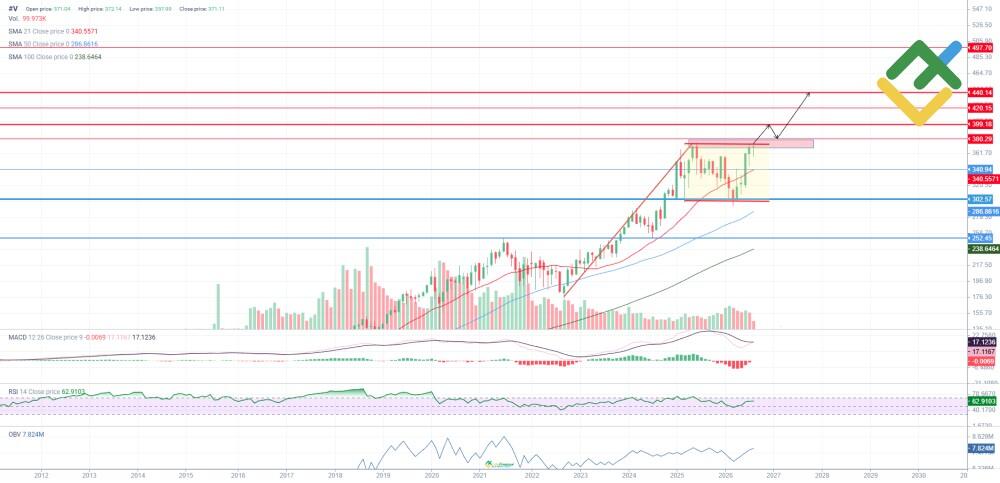
The upward trend remains intact on the #V chart. The price is trading above the SMA21, SMA50, and SMA100. The rally from the 2022 low forms the pole of a potential Bull Flag, while the $302.57–$380.29 range represents the flag. Two rebounds from $302.57 also form a Double Bottom pattern.
The RSI stands at 62.91, with no signs of overbought conditions yet. MACD remains in positive territory, although its negative histogram points to a slowdown in momentum. The recovery in OBV supports the ongoing rally. A break above $380.29 could open the way toward $399.18, followed by $420.15 and $440.14.
Below are the projected price levels for Visa (V) shares for the next 12 months:
Month | Minimum, $ | Maximum, $ |
September 2026 | 375.94 | 390.00 |
October 2026 | 370.94 | 395.29 |
November 2026 | 380.94 | 400.00 |
December 2026 | 380.29 | 399.18 |
January 2027 | 380.29 | 390.18 |
February 2027 | 385.29 | 395.18 |
March 2027 | 380.29 | 399.18 |
April 2027 | 380.29 | 405.15 |
May 2027 | 399.18 | 410.15 |
June 2027 | 389.18 | 420.15 |
July 2027 | 410.15 | 430.14 |
August 2027 | 420.15 | 440.14 |
Long-Term Trading Plan for #V for 2026
Main Strategy: Consider long positions after a retest of the broken resistance at $380.29. Avoid buying the asset immediately after a sustained move above $399.18.
It is preferable to take profits in stages. The first target is $399.18, followed by $420.15. Further upside could bring the price to $440.14. Confirmation that the uptrend is continuing would come from an upward reversal in MACD, accompanied by rising OBV and an RSI that remains below 70.
If the price consolidates below $340.94, refrain from opening long positions. A break below $302.57 would invalidate the bullish setup. In that case, it would be prudent to stay out of the market and conduct a new technical analysis of V.
Analysts' VISA Price Projections for 2026
Forecasts for Visa's future price trend vary significantly. LongForecast expects steady growth, while CoinCodex anticipates a potentially sharp decline in the fall, followed by a possible recovery.
LongForecast
Price range: $341.00–$505.00.
According to LongForecast, Visa's stock price is expected to rise. By October, the closing price could reach $407.00. In December, it may climb to $468.00. The highest price is expected in December at $505.00.
Month | Min–Max, $ | Close, $ |
September | 341.00–422.00 | 381.00 |
October | 374.00–440.00 | 407.00 |
November | 392.00–460.00 | 426.00 |
December | 426.00–505.00 | 468.00 |
WalletInvestor
Price range: $344.39–$384.22.
WalletInvestor suggests that Visa's price may decline. In November, the average price could be $364.49. A recovery is expected thereafter, with the price potentially reaching a high of $384.22.
Month | Minimum, $ | Average, $ | Maximum, $ | Close, $ |
September | 359.43 | 369.31 | 381.89 | 366.22 |
October | 349.59 | 366.60 | 380.36 | 355.31 |
November | 344.39 | 364.49 | 382.71 | 373.71 |
December | 355.37 | 368.19 | 384.22 | 384.22 |
CoinCodex
Price range: $314.77–$383.69.
According to CoinCodex, volatility is expected to remain high. In September, Visa could fall to a low of $314.77. A recovery is then expected, and by November, the average price could reach $373.87. In December, the price will likely stabilize at $364.09.
Month | Minimum, $ | Average, $ | Maximum, $ |
September | 314.77 | 324.20 | 334.14 |
October | 333.45 | 356.84 | 372.77 |
November | 363.95 | 373.87 | 383.69 |
December | 361.50 | 364.09 | 366.27 |
Analysts' VISA Price Projections for 2027
Forecasts for 2027 vary widely. LongForecast expects steady growth, while CoinCodex also anticipates higher prices. StockScan, by contrast, expects the stock to trade largely sideways.
Note: The price ranges reflect the asset's expected volatility throughout the year. Lows and highs may not be shown in the summary tables.
LongForecast
Price range: $438.00–$640.00.
According to LongForecast, Visa shares are expected to continue rising. By the second quarter, the closing price could reach $524.00. The upward trend will likely continue in the second half of the year, and by the end of the year, the price could reach a high of $640.00.
Quarter | Min–Max, $ | Close, $ |
Q1 | 438.00–526.00 | 487.00 |
Q2 | 476.00–566.00 | 524.00 |
Q3 | 483.00–594.00 | 550.00 |
Q4 | 510.00–640.00 | 593.00 |
StockScan
Price range: $332.92–$381.09.
According to StockScan, Visa shares are expected to trade mostly sideways in the first half of the year. Moderate growth is then expected, and the average price could reach $364.06 by the end of the year.
Quarter | Minimum, $ | Average, $ | Maximum, $ |
Q1 | 332.92 | 355.19 | 378.33 |
Q2 | 340.41 | 346.74 | 381.09 |
Q3 | 333.36 | 362.47 | 377.14 |
Q4 | 336.47 | 364.06 | 370.08 |
CoinCodex
Price range: $366.69–$462.16.
CoinCodex expects Visa's price to rise gradually. In the third quarter, the average price could reach $427.85, and by the end of the year, it may settle at $456.27. The stock may hit a yearly high of $462.16 in the fourth quarter.
Quarter | Minimum, $ | Average, $ | Maximum, $ |
Q1 | 366.69 | 390.00 | 409.26 |
Q2 | 388.32 | 401.38 | 415.32 |
Q3 | 406.78 | 427.85 | 440.11 |
Q4 | 406.80 | 456.27 | 462.16 |
Analysts' VISA Price Projections for 2028
Forecasts for 2028 also vary. LongForecast expects strong growth, while StockScan anticipates a more moderate trend. CoinCodex forecasts growth with periodic corrections.
LongForecast
Price range: $521.00–$835.00.
According to LongForecast, Visa's stock price will continue to rise. By the second quarter, the closing price could reach $740.00. In the third quarter, the price could rise to a high of $835.00, after which a correction is expected. By the end of the year, the closing price could be $715.00.
Quarter | Min–Max, $ | Close, $ |
Q1 | 521.00–702.00 | 650.00 |
Q2 | 600.00–799.00 | 740.00 |
Q3 | 684.00–835.00 | 754.00 |
Q4 | 590.00–772.00 | 715.00 |
StockScan
Price range: $329.50–$409.84.
StockScan expects Visa's stock price to rise gradually. By the third quarter, the average price could reach $388.15, and by the end of the year, it may climb to $402.78.
Quarter | Minimum, $ | Average, $ | Maximum, $ |
Q1 | 329.50 | 363.04 | 370.58 |
Q2 | 349.68 | 383.33 | 384.01 |
Q3 | 370.19 | 388.15 | 409.84 |
Q4 | 380.23 | 402.78 | 403.58 |
CoinCodex
Price range: $454.74–$568.09.
According to CoinCodex, Visa's price will alternate between gains and corrections. In the second quarter, the average price could drop to $483.03. A recovery is then expected, and by the end of the year, the price could reach a high of $568.09.
Quarter | Minimum, $ | Average, $ | Maximum, $ |
Q1 | 456.96 | 500.49 | 512.30 |
Q2 | 466.02 | 483.03 | 497.25 |
Q3 | 454.74 | 499.82 | 515.90 |
Q4 | 488.09 | 557.99 | 568.09 |
Analysts' VISA Price Projections for 2029
Forecasts for 2029 suggest mixed trends. LongForecast expects a decline, while StockScan forecasts growth followed by a correction.
LongForecast
Price range: $590.00–$849.00.
According to LongForecast, after rising at the beginning of the year, the stock price may begin to decline. In the first quarter, the price could reach a high of $849.00. A correction is then expected, and by the end of the year, the closing price could be $684.00.
Quarter | Min–Max, $ | Close, $ |
Q1 | 671.00–849.00 | 729.00 |
Q2 | 615.00–767.00 | 688.00 |
Q3 | 613.00–746.00 | 691.00 |
Q4 | 590.00–739.00 | 684.00 |
StockScan
Price range: $370.78–$466.90.
According to StockScan, the price is expected to rise during the first three quarters. By the third quarter, the average price could reach $458.33. A sharp decline is expected in the fourth quarter, with the price potentially falling to $374.12.
Quarter | Minimum, $ | Average, $ | Maximum, $ |
Q1 | 393.95 | 409.51 | 418.50 |
Q2 | 396.85 | 428.04 | 428.50 |
Q3 | 423.97 | 458.33 | 460.68 |
Q4 | 370.78 | 374.12 | 466.90 |
CoinCodex
Price range: $541.79–$660.53.
According to CoinCodex, the price is expected to rise in the first half of the year. By the second quarter, the average price could reach $632.82. A correction is then expected, and by the end of the year, the price is projected to fall to $607.39.
Quarter | Minimum, $ | Average, $ | Maximum, $ |
Q1 | 541.79 | 604.90 | 641.87 |
Q2 | 549.25 | 632.82 | 660.53 |
Q3 | 594.77 | 606.14 | 633.15 |
Q4 | 571.18 | 607.39 | 629.53 |
Analysts' VISA Price Projections for 2030
Forecasts for 2030 vary widely. WalletInvestor predicts a recovery in prices in the second half of the year, while CoinCodex forecasts steady growth.
StockScan
Price range: $370.51–$449.54.
According to StockScan, Visa's stock price is expected to rise for most of the year, reaching an average of $425.83 in the third quarter. A decline is then forecast, with the average price potentially falling to $390.18 in December.
Quarter | Minimum, $ | Average, $ | Maximum, $ |
Q1 | 370.51 | 397.39 | 403.37 |
Q2 | 387.71 | 404.11 | 409.51 |
Q3 | 402.82 | 425.83 | 427.02 |
Q4 | 371.71 | 390.18 | 449.54 |
CoinCodex
Price range: $529.52–$672.33.
According to CoinCodex, after a decline at the beginning of the year, Visa's price will likely begin to rise. By the third quarter, the average price could reach $623.73. The upward trend will continue, and by the end of December, the price may reach a high of $672.33.
Quarter | Minimum, $ | Average, $ | Maximum, $ |
Q1 | 529.52 | 544.52 | 631.49 |
Q2 | 530.59 | 585.22 | 633.63 |
Q3 | 592.61 | 623.73 | 657.87 |
Q4 | 596.50 | 657.56 | 672.33 |
WalletInvestor
Price range: $434.19–$538.20.
WalletInvestor assumes Visa's stock price will decline in the first half of the year. By the second quarter, the average price could fall to $463.92. A recovery is then expected, and by the third quarter, the price could reach a high of $513.23.
Quarter | Minimum, $ | Average, $ | Maximum, $ |
Q1 | 447.70 | 482.85 | 538.20 |
Q2 | 434.19 | 463.92 | 477.17 |
Q3 | 470.92 | 497.59 | 513.23 |
Q4 | 456.17 | 480.76 | 510.12 |
Analysts' VISA Price Projections up to 2050
Long-term forecasts for Visa's stock price are highly uncertain. Nevertheless, they can provide a useful reference when developing long-term investment strategies.
According to CoinPriceForecast, Visa's stock price could reach $753 by the end of 2033, $822 by 2035, and $904 by 2037.
StockScan also expects further long-term growth. Its forecast puts the average price at $721.39 in 2040, $803.46 in 2045, and $953.77 in 2050.
Year | CoinPriceForecast, $ | StockScan, $ |
2033 | 753.00 | — |
2035 | 822.00 | 596.51 |
2037 | 904.00 | — |
2040 | — | 721.39 |
2045 | — | 803.46 |
2050 | — | 953.77 |
Visa Market Sentiment on Social Media
Media sentiment reflects market participants' views of Visa stock based on news coverage, comments, and other publications. Positive sentiment can support the share price, while negative sentiment may increase selling pressure. Analyzing sentiment across social media and financial news can therefore serve as an additional tool for assessing short-term trends in Visa's stock price.
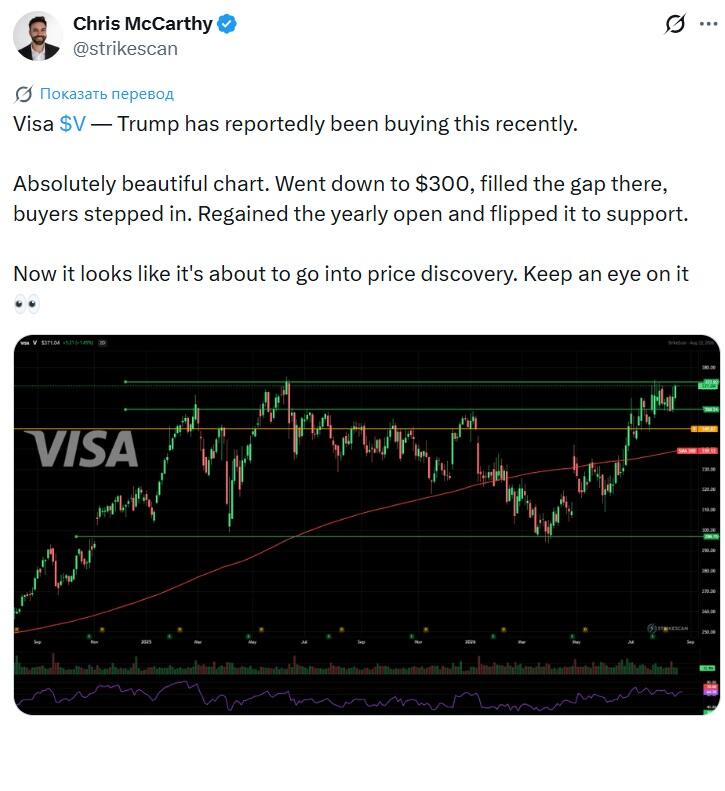
User Chris McCarthy (@strikescan) notes that after falling to $300, prices began to rise rapidly and have already surpassed the year's opening level. The uptrend is expected to continue.
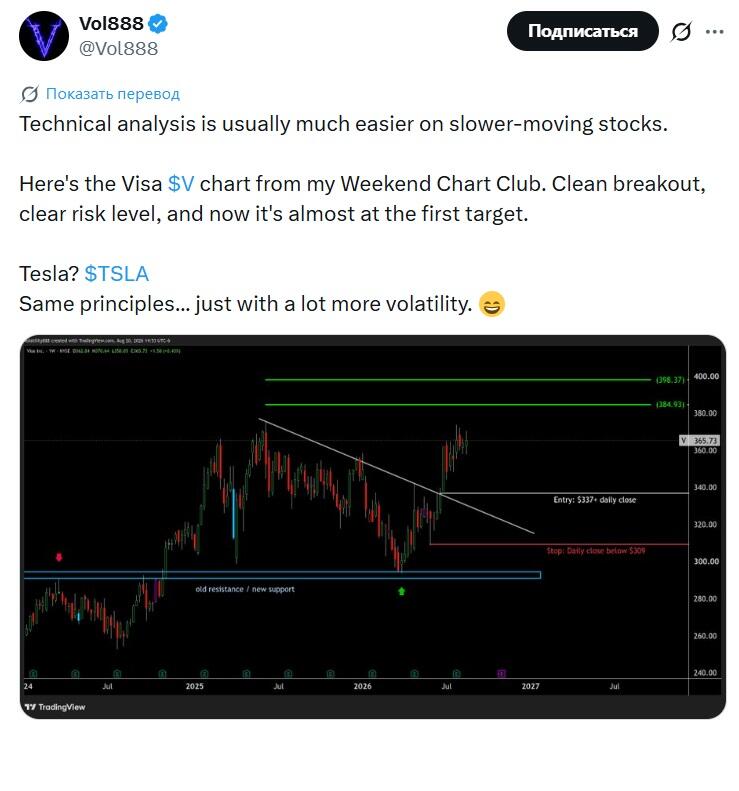
Vol888 (@Vol888) also highlights the breakout. The nearest buy targets are at $384.93 and $398.37.
Most users expect Visa's stock price to rise. However, before making any trading or investment decisions, conduct technical and fundamental analysis and review the latest expert insights.
Visa Price History
Visa reached its all-time high of $440.42 on 05.11.2026. The lowest price of Visa was recorded on 23.01.2009 when the stock declined to $10.44.
It is essential to evaluate historical data to ensure our forecasts are as accurate as possible. Below is a chart of Visa's performance over the last ten years.
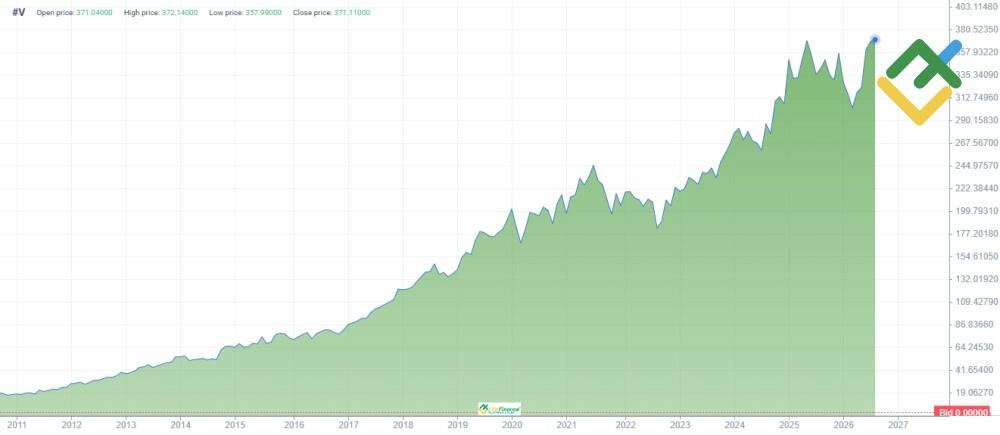
- In 2015, the price reached $75, driven by the widespread shift to cashless payments.
In 2017, the stock exceeded the $100 mark.
In 2020, the asset climbed to $200 amid the surge in digital payments during the COVID-19 pandemic.
In 2023, the price advanced to around $300 as transaction volumes increased.
In 2024, the stock surpassed $320, supported by expanding international partnerships and fintech innovation.
In 2025, Visa quotes approached $370, driven by the introduction of new digital payment solutions, the integration of blockchain technology, and the growth of online consumer activity.
In 2026, Visa's stock traded at around $347.27 in January but fell to $293.86 by the end of March amid inflation concerns. In April, the stock price rebounded to $341.77 thanks to a strong earnings report. Between May and June, the stock traded in a range of $308.87 to $335.07. In July, the rally accelerated, and the price reached $373.97. In August, prices remained close to their all-time highs.
Visa Shares Fundamental Analysis
Fundamental analysis enables us to evaluate the impact of internal and external factors on the performance of Visa's stock and anticipate potential shifts in its valuation. This section examines the key drivers of the company's share price, including economic conditions, technological breakthroughs, and regulatory risks.
What Factors Affect the Visa Stock?
The Visa share price movement depends on a variety of fundamental factors:
Development of electronic payment solutions. Visa is actively addressing the rapid evolution of technologies related to electronic payments to align its offerings with consumer preferences and emerging market demands. The advent of blockchains and cryptocurrencies presents both opportunities and challenges for the company, necessitating flexibility and innovation in products and services.
Macroeconomic conditions. Inflation, interest rates, and geopolitical events can have a significant impact on investor sentiment and market performance. Consequently, this has an impact on Visa's quotes. In periods of uncertainty, investors may alter their investment priorities, which can result in share price fluctuations.
Risks associated with regulatory changes. The introduction of new regulations, including antitrust investigations and directives, could create uncertainty for Visa's business operations. For instance, litigation or antitrust claims could result in a decline in the stock price, as evidenced by events in September 2024.
Competition in the payments industry. The emergence of new fintech companies and the development of competitors also impact Visa's market position. Competitors' actions, such as the introduction of new technologies and fee reductions, could have a significant impact on the company and its stock price.
Consumer spending. Consumer spending drives the volume of transactions conducted through Visa's network, ultimately affecting the company's revenue and stock price. The COVID-19 pandemic showed how global events can affect consumer behavior and spending patterns.
These factors represent the primary drivers of Visa's stock and will likely determine the company's share price trajectory in the coming years.
More Facts About Visa
Visa Inc. is an international payment technology company that was founded in 1958 as Bank of America's credit card program. It was subsequently spun off as a separate entity and listed on the New York Stock Exchange in 2008. The growth in the company's share price is attributed to an increase in transaction volumes worldwide, as well as expansion into new markets and the introduction of innovative fintech solutions.
Visa operates in the consumer and corporate payments sectors, offering a comprehensive range of solutions for payment cards, online payments, and real-time payments. Visa serves both individual customers and large enterprises by providing the infrastructure for financial transactions.
Visa's popularity among traders is due to the company's robust financial standing, unrivaled dominance in the global payments market, and consistent growth in earnings and dividend payments. Furthermore, Visa has demonstrated an ability to adapt to changes in the market, including the integration of new technologies such as mobile and digital wallets.
Advantages and Disadvantages of Investing in Visa
Investing in Visa shares has its advantages and disadvantages, which are important to consider when making decisions. Below are the main pros and cons of investing in this asset.
Advantages
Visa has a robust and resilient business model, with revenues generated through a percentage of each transaction. Furthermore, the company has demonstrated long-term earnings growth, making it an attractive investment for those seeking stability.
Visa operates in more than 200 countries, providing the financial infrastructure for billions of transactions. The recognizable brand helps retain customers and protect the company from competitors.
Visa shares are highly liquid, which means investors can buy and sell them quickly in the market, minimizing trading risks.
Visa is actively developing technologies in mobile and digital payments, which allows it to remain competitive and adapt to new trends such as blockchain and cryptocurrencies.
Disadvantages
The company may encounter regulatory constraints, particularly in the United States and the European Union, where antitrust and financial services regulations could have a detrimental impact on the stock price.
Visa's revenue is dependent on the overall health of the economy, as consumer spending represents the company's primary revenue stream. During economic downturns, revenue may decline, which could have an adverse effect on the stock price.
The growth of the fintech industry and the emergence of alternative payment solutions, such as cryptocurrencies and blockchain, present challenges that could potentially impact Visa's market position.
A shift in customer preferences, such as a decline in card usage or a switch to alternative payment methods, could have a negative impact on the company's revenue.
While Visa stock offers numerous advantages, including stability and innovation, it is important to consider the potential risks inherent to any investment, particularly in the context of evolving macroeconomic and regulatory conditions.
How We Make Forecasts
We use a comprehensive approach when making our forecasts for the Visa stock:
Short-term forecasts are based on current market data, including analysis of technical indicators, investor sentiment, and stock performance in recent days and weeks.
Medium-term forecasts include an assessment of key fundamental factors such as quarterly reports, company revenue and earnings, macroeconomic factors, and an analysis of the competitive and regulatory environment.
Long-term forecasts rely on strategic market analysis, long-term trends in the financial technology industry, the company's innovative solutions, and its role in the global economy, and take into account independent analysts' forecasts on the industry outlook.
As a result, our approach captures both internal company data and external economic and industry factors.
Conclusion: Is Visa a Good Investment?
Visa stock may appeal to long-term investors. The company maintains a strong position in the global payments market, while continued growth in cashless transactions, e-commerce, and digital payments could support long-term expansion. In 2025, Visa showed continued growth in payments volume and processed transactions.
However, investing in Visa carries risks. The stock could come under pressure from tighter antitrust regulation, intensifying competition, and a slowdown in the global economy. Visa is already facing competition-related legal and regulatory challenges in several markets. In the short term, the share price may also be influenced by US monetary policy, inflation, and consumer spending.
Over the long term, Visa's resilient business model and the continued expansion of digital payments could support further share-price growth. Nevertheless, Visa stock is best viewed as part of a diversified investment portfolio, with investors prepared for periodic corrections and periods of heightened volatility.
Visa Price Prediction FAQ
The current Visa stock price is $415.22 as of 19.11.2026.
Over the past year, Visa shares have risen about 7.9%. At the same time, volatility was quite high. The stock price was strongly influenced by the company's strong financial results, interest-rate expectations, and changes in consumer activity.
Short-term changes in Visa's share price are driven by quarterly financial reports, market sentiment and news, and regulatory changes. The release of financial results generally drives the value up or down.
The stock experienced its most substantial increase during the recovery from the COVID-19 pandemic, from March 2020 to August 2021. During that period, the price had climbed more than 50% and reached around $369.
The risks include regulatory pressure, competition from new fintech companies, and changing consumer preferences in favor of new payment technologies. These factors could lead to changes in growth rates and volatility.
Growth potential depends on the investment horizon. According to forecasts, the price could reach $505 by the end of 2026 and could exceed $670 by 2030. The price is expected to rise to $954 by 2050.
According to current estimates, Visa shares are expected to trade within a $315–$505 range during the remaining months of 2026. In December, the stock could trade between $364 and $468.
By the end of 2027, the stock price could range between $364 and $593, according to forecasts. The price could reach a high of $640 during the year.
Analysts expect Visa's stock price to range between $390 and $670 over the next five years. The price will depend on the growth of Visa's payments business, the performance of the global economy, and the company's financial results. Long-term forecasts vary considerably, underscoring the uncertainty surrounding such projections.
Forecasts for 2030 vary significantly. Visa's stock price is expected to range from $390 to $658. However, some forecasts suggest that the price could reach $672.
Visa shares are slightly overvalued according to traditional valuation multiples. However, given the company's strong financial performance and stable market position, this overvaluation is not indicative of a bubble. Buying Visa shares means investing in stability and long-term growth.
Visa remains an attractive long-term investment due to its stable growth and innovation in payment technology. Regulatory risks and competitive pressures are certainly critical, but the company's continued leadership points to strong growth prospects.
Visa Inc. is considered a good buy due to its strong financial performance and dominant position in the global payments industry. However, the high share price may not be appropriate for investors looking for undervalued assets or more explosive growth rates.
Price chart of #V in real time mode
The content of this article reflects the author’s opinion and does not necessarily reflect the official position of LiteFinance broker. The material published on this page is provided for informational purposes only and should not be considered as the provision of investment advice for the purposes of Directive 2014/65/EU.
According to copyright law, this article is considered intellectual property, which includes a prohibition on copying and distributing it without consent.