Currently, 1 euro equals 1.16930 US dollars.
A real-time chart of the euro to US dollar exchange rate is available here.
Currency exchange rates are influenced by a range of interconnected factors, including macroeconomic indicators, investment flowing into a country, and the balance of trade. Geopolitics also plays an important role, as sanctions can negatively impact a currency, even in countries with strong manufacturing sectors and solid economies.
So how can you tell what a currency is really worth? One simple approach is to look at consumer prices by comparing the cost of the same product, like a Big Mac, across different countries. Let's take a closer look at how this works in practice.
The article covers the following subjects:
Major Takeaways
- The Big Mac Index is a simple way to gauge the true value of the US dollar by looking at the price of a single burger.
- If a currency appears cheaper based on the Big Mac Index than its actual market rate, it is considered undervalued.
- When forecasting exchange rates, it is not enough to rely solely on the Big Mac Index, as technical and fundamental analysis are essential.
The Big Mac Index: How Much Is the Dollar Really Worth?
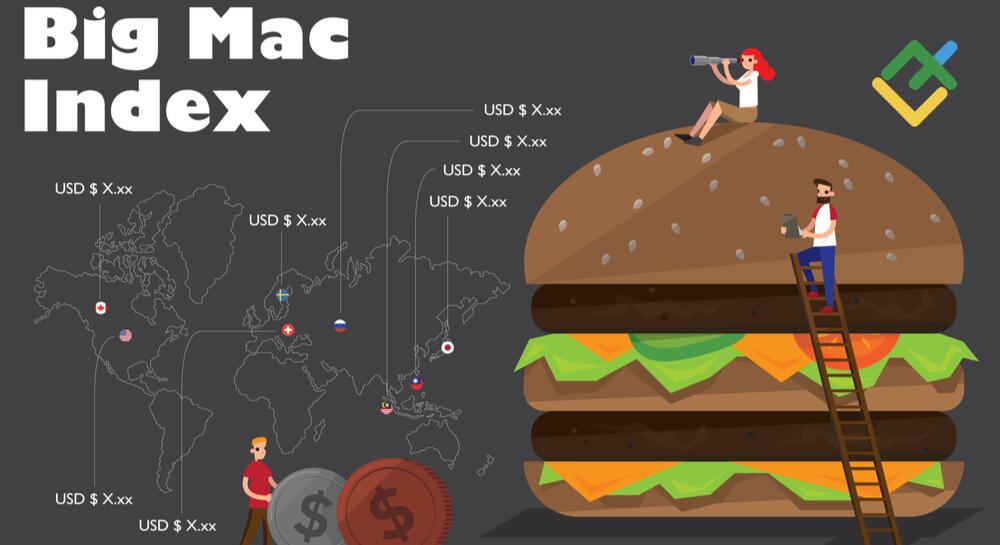
How can you find out whether the currency is undervalued or overvalued? You can assess the Big Mac Index in a certain country.
“Burgernomics” is not an absolute indicator of the currency disparity. But the index has become a global standard; it is included into some textbooks on economics and is a subject of academic studies.
This index was introduced in the Economist journal in 1967. At that time a hamburger cost 47 cents. 20 years later, it was $1.6. Currently, a Big Mac costs about $4.30. Therefore, the dollar has become ten times cheaper during the last fifty years. Of course, it doesn’t mean that dollar will be 10 times cheaper in another fifty years. Though, a certain trend is obvious.
How do know how much a dollar costs, using The Big Mac Index?
The Big Mac Index is used as a non-official means to calculate purchasing power parity. By its means, I can, for example, calculate the real dollar to euro price. Why? The McDonald’s requires a franchisee to comply with the strict regulations for each product on the menu. For example, all burger buns all over the world are produced by the same company from the same set of ingredients on the same equipment; also, the same procedure is followed when cooking in all restaurants of the chain. Simply put, it means that a Big Mac is made, according to the same technology in every country. Therefore, the cost of products sold will be the same everywhere. A Big Mac also contains a sufficient amount of food products (bread, cheese, meat and vegetables) to recognize it as a universal prototype of a national economy. And Big Mac is included in McDonald’s menu in each country. So, you may not spend time, looking for the burger price on the official McDonald’s website, as there are websites and special resources that track the prices all over the world and display the charts.
Based on the data at the end of 2024, let’s calculate the Euro to Dollar exchange rate using the Big Mac Index:
- USA: The average price of a Big Mac in 2024 is $5.69.
- Germany: The average price of a Big Mac in 2024 is €4.77.
To calculate the implied exchange rate, we divide Germany's price by the US price:
You can now look at the EUR/USD price chart on Forex and discuss in the comments below why there’s such a difference between the real value based on the Big Mac Index and the market price. Share your thoughts in the comment section below the article!
What Does the US Dollar Exchange Rate Depend On?
Let's find out why the official dollar exchange rate differs so much from its value based on the Big Mac Index.
Macroeconomic factors, the Federal Reserve's policy, the trade balance, investment flows, and geopolitics all influence the value of the US dollar.
The US president is one of the most influential figures in the Forex market. Although Donald Trump's statements no longer surprise the market, his policies still have a strong impact on the dollar. Policies such as tax cuts and trade restrictions continue to support the US currency.
Investors often compare economic growth rates. If global GDP is growing faster than the US economy, largely due to China and other emerging markets, capital may flow to these markets. However, stronger US growth or higher Fed rates usually bolster the greenback. Trade wars, sanctions, and periods of uncertainty also strengthen the US dollar, as it is considered a safe-haven currency.
Moreover, higher US Treasury yields often attract investors from other countries, including Europe and Japan, where interest rates remain lower.
Exchange Rate Undervaluation and Overvaluation
Exchange rate fluctuations have a broad impact on the economy, although many people only notice them when traveling or shopping abroad. A stronger currency makes imports cheaper but can hurt exporters, while a weaker currency supports commodity exports and helps create jobs.
Key insights from the Big Mac Index:
- The Japanese yen is one of the most undervalued currencies, estimated to be about 50% below its fair value. At times, Japan deliberately keeps the yen weak to boost exports.
- The euro is undervalued against the US dollar.
- The Australian and Canadian dollars are often undervalued by 10–20%, as their exchange rates are closely tied to commodity prices such as gold, oil, and iron ore.
- The Swiss franc is traditionally overvalued and is currently about 48% above its fair value. The Norwegian and Swedish krona are also overvalued.
- The South African rand and the Russian ruble are among the world's most undervalued currencies. According to the Big Mac Index, the ruble is undervalued by about 60%.
When a currency moves too far from its fair value, it may reverse soon. However, the Big Mac Index is only a guideline rather than a definitive trading signal.
Cheap and Expensive Big Mac
Why is a burger so expensive in Switzerland (around $7.99)? High wages, expensive rent, and a harsh climate all push costs up. The cold weather increases heating expenses, while limited agricultural conditions make food production more costly and often dependent on imports. Similar factors are at play in Norway and Sweden.
In developing countries, prices are generally lower due to cheaper labor and the availability of locally produced goods. However, during periods of economic turmoil, such as Argentina’s 2001 crisis, burger prices can drop sharply as a result of currency devaluation.
In countries like Russia and Thailand, prices may appear similar in dollar terms, but purchasing power differs significantly. In Canada, a severe climate, high heating costs, and difficult farming conditions all contribute to higher prices.
Although the Big Mac Index does not provide a complete picture of a country’s economy, it is an excellent indicator of long-term imbalances in exchange rates.
Conclusion
Overall, the Big Mac Index can provide a rough indication of whether a currency is overvalued or undervalued. It is not a precise tool and should not be relied on alone when forecasting exchange rates or making trading decisions.
However, it can still be useful as a simple benchmark within a broader analysis. When combined with technical and fundamental factors, it may help traders better understand long-term currency trends.
P.S. Did you like my article? Share it in social networks: it will be the best "thank you" :)
Useful links:
- I recommend trying to trade with a reliable broker here. The system allows you to trade by yourself or copy successful traders from all across the globe.
- Use my promo code BLOG to get a 50% deposit bonus on the LiteFinance platform. Simply enter this code in the appropriate field when funding your trading account.
- Telegram chat for traders: https://t.me/litefinancebrokerchat. We are sharing the signals and trading experience.
- Telegram channel with high-quality analytics, Forex reviews, training articles, and other useful things for traders https://t.me/litefinance
US Dollar Value and Big Mac Index FAQ
According to the Fed, producing a single $1 bill costs about 4.1 cents ($0.041) in 2026, including expenses for paper, ink, labor, and other production costs. Despite this, its face value remains $1.
There are approximately $2.43 trillion in circulation, according to Federal Reserve data as of 2026. Roughly half is held outside the United States.
The dollar may decline due to the Fed's rate cuts, a growing budget deficit, trade wars, or a weakening US economy. However, it is currently strengthening as a safe-haven asset.
The Big Mac Index is an unconventional measure of purchasing power parity. It compares the price of a Big Mac across different countries to determine whether a currency is overvalued or undervalued.
The Big Mac is a standardized product with the same recipe and quality worldwide, making it a convenient benchmark for comparing the cost of labor, ingredients, and services across countries.
Price chart of EURUSD in real time mode
The content of this article reflects the author’s opinion and does not necessarily reflect the official position of LiteFinance broker. The material published on this page is provided for informational purposes only and should not be considered as the provision of investment advice for the purposes of Directive 2014/65/EU.
According to copyright law, this article is considered intellectual property, which includes a prohibition on copying and distributing it without consent.