Greetings, fellow traders!
This time I’m going to cast a light on a famous trading strategy, Straddle Trade. The strategy is based on trading on the news releases. On the Internet, it is often written about the advantages of this trading: swings are very large, the entry point is often clear, risk/profit ratio is perfect...All the opportunities to trade. But if everything is so simple, then why should one worry about all those trading strategies, test them, study price formation and other unclear staff, like volatility or liquidity? Why don’t we all together trade on the news and buy apartments somewhere at the warm sea shore?
So, as you have already understood, I like asking tricky questions like that. =) The sooner traders start thinking about that, the shorter is their way to understating of the real trading.
The article covers the following subjects:
1. Trading on the news: the phantom of quick money
So, trading on the news. What’s that all about? Imagine, you are trading the British pound and SUDDENLY you learn that Great Britain will exit the European Union soon. What will be the chain of thoughts in your head? “The pound is going to crash, I’m not likely to be the single to learn, so I’d rather sell until the others haven’t started”, I think, something like this, isn’t it? That is, during the week some news about the economy of the developed countries is released, this can significantly influence the currencies of these countries.
For example, usually, euro costs about 1.09 USD. However, if everybody suddenly learns that in Europe for some reason “something has been wrong” since morning, euro price is likely to fall down. Because the price of 1.09 USD per euro is a norm for a group of European countries with strong economy; for a group of the countries where “things go wrong” it is too high, and everybody understands that. Trading on the news, according to many, is exactly a try to enter the market IN ADVANCE, so that they can PREDICT the market response to one or another bit of news. If you have read my previous articles before and agree with them, you are likely to smile at the word “predict”.
So, let’s look at the principle of this approach. Even just assuming that you can know in advance, how the market will respond to the price, you think it is possible that:
- You really know fundamental analysis better that hundreds of hedge funds with their crowds of analysts. As to enter the market “ahead the fuss”, you need to draw a RIGHT conclusion about the news’ impact on the market before they do.
- You will manage to place an order BEFORE the hundreds of hedge funds will do, with their capacities and expensive infrastructure, designed exactly to increase the speed of transactions.
- You will be the first to learn this bit of news. So, you think it is possible that nobody hasn’t learnt about the news before you do, and they haven’t “stock up” BEFORE the piece of news is released.
- You are sure, besides this piece of information, you FULLY UNDERSTAND the fundamental situation in the country, whose currency you are going to trade. Therefore, you can predict, how much the news will influence the price of this or that currency.
2. Ask yourself if you really think so? What is in fact?
To understand, if everything is so sad as I have described, you should have at least basic knowledge of what liquidity, volatility and spread are in Forex.
2.1. Liquidity
Liquidity – Liquidity is the amount of traders’ orders for one or another instrument. Let’s study 2 examples:
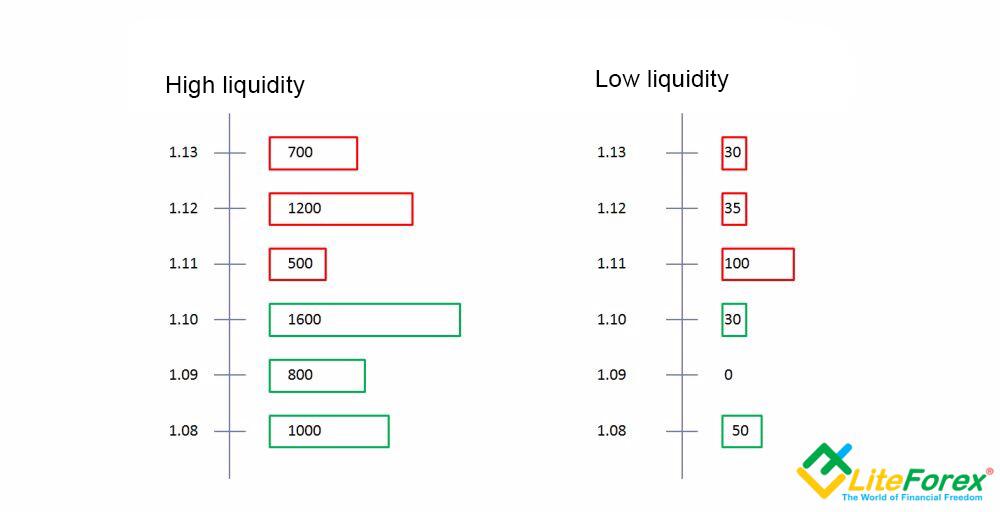
In the picture, in the red boxes we see the amount of sell orders at different prices. In the green ones – the amount of buy orders. We see on the left that the instrument is very good to trade: it is traded by many traders, trading volumes are very large. You can buy up to 500 units of the instrument, having no influence on the price.
On the right, on the contrary, we see the instrument be traded by few people. If you want to buy even 150 market units you will shift the price from 1.11 to 1.13. So, the average trading price will be not 1.11 but 1.116.
2.2 Volatility
Liquidity is clear now, I believe. Let’s speak about volatility. Simply put, volatility is the range of price swings.
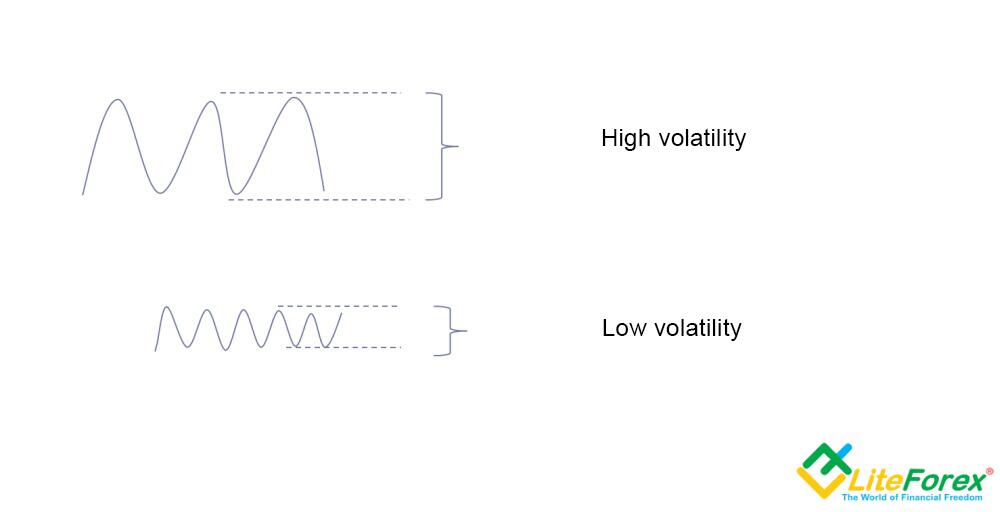
As we have learned before, it is easier to influence the price with low liquidity, than with high liquidity, as a far smaller volume is needed in the first case.
Therefore, the higher is liquidity, the lower is volatility. The lower is liquidity, the higher is volatility (of course, there can be exceptions).
2.3. Spread
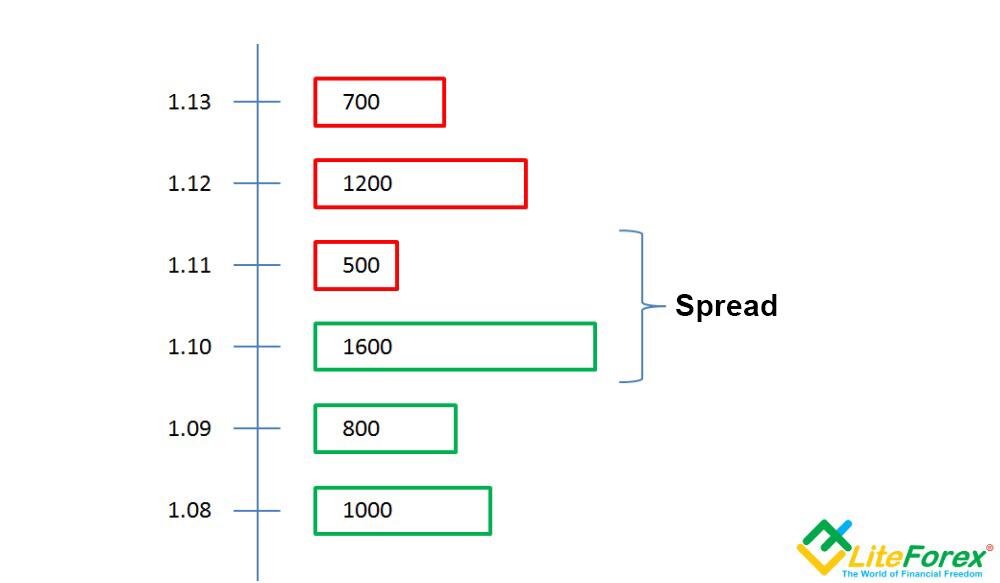
Spread is the difference between the nearest price of a seller and the nearest price of a buyer.
Simply put, volatility is the range of price swings.
Spread is the difference between the nearest price of a seller and the nearest price of a buyer.
Therefore, the spread is less for more liquid instruments, it is wider for less liquid ones.
3. What is your trading advantage?
Now, to prove my theory, let’s return to those 4 points, written in the beginning:
- You really know fundamental analysis better than hundreds of hedge funds with their crowds of analysts. As to enter the market “ahead the fuss”, you need to draw a RIGHT conclusion about the news’ impact on the market before they do.
At any moment of time, there is the best sell price and the best buy price in the market (the spread). If at the moment of the news release the MAJORITY expects positive influence on the market, then the MAJORITY will buy. Who will it by from? From sellers, offering the best prices. As a result, the price will rise. So, if you are just a little slow, the price will have ALREADY been pushed up by a million people, who made their decision faster than you.
- You will manage to place an order BEFORE the hundreds of hedge funds will do, with their capacities and expensive infrastructure, designed exactly to increase the speed of transactions.
Here is the same. Imagine, everybody knows the news simultaneously. Who will be the fastest to enter a trade? Those who have adjusted and automated everything before. OK, then, who of them will be the fastest to open an order? Those, whose equipment is simply CLOSER to the center of orders processing (yes, we all live in a physical world). Do you understand? The fight is for milliseconds!
- You will be the first to learn this bit of news. So, you think it is possible that nobody hasn’t learnt about the news before you do, and they haven’t “stock up” BEFORE the piece of news is released.
Imagine, you know some important information about a country’s economy, nobody else knows yet. You expect the price to go up. That is, buying at the current price, you would be buying “cheap”. What will you do? I guess, you will buy out rather large volumes. However, when you have bought a lot, you need someone to sell to at higher prices. Ha-ha! Do you understand, who will be that? They will be those, WHO WILL BE BUYING AT THE TIME OF THE NEWS RELEASE!! They will think the price to grow up, but it MAY NOT GROW AT ALL, because you will be SELLING OUT your huge volumes.

- You are sure, besides this piece of information, you FULLY UNDERSTAND the fundamental situation in the country, whose currency you are going to trade. Therefore, you can predict, how much the news will influence the price of this or that currency.
I wouldn’t like to use the word “impossible”, because, as a rule, it makes one argue against, I’ll say so: It is EXTREMELY DIFFICULT for a private trader to assess the MULTI-FACTOR fundamental situation in even a single country. To do it, it is necessary to monitor multiple sources, a vast amount of information and news, piles of statistical data and follow their changes by the minute. If don’t do that, you are in the same situation as others when the news is published. That is, you face two dilemmas:
- strong influence/weak influence;
- influence according to the news/influence according to the general situation.
As for strong/weak, I’ll explain in simple terms. If there is a publication of positive statistics on unemployment, and everything is going well in the country; everything is developing, economy is growing, international projects give excellent results, then that statistics release is unlikely to trigger a SHARP rise. Total influence of that unemployment statistics on the country’s economy is not so strong at this period. As for the choice between the bit of news and the general situation, I will give an example: if positive statistics on unemployment is published, and everything is bad in the country, the economy is destroyed, average wages are extremely low, then this bit of news is unlikely to influence the currency general rate positively. That is why some traders wonder, why the positive news didn’t draw the price up? The matter is that the price always goes the right way. The market never mistakes.
How to trade the news in Forex
At first sight, technical analysis may seem more universal than fundamental. In fact, analyzing monthly and weekly timeframes, one may anticipate the trends of currency pairs for a long-term horizon; if you study daily and weekly timeframes – for a middle-term horizon, intraday timeframes may help you forecast the short-term price movements. The analysis of macroeconomic statistics aims at anticipating the future prices for an asset at a middle- or long-term investment horizon. However, one may employ fundamental analysis in short-term trading as well. I mean that one may trade Forex on the news releases.
As a rule, after analyzing economic, political and other factors of changes in the forex rates, investors make up a portfolio of assets and revise it from time to time. It is usually done once a week and (or) ahead an important news release concerning economic performance of a particular country. Therefore, important economic reports or meetings of the central banks are a reason to revise the structure of portfolios by big traders, which results an active market response.
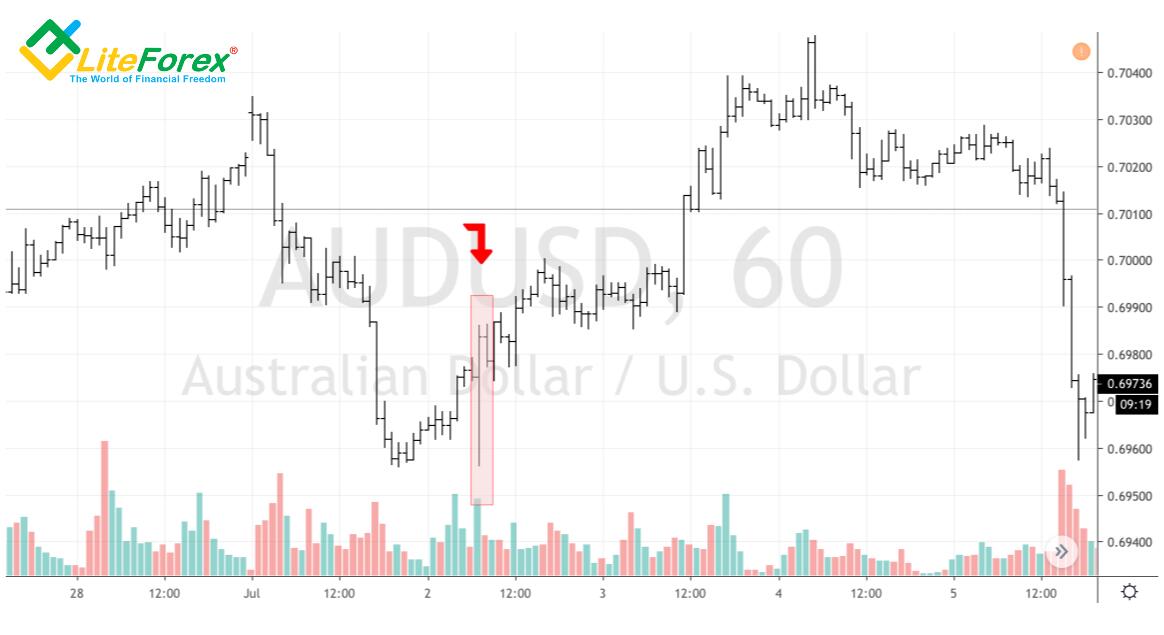
When you trade the news in Forex, it is very important how an asset price behaves ahead the important news release. If the forecast is negative, a currency may be going down in value; however, after the market’s expectations are met, short trades will be massively exited. As a result, following a negative report, the asset may unexpectedly surge, according to the principle “sell on rumors, buy on facts”. A typical example is the AUD/USD reaction to the RBA meeting in July. Ahead the meeting, the Australian dollar was being actively sold, as investors expected a cash rate cut from 1.25% to 1%. The Reserve Bank of Australia actually lowered the interest rate; after that, traders began exiting short trades and the pair started rising after a fall.
AUD/USD reaction to cash rate cut
Neutral outlook for economic indicators or uncertainty around the further monetary policy of a central bank most often results in consolidation period for a currency pair ahead the important event. None of the big traders wants to take active steps until the situation clarifies. As a result, a currency pair’s price chart will be drawing a narrow trading range during a few days. That was in the case with the US jobs report for June. In May, non-farm payrolls data were weak, and investors wondered if it was just a random market noise or it was the first sign the indicator’s decline. The EUR/USD pair was consolidating in the range of 1.127-1.131 during almost the entire week ahead the release. Strong data allowed the bears to draw the rate down to figure 12 bottom.
EUR/USD reaction to US jobs report
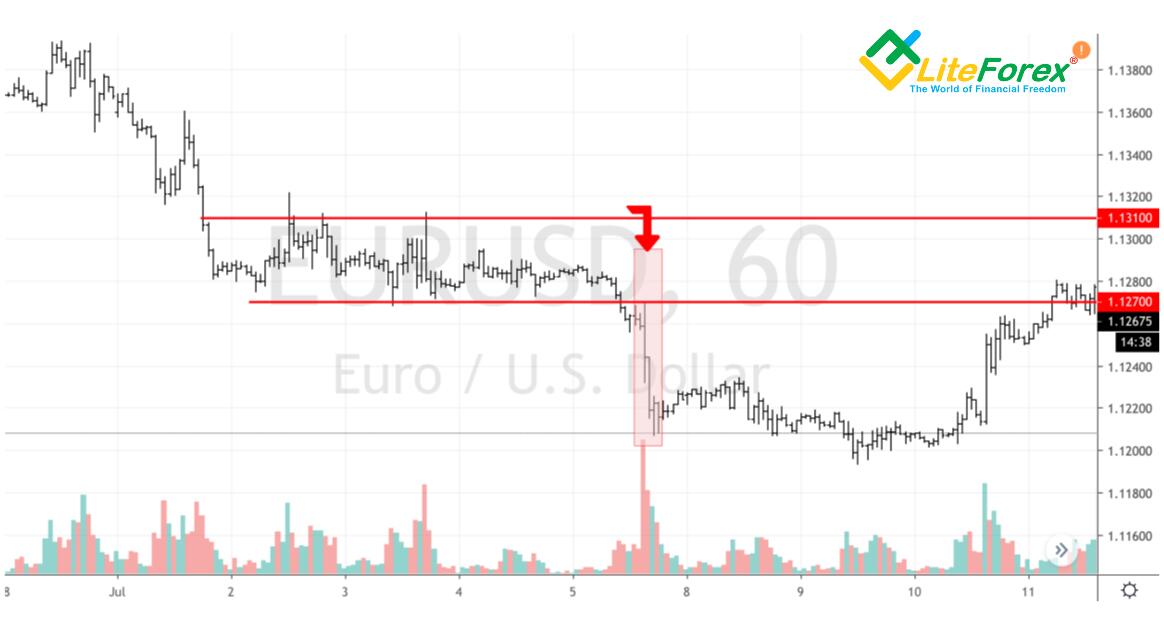
Next, investors had another puzzle, how the Fed would treat the impressive growth of non-farm payrolls. It was not clear whether the central bank was still willing to lower the rates. The market was waiting for Jerome Powell’s testimony to the Congress, and the EUR/USD pair again started consolidating in the range of 1.1195-1.123. Dovish comments of the Fed Chairman helped the bulls go ahead.
EUR/USD reaction to Jerome Powell’s speech
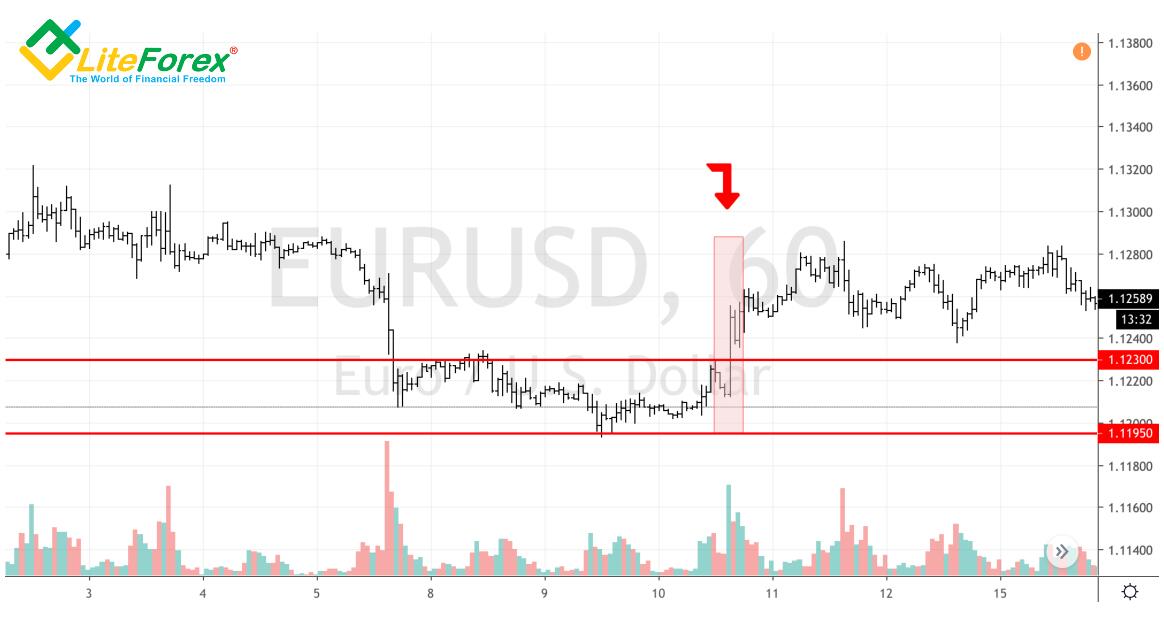
In the fundamental analysis theory, news bits are grouped into the expected (they are usually scheduled in the economic calendar) and the unexpected events. If there is a positive report on economic data amid an unexpected negative surprise, an asset is usually going down in value. Something like that was in the case with the GBP/USD pair. The UK employment data exceeded the expectations, however, the news about increased risks of no-deal Brexit sent the British pound down.
GBP reaction to economic and political news
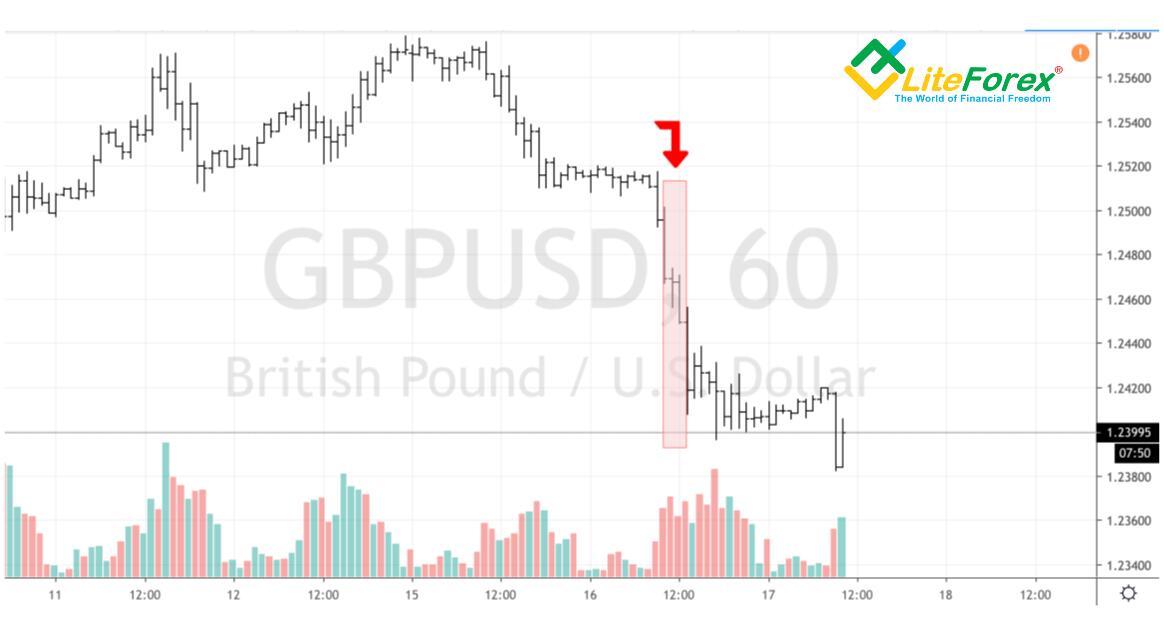
So, the initial situations for Forex trading on the news releases are different. I will explain the trading strategy for each situation in my next training articles.
Instead of a conclusion
What is all that for? For you to think. If you are going to trade on the news, think about WHAT LOGIC your trading strategy is BASED ON, WHAT you are going to STEADILY make profits FROM.
I read about most of these “easy ways” to trade on the news releases myself. I even tried to apply some of them:
- “Open the position in the direction where the price started moving just after the news release/was moving before the release/wasn’t moving before the release and so on”. Just after the news release, the spread is wider, as a rule. For you to close the position at breakeven, the price should pass through more points in your direction! And what if it moves in the opposite direction?
- “Put an order above and an order below and wait until one of them works”. Here, pending orders work as market ones, that is the SPREAD is INCLUDED, so remember example № 1 and a funny spread at the time the news release.
- “Before an important news release the price forms a narrow range. We open a position inside and put a short stop loss.” Let’s remember how a stop loss works? Ta-da! A stop loss ALSO works out as a MARKET order. That is, when it works out at 1.0900, in fact, you could be closed at 1.0980 including spread, and your 5/1 ratio, can well turn into 1/1 ratio, if not worse.
So, if you still hope for quick profits from the currency exchange market, I warn you that even if you happen to be lucky, that won’t last for long, that is not a steady income.
I understand that it is not pleasant and can even be fearful, to take up for a business, a few succeed in. I understand, that the prospect, to start from the basics, study the fundamentals and develop necessary skills without any financial return at first, looks discouraging. Alas, no trader has become rich by chance. In general, there is no professional in no area, who would get a good steady income without deep understanding of the profession. Think, what do you want more: play a game or become a successful trader. If the latter, then, instead of playing games with trading, you had better spend your time on theory and practice in trading according to some strategy.
P.S. Did you like my article? Share it in social networks: it will be the best "thank you" :)
Useful links:
- I recommend trying to trade with a reliable broker here. The system allows you to trade by yourself or copy successful traders from all across the globe.
- Use my promo code BLOG to get a 50% deposit bonus on the LiteFinance platform. Simply enter this code in the appropriate field when funding your trading account.
- Telegram chat for traders: https://t.me/litefinancebrokerchat. We are sharing the signals and trading experience.
- Telegram channel with high-quality analytics, Forex reviews, training articles, and other useful things for traders https://t.me/litefinance
The content of this article reflects the author’s opinion and does not necessarily reflect the official position of LiteFinance broker. The material published on this page is provided for informational purposes only and should not be considered as the provision of investment advice for the purposes of Directive 2014/65/EU.
According to copyright law, this article is considered intellectual property, which includes a prohibition on copying and distributing it without consent.