Electric vehicle companies continue to attract significant investor demand, and Rivian Automotive is one of the most closely watched players in the industry. Whether you are researching how and where to buy Rivian stock, this guide will explain how to invest in Rivian stock.
In this quick overview, we will examine the company's business model, major shareholders, share price performance, and the key steps involved in investing in Rivian. As with many growth-oriented EV companies, Rivian's stock can be volatile, making it essential to evaluate your risk tolerance and investment objectives before buying Rivian stock.
If you are wondering how to invest in Rivian, conducting stock research on the company's competitive edge and long-term prospects is an important first step. Electric vehicles continue to gain market share worldwide, and Rivian remains a notable participant in this rapidly evolving sector. Read on to learn how to buy Rivian stock and what factors to consider before making an investment decision.
The article covers the following subjects:
- Major Takeaways
- Rivian Automotive: Overview and History
- Main Shareholders of Rivian
- How Much Does Rivian Stock Cost?
- Factors Affecting RIVN Quotes
- Where and How to Buy Rivian Stock?
- How Can an Individual Buy Rivian Shares?
- How to Trade RIVN Stock CFDs
- How to Invest in Rivian Through an ETF
- Rivian Dividends
- Conclusion
- How to Buy Rivian Stock RIVN FAQs
Major Takeaways
Rivian Automotive is a US electric vehicle manufacturer founded in 2009. The company designs EVs and produces the R1T pickup, the R1S SUV, and commercial vans for Amazon, while also investing in autonomous driving technologies and premium, eco-friendly vehicles.
Volkswagen AG is Rivian's largest shareholder with a 16.39% stake. Founder Robert (RJ) Scaringe owns about 1.4%, while Amazon, Abdul Latif Jameel, Vanguard, and BlackRock are among the major investors. The RIVN stock is publicly traded on the Nasdaq.
RIVN shares trade near $15. Over the past year, the stock has gained about 1.3%, remaining far below its record high of $179.47.
Rivian's stock is driven by production and delivery figures, developments in its Amazon partnership, financial results, EV demand in the US, and Federal Reserve interest rate decisions.
Investors can buy RIVN stock through a broker. On platforms such as LiteFinance, users can open an account, deposit funds, and trade the RIVN ticker. Exposure is also available through Rivian ETFs and CFDs.
Rivian does not pay dividends. As the company remains unprofitable, it reinvests capital into production growth and R&D, making dividend payments unlikely in the near term.
Rivian Automotive: Overview and History
Rivian Automotive Inc. is an American electric vehicle manufacturer founded in 2009. The company offers consumer vehicles, specializing in electric trucks and SUVs, with its lineup including the five-passenger pickup truck R1T, the three-row R1S SUV, and a two-row SUV model.
One of Rivian's key strengths is its proprietary vehicle electrical architecture, which underpins both its consumer vehicles and the electric delivery vans developed for Amazon. The company's commercial van program has emerged as a notable player in the rapidly growing electric logistics and last-mile delivery market.
Rivian's business encompasses two segments: consumer and commercial markets. In addition to selling consumer vehicles, the company generates revenue from vehicle accessories, after-sales software and services, vehicle repairs, maintenance services, software development, and other services.
Software subscriptions are a key focus, as they can provide a consistent cash flow. The Georgia plant under construction is expected to boost the company's production capacity.
RIVN's initial public offering took place in November 2021. After going public, the company's shares, priced at $78 per share, reached an all-time high of $179.47.
Main Shareholders of Rivian
The question of who owns Rivian stock is important for assessing the company's stability and investor confidence. The largest shareholders are the company's founder, R.J. Scaringe (1.4%), Volkswagen AG (16.39%), and Amazon (12.37%). Amazon not only holds a significant stake but is also one of the key customers of Rivian's commercial van platform.
Major institutional investors also include Abdul Latif Jameel Company Ltd., BlackRock, and Vanguard. Many of them invested in Rivian even before the IPO, which demonstrates a high level of confidence in the company's business model.

Rivian stock is also widely found in the portfolios of retail investors who expect long-term growth for the company and the EV market. Rivian offers employee equity through multiple programs.
The company's share structure allows its founder to maintain significant control through enhanced voting rights. This approach is common among EV and technology firms, where investors often place confidence in the founder's vision and long-term strategy.
Amazon's investment in Rivian played a crucial role in the company's development and helped it navigate the challenging phase of launching production and bringing products to market.
How Much Does Rivian Stock Cost?
The current price of RIVN stock is around $15.19 per share. Since the price fluctuates throughout each trading session, it is recommended to monitor live quotes via a trading terminal or broker platform.
Rivian Automotive, Inc.'s market cap is approximately $19.46 billion, significantly lower than its peak of over $150 billion. However, the current valuation more precisely reflects the company's operational and financial performance.
Rivian's IPO price was $78 per share. Since then, its market valuation has fluctuated significantly, reflecting changing investor expectations regarding the company's growth trajectory and long-term prospects.
Factors Affecting RIVN Quotes
Rivian's stock price is influenced by several key factors:
Production performance — quarterly vehicle production and deliveries.
Financial results — cash flow, losses, capital spending, and investments in manufacturing expansion.
Amazon partnership — developments related to electric van orders and ongoing collaboration.
Competition — actions and performance of rivals such as Tesla and Lucid.
Macroeconomic conditions — interest rates and broader market trends affecting growth stocks.
EV market demand — changes in global demand for electric vehicles.
Analyst opinions — forecasts, ratings, and recommendations from investment firms and financial publications.
Market sentiment — investor expectations and pre-market trading activity.
Share dilution — new share issuances that may increase supply and weigh on the stock price.

Following the release of quarterly earnings reports, Rivian's stock may fluctuate significantly. Intraday price changes can reach 10–20%, which is why it is important to factor this high level of volatility into your investment strategy.
Where and How to Buy Rivian Stock?
To buy Rivian Automotive shares, you first need to open a brokerage account. Selecting a reliable broker is an important step, as it determines your access to markets, trading conditions, and available investment products.
For example, the LiteFinance platform provides access to US markets and instruments linked to Rivian stock.
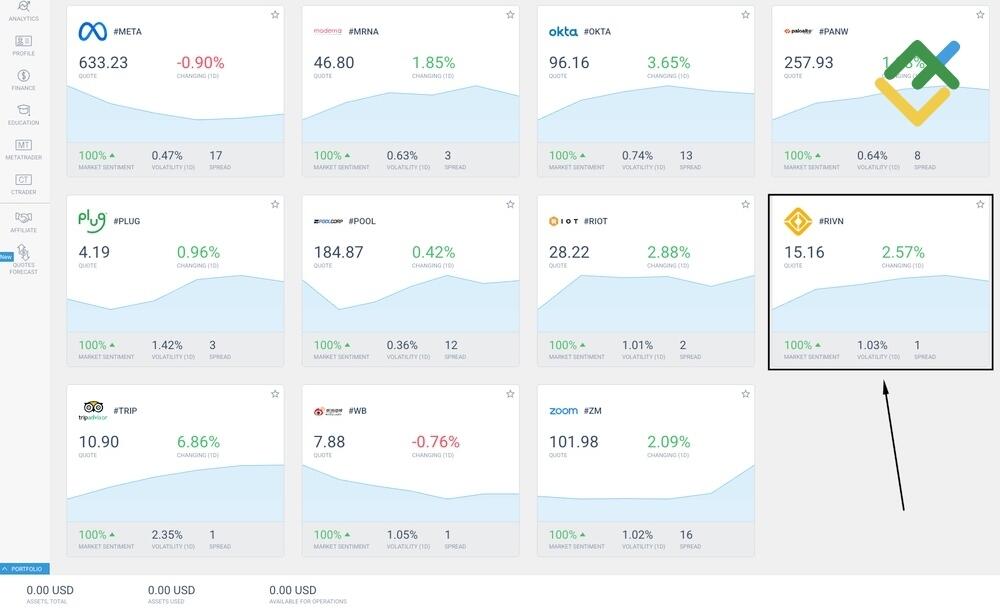
To buy RIVN shares through LiteFinance, you need to:
Register for an account on the platform.
Open and top up your trading account.
Find the RIVN ticker on the trading platform.
Choose your position size and place an order.
CFDs on RIVN shares are available on the platform, while other brokers may offer full shares or fractional ownership.
If your budget is limited, fractional shares let you invest in a portion of a stock with a smaller initial amount.
Before opening an account, check that the broker is properly licensed and provides real-time market data and quotes.
How Can an Individual Buy Rivian Shares?
Securities trading offered through a brokerage account allows you to become a shareholder in a company. The process of buying Rivian shares involves several steps for individual investors.
First, you need to define your investment goals and assess your risk profile. Investing all your savings in a single company is not recommended, especially for high-risk assets.
Next, open a brokerage account. After registering and funding your account, log in, select the US market, and find Rivian stock with the ticker RIVN.
Then, choose the order type:
Market order — executes immediately at the current market price.
Limit order — executes only when the price reaches your specified level.

If you do not have enough funds to buy a whole share, some brokers allow you to purchase fractional shares. However, consider broker commissions and other costs, as trading securities may involve additional fees.
Key steps for buying Rivian stock:
Sign up with a broker.
Open and fund an account.
Find the RIVN ticker symbol using a search bar.
Select your trade parameters.
Buy stocks.
Unlike mutual funds, when buying individual shares, you are directly exposed to changes in the value of a specific company. That means both the potential returns and the level of risk are higher.
How to Trade RIVN Stock CFDs
An alternative to buying Rivian shares is trading Contracts for Difference (CFDs), which allow you to potentially profit from both rising and falling prices. If you expect the price to decline, you can open a short CFD position.
Trading CFDs on Rivian shares via the LiteFinance platform involves a few simple steps. Unlike buying the underlying stock, you do not own the asset; instead, your profit or loss depends on price movements.
When trading CFDs, the same types of orders are available:
Market order — executes immediately at the current market price.
Limit order — lets you set a specific price at which the trade will be executed.
Notably, CFDs often involve leverage, which can amplify both potential gains and potential losses.
Stock trading via CFDs is better suited for active traders focused on short-term market movements. CFDs do not grant ownership rights to the underlying securities or the ability to participate in a company's corporate governance.
The main feature of CFDs is that they allow traders to profit from changes in an asset's price without directly owning it. It is a flexible but high-risk instrument that requires careful risk management.
How to Invest in Rivian Through an ETF
If you want to reduce risk through diversification while also gaining exposure to other EV stocks, you may want to consider Exchange-Traded Funds (ETFs). RIVN shares are included in a number of sector-specific funds:
First Trust Indxx Global Electric Vehicle Index Fund (KARS);
First Trust Nasdaq Clean Edge Green Energy UCITS ETF;
VanEck Green Infrastructure ETF;
Invesco WilderHill Clean Energy ETF;
Vanguard Consumer Discretionary ETF.

Investing in Rivian through ETFs suits investors seeking lower volatility. Instead of a single stock, ETFs provide a diversified portfolio, reducing the impact of any one company's performance.
ETFs are popular among long-term investors due to diversification and regular rebalancing. As the EV sector grows, ETF values may rise even if individual companies face short-term setbacks.
Rivian's weight in sector ETFs is typically small and varies with fund composition, allowing exposure to the EV industry without requiring detailed stock selection.
For beginners, ETFs offer a simple way to invest in electric vehicles, typically with more stable performance than individual stocks.
Rivian Dividends
One of the key questions for investors: Does Rivian stock pay dividends? Currently, the company does not pay dividends to shareholders. Rivian Automotive Inc. remains a growth company and continues to actively invest in business development.
Instead, available funds are reinvested to expand production capacity, develop new models, build facilities, and advance software. As the company has yet to achieve consistent profitability, prioritizing long-term growth remains central to its strategy.

Analysts say dividend payments are unlikely in the coming years. Therefore, investing in Rivian is mainly seen as an investing strategy for potential share price growth rather than as a source of regular passive income.
Investors seeking stable dividends may prefer more mature companies with consistent earnings and established payout policies. However, the absence of dividends is common among fast-growing firms, including many EV manufacturers.
Until Rivian achieves sustained profitability, shareholder returns will depend largely on share price appreciation.
Conclusion
The electric vehicle market continues to expand rapidly, and Rivian stock remains a key focus for many investors. We have outlined the main ways to invest in Rivian stock, including direct purchase via a brokerage account, CFD trading, and ETF exposure.
If you want to start investing in the company, you need a balanced approach, patience, and a clear understanding of your risk profile. RIVN shares are highly volatile and may experience both strong gains and sharp short-term fluctuations.
Rivian offers promising products and operates in both consumer and commercial segments. However, it also faces financial and operational challenges typical of fast-growing EV manufacturers.
If you are considering buying Rivian stock, start by selecting a reliable broker, researching the company, and defining an investment strategy aligned with your goals and risk tolerance.
Investing always involves risk, so it is essential to conduct your own analysis and consider all possible outcomes before making a decision.
How to Buy Rivian Stock RIVN FAQs
The price of RIVN stock fluctuates depending on market conditions and trading activity. The current price is around $15. You can track live quotes through trading platforms and brokerage services.
Such a scenario is theoretically possible, but the company would need to significantly expand its business and market value. At a price of $1,000 per share, Rivian would need to reach the level of the world's largest corporations. Today, the company is still far from achieving such figures.
Rivian's stock is traded on Nasdaq under the ticker RIVN. This is the primary exchange for trading the company's shares. Many brokers and trading platforms provide access to real-time quotes and stock trading.
Since its initial public offering on the Nasdaq in November 2021, Rivian has not conducted a stock split. The number of shares outstanding has changed only as a result of corporate and market activities unrelated to stock splits.
Price chart of RIVN in real time mode

The content of this article reflects the author’s opinion and does not necessarily reflect the official position of LiteFinance broker. The material published on this page is provided for informational purposes only and should not be considered as the provision of investment advice for the purposes of Directive 2014/65/EU.
According to copyright law, this article is considered intellectual property, which includes a prohibition on copying and distributing it without consent.