If you open the chart of the NASDAQ (National Association of Securities Dealers Automated Quotation) index for a long period, with 99% probability you will see beautiful smooth growth. But if there is such a perfect instrument, why won't investors just use it and drop everything else?
In this article, we will look at the macro- and microstructure of the process of investing in the index, identify its downsides and, most importantly, study the basis of the NASDAQ index. We will also touch on trading, so the article will be useful for traders as well.
The article covers the following subjects:
- Nasdaq market summary
- What affects the Nasdaq index
- Nasdaq-100 and Nasdaq Composite Index: difference
- Nasdaq 100 Index (NDX)
- Nasdaq Composite Index (IXIC)
- How to invest in NASDAQ Index
- How to buy the NASDAQ index
- How to trade NASDAQ: Best Strategies
- How to buy stock on NASDAQ
- Advantages/Disadvantages of NASDAQ Index Investing
- Conclusion
- NASDAQ trading FAQs
Nasdaq market summary
NASDAQ Composite Index ticker: #IXIC.
NASDAQ-100 futures ticker: #NQ.
Current price: 1NQ = 29 992.1 USD.
Basis: prices of common stocks of high-tech companies traded on the NASDAQ stock exchange.
Main trading platforms: NASDAQ. Derivatives of the NASDAQ composite index are also traded on the CME (Chicago Mercantile Exchange) and CBOE (Chicago Board Options Exchange).
Leverage: 1:100.
Margin: 1%.
Maximum trade volume: 100 lots (100 CFDs, each equivalent to the current index price).
1 lot is equal to the market price of the NASDAQ index.
The below companies are included in both the NASDAQ Composite Index and the NASDAQ-100 Index:
Activision Blizzard | #ATVI |
Amazon.com, Inc. | #AMZN |
Apple, Inc. | #AAPL |
Autodesk, Inc. | #ADSK |
Baidu.com, Inc. | #BIDU |
Cisco Systems, Inc. | #CSCO |
DocuSign, Inc. | #DOCU |
eBay, Inc. | #EBAY |
Electronic Arts | #EA |
#FB | |
Microsoft Corporation | #MSFT |
Netflix | #NFLX |
NVIDIA Corporation | #NVDA |
PepsiCo, Inc. | #PEP |
Starbucks Corporation | #SBUX |
The list only includes large global companies.
What affects the Nasdaq index
The NASDAQ Composite index is calculated based on the prices of ordinary shares of companies included in the NASDAQ. The total market capitalization of the corporations is also taken into account: the more shares a company issues, the more their price affects the index.
Therefore, the price of the NASDAQ Composite index is more dependent on the financial health of the biggest companies with higher share prices. On the other hand, due to the large number (over 3,200) of outstanding shares, their effect is not as great as in other stock market indices, such as the Dow Jones or the S&P 500.
The NASDAQ composite index does not have any annual, quarterly or unscheduled rebalancing, as the list of companies is updated every day.
The NASDAQ Composite Index is dependent on factors affecting individual sectors of the economy – high tech, healthcare, and consumer goods – due to the greater share of companies from these industries in the index. For example, problems in international logistics will negatively affect the volume of tech stocks and the pace of production of consumer goods, and the boom of the fintech industry will positively affect companies in the high-tech industry.
You can track these factors using news analysis. To do this, traders use the Economic Calendar available on the LiteFinance website.
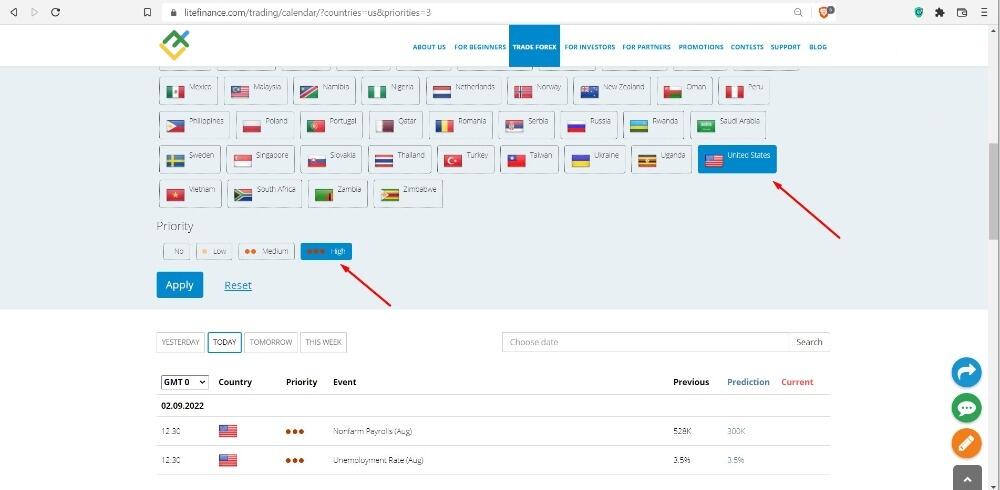
It is generally believed that only important news has a visible impact on the price. For a change, you can listen to market commentators on dedicated TV channels or read publications about the state of the industries of interest. But try to skip content that tries to predict future price movements.
Nasdaq-100 and Nasdaq Composite Index: difference
NASDAQ-100 and NASDAQ Composite are market cap weighted indices, which means they are calculated not only based on the price of NASDAQ shares, but also their number. This means that the effect of each company on the index performance is proportional to the size of its market capitalization.
The most popular Nasdaq index is the NASDAQ-100. It includes shares of companies with the highest capitalization traded on the stock exchange of the same name. Apple, Amazon, and Microsoft have the largest shares – about 30% in total. The NASDAQ Composite index includes all the companies on this exchange. Therefore, it is harder for a company to be included in the NASDAQ-100 than the NASDAQ Composite index.
The share of companies from the NASDAQ-100 in the NASDAQ Composite index is 90%, so it is more heavily weighted by capitalization.
Nasdaq 100 Index (NDX)
The NASDAQ-100 is made up of the top 100 companies listed on the NASDAQ Stock Exchange.
In terms of weighted market capitalization, high-tech companies have the largest weight. Financial sector companies are completely excluded. Since 1998, it has included shares of not only US companies, but also companies from other countries.
As of April 2022, the market capitalization of the index reached $16.9 trillion.
Basic requirements for a company to be included in the NASDAQ-100:
- Non-financial sector.
- Daily volume of shares traded on the market is at least 200,000 within 3 calendar months.
- The company must have previously been included in one of the two stock market indices: NASDAQ Global Select Market or NASDAQ Global Market (for companies registered in the US).
- Company options must be traded on the US stock market (for companies registered outside the US).
75 of the 100 largest companies on the NASDAQ stock exchange are automatically included in the NASDAQ-100. Of the remaining 25, only those that were previously included in the index are added automatically. The rest are evaluated.
Rebalancing is carried out quarterly and annually. During quarterly rebalancing, changes are made to the index composition if:
- the share of one company is more than 24%. It is reduced to 20%;
- companies with more than 4.5% but less than 24% of their own shares together account for 48%. It is reduced to 40%.
During the annual rebalancing, changes are made in the following cases:
- the share of one company exceeds 15%. It is reduced to 14%;
- the total share of the 5 largest companies exceeds 40%. It is reduced to 38.5%;
- the weight of any company not belonging to the top 5 exceeds 4.4%.
Therefore, the index is sensitive to the financial situation of several largest companies due to their large share in its market capitalization.
Nasdaq Composite Index (IXIC)
The NASDAQ Composite Index is made up of ordinary shares of local and international companies that are listed on the NASDAQ exchange. The stock ticker is #IXIC. When people simply refer to the NASDAQ index, they are referring to the NASDAQ Composite index.
It may include:
- ordinary shares;
- American Depositary Receipts;
- real estate investment trusts (REITs);
- shares of limited liability partnerships.
Incidentally, some real estate investment trusts are growing faster than the NASDAQ itself. You can look into them to diversify your investments.
Instruments that cannot be included:
- preference shares;
- exchange traded funds (ETFs);
- warrants;
- closed funds.
Due to the high concentration of technology stocks (more than 50%) the NASDAQ Composite Index more accurately reflects what is happening in the technology sector of the economy. Consumer services companies make up 20%, healthcare businesses – 10%.
At the same time, the largest number of companies in the NASDAQ composite index is represented by the healthcare sector – about 900.
If we evaluate the performance of the NASDAQ over the past 10 years, the growth rate of its composite index exceeds that of the S&P 500 and the Dow Jones Industrial Average by 1.8 and 1.6 times, respectively.
How to invest in NASDAQ Index
You can start investing in NASDAQ only through its derivative financial instruments: futures, mutual funds, and ETFs. All of these instruments are traded on the stock market, so you will need a stock broker to invest.
You cannot directly invest in the index.
Futures
This is a derivative financial instrument with the NASDAQ Composite or NASDAQ-100 index as the underlying asset. This means that the futures price will be similar to the index price.
How to invest in the NASDAQ using futures:
In addition to the classic "buy and hold” investment, you can open sell trades (“short positions”) in futures. You could do that if you expect the price of the NASDAQ Composite Index or the NASDAQ-100 Index to fall.
The main trading platform for futures is the Chicago Mercantile Exchange (CME). This is where you find the highest liquidity. However, NASDAQ futures are also traded on other stock markets – you can request information and trading conditions from the exchanges in your country.
CME instrument tickers:
- NASDAQ Composite Index futures – #QC;
- NASDAQ-100 index futures – #NQ.
The value of both futures contracts is calculated using the same formula:
The duration of the futures contract is 1 quarter (3 months). Then comes the expiration date, after which transactions cannot be concluded under the current contract. If the trader's or investor's trade was not closed before expiration, the position will be closed automatically, and the difference between the buy and sell price of the futures will be credited to their account.
To continue trading, you must switch to the next period contract. For example, after the expiration of the July futures (Q2) you need to switch to the September futures (Q3). Therefore, long-term investing in the NASDAQ through futures is inconvenient.
For futures trading, stockbrokers usually provide leverage. In this case, the profit potential, as well as the risk potential, will be higher than when buying NASDAQ shares.
Mutual funds
Mutual funds allow you to get a share in the total assets of the fund, in which many investors have also invested. Each mutual fund is managed by managers. They are responsible for the selection of securities, unlike ETFs, where the portfolio is identical to the list of stocks included in the NASDAQ or NASDAQ-100 composite index.
Investing in mutual funds is cheaper than investing in ETFs. You can find options from $0.1 per 1 share. However, due to the presence of multiple managers, management fees tend to be higher than in ETFs.
Some of the most popular NASDAQ-based mutual funds include:
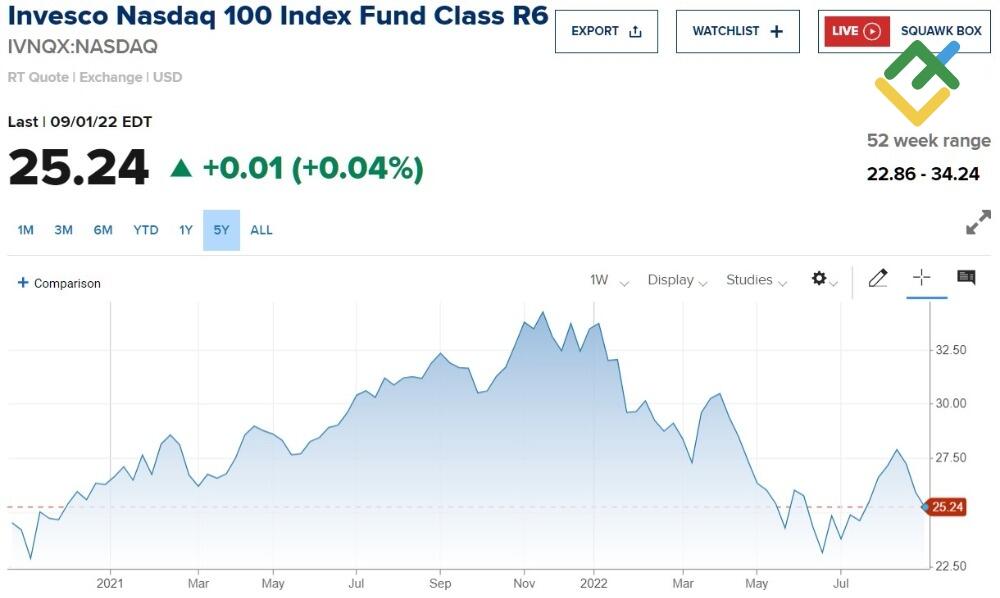
- mutual fund Invesco NASDAQ-100 Index Fund (ticker — #IVNQX);
- mutual fund USAA NASDAQ-100 Index Fund (ticker — #USNQX).
#IVNQX Chart:
#USNQX Chart:
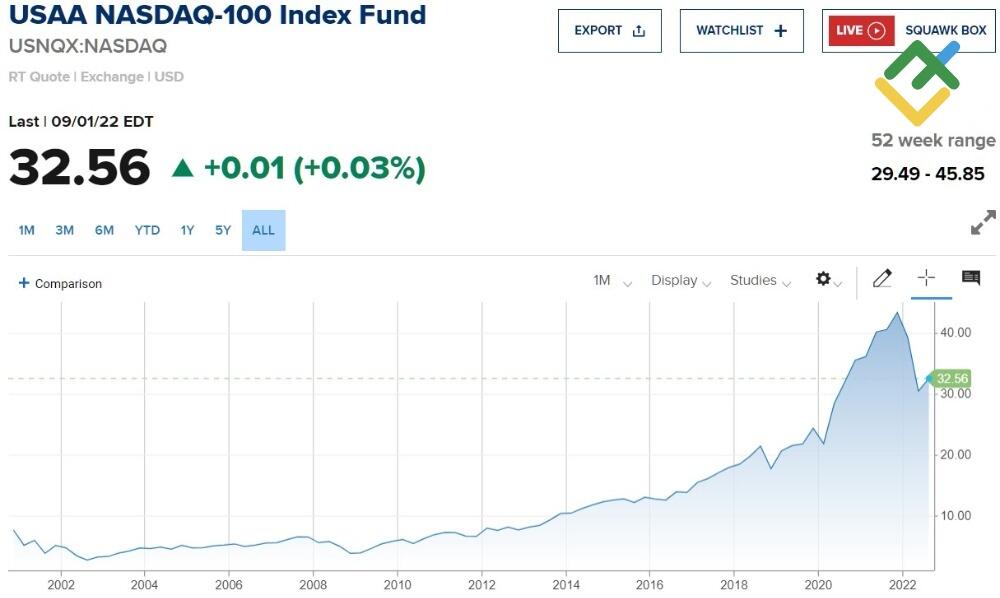
The management fees are 0.15% and 0.48% respectively, and it's pretty cheap with a market average fee of 0.96%.
Mutual funds are a popular investment vehicle among stock brokers. Local mutual fund fees may vary in your country. To assess the competence of mutual fund managers, it is recommended to evaluate returns for a period of at least 2 years.
ETF
An exchange-traded fund or ETF invests in the same portfolio of stocks that make up the NASDAQ index. In our case, this is the NASDAQ-100 index or the NASDAQ Composite index. The weight of the shares is distributed in the index ETF in the same way as in the index itself.
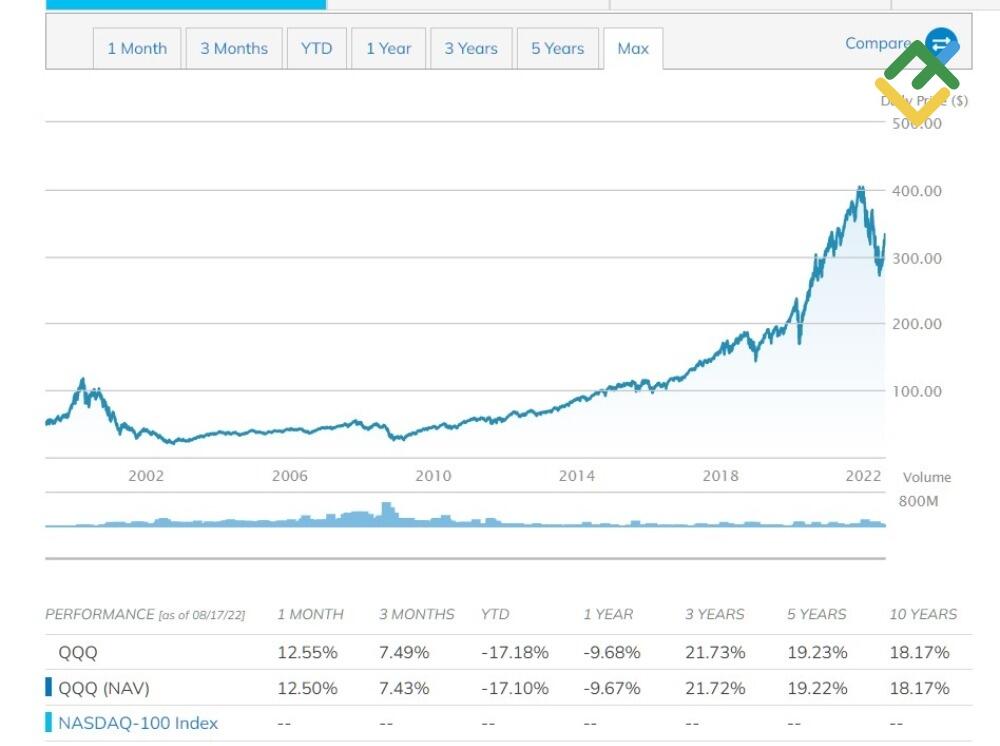
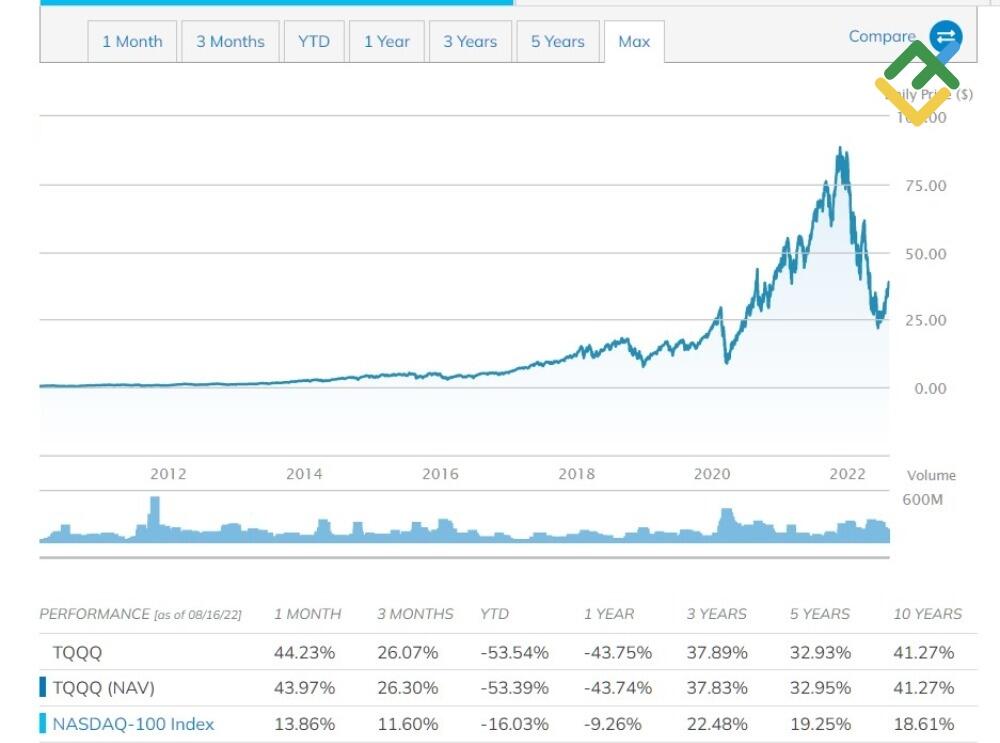
The most popular ETFs on the NASDAQ-100 are held by Invesco (fund ticker #QQQ) and Proshares (fund ticker #TQQQ).
Medium-term chart of the #QQQ ETF:
Medium-term chart of the #TQQQ fund:
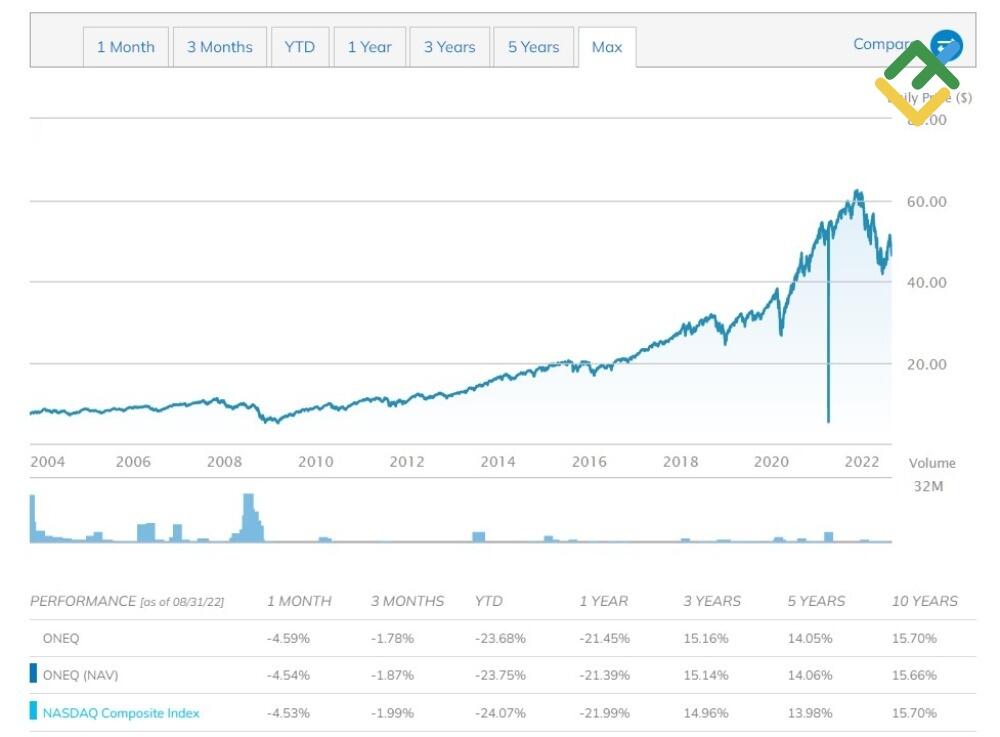
The most popular NASDAQ Composite ETFs were created by Fidelity Investments (tickers #ONEQ and #FNCMX).
Medium-term chart of the #QNEQ fund:
Medium-term chart of the #FNCMX fund:
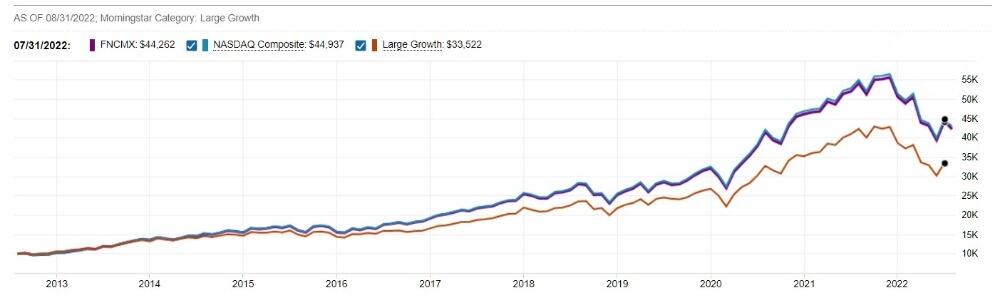
Investing in ETFs is more convenient than choosing company stocks on your own – it's cheaper and faster. I admit it’s possible to pick out the NASDAQ-100 stocks, but in the case of the NASDAQ Composite index, the investor will have to buy more than 3,000 shares of companies, which does not seem reasonable to me.
The ETF parameters are currently as follows:
Name | Price | Management fee | Yield in 5 years |
#QQQ | $329.28 | 0.2% | 134% |
#TQQQ | $37,72 | 0,95% | 294% |
#ONEQ | $50,71 | 0,21% | 112% |
#FNCMX | $160,74 | 0,29% | 110% |
Compared to the cost of buying the shares, the price of an ETF is quite reasonable. In addition, the only expense for investing in ETFs is the management fee, while with stocks you will have to pay to roll over the position overnight on a daily basis. This can significantly reduce the results of long-term investments.
How to Invest in the NASDAQ with an ETF
The choice of an index fund is individual and depends on the goals and expectations of the investor. The table shows that low-yield instruments have lower fees. I intentionally provided market data on yield in 5 years: long-term investments in ETFs have a higher priority. Their underlying asset is subject to medium-term declines over several months, during which there may be drawdowns in yield. But over a longer distance, such investments have good potential and a high probability of yield.
Note that I have only listed the most well-known funds based on the NASDAQ Composite Index and the NASDAQ-100. If you are interested in investing in the NASDAQ through index funds, I recommend that you study the domestic market in your country. Local stock brokers usually offer ETFs for popular stock indices. Pay attention to the returns, management fees, and compare the ETF chart with the underlying asset chart: the greater the correlation, the better.
How to buy the NASDAQ index
You cannot directly buy either the NASDAQ-100 or the NASDAQ Composite as such, since each of them is the result of a calculation and not an investment object. It’s a ratio, not a financial instrument. This applies to any stock index.
But you can make money by trading or investing with the NASDAQ. In addition to the above-mentioned futures, options, ETFs (exchange-traded funds), there is another instrument for short-term speculation – CFDs (contracts for difference).
NASDAQ CFD
The NASDAQ index contract for difference or CFD is suitable for both trading and investing. Unlike futures, a CFD is an indefinite duration instrument.
The NASDAQ-100 CFD (#NQ) is the most popular one, so many Forex brokers have it.
Chart of the NASDAQ CFD from LiteFinance web terminal, D1 timeframe:
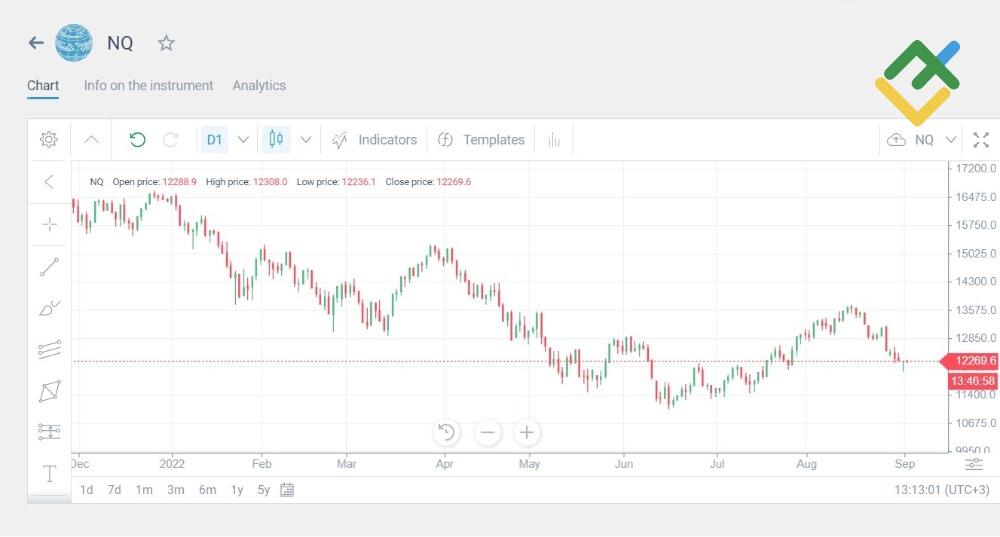
CFDs, like futures, are traded almost around the clock – 23 hours a day on weekdays.
The minimum volume is 1 lot. To secure the trade as of August 2022, $7.62 per lot was required. It means that in order to open a position of 3 lots, the account must have at least $7.62 × 3 = $22.86.
NASDAQ mainly includes the US companies, so when trading intraday it is better to make trades during the American trading session from 16.00 to 00.00 (GMT+3, LiteFinance trading terminal time). At this time, all US stock markets are open, which contributes to higher liquidity and large price movements.
How to trade NASDAQ: Best Strategies
When trading index CFDs, price movements occur in “steps”. In my opinion, it is more convenient to work with them using horizontal price levels.
Let's look at a simple range breakout strategy. We need 2 horizontal levels. The main idea is to "jump" into a trend movement after a breakout of the top or bottom of the range, which may continue due to increased volatility during the American session.
Trading plan
1. On the M15 timeframe, let’s mark 2 horizontal levels that formed BEFORE the opening of the EUROPEAN trading session. In my time zone, this is the period from 03:00 to 11:00 (GMT+3, LiteFinance trading server time):
- day high;
- day low.
2. We place 2 pending orders:
- Buy stop above the high price (stop loss – below the day low);
- Sell stop below the low price (stop loss – above the day high).
3. After the first order is triggered, don’t get rid of the second order: a false breakout is possible and the price might move in the opposite direction.
4. At the end of the American session, all trades must be closed. Since we are exploiting the volatility of this particular session, holding trades after it closes does not make sense.
Orders should be places with a separate margin equal to the spread, and not strictly above / below the level. Depending on the account parameters, spread can be fixed (always the same number of points) or floating (market).
If for some reason the order has not been opened, you should not try to catch up with the price by opening a trade with the market as the ratio of profit and risk will be worse.
Let's look at a few trades in history:
The screenshot shows 2 horizontal levels – the high and low price for the period from the beginning of the day until the opening of the European session.
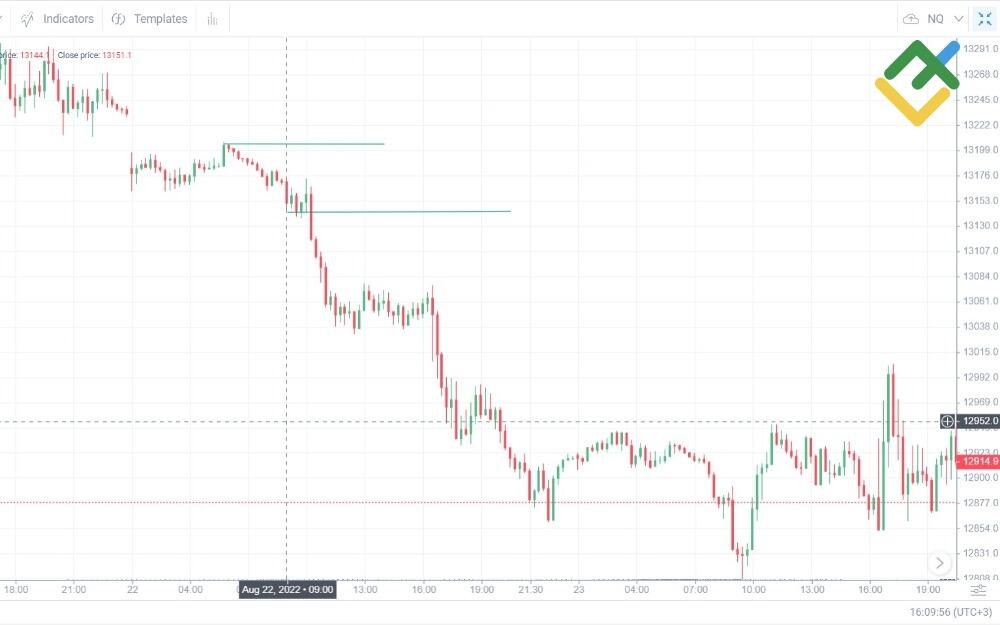
At 9:30 there was a breakdown of the lower level, a sell position was opened. Stop-loss is set behind the upper horizontal level with a separate margin, taking into account the spread.
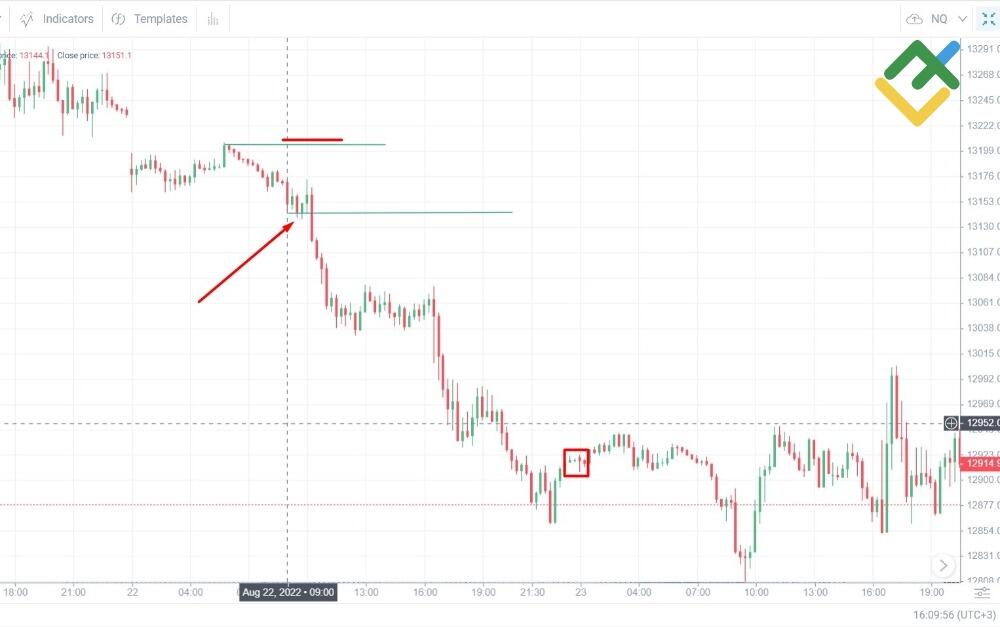
The position remains open until the end of the American session, the closing point is marked with a red square. As a result, we get a profit of 3/1 in comparison with the risk: a profit of 225 points with a stop loss of 65 points.
Example of a trade for the next day:
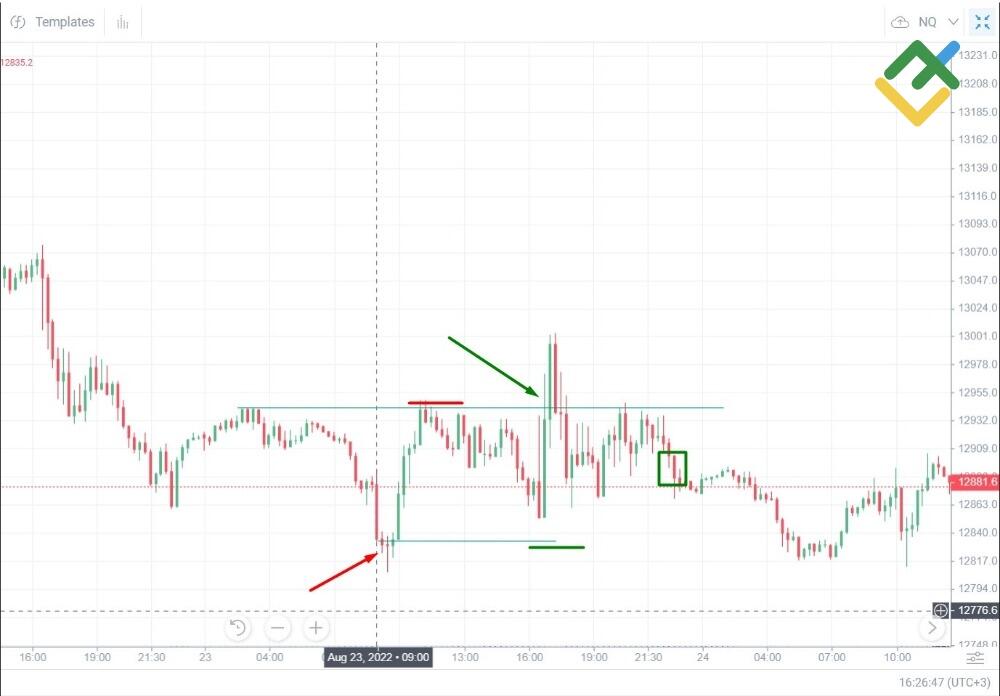
The red arrow shows a breakdown of the lower level, which activated a pending sell order. The entry order must also be placed with a separate margin for the current spread. The stop loss for this short trade is marked with a red line – it is placed beyond the upper horizontal level.
Then the price knocked out the stop-loss and at the same time activated the pending buy level since we expected an uptrend. The stop loss for this buy trade is placed below the lower level marked with a green line.
As a result, the price was trading in the corridor all day and there was no directional movement. The trade was closed at the end of the American session, the closing point is shown by the green rectangle.
The result of the day: 1 losing trade in the amount of a full stop order, 1 losing trade in the amount of 0.5 stop orders.
If the stop loss is at 1% of the deposit, the result of two days of trading is as follows:
- 1 profitable trade in the amount of 3%;
- 1 losing trade in the amount of 1%;
- 1 losing trade in the amount of 0.5%.
Therefore, the result of two trading days is a profit.
The strategy is a trend one, so it has the following properties:
- the share of profitable trades will be about 30-35%;
- recommended profit/risk ratio: from 4/1.
So don’t be afraid of losing trades. As long as you risk no more than 1% of the deposit, they are acceptable.
More experienced traders can use the following tools:
- ATR indicator with a period of 5 on the D1 timeframe. Before placing orders, compare the range width with the indicator value. It is preferable that ATR be at least 3 times greater than the range width;
- trailing stop. But you should start from the ratio 2/1. With a trending strategy, trades closed by take profit are worth their weight in gold. On the other hand, trailing the stop loss prematurely can lead to a decrease in potential profit.
If you encounter complicated situations when trading with this strategy, ask questions in the comments.
I should note that this strategy is only a starting point for developing your own practice and not a ready-made universal trading system. Its purpose is to help the trader figure out whether they are comfortable trading level breakouts and whether they are interested in further research of this approach.
How to buy stock on NASDAQ
Stocks listed on the NASDAQ fall into two categories:
- NASDAQ National market – the main market of large companies with the most liquid shares;
- NASDAQ Small Cap is a market for small companies with a low market capitalization and, as a result, less liquidity.
Private investors can only buy NASDAQ shares through a stock broker that provides access to the stock market. You don’t have to go to the US – a number of brokers have representative offices in other countries.
Another important point: the largest companies whose shares are traded on NASDAQ are also listed on other stock exchanges. Therefore, your local exchange can provide everything you need to trade such stocks. But local stock markets are likely to have limited selection: there will most likely be no low-cost securities from the small market cap category.
How to invest in the NASDAQ step by step:
1. Determine the investment strategy – preserving or increasing capital. In the case of stocks, the higher the desired return, the higher the risk and possible drawdown. The basis of the portfolio should always be low-yielding stable stocks with a low risk of drawdowns. Highly profitable and, as a result, high-risk assets should be selected based on the desired return. Therefore, in the first case, with low risk tolerance, the share of high-risk stocks in the portfolio should be minimal, and in the second case, there should be more high-yielding stocks.
2. Determine the amount of investment capital. We usually go all in when starting something new. If you want to lose weight – immediately eliminate all sweet and fatty foods. If you want to invest – no fun and start investing all the saved money in stocks. No one wants to admit that this approach does not work in the long term. Therefore, the initial amount of capital should be such that you could lose it without regret. Then multiply this number by 3 and get the required amount of capital. If you are curious about this formula, ask a question in the comments.
3. Choose a broker. The main criterion is the licensing information that should be readily available. If you are going to trade on the NASDAQ stock exchange, the American broker must have an SEC license. Next, study the trading conditions. The general recommendation is to reduce costs. And check the following details:
- broker commission. It is charged for providing access to the stock market and can be indicated ex VAT. If you are investing a small amount, commission as % of turnover is preferable. For large investments, select a fixed amount per trade, for example, $2;
- commission for maintaining a brokerage account. It is charged regardless of whether you make trades or not. Therefore, it is best to avoid it altogether;
- depository fee. Charged for holding securities. May be indicated separately from other commissions;
- exchange commission. Its size depends on which of the stock exchanges you are going to buy shares on.
4. Open a brokerage account and deposit funds.
After that, you can invest in the shares of the desired companies. Investors buy shares online via a trading terminal provided by the broker.
NASDAQ stock trading is a vast topic that is difficult to cover in one article. Tell us about your personal experience. What stocks do you prefer to invest in? Share your opinions or questions in the comments, I will be glad to discuss them.
Advantages/Disadvantages of NASDAQ Index Investing
Advantages | Disadvantages |
Diversification | Limited diversification |
No strict requirements for the size of the deposit | Affected by economic bubbles |
Low costs | Exponential growth is unlikely |
No special investment knowledge required | Rebalancing only on scheduled dates |
Highly liquid instruments |
The main advantages of investing in indices are simplicity and low limit of deposit size. The investor doesn’t need to understand stocks or portfolio formation, since the NASDAQ Composite Index and the NASDAQ-100 Index are already formed portfolios. In order to invest, you only need to buy one of the derivatives corresponding to the amount of your capital.
Investing in NASDAQ through futures, index traded funds (ETFs), and mutual funds already implies diversification, since each index is made up of shares of a number of companies. On the other hand, diversification in this case is limited: investors only buy shares of companies included in the NASDAQ.
When investing in the NASDAQ-100 and NASDAQ Composite, the costs will be lower than when building an investment portfolio on your own. Indices also have higher liquidity compared to individual stocks – an index investor will be able to sell an asset at a price close to the market price.
Each of the NASDAQ indices is made up of companies from a specific economic sector. As a result, during the formation of economic bubbles – sharp and unreasonable increases in demand for assets – the index and its derivatives will rise sharply in accordance with the law of supply / demand, instead of reflecting the real situation in the sector. When the bubble bursts, the market enters a downturn of unknown duration. Investors inspired by the surge and investing a lot of money are at risk of an extended drawdown.
The index has existed for several decades, so it is constantly rebalanced according to certain rules. The NASDAQ does not include innovative assets, so it is unlikely that the price will rise sharply.
Rebalancing occurs only a few times a year, which means that before it is carried out, weak stocks can negatively affect the value of the NASDAQ for a long time.
Conclusion
This article provides a comprehensive account of the two major NASDAQ indices: the NASDAQ-100 and the NASDAQ Composite. However, the NASDAQ is a broader area for potential investors to explore. Each of the indices of this exchange covers a certain sector of the economy and can be used to diversify your investments. In addition, when forming an investment portfolio, you can distribute investments not only among various indices, but also among their derivative instruments. For example, combine NASDAQ Composite futures and NASDAQ-100 ETFs.
NASDAQ is one of the most popular and recognizable exchanges, so brokers from different countries provide the opportunity to invest in derivative financial instruments of this family of indices without opening a brokerage account in the United States.
In my opinion, it makes sense to invest in the NASDAQ in two cases:
- at the beginning of the investor's journey, in particular with the help of a wide range of NASDAQ ETFs and mutual funds and due to low requirements for the deposit size;
- for medium and long-term investments with a yield higher than inflation and bank rates.
NASDAQ has outperformed the US Dow Jones and S&P 500 in recent years, so investing in the NQ is more suitable for aggressive than conservative investors.
NASDAQ trading FAQs
This is an acronym for the National Association of Securities Dealers Automated Quotation. It is the American stock exchange where shares of high-tech companies are traded. The same name was given to the index made up of ordinary shares of companies that are traded on this exchange.
At the moment, stocks of about 3,200 companies are traded on this exchange. The same number is included in the index of the same name.
This is an index made up of the shares of all companies traded on the stock exchange of the same name. Preferred stocks and ETFs cannot be included.
This is an index composed of the shares of 100 non-financial companies with the largest capitalization, which are traded on the NASDAQ US stock exchange.
From the opening of the American trading session – at 12:30 EST (Eastern Standard Time) or at 17:30 GMT+3 (LiteFinance trading terminal time).
This is the period after the closing of the trading session, during which traders can continue making buy or sell trades. After hours are from 00:30 to 04:00 GMT+3. During this period, orders of buyers and sellers are brought together using electronic communication networks (ECN).
There are two main differences. The NYSE has a hybrid structure: in addition to online trading, there is also a physical trading floor. On the NASDAQ, trading only occurs online. On the NYSE, buyers and sellers connect directly with each other. On the NASDAQ, buyer and seller orders are matched through a dealer or market maker, who can act as the opposite side of the trade. Therefore, the NASDAQ is more liquid than the NYSE.
These are derivative instruments with one of the indices of the NASDAQ stock exchange as the underlying asset. The $100 NASDAQ-100 standard futures contract trades under the ticker symbol #ND, while the $20 mini contract trades under the ticker #NQ. The NASDAQ Composite only has a mini-contract futures under the ticker #QCN, which is worth $20. These assets are traded on the Chicago Mercantile Exchange (CME).
Both are US stock indices. Dow Jones includes the 30 largest enterprises in the country, regardless of industry. NASDAQ includes ordinary shares of all the companies (about 3200) traded on the stock exchange of the same name.
According to the arithmetic mean formula. First, each company's share price is multiplied by its number of shares. The results are then added up and divided by the number of companies listed on the exchange.
Indices and their derivatives are traded in US dollars. To identify the instrument, look at the ticker, contract value, as well as the cost and size of the minimum price change.
Given the current pace of growth and development of the IT industry, yes. Before investing, it is advisable to study the past price dynamics of companies and current financial performance.
The ones with acceptable liquidity. It is preferable that they have publicly available information on the financial performance of the issuing companies for a more comprehensive analysis. With low liquidity, shares will be difficult to sell.
Price chart of NQ in real time mode
The content of this article reflects the author’s opinion and does not necessarily reflect the official position of LiteFinance broker. The material published on this page is provided for informational purposes only and should not be considered as the provision of investment advice for the purposes of Directive 2014/65/EU.
According to copyright law, this article is considered intellectual property, which includes a prohibition on copying and distributing it without consent.