Investors believe in positive news and don’t pay any attention to the bans of China and South Korea
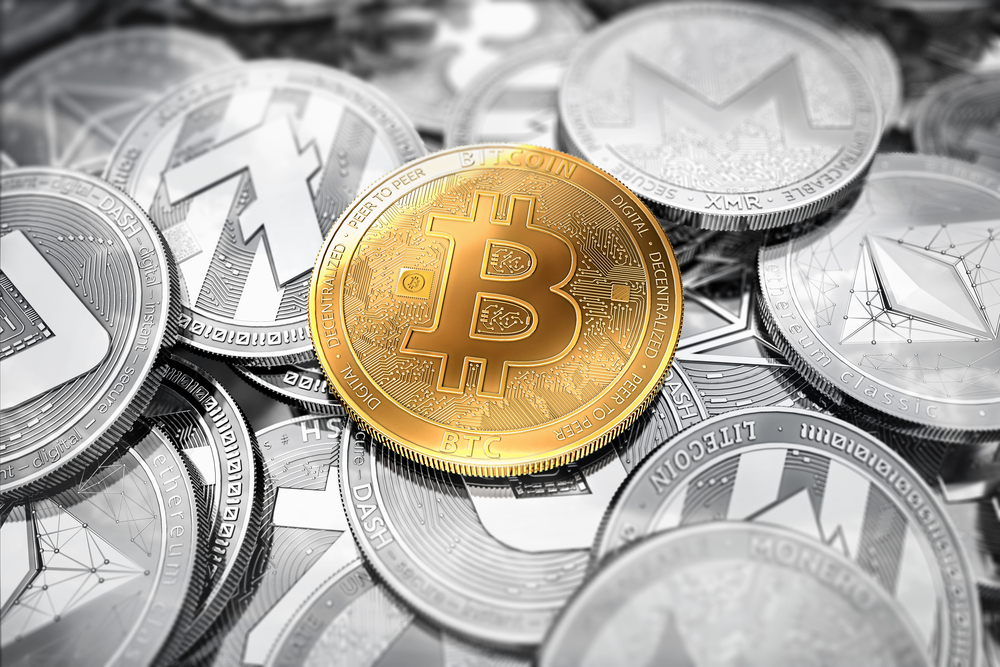
Ahead Segwit2x, bitcoin during a few days grew up to more than $1000 and outbroke level $7000. Some people think that bitcoin and other cryptocurrencies rates are increasing due to speculative capitals, others, on the contrary, believe in blockchain future. Some countries support the progress, others, on the contrary, impose restrictions, trying to establish tax control over cryptocurrencies. Traders ignore the restrictions, they prefer to believe in positive news. How fundamental factors influence cryptocurrencies and why statutory limitations are ineffective, read in our review.
What is cryptocurrency afraid of?
There are two weeks before the new bitcoin fork, and cryptocurrency sets new records in growth pace and historic highs. Just in the last few days, BTC has appreciated by more than 20%, from $5700 up to $7200, during the year, the cryptocurrency has increased by almost 900% and shows no signs of stopping there. Meanwhile, analysts’ most positive predictions for bitcoin rate, to be $10000 or so by the end of the year, are coming true. According to Coin Market Cup site, bitcoin capitalization is already more than $120 billion and constitutes more than 60% of all cryptocurrencies’ total capitalization. Only a month ago, total capitalization was $130 billion or so and bitcoin proportion was about 47%.
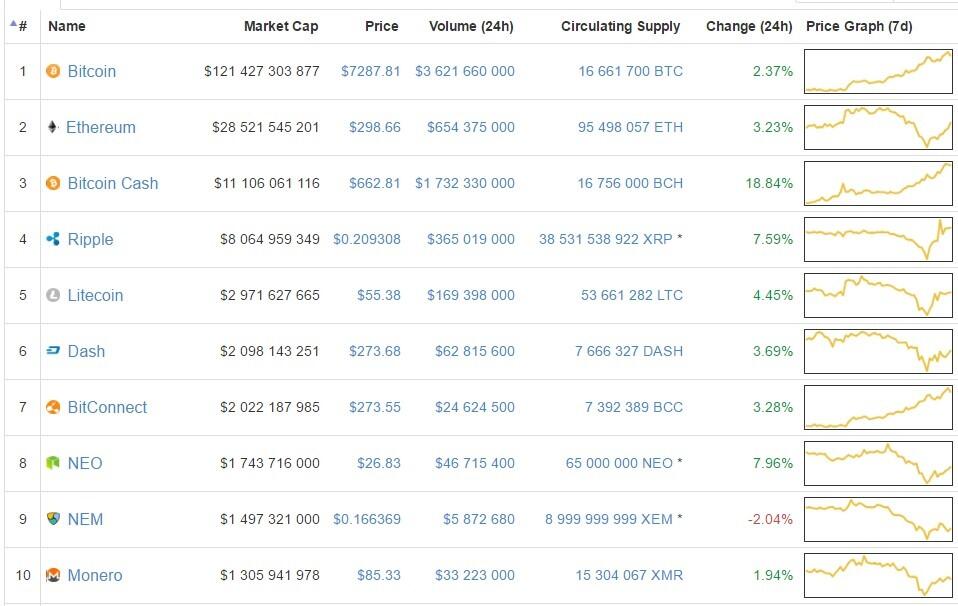
In this picture it is clearly seen that, there are straight uptrends only for BTC and its forks: BCH, appeared in August, and BitConnect (the currency appeared in January, 2017, and according to most people, is a classic Ponzi scheme, or HYIP). Some cautious investors are concerned about exactly bitcoin’s explosive growth:
- speculative BTC growth is too fast compared to other cryptocurrencies and can drawdown after the fork (demand is rising only because it is possible to obtain coins after Segwit2x). Some analysts compare the cryptocurrency market situation with that of 2000 (“dot com bubble”);
- the volatility of $400-$500 is too much. With such strong growth, there can be an equally strong drawdown as well
- several countries impose more and more restrictions on transactions and mining.
The fears of bitcoin drawdown after the fork are groundless. After BCH launch in August, bitcoin rate, on the contrary, went up. The same is with Bitcoin Gold too. Only just ahead the fork, the price slightly went down, and then it grew up again.
The fears of “dot com bubble” are unfounded either. Cryptocurrency supporters believe that blockchain is the future. Their argument is that corporations are interested in bitcoin. Cryptocurrencies capitalization is $200 billion, the capitalization of NASDAQ companies at the time of collapse on March 10th, 2000, was trillions, so it’s irrelevant to draw analogies between cryptocurrencies and NASDAQ. The biggest problem is the restrictions by some countries; they can become an obstacle for bitcoin and other cryptocurrencies.
How bitcoin responds to State restrictions and whether we should worry about them
On September 4tyh, 2017, media reported that China banned ICO (initial coin offering), allowing private individuals to continue conducting any cryptocurrency transactions. Only a year ago China accounted 85% of all bitcoin transactions, but after a series of restrictions, transactions volume decreased to less than 15%. Traders didn’t respond actively to China’s decision; quotes temporary wend down from level 4800 to level 4200, being far from August’s lows.
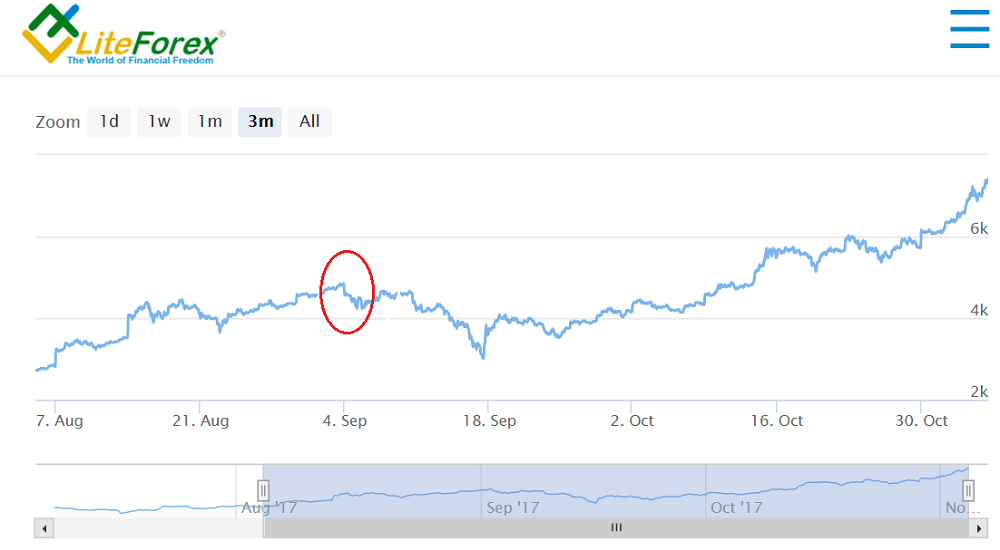
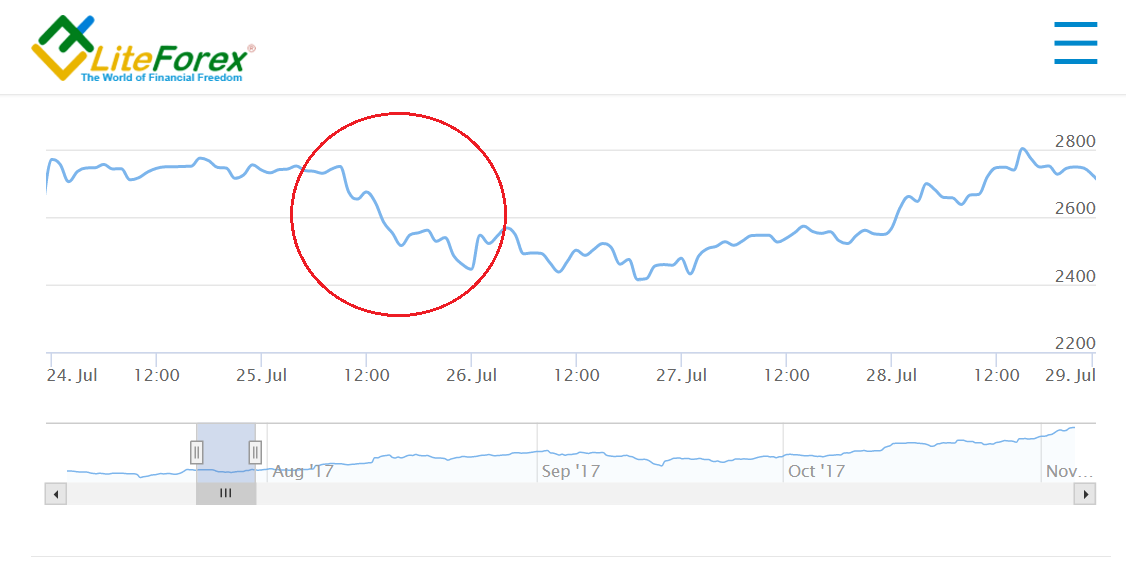
Stronger was traders’ response when China’s cryptocurrency exchange BTCC stopped trading on September 14th-15th. It can also be seen in the chart. The same happened on July 25th, when one of the largest world’s exchanges, BTC-e, stopped operating. Then bitcoin lost about 20% of its price. This indicates that traders react more to the practical problems with trading and transactions than to any restrictions.
When China’s authorities tightened the policy, bitcoin turnover moved to Japan and South Korea. South Korea took about 30% of cryptocurrency turnover, being the for this indicator. Already at the end of September, there was another shock for traders – ICO ban in South Korea. Although the country is still tolerant to bitcoin, the launch of new cryptocurrencies and all lending in cryptocurrencies are banned. South Korea’s decision on September 29th was nearly ignored by traders, bitcoin drop by 4% is insignificant, compared to the subsequent growth.
Far more active was traders’ response to the news that Japan was going to legalize cryptocurrency exchanges and express tolerance to the control over cryptocurrency trading. In April, Japan will be the first country to equate bitcoin to fiat money. Bitcoin has been growing recently only due to the November’s fork anticipation.
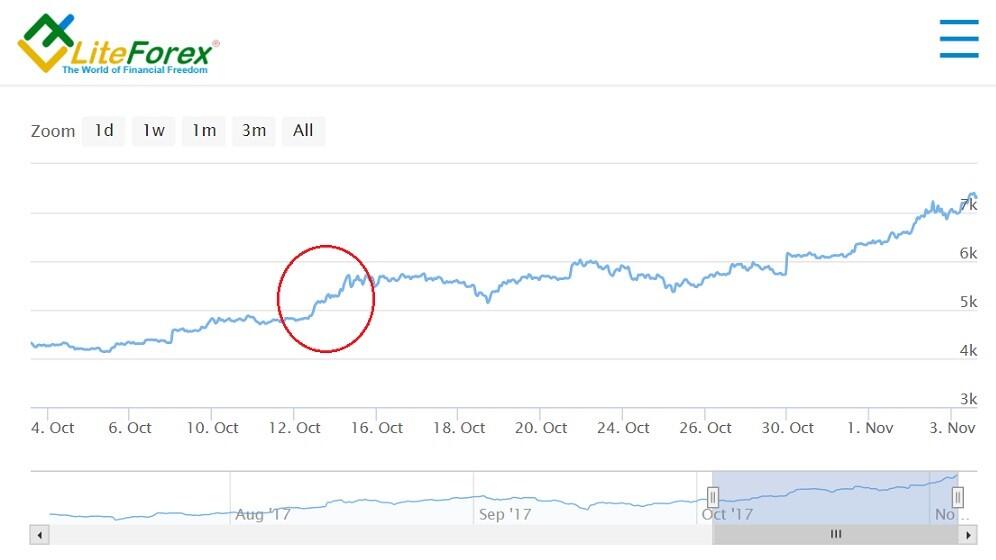
Russia is keeping up with Asia. On October 24th, the Russian president instructed the Government and the Central bank to establish the requirements for cryptocurrency mining, and to provide in future the registration of entities, engaged in mining.
The willingness of some countries to restrict cryptocurrencies (include bitcoin recognized as a payment means) is understandable:
cryptocurrency turnover and mining volumes increase every day. This is a good sector to be taxed. And if income from stock trading or forex trading is taxed why not tax the income from cryptocurrency trading and mining?
an advantage of cryptocurrencies is their anonymity. The countries, limiting cryptocurrencies turnover, explain their bans with the fact that cryptocurrencies cause pouring money out of the country without regulators’ control and can be a means of money laundering;
a country’s currency is an instrument to regulate economy. Even foreign currencies turnover is controlled by the regulator. Uncontrolled cryptocurrency turnover can threaten country’s economic integrity.
Many countries don’t know yet how to interpret cryptocurrency from financial point of view. The authorities’ opinions divided as follows:
cryptocurrencies are completely banned in Island, Vietnam, Bolivia, Ecuador, Bangladesh, Lebanon, Thailand (countries can be linked based on their economic development);
USA. There cryptocurrency is a full-fledged financial instrument (stock unit), which is taxed by the tax law. Creation of the first cryptocurrency ETF fund has been discussed for more than a year, but the regulators haven’t allowed it yet.
in Finland and Belgium bitcoin is considered as valuable assets, free from VAT;
Canada is completely open to bitcoin. Taxation is applied according to bitcoin use: to resell or to invest.
EU. There, opinions differ. Germany is tolerant to bitcoin, allowing it as a “personal capital”. In France, on the contrary, bitcoin is criticized for its anonymity. As early as in 2015, the EU court canceled VAT on bitcoin transactions, describing it as a kind of conventional currency;
in Cyprus, cryptocurrency status hasn’t been defined yet, and in Bulgaria cryptocurrency is taxed;
Russia. Cryptocurrency is banned as a payment means, but mining is successfully developing, especially in regions with low electricity prices.
Most developed countries haven’t yet decided on bitcoin status and are looking for an opportunity to regularize it. They have already accepted the inevitability of cryptocurrencies and allow to make domestic transactions. Amazon has promised to start accepting bitcoin in October, Aliexpress doesn’t yet accept bitcoins, but the problem is addressed through intermediaries, accepting bitcoin and paying for the goods in real currency.
Now I shall return to things, bitcoin and other cryptocurrencies are afraid of, those they respond to most of all. It is easy to notice that traders almost completely ignore (or react in the short term) any decisions of countries, and, on the contrary, cryptocurrencies price is growing when there is information about new forks or agreements. It can be explained, why traders ignore the bans:
- regulators, in fact, have no instruments to limit cryptocurrencies completely. Cloud services are located on servers of different countries. It is hardly possible to ban mining or impose a tax;
- cryptocurrencies are issued in the global system. The absence of the single issuer (except for private farms, which mine cryptocurrencies for personal use) doesn’t allow to apply measures to private individuals;
- until there is unity among the countries, cryptocurrency ban in one country automatically means the growth of its turnover in another one.
Adapting to advanced technologies is wiser than attempts to limit them.
Main fundamental factors that influence cryptocurrencies rates:
- innovations that make mining simpler and more profitable;
- problems of cryptocurrency exchanges;
- bitcoin and ethereum are inversely related to other altcoins. The interest in one altcoin can cause money outflow from bitcoin and vice versa. During fundamental events (for example, forks) bitcoin price is rising due to capital outflow from other alts;
- traders’ interest in the project, provided by a cryptocurrency. If the project itself is promising, investors will respond accordingly.
There is an opinion in forums, that volatility is associated with algorithmic trading. It is interesting that analysts themselves often can’t explain high cryptocurrency volatility, which means great speculative element and extreme popularity. These are partly signs of a bubble, but may be the future is really in cryptocurrencies? And those who risk now, can make huge profits in future. In the nearest future, even bitcoin won’t be universally recognized, but in five-ten years everything can change completely.
Now, there are no significant fundamental factors, that can reverse bitcoin downwards with potential fall by 25% or more. Traders prefer to believe in positive news, that can influence commission fees, transactions speed, simplifying mining, and ignore any kinds of State announcements. This is the main difference between cryptocurrencies and usual currencies, which depend on the speeches of the Fed, ECB, etc., heads.
Advice to traders: don’t be late to catch the uptrend before Segwit2x. The ceiling hasn’t been overcome yet, although, day’s volatility is $150-250. Especially for trading leading cryptocurrencies, LiteFinance offers its new product, it’s quite simple even for beginners. Its advantages are minimum investment, simplicity and no risk compared to electronic purses. Just before the fork, it’s better to close the position and wait for the market response.
Dear traders! Follow our channel and have access to daily efficient analyses package made by true experts:
- unique analytical reviews and forecasts;
- technical, fundamental, wave analysis;
- experts' opinions and learning materials.
Join at the link: t.me/litefinance
Welcome!
P.S. Did you like my article? Share it in social networks: it will be the best "thank you" :)
Useful links:
- I recommend trying to trade with a reliable broker here. The system allows you to trade by yourself or copy successful traders from all across the globe.
- Use my promo code BLOG to get a 50% deposit bonus on the LiteFinance platform. Simply enter this code in the appropriate field when funding your trading account.
- Telegram chat for traders: https://t.me/litefinancebrokerchat. We are sharing the signals and trading experience.
- Telegram channel with high-quality analytics, Forex reviews, training articles, and other useful things for traders https://t.me/litefinance
The content of this article reflects the author’s opinion and does not necessarily reflect the official position of LiteFinance broker. The material published on this page is provided for informational purposes only and should not be considered as the provision of investment advice for the purposes of Directive 2014/65/EU.
According to copyright law, this article is considered intellectual property, which includes a prohibition on copying and distributing it without consent.