First look and introduction of the Quickfinger Luc (QFL) strategy.
Description of the Quickfinger Luc trading strategy. Main elements of the QFL trading strategy. Building the Quickfinger Luc trading model.
Dear friends,
Today in my training block I would like to introduce to you the Quickfinger Luc (QFL) strategy. You will not find any information on this strategy in Russian, so I'll try to explain it in detail in this article. The author of this strategy and the source of information is a trader under the nickname @quickfingersluc. Luc shows really outstanding results even in a falling market. Given the current situation, I could not stand idly by and decided to explain to you the details of this trading strategy.
Like any other TS, QFL requires strict discipline and compliance with the rules. Moreover, to use Quickfinger Luc, you will have to have patience, because the signals for this strategy do not appear as often as we would like. On the other hand, QFL is a whole methodology in technical analysis that teaches you to understand graphics and distinguish false noises from real movements that are signals for buying or selling.
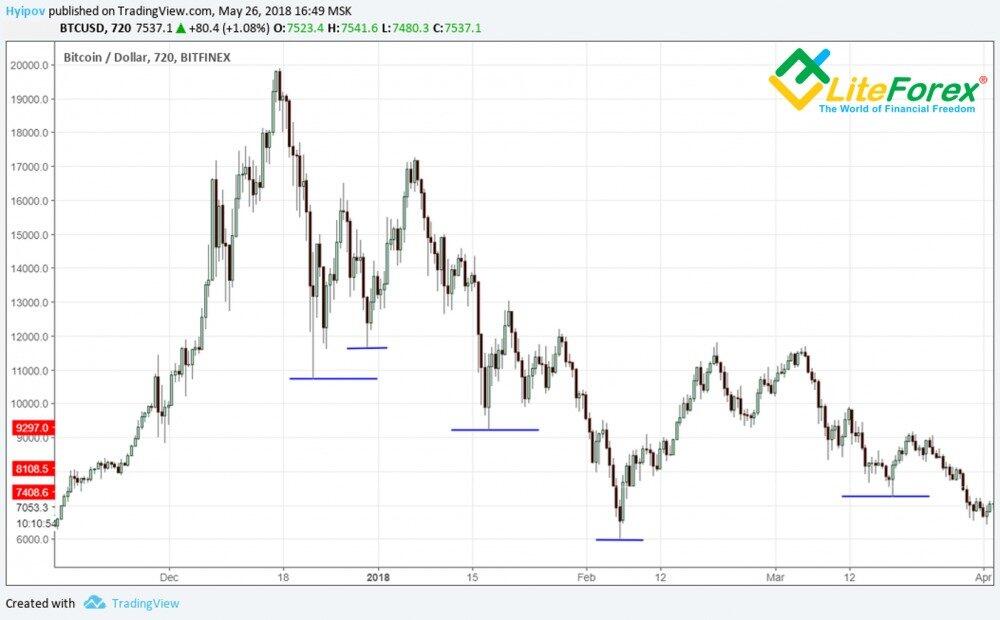
If simplified, the Quickfinger Luc strategy boils down to buying in a panic in the market. In order to make it easier for you to understand this strategy, first, consider the basic concepts:
- the base or base level is the price level at which the strong reaction of buyers occurs (see the blue lines on the chart below)
- Rebound is a sharp price movement up after touching the base level (see the red arrows in the chart below).
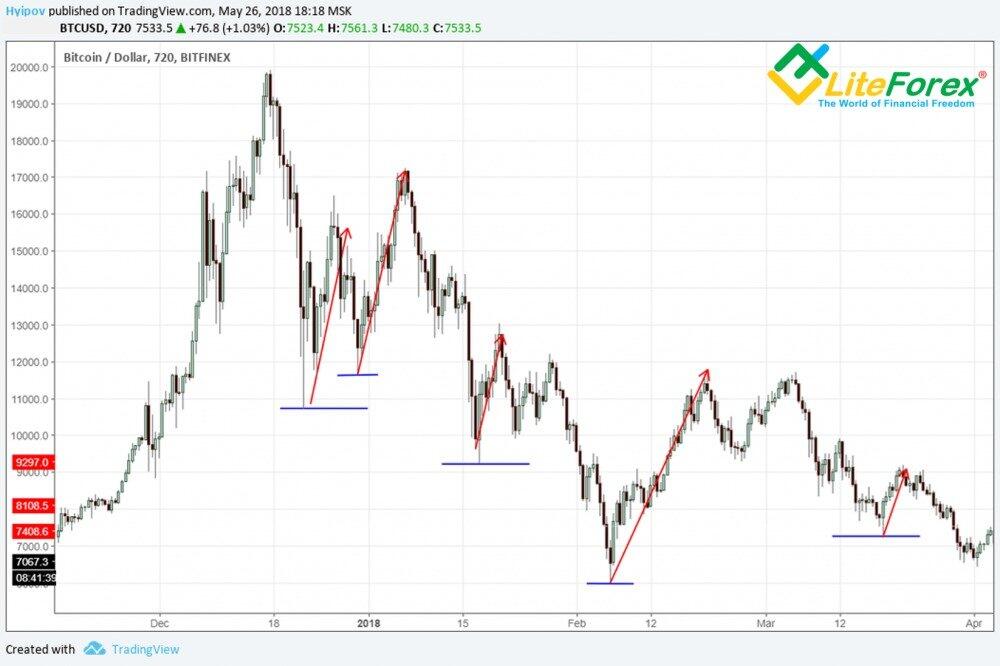
- A crack is a strong pulse movement of the ticker at a distance from the base level down to the formation of the next rebound (the green arrows in the chart below).
I should note that it is the crack that forms the safe zone.
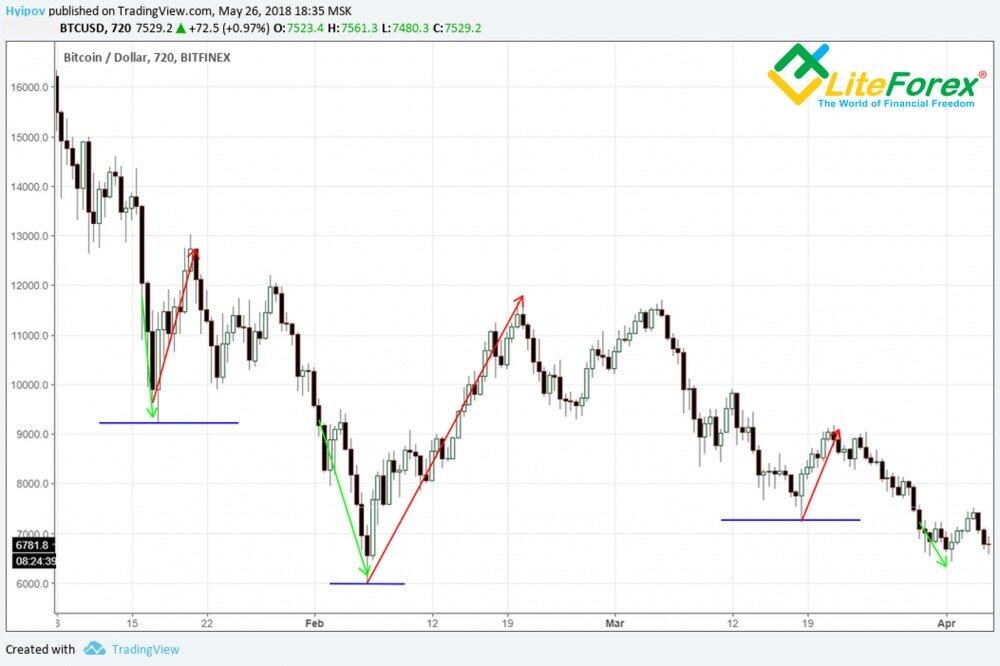
If we summarize all of the above, the entire strategy consists of 5 actions:
1. Find the base level in the chart and analyze its strength;
2. Analyze the retrospective of the trading instrument and assess the fall levels at panic sales in the past;
3. See how often there was a panic sale in this market and what were the reasons for it.
4. Calculate the average size of panic sales and offer your successful trade level. Set an alert at this level.
5. Wait for the next panic sale to enter the market, taking into account your risk management.
Now let's talk about these steps in more detail:
Step one. Look for the base level!
The currency exchange, like any other trading platform, is a place where people do not agree with the current price. One side wants to buy cheaper, another wants to sell for more. But there are levels at which the prices of buyers and sellers coincide and a transaction takes place. The stronger the buyer's reaction at this level, the better.
Step two. Read the history of the chart and assess the likelihood of the base being reached.
Usually this step takes about 30 seconds. Look at how often panic sales occur and the market returns to the previous base level.
By knowing your base levels and the frequency of panic impulse sales, you can calculate the likelihood of a new crack in the near future.
Thus, once you find a good trading instrument you can trade on it for several months.
Step three. Set an alert.
You have already found a suitable trading instrument, and determined the base level for the entry. We have calculated the probability of success and risks at this level.
Now all that remains is to set an alert at this level, and if successful, after a short analysis, make a buy trade.
Let's sum up the above:
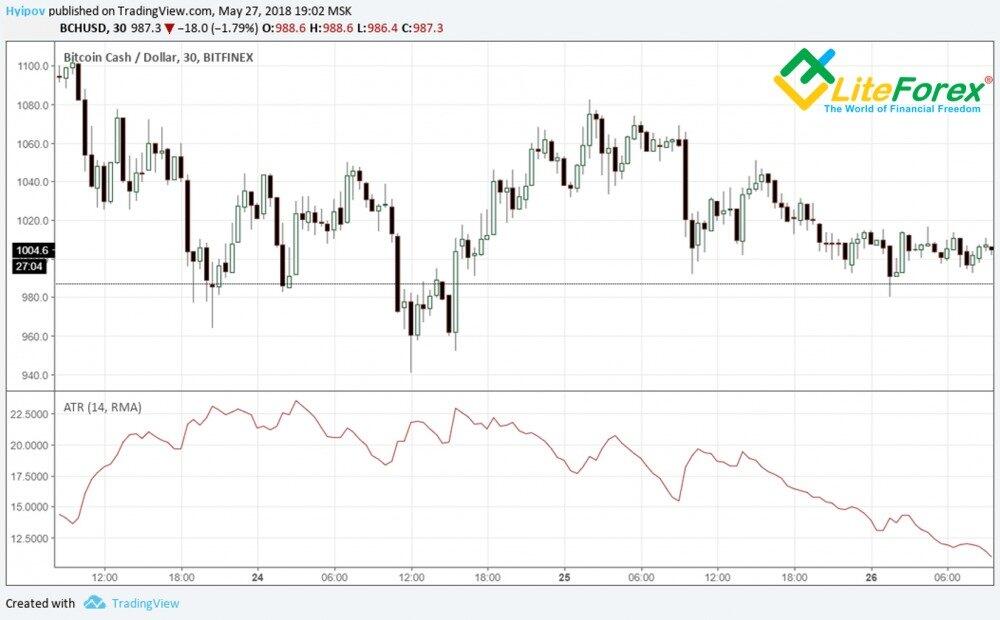
1. We are looking for a trading instrument, preferably one of the TOPs or the one which I am sure is not a scam. It is desirable to select the instrument with high volatility and a wide price range (it can be estimated with the help of the ATR indicator) - in this respect, cryptocurrency pairs with BTC and ETH are suitable for our needs;
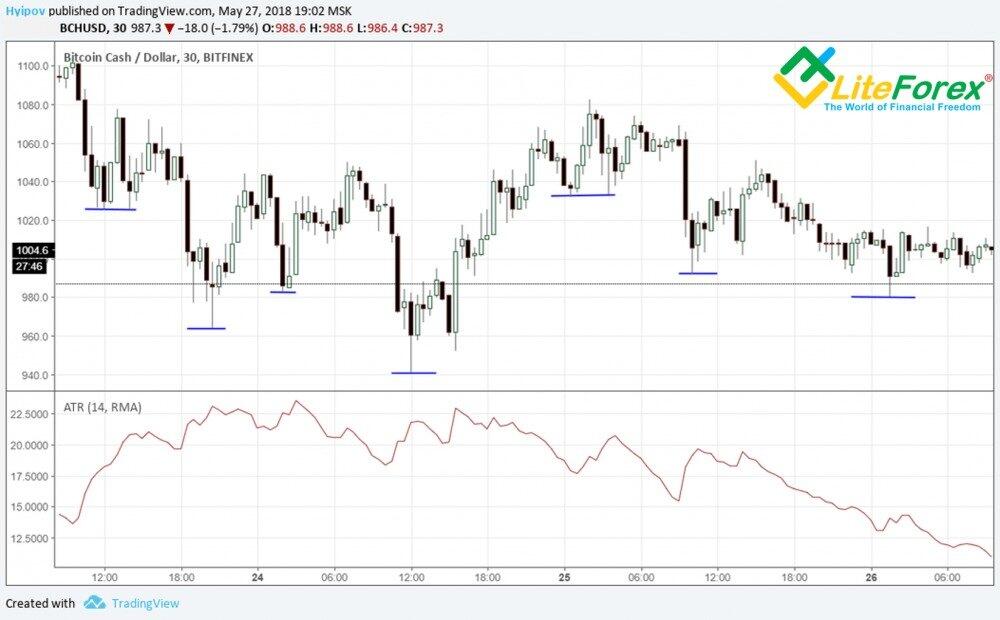
2. Look for the base level with large rebounds.
3. Analyze the history of the ticker. We need to find panic sales and look at how they work the previous base levels at the rebound. If in 9 cases out of 10, panic sales reached the previous level, which was higher in price, then your chance of success will be 90% (which is a very good chance);
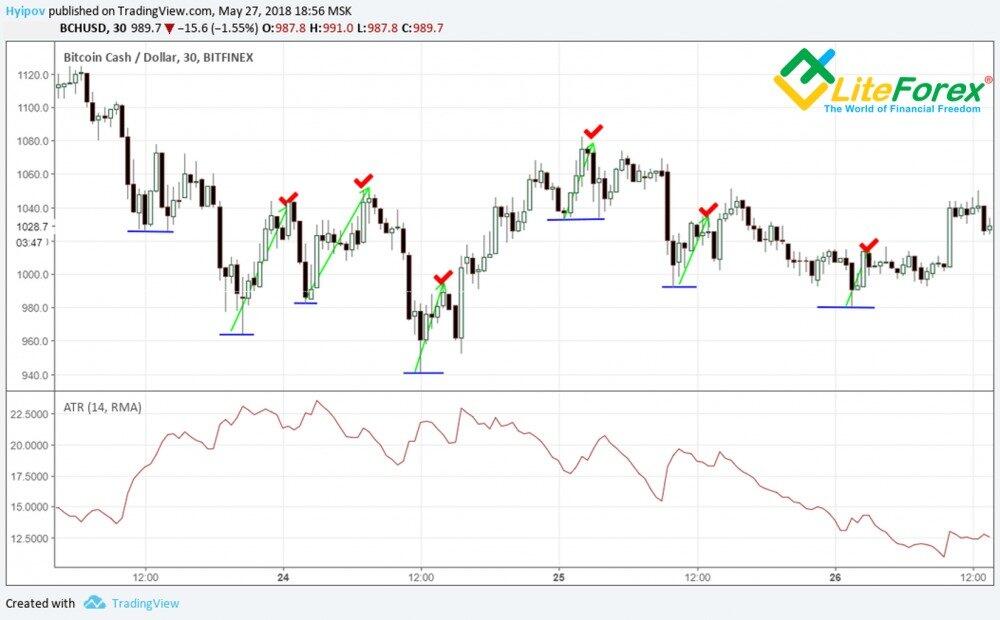
4. Start analyzing the history of the ticker on higher timeframes. (The author suggests starting the analysis with 1-2 month TFs, because the higher the timeframe, the more time you have to work out the signal and make a decision);
5. Learn to wait! If you trade on hourly charts, then you should expect your entry position to appear within 1-2 hours.
If you are trading on a 4-hour chart, you can expect the entry position to appear within a few days.
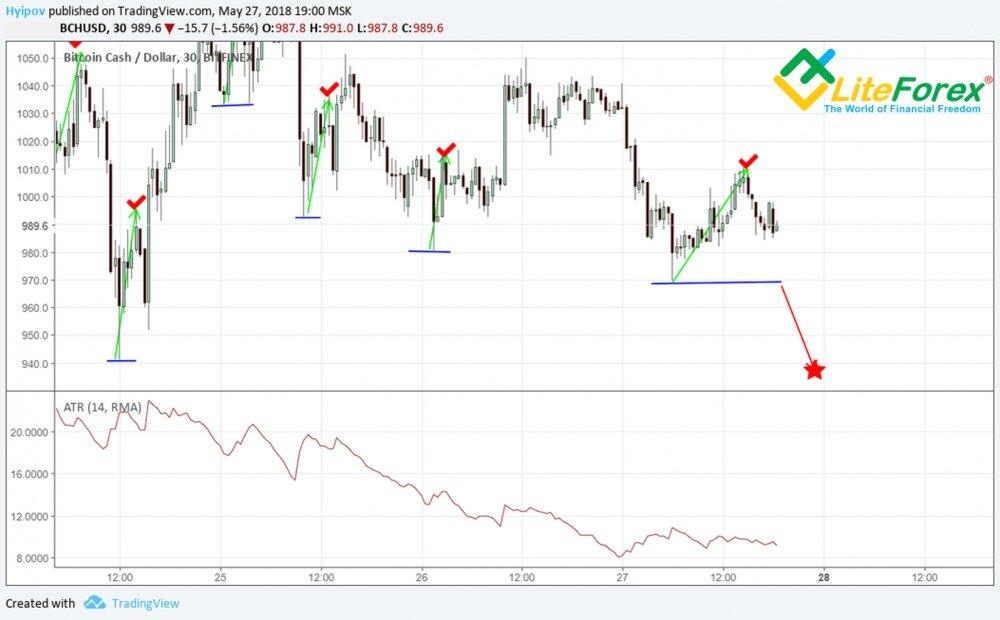
As you have already understood from the description, the crucial point for using the Quickfinger strategy is the precise identification of this basic level.
In order to determine the real base level of the price, ask yourself the following questions:
- Does this base level mean there is a buyer on the market? (look at the volumes and the rebound size). If these two signs are not there, you need to wait for the next base.
- Look at the previous two bases. Were there buyers?
- What happened at the time of formation of the base? Any events, news? If the fall was amid the bad news, after which the buyout occurred, then there is a strong buyer on the market.
- Where would I like to enter the market? Find the entry-level, which should be lower than the base level under consideration.
Remember this: no strong rebound - no good buy in the future.
How do I understand how deep the crack will be?
For this, you need to look at the retrospective of the last two months of ticker movement and note the previous bases and cracks in them. You can estimate the average crack size visually based on this data and use it. At the same time, you should not forget that if the base did not have a strong rebound, then the crack has a high probability of being less than average in size.
Also pay attention to the size of the rebound. If the rebound does not reach the previous base level, then the buyer has weakened, and entering a buy position in that case when a crack is being formed is a big risk!
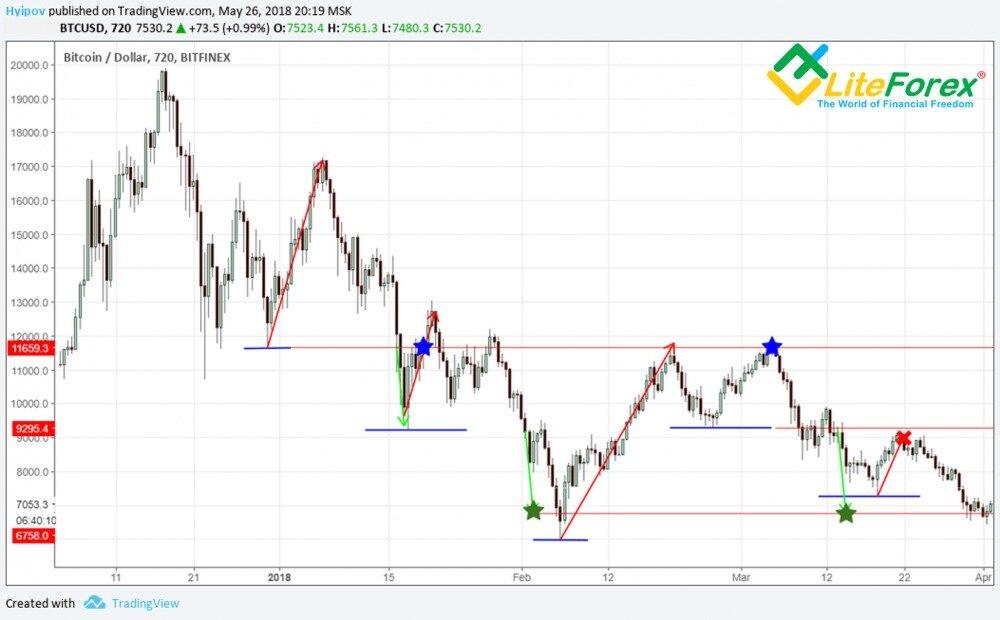
The chart above shows an example of a crack in which you can make a purchase and one in which you should not. In the first case, we see that the rebound has crossed the previous base level (marked by a blue star). Therefore, we can consider entering when the given base is broken out by the depth of the average crack (marked with a green star). Then we see that after the formation of the next base, the ticker did not go through it, but made another one above it at the level of 9295 USD. We see that the rebound from this base is rather flat and is at a smaller angle, which indicates the weakness of the buyer. Nevertheless, the rebound reaches the nearest base level, which means the future crack can also be considered for buy trades.
An experienced trader could adjust the entry-level and make it closer to the base based on the inclination of the rebound. If you did not, it's okay. You will still have the opportunity to enter the market in the future. As we see, the last rebound from the base was very weak, therefore, the buyer is weak, and the next crack should not be considered for buy trades.
This concludes the introductory part of the Quickfinger Luc strategy. I'll give more details about the elements of the strategy and how to trade in the next training block.
Good luck!
P.S. Did you like my article? Share it in social networks: it will be the best "thank you" :)
Useful links:
- I recommend trying to trade with a reliable broker here. The system allows you to trade by yourself or copy successful traders from all across the globe.
- Use my promo code BLOG to get a 50% deposit bonus on the LiteFinance platform. Simply enter this code in the appropriate field when funding your trading account.
- Telegram chat for traders: https://t.me/litefinancebrokerchat. We are sharing the signals and trading experience.
- Telegram channel with high-quality analytics, Forex reviews, training articles, and other useful things for traders https://t.me/litefinance

The content of this article reflects the author’s opinion and does not necessarily reflect the official position of LiteFinance broker. The material published on this page is provided for informational purposes only and should not be considered as the provision of investment advice for the purposes of Directive 2014/65/EU.
According to copyright law, this article is considered intellectual property, which includes a prohibition on copying and distributing it without consent.