The Walt Disney Company has solidified its position as a frontrunner in the entertainment industry, both domestically and internationally. The corporation's diverse portfolio encompasses a variety of sectors, including original content and TV series production, streaming services, theme parks, cruise lines, and licensed product manufacturing.
Disney shares are generally regarded as a valuable investment for long-term investors due to the company's reputable brand, diversified business model, and consistent demand for its products and content. Despite market fluctuations, the company continues to expand in high-value segments such as streaming and entertainment, solidifying its position as a valuable investment prospect.
In this article, we will review forecasts for 2026, 2027, 2028, and beyond, and analyze the asset using chart patterns and technical indicators. In addition, we will identify the primary trend for 2026 and outline potential entry zones, using additional tools. Media sentiment will indicate market participants' positioning, while the company's history and key metrics will help assess DIS's long-term outlook.
The article covers the following subjects:
- Major Takeaways
- DIS Real-Time Market Status
- DIS Stock Price Forecast for 2026 Based on Technical Analysis
- Analysts' DIS Price Projections for 2027
- Analysts' DIS Price Projections for 2028
- Analysts' DIS Price Projections for 2029
- Analysts' DIS Price Projections for 2030
- Analysts' DIS Price Projections until 2050
- DIS (Disney) Market Sentiment on Social Media
- DIS Price History
- DIS Fundamental Analysis
- More Facts About Disney
- How We Make Forecasts
- Conclusion: Is DIS a Good Investment?
- DIS Price Prediction FAQs
Major Takeaways
- The DIS stock price is trading at $105.48 as of 30.09.2026.
- The DIS price reached its all-time high of $201.91 on 08.03.2021. The stock's all-time low of $0.36 was recorded on 17.12.1974.
- Experts predict different scenarios for the DIS stock price movement in the second half of 2026. Some suggest the price may rise to $147.80 by year-end, while others assume it may drop to $94.30.
- According to analysts, the asset may move in various directions in 2027. In a favorable scenario, the price is projected to climb to $136.00. However, some experts believe the stock may fall to $98.97 by year-end.
- Mixed trends are projected for the period from 2028 to 2030. Some analysts predict an uptrend with the price increasing to $168.00 by 2030. Other experts anticipate the price will settle at $105.10 or decline to $47.83.
- Forecasts for the DIS stock price in 2040–2050 also vary significantly. Conservative estimates suggest the asset may plunge to $42.36 by 2040 and to $35.54 by 2050. Meanwhile, other forecasts predict the stock price will surge to $249.00 by 2037.
DIS Real-Time Market Status
The current DIS stock price is $105.48 as of 30.09.2026.
Tracking Disney's key financial metrics allows investors to objectively assess the company's financial strength, profitability, and upside potential. Revenue and net income show the current performance of a business, while the P/E ratio helps determine how undervalued or overvalued a stock is. Additionally, analyzing free cash flow and debt levels is crucial for assessing the company's overall financial strength. Disney+ subscriptions and operating margin reflect the company's prospects.
Regular analysis of these indicators helps make informed investment decisions and mitigate risks.
Metric | Value |
Revenue | $97.263 billion |
Net income | $11.224 billion |
EBITDA | $19.72 billion |
Shares outstanding | 1.737 billion shares |
Price-to-earnings (P/E) ratio | 16.1 |
Return on Equity (ROE) | 10.5% |
Return on Assets (ROA) | 6.2% |
Gross Profit Margin | 37.2% |
DIS Stock Price Forecast for 2026 Based on Technical Analysis
Let's perform a technical analysis of the weekly Disney chart to forecast the stock's price movements throughout the year.
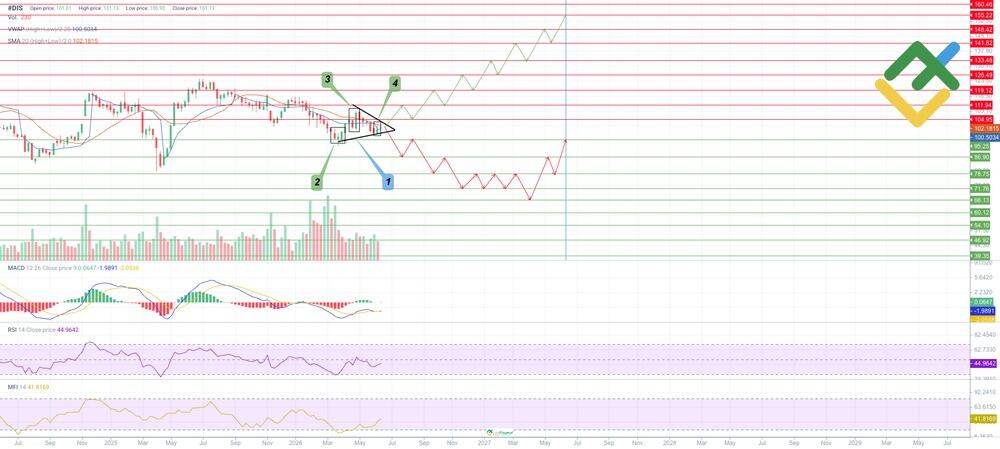
Since early May 2026, DIS's stock price has been declining. It is currently trading at 105.48. Technical indicators and candlestick patterns are giving mostly bullish signals:
- A major Symmetrical Triangle (1) pattern is forming on the weekly chart. The price may break out of this pattern in either direction. Within this pattern, the Morning Star (2), Bullish Engulfing (3), and Inverted Hammer (4) reversal patterns have developed in the 95.25–111.94 range. The combination of these patterns signals a potential shift to a bullish trend.
- MACD is moving sideways around the zero line, indicating a lack of momentum.
- The RSI is gradually rising, with the reading holding at 44. Upside potential remains.
- The MFI indicator is also increasing, reflecting an inflow of liquidity.
- The market price is located between the VWAP and the SMA20 line, pointing to a temporary consolidation and a balance of power between bulls and bears.
Below are the projected price levels for Disney (DIS) shares for the next 12 months:
Month | Minimum, $ | Average, $ | Maximum, $ |
July 2026 | 103.25 | 107.18 | 111.11 |
August 2026 | 104.68 | 108.85 | 113.02 |
September 2026 | 108.25 | 112.89 | 117.54 |
October 2026 | 112.06 | 116.23 | 120.40 |
November 2026 | 114.68 | 120.28 | 125.88 |
December 2026 | 118.97 | 123.37 | 127.78 |
January 2027 | 124.92 | 128.85 | 132.78 |
February 2027 | 125.40 | 132.06 | 138.73 |
March 2027 | 133.26 | 138.02 | 142.78 |
April 2027 | 132.30 | 139.21 | 146.12 |
May 2027 | 142.54 | 146.23 | 149.93 |
June 2027 | 145.40 | 149.80 | 154.21 |
Long-Term Trading Plan for #DIS for 2026
Technical analysis has enabled us to identify key support and resistance levels that you can use in your trading strategy for the coming year.
Trading Plan for the Year
- The price is expected to grow in the near future.
- Key support levels: 95.25, 86.90, 78.75, 71.76, 66.13, 60.12, 54.10, 46.92, and 39.35.
- Key resistance levels: 104.95, 111.94, 119.12, 126.49, 133.48, 141.82, 148.42, 155.22, and 160.46.
- Main long-term scenario: Open long trades above the key resistance level of 104.95 on increased volume or when the price rebounds from the 95.25 level, targeting the 111.94–160.46 range. Time horizon: 12 months.
- Alternative long-term scenario: Open short trades below the key support level of 95.25 on increased volume, with potential targets in the 86.90–39.35 range.
Analysts' DIS Price Projections for 2026
Most analysts expect Disney's stock to post moderate gains in the second half of 2026, bolstered by strong performance in its streaming business and higher revenue from theme parks. However, fierce competition in the media industry and ongoing uncertainty in the advertising market may cap the stock's upside potential.
LongForecast
Price range: $87.00–$120.00.
LongForecast expects Disney's stock price to climb to $111.00 by the end of August. In Q4, a correction is predicted, which may bring the stock price down to $95.00 by the end of November. At the end of the year, the stock is expected to rebound to $101.00.
Month | Min–Max, $ | Close, $ |
July | 89.00–112.00 | 104.00 |
August | 102.00–120.00 | 111.00 |
September | 93.00–111.00 | 101.00 |
October | 87.00–103.00 | 95.00 |
November | 87.00–103.00 | 95.00 |
December | 93.00–109.00 | 101.00 |
StockScan
Price range: $146.90–$168.70.
According to StockScan, the price may rise to $152.10 by the end of July. The bullish trend is expected to continue in Q3, with the price reaching $155.40 by the end of September. In Q4, gains are likely to slow, and the asset's price may settle at $147.80.
Month | Minimum, $ | Average, $ | Maximum, $ |
July | 147.10 | 152.10 | 168.70 |
August | 146.90 | 155.80 | 159.40 |
September | 148.30 | 155.40 | 157.50 |
October | 149.50 | 155.70 | 164.80 |
November | 151.10 | 159.80 | 166.10 |
December | 147.70 | 147.80 | 166.20 |
CoinCodex
Price range: $92.12–$134.23.
CoinCodex forecasts mixed price movements in the second half of 2026. By the end of August, the price is expected to range between $104.36 and $134.23, closing at $123.40. In Q3 and Q4, a predominantly bearish trend is anticipated, with the price sliding to $94.30 by year-end.
Month | Minimum, $ | Average, $ | Maximum, $ |
July | 104.36 | 115.89 | 134.23 |
August | 118.51 | 123.40 | 133.32 |
September | 100.26 | 106.90 | 117.06 |
October | 96.38 | 107.60 | 114.79 |
November | 98.98 | 102.51 | 106.30 |
December | 92.12 | 94.30 | 99.92 |
Analysts' DIS Price Projections for 2027
Most analysts expect Disney's stock to continue climbing in 2027, fueled by the completion of its restructuring efforts and the Direct-to-Consumer segment reaching sustainable profitability. New franchise launches and an expanded sports content offering could provide additional growth drivers.
Note: The price ranges below reflect the expected volatility of the asset over a year. The minimum and maximum prices may not be displayed in the tables.
LongForecast
Price range: $94.00–$154.00.
LongForecast predicts a positive trend for Disney's stock price throughout 2027. The price is predicted to remain at $103.00 in Q1, fluctuating between $94.00 and $125.00 during the first half of the year. The average price is projected to reach $116.00 in June. By the end of the year, the bullish trend is expected to continue, pushing the price up to $136.00.
Quarter | Min–Max, $ | Close, $ |
Q1 | 94.00–111.00 | 103.00 |
Q2 | 97.00–125.00 | 116.00 |
Q3 | 116.00–151.00 | 140.00 |
Q4 | 125.00–154.00 | 136.00 |
StockScan
Price range: $69.55 –$158.30.
According to StockScan, the Disney stock price will fluctuate broadly between $69.55 and $158.30 throughout 2027. The asset is estimated to reach $127.60 at the beginning of the year and then weaken, potentially dropping to $100.90 by year-end.
Quarter | Minimum, $ | Average, $ | Maximum, $ |
Q1 | 120.90 | 127.60 | 158.30 |
Q2 | 108.20 | 119.70 | 139.20 |
Q3 | 78.64 | 88.52 | 123.50 |
Q4 | 69.55 | 100.90 | 102.60 |
CoinCodex
Price range: $85.22–$121.49.
CoinCodex suggests the asset may reach $103.33 by the end of Q1. After that, price movement is expected to be uneven. The stock is projected to dip to $88.27 by the end of Q3 and then rebound to $98.97 by year-end.
Quarter | Minimum, $ | Average, $ | Maximum, $ |
Q1 | 94.01 | 103.33 | 121.49 |
Q2 | 94.26 | 97.35 | 110.38 |
Q3 | 85.87 | 88.27 | 97.06 |
Q4 | 85.22 | 98.97 | 103.05 |
Analysts' DIS Price Projections for 2028
Forecasts for 2028 point to continued growth, driven primarily by the expansion of Disney's theme parks, particularly in Asian markets, and the development of new themed attractions. The streaming business reaching positive free cash flow could provide additional support for the stock.
LongForecast
Price range: $113.00–$178.00.
LongForecast predicts that Disney's share price will reach $165.00 by the end of Q1 2028. During the first three quarters, the price is expected to move erratically, reaching $150.00 by the end of September. In Q4, the asset is forecast to decline, closing at $128.00.
Quarter | Min–Max, $ | Close, $ |
Q1 | 136.00–178.00 | 165.00 |
Q2 | 124.00–176.00 | 135.00 |
Q3 | 113.00–162.00 | 150.00 |
Q4 | 118.00–150.00 | 128.00 |
StockScan
Price range: $63.76 –$105.90.
StockScan estimates that the average price of the stock will reach $86.10 in Q1 and drop to $83.22 by mid-year. The downward trend is expected to persist in the second half of the year, pushing the price down to $69.37 by the end of December.
Quarter | Minimum, $ | Average, $ | Maximum, $ |
Q1 | 70.23 | 86.10 | 105.90 |
Q2 | 63.76 | 83.22 | 88.41 |
Q3 | 70.33 | 79.88 | 97.97 |
Q4 | 67.03 | 69.37 | 83.89 |
CoinCodex
Price range: $91.68–$131.47.
According to CoinCodex, the average price of DIS shares may reach $123.56 in Q1. Although the price is expected to stabilize in the first half of the year, it could stand at $109.05 by the end of June. In the second half of the year, the price is projected to move in different directions, settling at around $122.66 by year-end.
Quarter | Minimum, $ | Average, $ | Maximum, $ |
Q1 | 95.91 | 123.56 | 131.47 |
Q2 | 105.76 | 109.05 | 130.46 |
Q3 | 91.68 | 98.37 | 105.69 |
Q4 | 99.67 | 122.66 | 126.10 |
Analysts' DIS Price Projections for 2029
The outlook for 2029 is moderately positive. Potential acquisitions in the gaming industry and the increasing use of artificial intelligence in content creation could serve as additional growth drivers. However, the ongoing decline of traditional cable television is expected to continue weighing on legacy revenue streams. Despite these challenges, long-term investors generally remain cautiously optimistic about Disney's future prospects.
LongForecast
Price range: $109.00–$160.00.
LongForecast predicts that Disney's share price may reach $129.00 by the end of Q1 2029. Mixed performance is expected throughout the year, with the stock price potentially reaching $118.00 by mid-year. After rising to $138.00 in Q3, the price is forecast to consolidate, settling at $121.00 by year-end.
Quarter | Min–Max, $ | Close, $ |
Q1 | 119.00–147.00 | 129.00 |
Q2 | 109.00–135.00 | 118.00 |
Q3 | 118.00–160.00 | 138.00 |
Q4 | 109.00–138.00 | 121.00 |
StockScan
Price range: $59.04–$104.40.
StockScan forecasts an uptrend for DIS shares in 2029. The average share price is expected to reach $65.85 in Q1 and advance to $88.37 by Q3. By the end of the year, the uptrend is likely to decelerate, with the price settling at $87.25 in December.
Quarter | Minimum, $ | Average, $ | Maximum, $ |
Q1 | 60.01 | 65.85 | 72.72 |
Q2 | 59.04 | 73.03 | 76.93 |
Q3 | 69.22 | 88.37 | 93.53 |
Q4 | 84.78 | 87.25 | 104.40 |
CoinCodex
Price range: $89.32–$132.97.
According to CoinCodex, the average price of DIS shares will reach $108.70 in Q1 and increase to $126.85 by the end of June. Afterward, a correction may occur, causing the price to drop to $118.35 by the end of December.
Quarter | Minimum, $ | Average, $ | Maximum, $ |
Q1 | 104.57 | 108.70 | 122.30 |
Q2 | 89.32 | 126.85 | 132.97 |
Q3 | 120.69 | 123.96 | 132.87 |
Q4 | 110.76 | 118.35 | 124.26 |
Analysts' DIS Price Projections for 2030
According to analysts, Disney's stock outlook for 2030 remains uncertain. Intensifying competition in the streaming market, rising debt levels, weaker box office performance, and the risk of lower consumer spending during an economic slowdown could all weigh on the stock.
WalletInvestor
Price range: $75.51–$98.95.
WalletInvestor expects the stock to maintain its positive momentum in 2030. The average price is projected to reach $84.62 in Q1 and rise to $85.14 by mid-year. During the second half of the year, the uptrend is expected to strengthen, bringing the price to $94.61 by the end of December.
Quarter | Minimum, $ | Average, $ | Maximum, $ |
Q1 | 82.08 | 84.62 | 98.93 |
Q2 | 75.51 | 85.14 | 90.15 |
Q3 | 78.36 | 87.30 | 93.12 |
Q4 | 84.28 | 94.61 | 98.95 |
StockScan
Price range: $33.96–$107.80.
StockScan provides an ambiguous forecast regarding the performance of DIS shares throughout 2030. The average share price is expected to reach $95.85 by the end of Q1, decline to $85.41 in Q2, rebound to $99.10 in Q3, and then fall again to $47.83 by year-end.
Quarter | Minimum, $ | Average, $ | Maximum, $ |
Q1 | 84.12 | 95.85 | 101.00 |
Q2 | 81.74 | 85.41 | 96.14 |
Q3 | 83.03 | 99.10 | 107.80 |
Q4 | 33.96 | 47.83 | 102.00 |
CoinCodex
Price range: $99.11–$144.34.
According to CoinCodex, the average price of the Disney stock may reach $106.45 in Q1 2030. The price is expected to rise during the first three quarters, potentially hitting $123.43 by the end of September. In Q4, a correction may unfold, potentially dragging the asset's price down to $105.10.
Quarter | Minimum, $ | Average, $ | Maximum, $ |
Q1 | 100.52 | 106.45 | 123.51 |
Q2 | 103.26 | 108.79 | 116.89 |
Q3 | 106.10 | 123.43 | 144.34 |
Q4 | 99.11 | 105.10 | 123.46 |
Analysts' DIS Price Projections until 2050
It is extremely difficult to predict Disney's stock price over such a long period due to the high degree of uncertainty. Shifting consumer preferences, technological advances, regulatory changes, and geopolitical factors can greatly impact the company's business model. Furthermore, Disney stock reacts not only to financial results but also to the success of individual movies and theme parks, making forecasts decades into the future speculative.
Nevertheless, analyst forecasts remain a valuable tool for investors. They help identify long-term trends, such as the growth of the streaming industry and corporate expansion into new markets, while also promoting realistic return expectations and a more disciplined approach to investing. When incorporated into a long-term strategy, such forecasts can help mitigate risks and improve decision-making.
Coin Price Forecast offers a bullish long-term outlook for DIS stock, predicting the price may climb to $226.00 by 2035 and to $249.00 by 2037.
StockScan's forecasts indicate a bearish trend between 2030 and 2040. According to the platform, the Disney stock price may plummet to $42.36 by 2040 and to $35.54 by 2050.
Year | Coin Price Forecast, $ | StockScan, $ |
2035 | 226.00 | 56.90 |
2037 | 249.00 | – |
2040 | – | 42.36 |
2045 | – | 15.17 |
2050 | – | 35.54 |
DIS (Disney) Market Sentiment on Social Media
Media sentiment reflects the overall attitude of investors as expressed through social media posts, comments, and online discussions. Positive sentiment can support DIS stock, while negative sentiment may weigh on the share price as market participants react emotionally to unfavorable news or opinions.
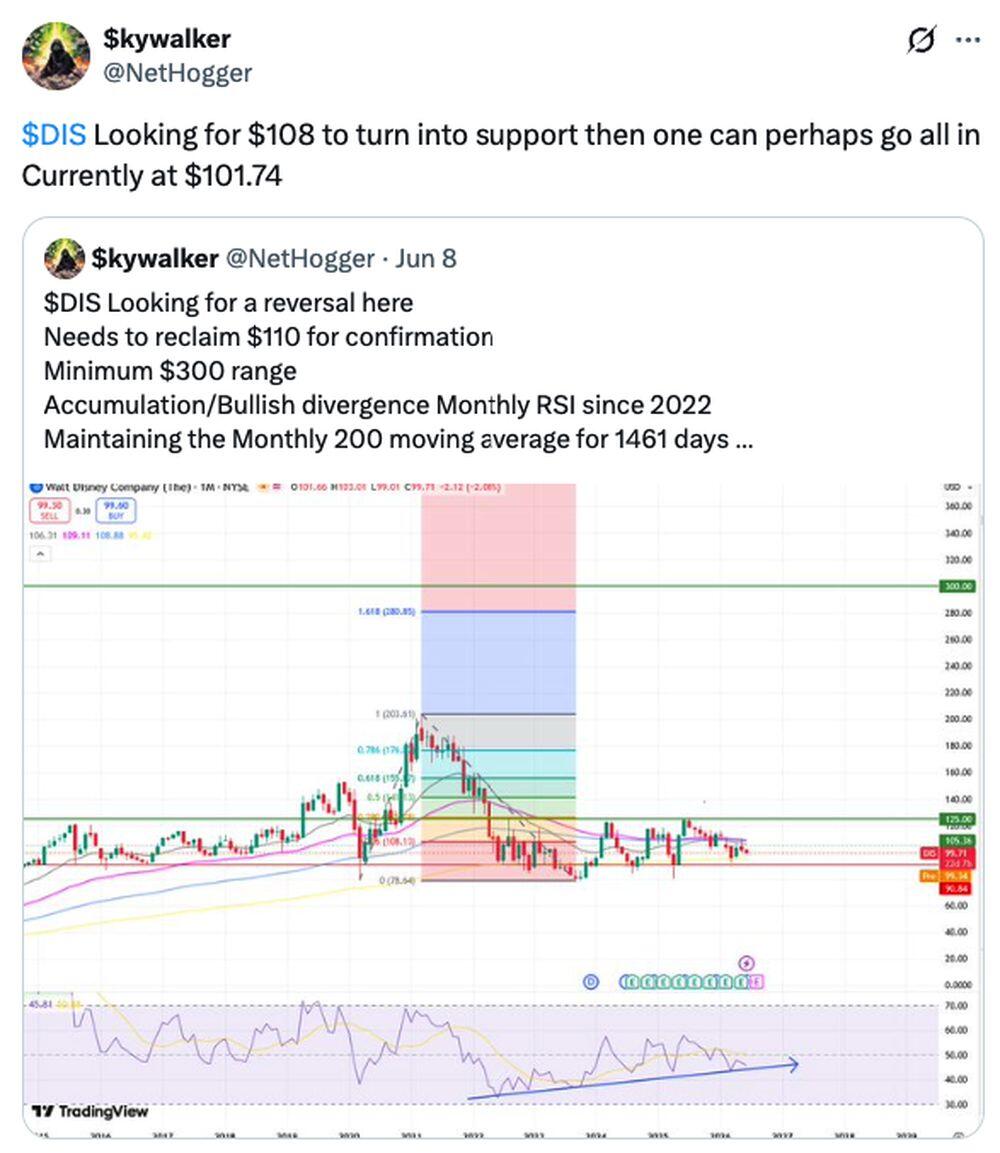
For example, user @NetHogger posts on X (formerly Twitter) that DIS will rise to $300.00 if it stays above the $108.00–$110.00 range.
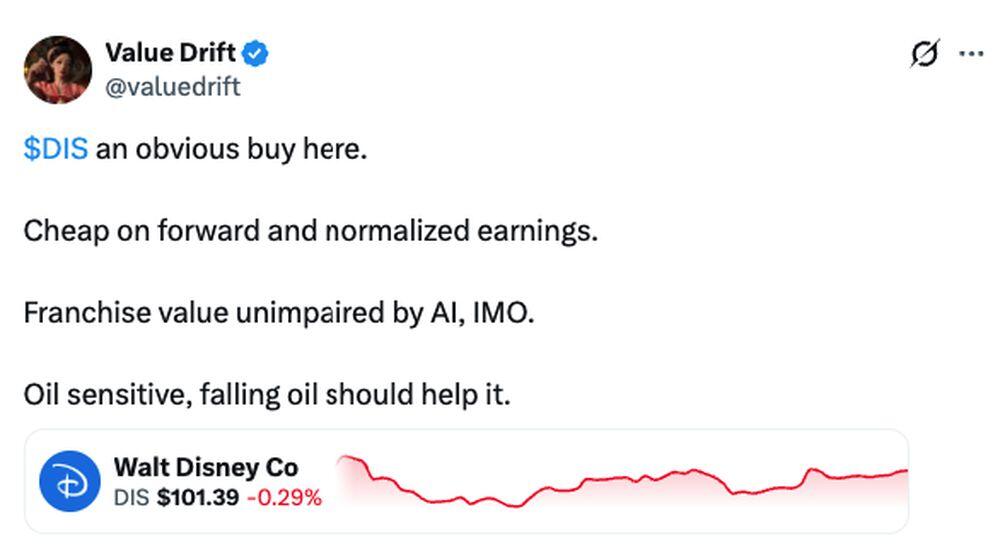
Independent expert @valuedrift suggests buying DIS stocks, noting their attractive price. The user believes the adoption of artificial intelligence is unlikely to negatively impact the company's stock price, and falling oil prices could serve as an additional growth driver.
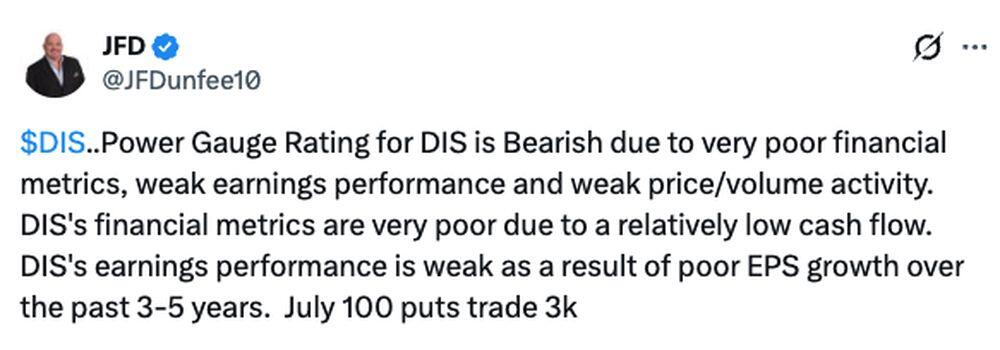
Analyst @JFDunfee10 has a bearish outlook on the DIS stock, expecting the price to decline due to the company's weak financial results and low earnings per share over the past 3–5 years.
The analysis of posts on X shows that traders and investors remain uncertain about DIS's future performance. Nevertheless, the company's overall assessment remains largely positive.
DIS Price History
Disney (DIS) reached its all-time high of $201.91 on 08.03.2021. The lowest price of Disney (DIS) was recorded on 17.12.1974 when the stock declined to $0.36.
It is crucial to evaluate historical data to make predictions as accurate as possible. Below is a chart showing the performance of DIS over the last ten years.
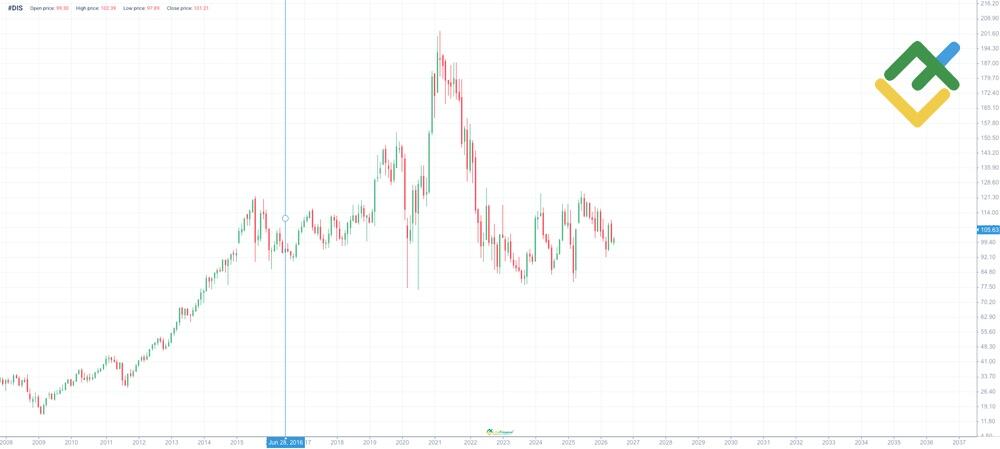
The Walt Disney Company's shares have demonstrated significant appreciation since going public in 1957:
- 1957–1980. DIS shares traded mainly at low levels, not exceeding $5. The company's main revenue came from the production of animated films, amusement parks, and broadcasting, which contributed to moderate growth in share prices.
- 1984–1990. Michael Eisner was appointed CEO of the Walt Disney Company. Shares surged to around $40 on the back of the success of Disney's animated films such as The Little Mermaid, The Lion King, Beauty and the Beast, and others.
- 2005–2011. Disney acquired Pixar and Marvel. DIS stocks returned to $40–$45 after a short-term decline amid the dot-com crisis.
- 2012–2015. The acquisition of Lucasfilm, as well as the success of Marvel and Star Wars, drove the company's stock price up to $120.
- 2019–2020. The beginning of the streaming revolution, which saw a significant increase in popularity during the COVID-19 pandemic. Disney's shares surged to $150.
- 2021. The price hit a new all-time high of around $203.02, thanks to the success of Disney+, which attracted over 100 million subscribers.
- 2024. Disney posted strong fourth-quarter financial results: revenues rose 6.3%, and earnings per share rose to $1.14. In addition, research firm Redburn Atlantic upgraded its outlook for Walt Disney stock from "neutral" to "buy" and increased its target price from $100 to $147.
- 2025. In February, Disney's share price declined to the $105–107 range. In April, the drop accelerated, with the price reaching a new local low near $80.00. During the summer, the price rose above $120, before correcting to the $100–115 range by the end of the year.
- 2026. Until mid-January, the price hovered around the $113.00–$114.00 range. From mid-January to late March, it declined to $92.16. The asset then rebounded to $110.48 between early April and early May, supported by news of a new theme park launch in China. By mid-June, it had corrected to $100.78 amid broader market volatility and investor focus on upcoming earnings reports.
DIS Fundamental Analysis
Fundamental analysis plays a key role in stock valuation. It helps determine the real value of a company and its upside prospects. Fundamental analysis involves examining financial statements (revenues, earnings, debts), competitive advantages, a business model, industry conditions, and macroeconomic factors.
With Disney's stock, for example, it is essential to consider streaming revenue, theme park attendance, film box office returns, and management decisions.
What Factors Affect the DIS Stock?
- Financial metrics. Revenue, net income, margins, the P/E (price-to-earnings) ratio, and revenue gains from various business units (streaming, parks, film industry).
- Disney+ and streaming services development. Number of subscribers, profitability, and audience churn rate.
- Revenue from theme parks and resorts. Attendance, ticket prices, guest spending, and the impact of macroeconomic factors.
- Film industry and content. The success of movies and TV series, box office returns, content licensing, and franchise popularity.
- Dividend policy. Renewed or increased payouts to shareholders can positively impact the share price.
- Management and strategy. Top management decisions, restructuring and cost-cutting plans, etc.
- Macroeconomic situation. Inflation, interest rates, the state of the US economy, and the global entertainment market.
- Regulatory and litigation matters. Antitrust investigations, disputes with state authorities, and legislative initiatives.
More Facts About Disney
The Walt Disney Company, founded in 1923 by brothers Walt and Roy Disney, has become one of the largest media companies in the world. In 1928, the iconic character Mickey Mouse appeared. In 1937, Disney released its first full-length animated film, Snow White and the Seven Dwarfs. The opening of the first Disneyland theme park in 1955 became the cornerstone of a global entertainment empire.
In the 1990s, Disney produced hits like "The Lion King" and "Aladdin." After that, the company expanded aggressively, acquiring major studios, including Pixar in 2006, Marvel in 2009, and Lucasfilm in 2012. Additionally, in 2019, Disney took over part of the assets of 21st Century Fox. That same year, the Disney+ streaming service was launched, positively impacting the share price.
Investors appreciate Disney for its revenue diversification (film production, parks, streaming services), strong brands (Marvel, Star Wars), and global presence. The company demonstrates financial stability and is successfully adapting to the digital age, ensuring its long-term growth.
Advantages and Disadvantages of Investing in DIS
Investors are keeping a close eye on the company's stock. Although investing in Disney is associated with high upside potential, it also involves risk due to its dependence on the entertainment sector and stiff competition. Let's examine the advantages and disadvantages in more detail.
Advantages
- Business diversity. Disney has several revenue sources, such as theme parks, film production, television, and streaming services. This diversity reduces risks.
- Strong brands. The company owns legendary franchises (Mickey Mouse, Marvel, Star Wars, Pixar) that provide a stable revenue stream.
- Global presence. Parks and content are available worldwide, expanding audiences and markets.
- Digital transformation. Disney+ is rapidly gaining popularity, allowing the company to remain competitive in the streaming era.
- Solid growth over decades. The company has shown sustainable expansion throughout the decades due to innovation, adaptation to trends, and competent management.
- Liquidity. The company's shares are included in key stock indices (S&P 500, Dow Jones, Nasdaq-100).
Disadvantages
- Dependence on the entertainment industry. Theme parks and film premieres are sensitive to economic crises, as seen in 2020 during the COVID-19 pandemic.
- Streaming competition. Disney+ competes with Netflix, Amazon Prime Video, Apple TV+, and other giants, which requires greater investment in content.
- High costs. Business expansion, film production, and supporting digital platforms require significant expenditure, which can impact profits.
- Regulatory risks. Acquisitions of large assets like 21st Century Fox may raise antitrust concerns.
- Market oversaturation. Possible oversaturation of media content may reduce audience interest in new Disney projects.
Disney holds tremendous potential with its vast array of assets, including popular streaming platforms, legendary franchises, and amusement parks. However, the landscape is increasingly competitive, with rivals like Netflix launching their own services, developing trendy new brands, and merging with other companies. In order to invest in Disney, market participants need to monitor the entertainment industry and keep a close eye on competitors.
How We Make Forecasts
When analyzing stocks, technical and fundamental approaches are usually used. Technical analysis includes studying price movements, identifying key support and resistance levels, and determining long-term trends. Moving averages (SMA, EMA), oscillators (RSI, MACD), pivot points, and the Ichimoku indicator are utilized for more accurate forecasts. They help to estimate the price direction, determine the overbought or oversold condition, and find optimal points for opening trades.
Fundamental analysis focuses on a company's financial indicators, such as earnings, revenue, dividends, and liquidity ratios. Macroeconomic factors such as central bank interest rates, economic growth rates, unemployment, and the geopolitical environment are also factored in. Besides, studying company reports, analysts' opinions, and expert forecasts is crucial. Moreover, media sentiment helps gauge investor sentiment in the market.
Combining these methods can provide a detailed picture for making informed investment decisions over different time frames.
Conclusion: Is DIS a Good Investment?
Disney remains one of the world's largest media companies, with a unique portfolio of assets that includes film studios, theme parks, streaming services, sports broadcasting rights, and merchandising. The company is actively adapting to the digital age, although it continues to face high content production costs and fierce competition.
DIS stock may be an attractive long-term investment for those seeking exposure to a strong and resilient brand. Disney has successfully navigated numerous challenges over the years, and its current valuation appears reasonable. Continued investment in technology and digital platforms could support the company's future growth.
However, DIS shares may remain volatile in the short term due to macroeconomic headwinds. Investors with a 5–10-year horizon may consider gradually accumulating the stock during market corrections. The main risks are a slowdown in its theme park and streaming businesses.
DIS Price Prediction FAQs
The current DIS stock price is $105.48 as of 30.09.2026.
Disney's stock may rise further, driven by growth in its streaming business, expansion of its entertainment ecosystem, and a strong brand portfolio. However, actual stock price movements will depend on financial results and market conditions.
The consensus forecast is for DIS to reach around $100.90 by 2027. Optimistic scenarios suggest an increase to $136.00, while conservative estimates range from $88.27 to $98.97.
According to forecasts, the DIS stock price may reach $168.00 by 2030. However, some analysts foresee a less favorable scenario, with the price falling to $47.83.
Investing in Disney shares can be a lucrative opportunity for long-term investors, particularly if the company's business restructuring efforts are successful. However, given the high volatility and competition, it is essential to exercise caution. This opportunity is ideal for investors who are willing to assume risks and analyze fundamental changes.
The exact real value is debatable. Some consider the stock to be undervalued given the brand's potential, while others believe it is overvalued due to sluggish profit margins. It is important to take into account not only current prices but also long-term revenue and profit trends.
Price chart of #DIS in real time mode
The content of this article reflects the author’s opinion and does not necessarily reflect the official position of LiteFinance broker. The material published on this page is provided for informational purposes only and should not be considered as the provision of investment advice for the purposes of Directive 2014/65/EU.
According to copyright law, this article is considered intellectual property, which includes a prohibition on copying and distributing it without consent.