The futures market expects the repo rate to rise from 3.75% to 4.25% in 2026. However, the weakness of the UK economy and labor market will most likely prevent the Bank of England from taking aggressive action. Let's discuss this topic and develop a trading plan for the GBP/USD pair.
The article covers the following subjects:
Major Takeaways
- Markets estimate the scale of the BoE's rate hike at 47 basis points.
- There will be a split within the MPC.
- The pound will continue to react to geopolitical developments.
- If GBP/USD quotes fail to settle above 1.345, short trades can be considered.
Weekly Fundamental Forecast for Pound Sterling
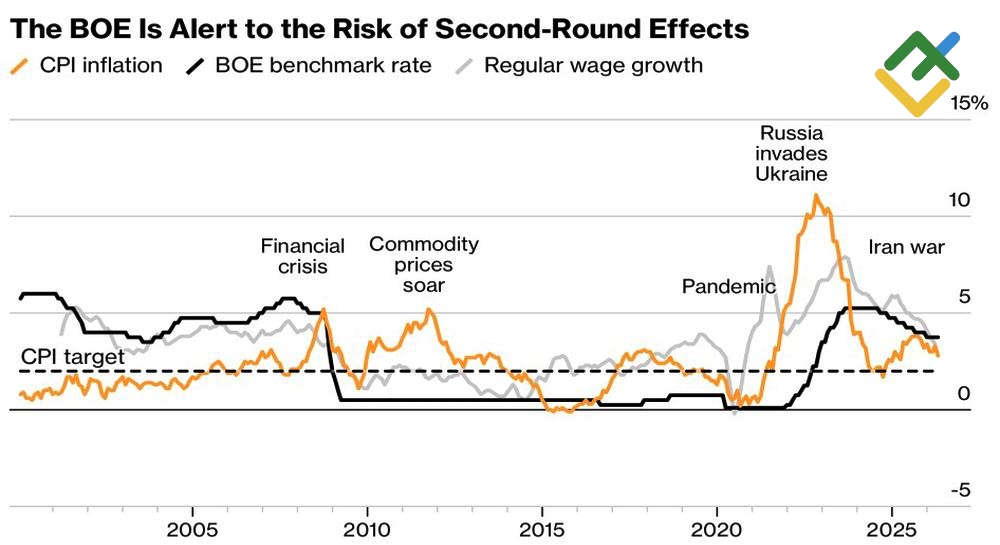
Investors have factored in the fastest inflation growth in the UK among G7 countries and estimate that the Bank of England's monetary tightening in 2026 will total 47 basis points. The first 25-basis-point hike in the repo rate is expected by September, and the probability of a second round of monetary tightening by year-end stands at 85%. These factors are preventing the GBP/USD pair from collapsing amid the ongoing conflict in the Middle East. However, the pound's advantage may not be as strong as it appears.
The OECD believes that the Bank of England will keep the repo rate at 3.75% until the end of 2026 and lower it to 3.5% in 2027, even though inflation may exceed the 2% target for an extended period. According to the organization, consumer price growth, driven by the energy shock, is temporary, and weakness in the UK labor market will keep price pressures in check.
UK Inflation, Repo Rates, and Wages
Source: Bloomberg.
The OECD's forecasts appear reasonable in light of Andrew Bailey's statement about the need to be patient with inflation. According to the BoE governor, signs of weakness in the UK economy, coupled with uncertainty regarding the energy shock, require the central bank to be patient about consumer prices remaining above target. It is necessary to support GDP. However, the regulator's patience will wane if second-order effects begin to surface.
In contrast, Monetary Policy Committee member Megan Greene, one of the BoE's leading hawks, believes it is necessary to raise the repo rate as soon as possible. In her view, the speed of the response to inflation is just as important as the scale of monetary tightening. Such rhetoric increases the likelihood of a split at the MPC's upcoming June 18 meeting. In April, officials voted 8 to 1 to keep borrowing costs unchanged, with Chief Economist Huw Pill the sole dissenter.
The OECD is likely to be proven right. The stagflationary backdrop will prevent the Bank of England from tightening monetary policy to the extent that futures markets expect. While the US economy can function under higher rates, its UK counterpart can hardly do so. This makes the outlook for the GBP/USD pair bearish.
In the short term, the pair's performance will be driven by events in the Middle East and the reaction of US stock indices to them. For a long time, the S&P 500 has disregarded geopolitics, but a pullback in the index will act as a catalyst for the US dollar's strengthening.
Weekly Trading Plan for GBP/USD
Against this backdrop, investors should consider risks on both sides. If the conflict in the Middle East escalates, or GBP/USD quotes fail to settle above 1.345, short positions can be considered.
This forecast is based on the analysis of fundamental factors, including official statements from financial institutions and regulators, various geopolitical and economic developments, and statistical data. Historical market data are also considered.
Price chart of GBPUSD in real time mode
The content of this article reflects the author’s opinion and does not necessarily reflect the official position of LiteFinance broker. The material published on this page is provided for informational purposes only and should not be considered as the provision of investment advice for the purposes of Directive 2014/65/EU.
According to copyright law, this article is considered intellectual property, which includes a prohibition on copying and distributing it without consent.