Brent is not breaking records despite a roughly 20% drop in supply—a seeming paradox, but one with clear explanations. Rising US exports, falling global inventories, and weaker Chinese imports are supporting the oil market. The key question is whether this balance can last. Let's analyze the situation and develop a trading plan.
The article covers the following subjects:
Major Takeaways
- Global oil inventories are falling by 4 million bpd.
- US seaborne exports have exceeded 10 million bpd.
- China may reduce imports to 6.9 million bpd.
- Long positions on Brent can be considered with targets of $115 and $125.
Weekly Fundamental Forecast for Oil
Against the backdrop of the most severe oil crisis in history, prices do not skyrocket. According to the US Energy Information Administration, 20.7 million bpd passed through the Strait of Hormuz in October–December. In January–March, that figure fell to 14.6 million bpd. In April–May, it plummeted almost to zero. The market has lost about 20% of its supply, production in Saudi Arabia has fallen to 6.3 million bpd—the lowest level since 1990—and Brent is barely above $100 per barrel. Has the oil market adapted so quickly, or is this the calm before the storm?
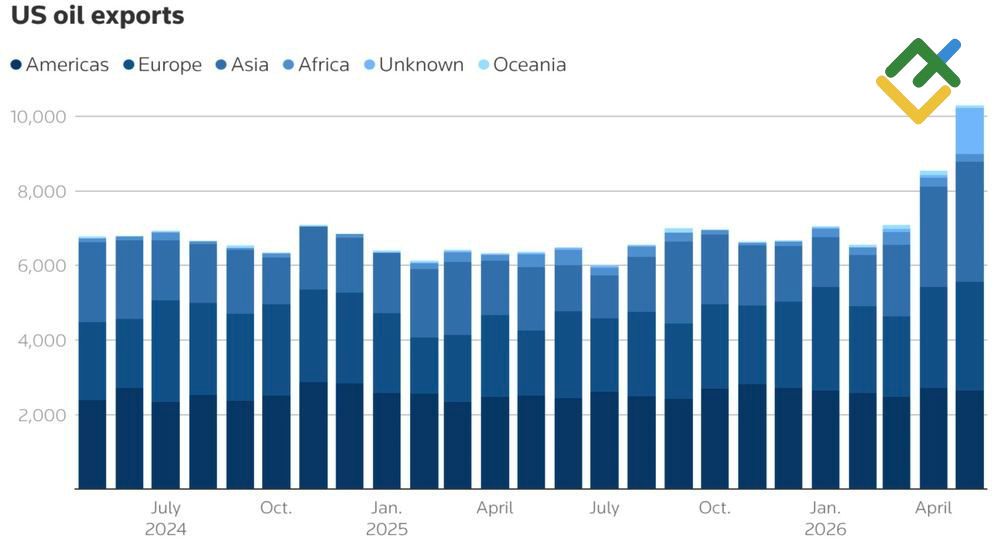
The key factors stabilizing Brent were increased exports from the US and Latin American countries, a decline in Asian imports, and a sharp drop in global inventories. According to Kpler, oil shipments from the United States by sea reached 8.55 million bpd in April and are expected to exceed 10 million bpd in May.
US Oil Exports
Source: Reuters.
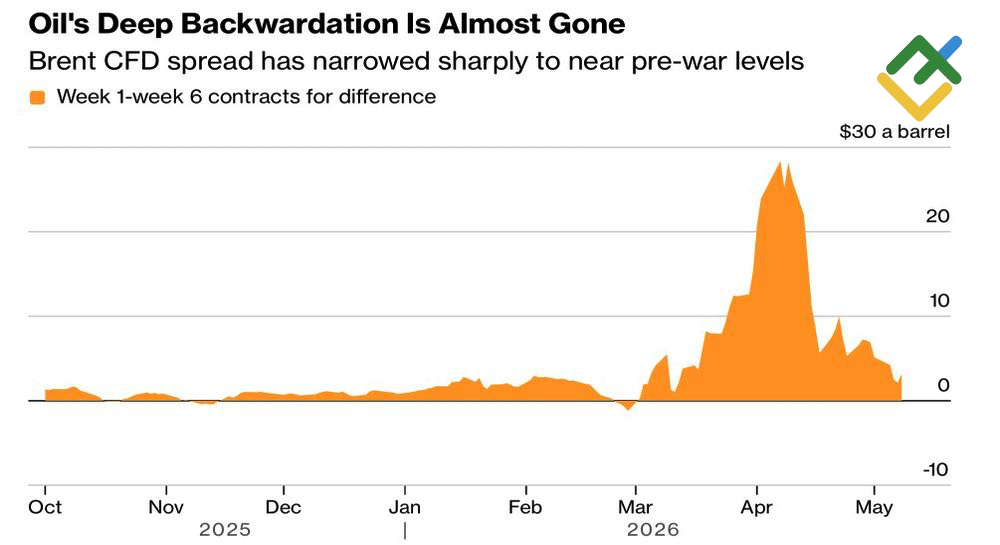
Before the armed conflict in the Middle East, more than 60% of the oil supplied to Asia came from the Gulf countries. The crisis forced them to look for alternatives and led to record premiums between the spot and futures markets. By mid-May, they had returned to pre-war levels, as shipping oil by sea from the US and Latin America is time-consuming. The first barrels of oil are only now beginning to arrive in Japan and other countries in the region.
Premium Between Spot and Futures Oil Markets
Source: Bloomberg.
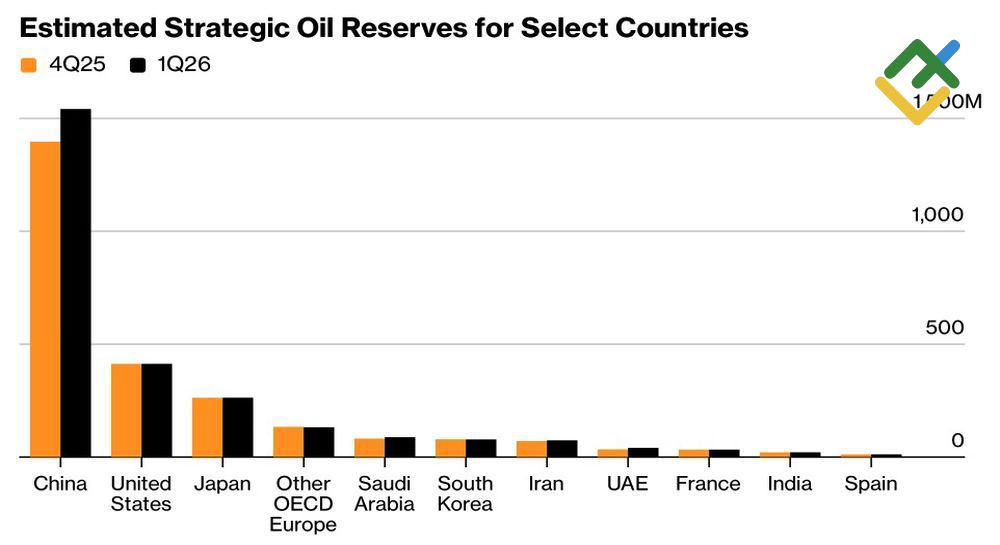
China is playing its part in rescuing the global economy. With the world’s largest strategic reserves, China is in a position to reduce its crude oil imports. According to Kpler, seaborne purchases fell from a near-record 11.5 million bpd in February to 8 million bpd in April. In May, the figure may fall to 6.9 million bpd.
Strategic Oil Reserves
Source: Bloomberg.
The growing global oil market deficit is leading to a rapid decline in global inventories. According to the IEA, inventories fell by 4 million bpd in April and May. The longer the Strait of Hormuz remains closed, the faster inventories will drop to a critical level.
The current situation is more like the calm before the storm. As the driving season approaches in the US, domestic demand for oil and petroleum products will increase. The potential for US exports, given the existing infrastructure, is limited. Global reserves are dwindling before our eyes, and only China knows how long it intends to keep imports at a low level.
Weekly Trading Plan for Brent
Since the US has no options other than a lousy agreement or renewed hostilities, Brent may surge even further toward $115 and $125 per barrel. Growing optimism about China's involvement in US-Iran negotiations could trigger a temporary price decline, offering an opportunity to open and build up long positions in oil.
This forecast is based on the analysis of fundamental factors, including official statements from financial institutions and regulators, various geopolitical and economic developments, and statistical data. Historical market data are also considered.
Price chart of UKBRENT in real time mode

The content of this article reflects the author’s opinion and does not necessarily reflect the official position of LiteFinance broker. The material published on this page is provided for informational purposes only and should not be considered as the provision of investment advice for the purposes of Directive 2014/65/EU.
According to copyright law, this article is considered intellectual property, which includes a prohibition on copying and distributing it without consent.