Pfizer (#PFE) stocks have garnered considerable attention from investors thanks to their promising upside potential and highly active market conditions. Amid global economic volatility and new healthcare challenges, #PFE offers a compelling option for both short- and long-term investments.
Forecasts for the coming years show a wide range of potential prices, reflecting possible fluctuations and yield increases. Analyzing current trends and seasonal movements presents a unique opportunity to identify optimal market entry points and assess investment risk.
This article provides an in-depth analysis of Pfizer stocks, helping you grasp the intricacies of the market and empowering you to make more informed trading decisions.
The article covers the following subjects:
- Major Takeaways
- Pfizer (PFE) Real-Time Market Status
- Pfizer (PFE) Stock Price Forecast for 2026 Based on Technical Analysis
- Analysts' PFE Price Projections for 2027
- Analysts' PFE Price Projections for 2028
- Analysts' PFE Price Projections for 2029
- Analysts' PFE Price Projections for 2030
- Analysts' PFE Price Projections up to 2050
- PFE (Pfizer) Market Sentiment on Social Media
- Pfizer (PFE) Price History
- Pfizer (PFE) Fundamental Analysis
- More Facts About Pfizer (PFE)
- How We Make Forecasts
- Conclusion: Is Pfizer (PFE) a Good Investment?
- Pfizer Price Prediction FAQs
Major Takeaways
The PFE stock price is trading at $28.68 as of 27.09.2026.
The PFE price reached its all-time high of $61.25 on 16.12.2021. The stock's all-time low of $0.43 was recorded on 04.10.1974.
In 2024, the company implemented strategic initiatives to optimize its product lineup and expand its global footprint.
The PFE stock is traded on the New York Stock Exchange (NYSE) under the ticker symbol #PFE, making it accessible to a wide range of investors.
The company maintains stable operating profit by actively investing in research and innovation.
Free cash flow makes it possible to finance new projects and maintain a proper dividend policy.
Forecasts for 2026 vary. According to some estimates, PFE is expected to trade within the $16.45–$26.98 range, while more optimistic forecasts suggest the stock could rise to $40.37.
Expectations for 2027 also differ significantly. Bearish forecasts point to a decline to $13.22, while more optimistic projections suggest growth to $50.54.
Forecasts for 2028–2030 vary widely. Under favorable market conditions, the stock could rise to $31.29. However, some analysts consider a decline toward the $9.00–$11.00 range to be the more likely outcome.
Forecasts beyond 2030 should be treated as rough estimates rather than precise predictions, as it is impossible to accurately predict future fundamental developments and their impact on the stock. Nevertheless, some analytical platforms expect PFE to rise to $44.14 by 2037. Others, by contrast, forecast a decline to $9.02 by 2040 and to around $0.29 by 2050.
Pfizer (PFE) Real-Time Market Status
The current Pfizer (#PFE) stock price is $28.68 as of 27.09.2026.
Investors should monitor key metrics that help assess the financial strength of a company, upside potential, and stock liquidity. For example, market capitalization indicates the overall value of the company, while trading volume reflects market activity. The P/E ratio assesses stock profitability, and the price change over the last 12 months helps to assess the stock's performance. Additionally, dividend yield and maximum supply help gauge shares' profitability and availability.
Metric | Value |
Market cap | $138.61 billion |
Trading volume | 58.1 million shares |
P/E ratio | 18.56 |
All-time high | $61.25 |
Price change over the last 12 months | -1.98% |
Dividends | $1.72 |
Shares outstanding | 5.7 billion |
Pfizer (PFE) Stock Price Forecast for 2026 Based on Technical Analysis
Pfizer (PFE) remains under pressure after breaking below a group of moving averages. The price is trading below the 21-day, 50-day, and 100-day SMAs, confirming weak buying interest.
The nearest support zone is located between $23.62 and $23.04. The overall technical picture points to further downside. If this support is broken, the price could decline toward $22.00, temporarily rebound to $23.62, and then continue falling toward the $20.00 area. No clear classical chart pattern is currently visible. Instead, the price action suggests a bearish breakout from a sideways trading range.
The RSI is holding around 36, indicating weak momentum without signs of oversold conditions. MACD remains below the zero line, confirming continued selling pressure. The OBV remains low, indicating a lack of sustained volume accumulation.
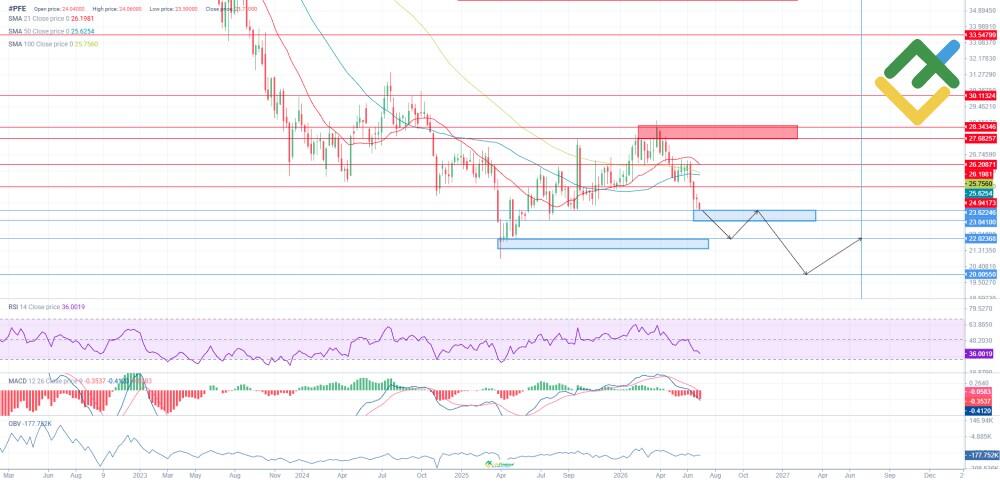
Unless the price moves back above $26.20, sellers are expected to remain in control, and rebounds from support should be viewed as corrective moves within PFE's broader downtrend.
Below are the projected price levels for Pfizer (PFE) shares for the next 12 months:
Month | Low, $ | High, $ |
July 2026 | 23.04 | 24.94 |
August 2026 | 22.02 | 23.62 |
September 2026 | 21.60 | 22.02 |
October 2026 | 22.02 | 23.62 |
November 2026 | 23.04 | 23.62 |
December 2026 | 22.02 | 23.04 |
January 2027 | 21.00 | 22.02 |
February 2027 | 20.00 | 21.00 |
March 2027 | 20.00 | 20.50 |
April 2027 | 20.50 | 21.00 |
May 2027 | 21.00 | 21.60 |
June 2027 | 21.60 | 22.02 |
Long-Term Trading Plan for #PFE for 2026
Sentiment toward #PFE remains bearish. The price continues to trade below the 21-, 50-, and 100-day SMAs, and the MACD confirms ongoing selling pressure. The base scenario is to look for selling opportunities on rebounds.
The preferred area for opening short positions is between $23.00 and $23.62, provided the price fails to break and hold above this range. The first downside target is located at $22.00. If this level is broken, the next target will be $20.00.
The RSI remains in weak territory, while the OBV shows no signs of sustained volume accumulation, indicating that buyers have yet to confirm a reversal. Another bearish signal would be a weak price reaction at the $22.00 support level.
An alternative scenario will be confirmed only if the price moves back above $26.20. In that case, the decline could temporarily pause.
Analysts' PFE Price Projections for 2026
Forecasts for Pfizer's stock price in 2026 remain mixed. Some analytical models point to a recovery following the stock's recent weakness, while others suggest there is still a risk of further declines.
LongForecast
Price range (USD): 16.45–26.98.
According to LongForecast, Pfizer shares could decline during the second half of 2026 before partially recovering by December. October is expected to be the weakest month, with the stock potentially falling to $16.45.
Month | Low–High, $ | Closing, $ |
July | 20.72–26.98 | 22.71 |
August | 19.51–25.17 | 21.21 |
September | 17.84–21.21 | 19.39 |
October | 16.45–19.39 | 17.88 |
November | 16.99–19.95 | 18.47 |
December | 17.77–20.87 | 19.32 |
CoinCodex
Price range (USD): 19.54–25.07.
According to CoinCodex, PFE shares could decline between August and October before recovering toward the $24.00 level by the end of the year. Based on the platform's estimates, no strong growth is expected, with PFE likely to remain close to its current price by December.
Month | Low, $ | Average Price, $ | High, $ |
July | 23.09 | 23.92 | 24.79 |
August | 21.28 | 22.48 | 23.14 |
September | 20.45 | 21.09 | 22.25 |
October | 19.54 | 20.59 | 22.07 |
November | 21.70 | 22.44 | 23.64 |
December | 23.24 | 24.04 | 25.07 |
StockScan
Price range (USD): 21.46–40.37.
StockScan analysts present a more optimistic outlook for 2026. According to their forecast, Pfizer shares could rise significantly in the second half of the year, particularly in October and November. However, the projected price range remains wide, making this scenario more speculative and highly sensitive to company-specific news.
Month | Low, $ | Average Price, $ | High, $ |
August | 26.80 | 28.46 | 29.06 |
September | 27.06 | 28.05 | 28.52 |
October | 27.96 | 33.54 | 34.34 |
November | 33.60 | 34.62 | 40.37 |
December | 31.04 | 31.62 | 36.07 |
Analysts' PFE Price Projections for 2027
Forecasts for 2027 show an even wider divergence. Some analytical models point to a recovery in Pfizer shares, while others project further weakness.
Note: The price ranges reflect the asset's expected volatility throughout the year. Lows and highs may not be shown in the summary tables.
LongForecast
Price range (USD): 18.87–30.15.
According to LongForecast, Pfizer stock is expected to recover gradually in 2027 following its weak performance in the second half of 2026. The lower bound of the forecast remains above $18.00, while the stock could rise to around $27–$28 by the end of the year. The strongest performance is expected during the second half of the year.
Quarter | Low, $ | Average Price, $ | High, $ |
Q1 | 18.87 | 20.74 | 22.80 |
Q2 | 19.88 | 23.47 | 27.06 |
Q3 | 23.41 | 26.61 | 29.43 |
Q4 | 25.24 | 27.73 | 30.15 |
CoinCodex
Price range (USD): 12.27–23.85.
According to CoinCodex, PFE could remain under pressure throughout 2027. After a relatively stable start to the year, the forecast points to a gradual decline. By the fourth quarter, the average price is expected to fall to around $14.00. This scenario suggests that the stock will be unable to break and hold above its current levels and will likely continue moving lower.
Quarter | Low, $ | Average Price, $ | High, $ |
Q1 | 18.40 | 20.25 | 23.85 |
Q2 | 16.83 | 18.17 | 19.44 |
Q3 | 14.89 | 16.51 | 17.43 |
Q4 | 12.27 | 14.11 | 15.75 |
StockScan
Price range (USD): 29.60–50.54.
StockScan analysts present a more optimistic outlook for Pfizer in 2027. In this scenario, the stock could rebound sharply during the first half of the year, with the highest projected price reaching $50.54. However, the forecast range remains wide, so this scenario should be viewed as more aggressive and highly dependent on positive company-specific news.
Quarter | Low, $ | Average Price, $ | High, $ |
Q1 | 29.60 | 39.89 | 50.24 |
Q2 | 34.38 | 41.14 | 50.54 |
Q3 | 35.49 | 40.41 | 45.44 |
Q4 | 35.55 | 39.26 | 43.81 |
Analysts' PFE Price Projections for 2028
2028 could be an important year for Pfizer's long-term strategy. Revenue growth, the expansion of its product portfolio, and the company's ability to maintain investor interest will be the key factors to watch. If the company's fundamentals improve, the stock could gain more room for growth. Weak financial results could keep the stock under pressure.
LongForecast
Price range (USD): 22.01–33.10.
According to LongForecast, Pfizer shares are expected to trade without a clear trend in 2028. The outlook remains moderate during the first half of the year, while the third quarter could see the stock rise to $30.65. After that, the price may pull back and finish the year around $26.00–$27.00.
Quarter | Low, $ | Average Price, $ | High, $ |
Q1 | 24.18 | 27.42 | 30.41 |
Q2 | 22.01 | 25.03 | 27.80 |
Q3 | 23.69 | 27.85 | 33.10 |
Q4 | 23.78 | 26.86 | 30.65 |
CoinCodex
Price range (USD): 11.54–14.32.
According to CoinCodex, PFE is expected to remain under pressure throughout 2028. The forecast points to trading within a narrow range of $11.54–$14.32, with no clear signs of a strong recovery. A modest rebound is possible during the summer, but by the end of the year, the average price is expected to fall back to around $12.00.
Quarter | Low, $ | Average Price, $ | High, $ |
Q1 | 12.03 | 12.92 | 13.88 |
Q2 | 11.79 | 12.79 | 13.69 |
Q3 | 12.89 | 13.56 | 14.32 |
Q4 | 11.54 | 12.64 | 13.85 |
StockScan
Price range (USD): 25.96–44.65.
StockScan analysts suggest that Pfizer could preserve part of its 2027 gains. The highest projected range is expected in the second quarter, with the stock reaching a high of $44.65. However, the average price is forecast to gradually decline during the second half of the year.
Quarter | Low, $ | Average Price, $ | High, $ |
Q1 | 31.00 | 34.87 | 39.60 |
Q2 | 34.44 | 38.45 | 44.65 |
Q3 | 29.17 | 31.52 | 35.14 |
Q4 | 25.96 | 27.97 | 32.00 |
Analysts' PFE Price Projections for 2029
Forecasts for 2029 point to mixed price action. Some scenarios suggest the stock could remain in a moderate uptrend, while others indicate a gradual decline following earlier recovery attempts. Overall, the outlook remains uncertain, and the stock could experience heightened volatility throughout the year.
LongForecast
Price range (USD): 24.96–33.97.
According to LongForecast, Pfizer shares could maintain a moderately positive trend during the first half of 2029. The forecast shows the stock rising above $30.00 several times before pulling back by December. This suggests a recovery scenario, although the stock is unlikely to hold near its yearly highs.
Quarter | Low, $ | Average Price, $ | High, $ |
Q1 | 25.69 | 28.93 | 32.02 |
Q2 | 24.96 | 28.96 | 32.35 |
Q3 | 27.12 | 30.79 | 33.97 |
Q4 | 25.70 | 29.63 | 33.35 |
CoinCodex
Price range (USD): 10.07–12.70.
According to CoinCodex, PFE could remain under pressure in 2029. The forecast points to trading mostly within the $10.00–$12.00 range, with no clear signs of a sustained recovery. Modest rebounds are possible during the second half of the year, but the broader outlook remains bearish.
Quarter | Low, $ | Average Price, $ | High, $ |
Q1 | 11.63 | 12.18 | 12.64 |
Q2 | 10.07 | 10.85 | 11.63 |
Q3 | 10.86 | 11.48 | 12.01 |
Q4 | 11.33 | 11.74 | 12.70 |
StockScan
Price range (USD): 12.93–28.06.
StockScan analysts suggest that Pfizer could enter a new downtrend after the stronger outlook projected for 2027–2028. In this scenario, the average share price is expected to decline gradually throughout the year, with selling pressure increasing by the fourth quarter. This forecast reflects the risk that the stock could lose momentum following its earlier recovery.
Quarter | Low, $ | Average Price, $ | High, $ |
Q1 | 23.93 | 25.83 | 28.06 |
Q2 | 18.89 | 20.69 | 24.55 |
Q3 | 16.38 | 18.60 | 20.95 |
Q4 | 12.93 | 16.28 | 19.54 |
Analysts' PFE Price Projections for 2030
Forecasts for PFE in 2030 point to high volatility. Some scenarios suggest the stock could remain near the price levels seen in previous years, while others indicate a deeper decline. Overall, the outlook remains uncertain. Although short-term rebounds are possible, the stock is expected to remain under pressure.
LongForecast
Price range (USD): 22.02–30.42.
According to LongForecast, Pfizer shares could trade within a moderate range in 2030, with no clear signs of sustained growth. During the first half of the year, the stock is expected to trade in the $25.00–$28.00 range, with a decline expected during the summer. However, the forecast is available only through August, so it does not provide a complete picture of the year's expected performance.
Quarter | Low, $ | Average Price, $ | High, $ |
Q1 | 25.60 | 27.95 | 30.42 |
Q2 | 23.41 | 25.83 | 28.39 |
Q3 | 22.02 | 24.85 | 27.82 |
Q4 | – | – | – |
CoinCodex
Price range (USD): 9.11–13.21.
According to CoinCodex, PFE could come under greater pressure by 2030. The forecast points to a decline through most of the year, particularly during the third and fourth quarters. Even with occasional rebounds, the stock is expected to remain well below its 2026 levels.
Quarter | Low, $ | Average Price, $ | High, $ |
Q1 | 11.60 | 12.33 | 12.89 |
Q2 | 11.15 | 12.21 | 13.21 |
Q3 | 9.53 | 10.56 | 11.55 |
Q4 | 9.11 | 10.35 | 11.68 |
StockScan
Price range (USD): 2.43–17.83.
StockScan analysts also suggest that PFE could weaken significantly by 2030. In this scenario, the stock is projected to decline sharply after the first quarter, with the widest forecast range appearing in the fourth quarter. The forecast points to a high degree of uncertainty and an increased risk of significant price fluctuations.
Quarter | Low, $ | Average Price, $ | High, $ |
Q1 | 11.10 | 14.41 | 17.83 |
Q2 | 7.46 | 9.80 | 12.00 |
Q3 | 10.24 | 13.13 | 13.84 |
Q4 | 2.43 | 8.42 | 15.25 |
Analysts' PFE Price Projections up to 2050
Pfizer's long-term stock forecast through 2050 should be viewed as a general reference rather than a precise scenario. Over such a long time horizon, the stock price will depend not only on the company's financial performance, but also on the development of its drug pipeline, patent risks, dividend policy, debt levels, and overall conditions in the pharmaceutical industry.
Forecasts from different sources vary considerably. Coin Price Forecast presents a moderately bullish outlook, projecting gradual long-term growth for PFE. According to its forecast, the stock could reach $32.67 by the end of 2031, $40.08 by the end of 2035, and $44.14 by the end of 2037.
StockScan, by contrast, projects a weaker scenario. According to its estimates, the average price of PFE could decline to $11.62 by 2035 and then fall further to $9.02 by 2040. Its forecast through 2050 points to continued downside, although these projections should be treated with caution given the high level of uncertainty associated with such long-term forecasts and the wide range of projections.
Year | Coin Price forecast, $ | StockScan, $ |
2031 | 32.67 | – |
2033 | 36.71 | – |
2035 | 40.08 | 11.62 |
2037 | 44.14 | – |
2040 | – | 9.02 |
2050 | – | 0.29 |
PFE (Pfizer) Market Sentiment on Social Media
Social media sentiment surrounding PFE remains cautious, as bearish technical signals shared online often encourage profit-taking and reduce investors' willingness to buy on price rebounds.
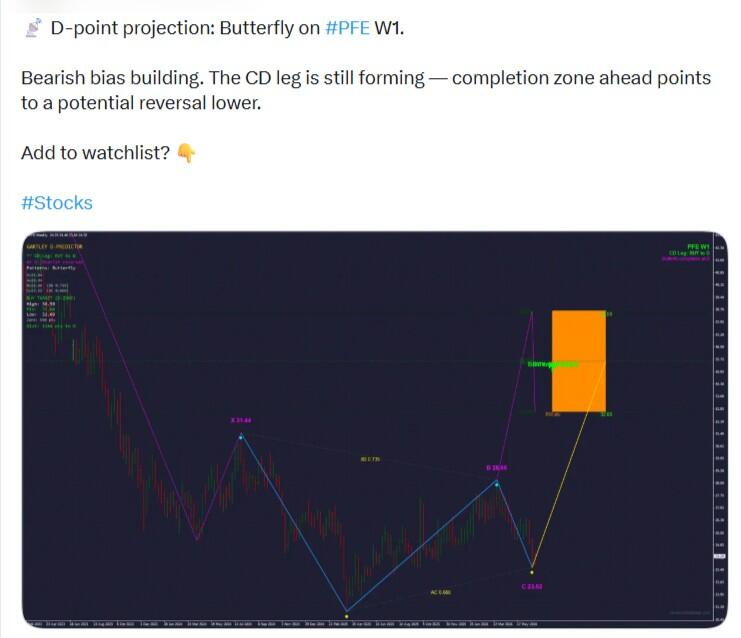
For example, X (formerly Twitter) user @currencyheatmap points to the formation of a bearish Butterfly harmonic pattern on the weekly chart. This suggests that any rally toward the pattern's completion zone could be viewed not as the start of a recovery, but as a setup for another decline.
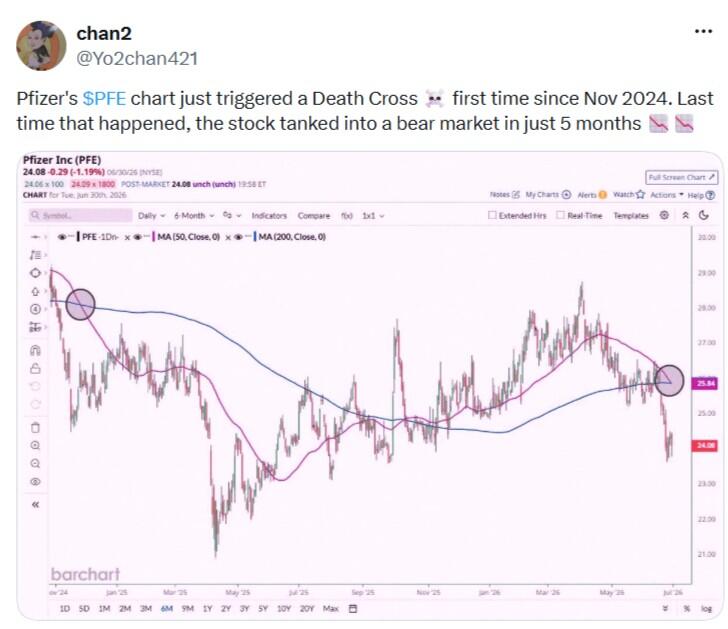
Another analyst, @chan2, notes the appearance of a Death Cross for the first time since November 2024. Such a signal increases concerns about a repeat of the previous bearish phase and may prompt some investors to adopt a more defensive approach.
Overall, sentiment toward PFE on X remains predominantly bearish, with investors currently focused more on downside risks than on the stock's recovery.
Pfizer (PFE) Price History
Pfizer reached the highest price of $61.25 on 16.12.2021. The lowest price of Pfizer was recorded on 04.10.1974 when the stock declined to $0.43.
The chart below shows the #PFE price performance over the last ten years. It is crucial to evaluate historical data to make our forecasts as accurate as possible.
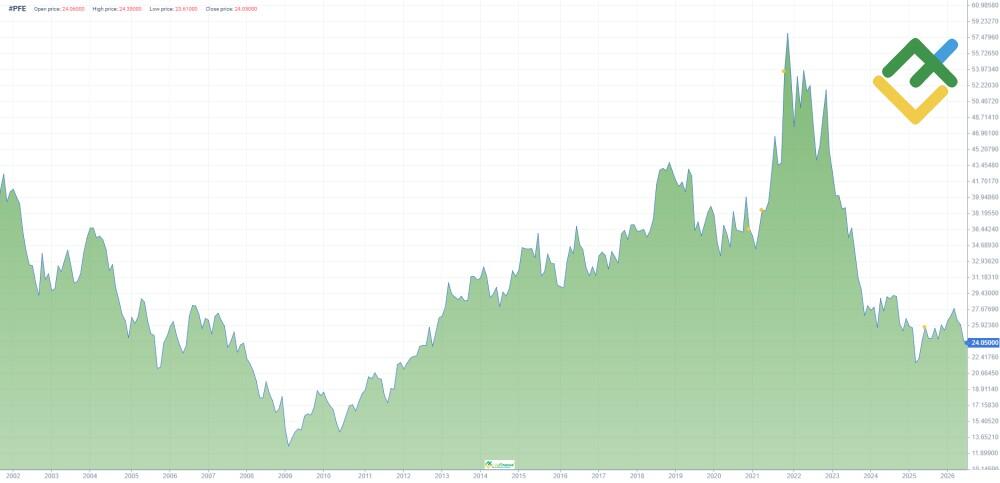
Pfizer's share price has hit several key milestones since the early 2000s:
In 2000, the #PFE price hit a record high of about $50, bolstered by the successful launch of blockbuster drugs such as Viagra, Lipitor, and Zoloft.
From 2004 to 2009, the #PFE price plunged to $12–$15 due to the company losing several patents and facing heightened competition. Moreover, the global financial crisis of 2008 contributed to these challenges.
From 2013 to 2019, Pfizer's share price stabilized in the $35–$45 range thanks to advances in oncology, vaccines, biopharmaceuticals, and a solid dividend policy.
In 2021, the asset set an all-time high of $61 as sales of Comirnaty, a vaccine developed with BioNTech, generated record revenue for the company.
In 2023–2025, demand for the vaccine dropped sharply, consequently reducing revenue, and the #PFE price plummeted to $25–$30.
Throughout 2025, Pfizer shares traded within a relatively narrow range of $20.91–$27.69 as sales growth for some of the company's products slowed.
During the first half of 2026, PFE consolidated between $25.00 and $28.00 as investors awaited the company's earnings reports.
In June 2026, the stock attempted to hold above the $25.00 level but failed to develop strong upward momentum. By early July, the shares came under pressure again, falling into the $23.00–$24.00 range, which further reinforced the market's cautious sentiment.
The Pfizer stock has historically demonstrated the capacity to recover from severe downturns, indicating future upside potential.
Pfizer (PFE) Fundamental Analysis
Fundamental analysis plays a key role in forecasting the price of any asset. It involves assessing financial data, the company's market position, and other indicators affecting the #PFE rate.
What Factors Affect the Pfizer (PFE) Stock?
Financials. The company's revenues, net income, profitability, and cash flows.
Development and market launch of new drugs. Successful clinical tests and regulatory approvals.
Patent protection. Expiration of patents on key drugs, the emergence of generics.
Mergers and acquisitions. Strategic deals that expand product range and distribution markets.
Regulatory environment. Changes in healthcare legislation and policy.
Global economic conditions. Economic crises, currency fluctuations, and geopolitical instability.
Competition. Actions of major competitors and innovation in the industry.
Reputational risks. Lawsuits, fines, and public opinion.
Dividend policy. Changes in the amount and regularity of payments to shareholders.
Investor sentiment. General trends in the stock market and investors' attitudes to the pharmaceutical sector.
Given these factors, investors can objectively assess the prospects of the Pfizer stock and make more informed decisions.
More Facts About Pfizer (PFE)
Pfizer Inc. is a prominent American biopharmaceutical company founded in 1849 by cousins Charles Pfizer and Charles Erhart in Brooklyn, New York. The company develops, produces, and sells drugs and vaccines to treat various diseases. Pfizer is particularly well-known for its flagship products, such as Lipitor (atorvastatin) to lower cholesterol, Viagra (sildenafil) to address erectile dysfunction, and Prevenar, a pneumococcal vaccine.
In 2020, Pfizer, in collaboration with the German company BioNTech, developed Comirnaty, one of the first COVID-19 vaccines based on mRNA technology, which significantly boosted Pfizer's global profile. The company is actively investing in research and development to expand its range of innovative medicines and solidify its position in the global pharmaceutical market.
Advantages and Disadvantages of Investing in Pfizer (PFE)
Pfizer is one of the largest pharmaceutical companies, producing popular and effective medications. Moreover, it adheres to a solid dividend policy, making the #PFE stock a safe investment option. However, like any other asset, #PFE carries not only benefits but also risks.
Advantages
Stable pharmaceutical business. Wide range of high-demand drugs and vaccines.
Dividend payouts. The yield is above the market average (~5%).
Innovation leadership. Significant investments in R&D and breakthrough drugs (oncology, vaccines).
Defensive asset. Demand for drugs remains strong even during crises.
Global expansion. Operations in key pharmaceutical markets.
Government support. Cooperation with regulators and research funding.
Access to new technologies. Regular acquisitions of biotech companies.
Disadvantages
Declining post-COVID revenues. Falling demand for vaccines and drugs used for COVID-19 treatment.
Dependence on regulators. FDA approvals and patent litigation can impact revenue.
Risk of patent expiration. Loss of exclusive rights reduces revenues (Lipitor is an example).
High competition. Competing with other pharma giants for market and innovation.
Long development cycle. Clinical tests can take years, and failures lead to significant losses.
Sensitivity to macroeconomics. Drug price regulation, inflation.
Stock fluctuations. Despite the stability of this field, the PFE price is susceptible to market trends.
Pfizer (PFE) is a resilient pharmaceutical company known for its solid dividends and opportunities for growth through innovation. However, investors should keep in mind that the stock price might be influenced by factors such as declining post-COVID earnings, upcoming patent expirations, and intense competition. Although the asset is suitable for long-term investments, it is essential to assess the associated risks thoroughly.
How We Make Forecasts
Stock prices are forecast based on three time frames.
Short-term forecasts (up to 6 months) rely on technical analysis (support/resistance levels, indicators, volumes) and news. Macroeconomic events, reports, and market reactions are taken into account.
Medium-term forecasts (from 6 months to 3 years) include fundamental analysis (financial indicators, competitive advantages, sales trends). Macroeconomic trends, interest rates, geopolitics, and the company's product cycle are assessed.
Long-term forecasts (3 years or more) are focused on strategic analysis. Industry potential, innovation, growth prospects, capital management, and global factors are explored. Besides, discounted cash flow (DCF) models and multiple valuations are also used.
However, each new forecast requires adjustment to align with the latest data and evolving market conditions.
Conclusion: Is Pfizer (PFE) a Good Investment?
Pfizer remains a leading pharmaceutical company with a broad portfolio of medicines, stable cash flows, and consistent dividend payments. However, the current outlook for PFE remains mixed. Following weaker vaccine demand and the stock's underperformance, the market has yet to identify a strong catalyst for a sustained recovery.
In the short term, the technical picture remains bearish, with the price trading below key moving averages and forecasts for 2026–2030 remaining highly mixed. While some sources expect a recovery, others point to the risk of further declines.
For long-term investors, Pfizer may remain attractive because of its dividends and the potential of its new drug pipeline. However, the stock should be approached with caution given its weak trend, revenue pressure, and an uncertain long-term outlook. A more convincing buy signal is likely to emerge only if the company's financial performance improves and the stock returns to a sustained uptrend.
Pfizer Price Prediction FAQs
The current Pfizer (PFE) stock price is $28.68 as of 27.09.2026.
Pfizer stock could rise, but forecasts remain mixed. Some analysts expect a recovery, while the technical picture points to the risk of continued pressure. A sustained recovery would be confirmed only if the price breaks above and holds above key resistance levels.
The future of Pfizer's stock price remains uncertain. Some models point to a gradual recovery toward $30.00–$44.00 in the long term, while others allow for a decline below $15.00. The key factor will be the company's ability to increase revenue and restore investor interest.
In 2026, Pfizer is a challenging investment. The company still offers dividend appeal, but its shares remain under pressure. For conservative investors, PFE may become attractive only after the stock shows clear signs of recovery.
Forecasts for 2027 vary widely. Some forecasts expect the price to reach around $27.83–$27.96 by year-end. Others anticipate a decline to $13.22. The most optimistic estimates suggest growth to $50.54.
Forecasts for Pfizer in 2030 remain mixed. CoinPriceForecast expects the price to reach around $31.29 by the end of the year. CoinCodex predicts a decline to $11.15, while StockScan shows a weaker scenario, with an average price of around $10.13.
Pfizer's intrinsic value depends on business stability, earnings, and adaptability. While the stock may appear fundamentally undervalued, there are no clear signs of a sharp recovery. For now, it looks more like a neutral asset than a compelling investment opportunity.
Pfizer can serve as a defensive, dividend-paying holding. Long-term growth depends on new catalysts, including innovation, portfolio expansion, and strategic initiatives. Without them, upside remains limited. The stock offers stability but may not suit investors seeking rapid capital appreciation.
Price chart of #PFE in real time mode

The content of this article reflects the author’s opinion and does not necessarily reflect the official position of LiteFinance broker. The material published on this page is provided for informational purposes only and should not be considered as the provision of investment advice for the purposes of Directive 2014/65/EU.
According to copyright law, this article is considered intellectual property, which includes a prohibition on copying and distributing it without consent.