Platinum is a rare precious metal that is widely used not only in jewelry but also in the industrial sector. Around 44% of global demand comes from car manufacturers, who use platinum in the production of catalytic converters.
Since platinum is a commodity, investing in the XPTUSD pair requires a different approach than investing in traditional instruments such as stocks or bonds. The price of this precious metal is influenced by numerous factors, including the US Fed's monetary policy, the global economic situation, and platinum mining rates. Read on to find out the potential trajectory of the XPTUSD exchange rate in 2026 and beyond.
The article covers the following subjects:
- Major Takeaways
- XPT Real-Time Market Status
- XPT Price Forecast for 2026 Based on Technical Analysis
- Analysts' XPT Price Projections for 2027
- Analysts' XPT Price Projections for 2028
- Analysts' XPT Price Projections for 2029
- Analysts' XPT Price Projections for 2030
- Analysts' XPT Price Projections up to 2050
- XPT (Platinum) Market Sentiment on Social Media
- XPT Price History
- XPT Fundamental Analysis
- More Facts About XPT
- How We Make Forecasts
- Conclusion: Is XPT a Good Investment?
- XPTUSD Price Prediction FAQ
Major Takeaways
- The current XPT price is $1 590.56 as of 29.07.2026.
- The highest XPT price of $2920.41 was reached on 26.01.2026, while the all-time low of $562.25 was set on 16.03.2020.
- Analysts expect XPTUSD to trade within a wide range of $1,140.29–1,775.00 in 2026. According to some estimates, the price could decline to $1,525.74, while other forecasts suggest predominantly sideways movement.
- Forecasts for 2027 vary considerably. According to analysts, platinum could trade within a range of $1,342.72–4,561.52. The projected scenarios include both a gradual decline and moderate growth, accompanied by periods of elevated volatility.
- Analysts also hold differing views on the outlook for XPTUSD between 2028 and 2030. According to forecasts, platinum could trade within a range of $1,569.24–2,971.51 in 2028, $1,621.28–2,413.94 in 2029, and $2,231.56–7,071.89 in 2030.
- Long-term forecasts point to further growth in platinum prices. According to some estimates, XPTUSD could reach $8,727.00 by 2037, approximately $8,319.73 in 2040, and around $23,067.00 by 2050. It is important to remember that such forecasts should be viewed as indicative rather than definitive, as long-term market performance depends on a wide range of economic and industry-specific factors.
XPT Real-Time Market Status
The current XPT price is $1 590.56 as of 29.07.2026.
It is crucial to monitor the following parameters to assess the prospects of the precious metal:
- Year-over-Year Inflation Rate (US), determined based on the Consumer Price Index (CPI), which measures changes in the prices of goods and services.
- Interest Rate (US): The cost of borrowing funds, expressed as a percentage of the borrowed amount. It impacts investment and consumer spending.
- 52-Week Range: The highest and lowest prices of the asset over the past year.
- Trading Volume: A metric used in financial markets to track the total amount of trading activity.
- Yearly Change: The cumulative change in the asset's price over the past year.
- Fear and Greed Index: A real-time indicator reflecting investor sentiment and expectations about the asset.
Indicator | Value |
Year-over-year inflation rate (US) | 4.2% |
Interest rate (US) | 3.75% |
52-week range | $1,249.54–2,923.66 |
Technical analysis signal | Neutral; moderate selling pressure |
Yearly change | 28.97% |
XPT Price Forecast for 2026 Based on Technical Analysis
XPTUSD remains under pressure following the strong rally seen in previous months. The price is trading near 1,700.00–1,720.00 and continues to develop a corrective move.
The nearest resistance is located in the 1,800.00–1,820.00 range, while the key support lies in the 1,540.00–1,600.00 area. MACD remains in negative territory, indicating weakening bullish momentum. The RSI also points to seller dominance in the short term. At the same time, the SMA50 and SMA200 continue to act as support levels, reflecting a relatively stable medium-term market structure.
As long as the price remains above the 1,540.00–1,600.00 area, the current move appears to be a correction within a broader trading range. A break and hold above 1,800.00–1,820.00 could strengthen the bullish outlook and increase the potential for a move toward 1,850.00–1,900.00. Conversely, a break below the support zone would increase the risk of further declines and a test of lower levels.
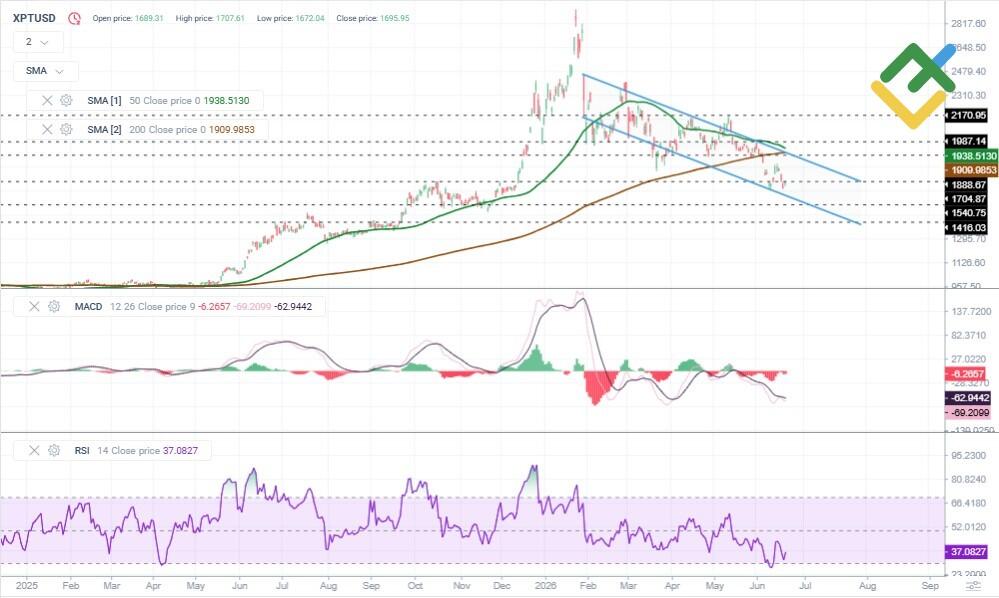
Below are the projected price levels for XPTUSD over the next 12 months:
Month | Low, $ | Average Price, $ | High, $ |
July 2026 | 1,620.00 | 1,675.00 | 1,730.00 |
August 2026 | 1,630.00 | 1,680.00 | 1,740.00 |
September 2026 | 1,640.00 | 1,690.00 | 1,750.00 |
October 2026 | 1,650.00 | 1,700.00 | 1,760.00 |
November 2026 | 1,660.00 | 1,710.00 | 1,770.00 |
December 2026 | 1,680.00 | 1,725.00 | 1,790.00 |
January 2027 | 1,690.00 | 1,730.00 | 1,800.00 |
February 2027 | 1,700.00 | 1,740.00 | 1,820.00 |
March 2027 | 1,710.00 | 1,750.00 | 1,830.00 |
April 2027 | 1,720.00 | 1,760.00 | 1,850.00 |
May 2027 | 1,730.00 | 1,775.00 | 1,870.00 |
June 2027 | 1,740.00 | 1,790.00 | 1,900.00 |
Long-Term Trading Plan for XPTUSD for 2026
It is important to closely monitor the 1,540.00–1,600.00 support zone, as it remains a key support level within the current market structure. As long as the price holds above this zone, consider buying on pullbacks targeting the resistance levels in the 1,800.00–1,880.00 range. However, the prevailing trend remains cautious, so confirmation of buying interest will be an important condition before opening new long positions.
If the price breaks and holds above the upper boundary of the descending channel, it will signal strengthening buyer momentum. In that case, the upside potential could extend toward 1,900.00 and higher, reinforcing the bullish outlook.
If selling pressure persists and the price returns to the lower boundary of the channel, close attention should be paid to the market's reaction near the support level. Until new reversal signals emerge, it is preferable to maintain a cautious approach to position management and take the ongoing market volatility into account.
Analysts' XPT Price Projections for 2026
Analysts expect mixed performance from XPTUSD in 2026. Some analysts expect platinum prices to decline, while others anticipate largely sideways trading throughout the year. The metal's price could be influenced by conditions in the automotive industry, interest rate decisions by major central banks, and overall demand for industrial metals.
WalletInvestor
Price range (USD): 1,525.74–1,720.20.
Analysts at WalletInvestor forecast that XPTUSD will continue its downward trend in the second half of 2026. According to the platform, the price is expected to decline from 1,663.76 in July to 1,582.51 in December. The lowest level of the year is also projected for December, at 1,525.74.
Month | Low, $ | Average Price, $ | High, $ |
July | 1,607.77 | 1,663.76 | 1,720.20 |
August | 1,590.15 | 1,647.30 | 1,704.92 |
September | 1,587.69 | 1,631.10 | 1,674.85 |
October | 1,549.09 | 1,614.90 | 1,681.30 |
November | 1,557.60 | 1,598.71 | 1,640.15 |
December | 1,525.74 | 1,582.51 | 1,639.79 |
CoinCodex
Price range (USD): 1,140.29–1,360.87.
According to the CoinCodex forecast, XPTUSD is expected to trade within a broad sideways range during the second half of 2026. After declining to an average of around 1,209.29 in September, the price is projected to gradually recover, rising to 1,322.51 by the end of the year. The lowest price is expected in September, at 1,140.29.
Month | Low, $ | Average Price, $ | High, $ |
July | 1,230.95 | 1,301.16 | 1,347.47 |
August | 1,239.98 | 1,281.88 | 1,337.19 |
September | 1,140.29 | 1,209.29 | 1,264.71 |
October | 1,206.22 | 1,237.30 | 1,262.41 |
November | 1,252.81 | 1,306.44 | 1,360.87 |
December | 1,312.37 | 1,322.51 | 1,335.01 |
LongForecast
Price range (USD): 1,369.00–1,775.00.
According to LongForecast analysts, XPTUSD is expected to trade within a broad sideways range for most of 2026. After declining to 1,476.00 in October, the price is projected to gradually recover, ending the year at around 1,653.00. The highest level of the year is forecast for July, at 1,775.00.
Month | Low, $ | Average Price, $ | High, $ |
July | 1,369.00 | 1,600.00 | 1,775.00 |
August | 1,472.00 | 1,549.00 | 1,626.00 |
September | 1,495.00 | 1,574.00 | 1,653.00 |
October | 1,402.00 | 1,476.00 | 1,574.00 |
November | 1,476.00 | 1,568.00 | 1,646.00 |
December | 1,568.00 | 1,653.00 | 1,736.00 |
Analysts' XPT Price Projections for 2027
Forecasts for 2027 vary considerably. Some analysts expect further weakness in the platinum market, while others forecast a sustained uptrend and a move to new multi-year highs. Platinum prices could be influenced by demand from the industrial sector, the state of the global economy, and changes in monetary policy by major central banks.
Note: The price ranges reflect the asset's expected volatility throughout the year. Lows and highs may not be shown in the summary tables.
WalletInvestor
Price range (USD): 1,342.72–1,610.52.
According to WalletInvestor, XPTUSD is expected to maintain its downward trend throughout 2027. After trading near 1,550.00 in the first quarter, the price is projected to gradually decline toward 1,405.00 by the end of the year. The platform expects the lowest level of the year to be reached in the fourth quarter, at 1,342.72.
Quarter | Low, $ | Average Price, $ | High, $ |
Q1 | 1,479.44 | 1,550.40 | 1,610.52 |
Q2 | 1,435.57 | 1,502.35 | 1,587.29 |
Q3 | 1,375.27 | 1,453.58 | 1,510.43 |
Q4 | 1,342.72 | 1,404.91 | 1,471.94 |
CoinCodex
Price range (USD): 1,305.14–4,561.52.
According to the CoinCodex forecast, XPTUSD is expected to post a sharp rally in the first half of the year before entering a downward phase. The average price is projected to rise to 3,633.02 in the second quarter and then decline to 2,686.83. The highest level of the year is expected in the second quarter, at 4,561.52.
Quarter | Low, $ | Average Price, $ | High, $ |
Q1 | 1,305.14 | 1,675.44 | 3,516.14 |
Q2 | 2,826.29 | 3,633.02 | 4,561.52 |
Q3 | 2,234.74 | 2,745.28 | 3,333.82 |
Q4 | 2,314.95 | 2,686.83 | 3,058.11 |
LongForecast
Price range (USD): 1,653.00–2,304.00.
According to LongForecast, XPTUSD is expected to post moderate gains throughout 2027. The average price is projected to rise from 1,812.00 in the first quarter to 2,146.00 in the fourth quarter, despite periodic declines. The highest level of the year is expected in the fourth quarter, at 2,304.00.
Quarter | Low, $ | Average Price, $ | High, $ |
Q1 | 1,653.00 | 1,812.00 | 1,957.00 |
Q2 | 1,817.00 | 1,971.67 | 2,144.00 |
Q3 | 1,943.00 | 2,106.67 | 2,301.00 |
Q4 | 1,955.00 | 2,146.00 | 2,304.00 |
Analysts' XPT Price Projections for 2028
Forecasts for XPTUSD in 2028 remain mixed. One source expects platinum prices to decline, while another anticipates sideways trading with moderate fluctuations. Price performance could be influenced by industrial demand, conditions in the automotive sector, and the supply-demand balance in the platinum market.
CoinCodex
Price range (USD): 1,569.24–2,971.51.
According to the CoinCodex forecast, XPTUSD is expected to gradually decline throughout 2028. After trading near 2,700.48 in the first quarter, the average price is projected to fall to 1,728.97 by the fourth quarter, despite short-term recovery attempts. The lowest level of the year is expected in the third quarter, at 1,569.24.
Quarter | Low, $ | Average Price, $ | High, $ |
Q1 | 2,392.50 | 2,700.48 | 2,971.51 |
Q2 | 1,951.14 | 2,124.09 | 2,333.48 |
Q3 | 1,569.24 | 1,834.61 | 2,151.50 |
Q4 | 1,628.10 | 1,728.97 | 1,870.71 |
LongForecast
Price range (USD): 1,772.00–2,227.00.
According to the LongForecast forecast, XPTUSD is expected to trade within a broad sideways range without establishing a sustained trend. The average price is projected to rise from 1,992.67 in the first quarter to 2,011.33 in the fourth quarter, remaining close to 2,000.00 for most of the year. The highest level of the year is forecast for the fourth quarter, at 2,227.00.
Quarter | Low, $ | Average Price, $ | High, $ |
Q1 | 1,857.00 | 1,992.67 | 2,186.00 |
Q2 | 1,836.00 | 2,002.00 | 2,200.00 |
Q3 | 1,772.00 | 1,958.67 | 2,132.00 |
Q4 | 1,799.00 | 2,011.33 | 2,227.00 |
Analysts' XPT Price Projections for 2029
Analysts' forecasts for XPTUSD in 2029 also differ. One source expects platinum prices to decline over the course of the year, while another anticipates continued sideways trading near current levels. The price trajectory could depend on industrial demand, conditions in the automotive sector, and the overall state of commodity markets.
CoinCodex
Price range (USD): 1,621.28–2,413.94.
According to the CoinCodex forecast, XPTUSD is expected to enter an upward trend in the second half of the year. After fluctuating within the 1,665.00–1,840.00 range during the first two quarters, the average price is projected to rise above 2,300.00 by the fourth quarter. The highest level of the year is forecast for the fourth quarter, at 2,413.94.
Quarter | Low, $ | Average Price, $ | High, $ |
Q1 | 1,644.39 | 1,698.15 | 1,853.20 |
Q2 | 1,621.28 | 1,745.95 | 1,890.92 |
Q3 | 1,667.02 | 1,904.07 | 2,351.58 |
Q4 | 2,122.68 | 2,258.20 | 2,413.94 |
LongForecast
Price range (USD): 1,694.00–2,170.00.
According to LongForecast analysts, XPTUSD is expected to remain within a broad sideways range throughout the year. After rising to 2,067.00 in the second quarter, the price is projected to correct before recovering in the autumn. The highest level of the year is expected in the second quarter, at 2,170.00.
Quarter | Low, $ | Average Price, $ | High, $ |
Q1 | 1,891.00 | 2,017.67 | 2,155.00 |
Q2 | 1,829.00 | 1,983.33 | 2,170.00 |
Q3 | 1,728.00 | 1,896.67 | 2,067.00 |
Q4 | 1,694.00 | 1,902.00 | 2,125.00 |
Analysts' XPT Price Projections for 2030
Analysts expect XPTUSD to remain in an uptrend in 2030, although estimates of the pace of growth vary. The platinum market could be supported by steady industrial demand, constrained supply, and continued investor interest in precious metals.
CoinCodex
Price range (USD): 2,231.56–7,071.89.
According to the CoinCodex forecast, XPTUSD is expected to post strong gains in 2030. The average price is projected to increase from 2,299.51 in the first quarter to 4,651.87 in the fourth quarter. The highest level of the year is expected at 7,071.89 by year-end.
Quarter | Low, $ | Average Price, $ | High, $ |
Q1 | 2,231.56 | 2,299.51 | 2,418.10 |
Q2 | 2,350.37 | 2,783.03 | 3,371.50 |
Q3 | 2,840.41 | 3,117.91 | 3,550.13 |
Q4 | 3,423.15 | 4,651.87 | 7,071.89 |
WalletInvestor
Price range (USD): 2,263.74–3,203.28.
According to the WalletInvestor forecast, XPTUSD is expected to rise at a more moderate pace throughout the year. The average price is projected to increase from approximately 2,450.00 in the first quarter to 2,988.00 in the fourth quarter. The highest level of the year is forecast at 3,203.28 in December.
Quarter | Low, $ | Average Price, $ | High, $ |
Q1 | 2,263.74 | 2,450.00 | 2,626.74 |
Q2 | 2,436.92 | 2,646.00 | 2,883.19 |
Q3 | 2,636.33 | 2,865.00 | 3,075.86 |
Q4 | 2,819.64 | 2,988.00 | 3,203.28 |
Analysts' XPT Price Projections up to 2050
Long-term XPTUSD forecasts should be viewed as guidelines rather than precise scenarios. Platinum prices depend on multiple factors, including industrial demand, its use in automotive catalysts, investment interest, and the potential development of the hydrogen sector. As a result, projections beyond 2030 remain particularly sensitive to changes in market conditions.
According to CoinPriceForecast, XPTUSD could maintain its upward trajectory throughout the 2030s. The forecast suggests that the price could rise to 6,271.00 by the end of 2033, 7,457.00 by the end of 2035, and 8,727.00 by the end of 2037.
CoinCodex provides an even longer-term outlook, which also points to continued growth in platinum prices. According to the platform, the average platinum price could reach 8,319.73 in January 2040 and rise to a range of 22,370.00–23,067.00 by early 2050.
Year | Coin Price Forecast, $ | Coin Codex, $ |
2033 | 6,271.00 | – |
2035 | 7,457.00 | – |
2037 | 8,727.00 | – |
2040 | – | 8,319.73 |
2050 | – | 23,067.00 |
XPT (Platinum) Market Sentiment on Social Media
Media sentiment has a noticeable impact on the short-term performance of XPTUSD, shaping market participants' emotions and amplifying price movements near key levels. Trader sentiment can either support short-term gains or accelerate price declines.
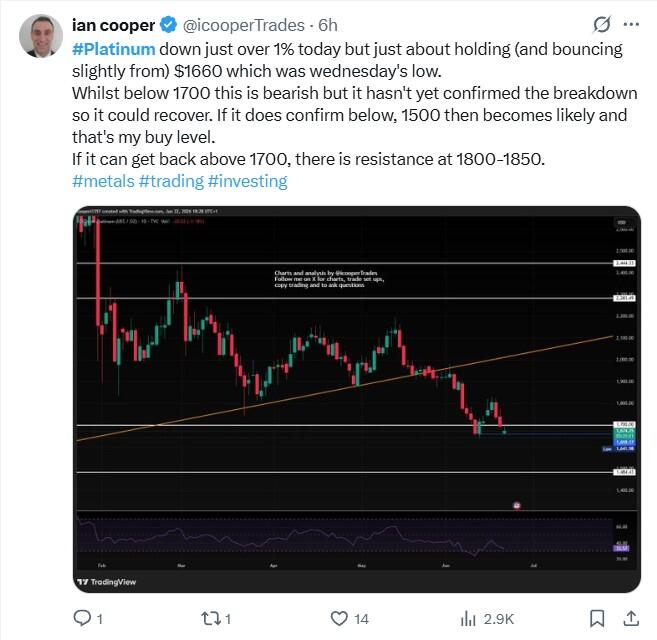
Trader @icooperTrades on X (formerly Twitter) pointed to market weakness and a cautious attitude among traders. In his view, a short-term rebound remains possible, although the overall sentiment stays restrained, with a strong focus on risk management.
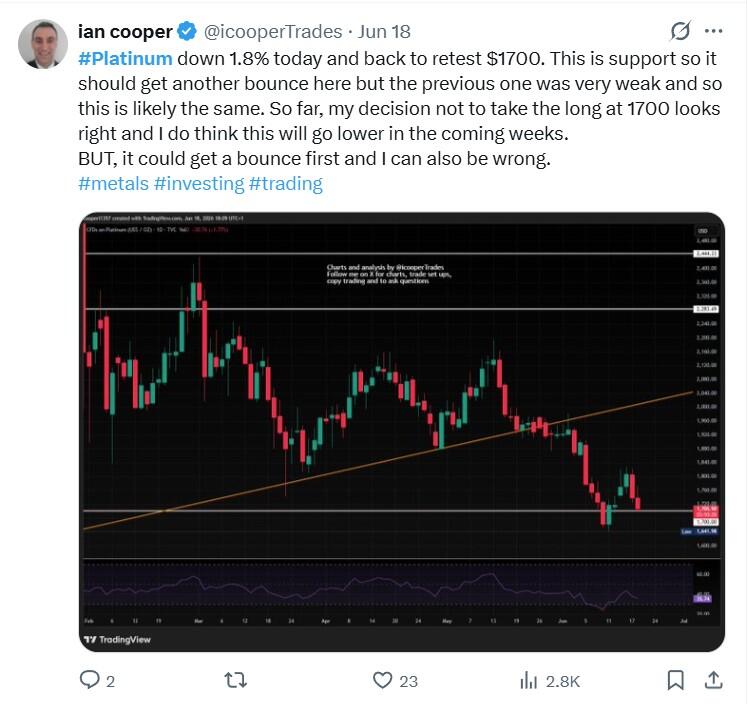
In another post, he noted that despite occasional recovery attempts, market participants remain cautious and continue to see the risk of further downside pressure.
Overall, the discussions reflect a moderately bearish sentiment. Market participants tend to take profits or reduce exposure amid price weakness, while still acknowledging the potential for short-term rebounds and closely monitoring shifts in market sentiment.
XPT Price History
Platinum hit its all-time high of $2920.41 on 26.01.2026.
The lowest XPT price of $562.25 was set on 16.03.2020.
It is essential to evaluate historical data to make predictions as accurate as possible. The chart below shows the XPTUSD pair's performance over the last ten years.
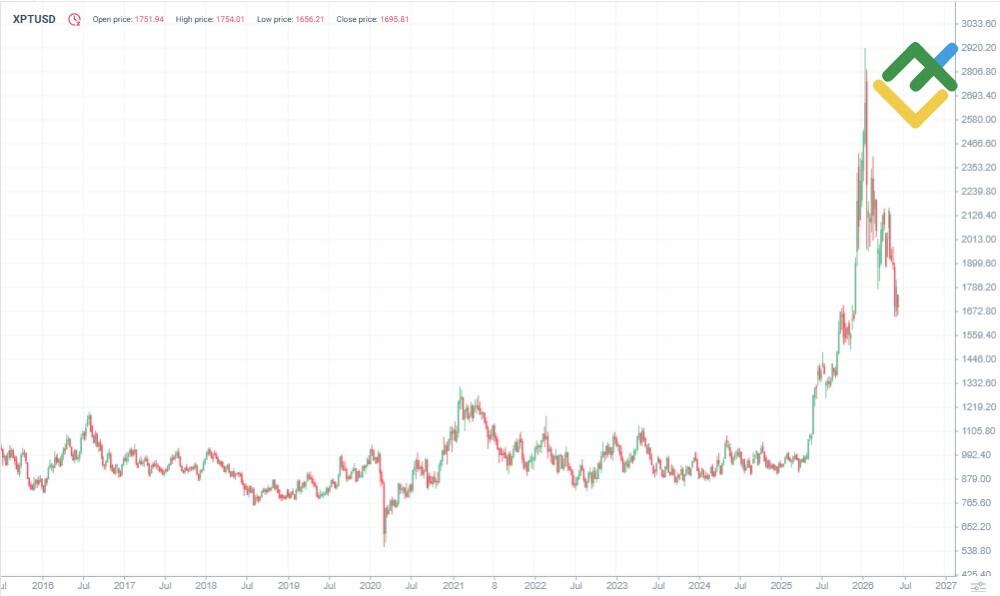
At the beginning of 2020, platinum demand fell sharply amid the COVID-19 pandemic, pushing prices down to $561.01. By the end of 2020, however, prices began to recover, supported by expectations of a global economic rebound and promising developments in hydrogen technologies.
Between 2021 and 2025, platinum traded within a wide range of $822.59–$1,317.41, reacting primarily to macroeconomic factors and geopolitical risks.
From May to December 2025, prices rose sharply, reaching $2,421.59, driven by heightened geopolitical tensions, high inflation, a weaker US dollar, and strong industrial demand.
Since January 2026, the platinum price has been rising amid high volatility. In February, the metal reached $2,920.55, fueled by stricter environmental regulations and growing industrial demand. In mid-March, the price pulled back to $1,780.23 as the US dollar strengthened.
By June, platinum prices had retreated to approximately $1,646.00–1,980.00 following a short-term rally seen in previous weeks. Market volatility remains elevated; however, demand from the automotive and jewelry sectors continues to provide support for prices.
XPT Fundamental Analysis
Analyzing the fundamental factors that influence the value of XPTUSD plays a crucial role in forecasting future prices. This provides a comprehensive view of market conditions, helping traders make more informed decisions.
Key Factors Influencing XPT's Price
- Demand and Supply. The balance between industrial demand (automotive industry, electronics, chemical industry) and supply from mines in South Africa, Russia, and other producing countries.
- Geopolitical Factors. Political risks in producing countries, sanctions, and trade wars.
- Economic Stability. The state of the global economy, inflation, and interest rates.
- Currency Exchange Rates. The relationship between the U.S. dollar (the primary currency for platinum trading) and the currencies of producing countries.
- Technological Innovations. The development of new technologies that reduce the need for platinum.
- Investment Demand. Interest from institutional investors and individuals.
- Automotive Standards. Stricter environmental regulations that encourage the use of platinum in catalytic converters.
- Platinum Inventories. The level of reserves held by producers and consumers.
- Prices of Other Metals. The cost of palladium, rhodium, and gold, which can serve as alternatives to platinum.
- Energy Crisis. The impact of electricity prices on platinum production.
More Facts About XPT
Platinum is the third most popular precious metal. When investing in this type of asset, a number of features should be taken into account:
- South Africa is the world's major platinum miner, accounting for approximately 70% of the global reserves. Consequently, production levels are heavily influenced by the region's geopolitical and macroeconomic conditions.
- Platinum serves as both an industrial and jewelry commodity, with the automotive sector driving most of the global demand, accounting for 44% of production. Meanwhile, the creation of ingots and coins makes up around 10%–15% of the market.
- Platinum is less liquid in the market than gold and silver due to low investor demand.
The development of green energy has a mixed impact on the use of platinum in manufacturing. On the one hand, the precious metal is used in the production of catalysts for diesel cars. On the other hand, the shift to electric vehicles, which do not require these catalysts, is pushing diesel and petrol engines out of the market. However, hydrogen energy, which is rapidly advancing, is closely tied to platinum. Consequently, the future demand for platinum will largely hinge on the development of green energy.
The jewelry industry is the second-largest sector in terms of consumption, representing nearly one-third of the total platinum supply. The main target market for jewelry made from this precious metal is China.
First and foremost, platinum is an excellent tool for diversifying your investment portfolio, helping to mitigate risks associated with other assets. Platinum began to gain recognition as an investment asset in the second half of the 20th century. Nowadays, there are many ways to invest in this asset:
- Buying shares in an ETF (exchange-traded investment fund) with net assets consisting of ingots;
- Buying physical metal, such as platinum ingots and coins;
- Buying the precious metal by opening an unallocated metal account in banks;
- Use of complex derivative instruments, like futures or CFDs, for speculation on the financial market;
- Investing in shares of public companies engaged in the exploration and mining of precious metals, including platinum.
Advantages and Disadvantages of Investing in XPT
This section explores the advantages and disadvantages of investing in platinum.
Advantages
- Industrial Importance of the Precious Metal. Platinum plays a significant role in the automotive industry and the emerging hydrogen energy sector. This can contribute to stable growth in investor interest.
- Diversification of the Investment Portfolio. Adding platinum to your investment portfolio helps hedge risks from declines in other assets.
- Undervaluation of Platinum and Growth Potential. Current platinum prices are lower compared to historical averages. This could lead to price increases if demand rises or supply decreases in the market.
Disadvantages
- Lack of Regular Income Like Dividends or Interest from Deposits. This means that to generate profit, you need to sell part or all of your assets.
- Volatility. Due to lower interest from market participants, platinum's volatility is generally lower than that of gold or silver. However, in some cases, platinum prices can be more volatile due to industrial demand for the metal.
- VAT Taxation. Unlike gold, platinum is subject to value-added tax, which can negatively impact the overall profitability of your investments. An exception is when platinum is stored in offshore locations or customs warehouses.
How We Make Forecasts
To forecast the price of platinum, we use a comprehensive approach.
1. Fundamental analysis includes:
- Analysis and evaluation of forecasts from major analytical agencies;
- Analysis of supply and demand in the platinum market;
- Monitoring the exchange rates of the U.S. dollar, South African rand, and currencies of platinum-producing countries;
- Assessment of progress in green energy and its development prospects (innovation adoption, development of new products, etc.);
- Evaluation of news related to the precious metal;
- Assessment of geopolitical and macroeconomic factors affecting the metal's value.
2. Analysis of market sentiment and social media trends.
3. Technical analysis includes:
- Evaluation of technical indicators to track current trends, their strength, and identify potential buying/selling zones;
- Analysis of candlestick and chart patterns to predict changes in the precious metals market in advance.
The combination of these methods allows us to identify current market sentiment, enter trades at the most favorable prices, and set trading and investment goals in advance.
Conclusion: Is XPT a Good Investment?
Investing in platinum involves carefully balancing risk against potential returns. In the long term, the metal appears promising due to its essential role in the automotive sector and its growing use in green technologies. Moreover, global supply is gradually declining. Together, these factors create a strong foundation that could support future price growth.
However, this asset is highly volatile, with its price strongly influenced by the automotive production cycle and conditions in the precious metals market. XPT can be a valuable addition to a long-term diversified portfolio, while its high volatility also makes it attractive for short-term trading. Nevertheless, before making any trading or investment decisions, it is essential to conduct thorough analysis and carefully review relevant news and expert insights.
XPTUSD Price Prediction FAQ
The price of XPT is $1 590.56 as of 29.07.2026.
Platinum prices are influenced by demand from the automotive industry, investment flows, and geopolitical factors. The market outlook remains mixed due to the transition to electric vehicles, although limited supply may continue to support prices.
Long-term platinum forecasts remain generally positive, although corrections and periods of sideways movement are possible. Industrial demand and constrained supply may support prices, creating conditions for further growth.
According to analysts' forecasts, platinum could trade within a wide range of $1,342.72 to $4,561.52 in 2027. Some experts expect a moderate decline in prices, while others anticipate a significant increase in the metal's value during the year.
Based on available estimates, platinum prices could range from $2,231.56 to $7,071.89 in 2030. Despite the expected upward trend, growth projections vary significantly depending on market conditions and demand for the metal.
The investment appeal of platinum in 2026 will depend on an investor's objectives and investment horizon. Forecasts suggest that prices could fluctuate between $1,140.29 and $1,775.00, making platinum potentially attractive to investors seeking long-term growth and portfolio diversification.
Platinum and gold prices are driven by different factors. Gold is a safe haven, while platinum is more volatile and unpredictable. The choice depends on a trader's investment goals and risk tolerance.
During a recession, demand for platinum may decline due to a slowdown in industrial output, potentially leading to lower prices. However, long-term prospects and limited supply may help support its value.
Platinum does have a future, particularly with the rise of hydrogen energy and increasingly stringent environmental standards. Its unique properties make it essential for several industrial uses, ensuring long-term demand.
Price chart of XPTUSD in real time mode
The content of this article reflects the author’s opinion and does not necessarily reflect the official position of LiteFinance broker. The material published on this page is provided for informational purposes only and should not be considered as the provision of investment advice for the purposes of Directive 2014/65/EU.
According to copyright law, this article is considered intellectual property, which includes a prohibition on copying and distributing it without consent.