The Swiss franc has always garnered the attention of traders and investors due to its exceptional stability. To ensure profitable and effective investments, it is essential to accurately predict its future price, particularly against the US dollar.
Forecasting the USDCHF pair is not trivial and straightforward since the exchange rate is sensitive to various global economic factors. The accuracy of the USDCHF rate forecast hinges on numerous aspects, including the global economic climate, the monetary policies of the Swiss National Bank and the US Federal Reserve, the geopolitical landscape, and other economic indicators.
This article provides an in-depth analysis of USDCHF from 2026 through 2030 and beyond. It is based on assessments by leading forecasting agencies, as well as technical and fundamental analysis.
The article covers the following subjects:
- Major Takeaways
- USDCHF Real-Time Market Status
- USDCHF Price Forecast for 2026 Based on Technical Analysis
- Analysts' USDCHF Price Projections for 2027
- Analysts' USDCHF Price Projections for 2028
- Analysts' USDCHF Price Projections for 2029
- Analysts' USDCHF Price Projections for 2030
- Analysts' USDCHF Price Projections up to 2050
- USDCHF Market Sentiment on Social Media
- USDCHF Price History
- USDCHF Price Fundamental Analysis
- More Facts About USDCHF
- How We Make Forecasts
- Conclusion: Is USDCHF a Good Investment?
- USDCHF Price Prediction FAQs
Major Takeaways
The current price of the USDCHF pair is ₣0.82211 as of 20.09.2026.
The USDCHF pair reached its all-time high of ₣1.3868 on 18.09.2003. The pair's all-time low of ₣0.71829 was recorded on 10.08.2011.
According to forecasts, the USD/CHF pair will fluctuate within the range of 0.78215–0.8631 by the end of 2026.
Analysts expect the pair to trade between 0.7527 and 0.9649 in 2027. Some analysts anticipate the price to increase, while others expect sharp declines.
Long-term forecasts for 2028–2030 remain uncertain. The USD/CHF is expected to range between 0.70628 and 0.9641. A strengthening of the Swiss franc cannot be ruled out.
Forecasting the USD/CHF exchange rate through 2050 is particularly challenging. The pair's value may be influenced by the monetary policies of the Fed and SNB, US debt levels, changes in international capital flows and the structure of global trade, as well as geopolitical risks. Long-term estimates should therefore be viewed as indicative scenarios rather than precise forecasts.
USDCHF Real-Time Market Status
The USDCHF currency pair is trading at ₣0.82211 as of 20.09.2026.
It is essential to monitor the following key indicators to forecast the USDCHF currency pair's performance:
An interest rate refers to the cost of borrowing money, expressed as a percentage of the principal. It impacts investment and consumer spending by affecting borrowing costs and savings returns.
The National Consumer Price Index (CPI) (y/y) displays an inflation rate that reflects the change in the cost of a basket of goods and services over the year.
Economic growth (GDP) (y/y) measures the percentage change in a country's total output of goods and services over a year.
The employment rate is the proportion of the working-age population that is employed. A high employment rate is a sign of a robust economy.
The unemployment rate is the share of the working-age population that is unemployed but actively seeking work. A low unemployment rate indicates a strong labor market.
A trade balance refers to the difference between exports and imports of goods and services.
Foreign exchange reserves are foreign assets, like currencies, bonds, and other securities, held or controlled by a country's central bank.
An external debt is the total amount a country owes to foreign creditors.
Metric | Value (Switzerland) |
Interest rate | 0% |
National Consumer Price Index (CPI) (y/y) | 0.4% |
Economic growth (GDP) (y/y) | 1.3% |
Employment rate | 79.3% |
Unemployment rate | 3% |
Trade balance | 3.8 billion CHF |
Foreign exchange reserves | 768.26 billion CHF |
External debt | 2.022 trillion CHF |
USDCHF Price Forecast for 2026 Based on Technical Analysis
After a prolonged decline, the USD/CHF pair has entered a recovery phase. The price is holding above the SMA50 but remains close to the SMA200, so there is no clear trend yet.
The MACD line has crossed above the signal line, while the histogram has moved into positive territory, indicating strengthening bullish momentum. The RSI is around 58, with no signs of overbought or oversold conditions.
The nearest resistance lies in the 0.85–0.86 zone, followed by the 0.87–0.90 area. Support is forming around 0.80–0.81. Over the coming months, the USD/CHF may continue to rise, although temporary corrections cannot be ruled out. A sustained move above key resistance levels would confirm the development of an uptrend.
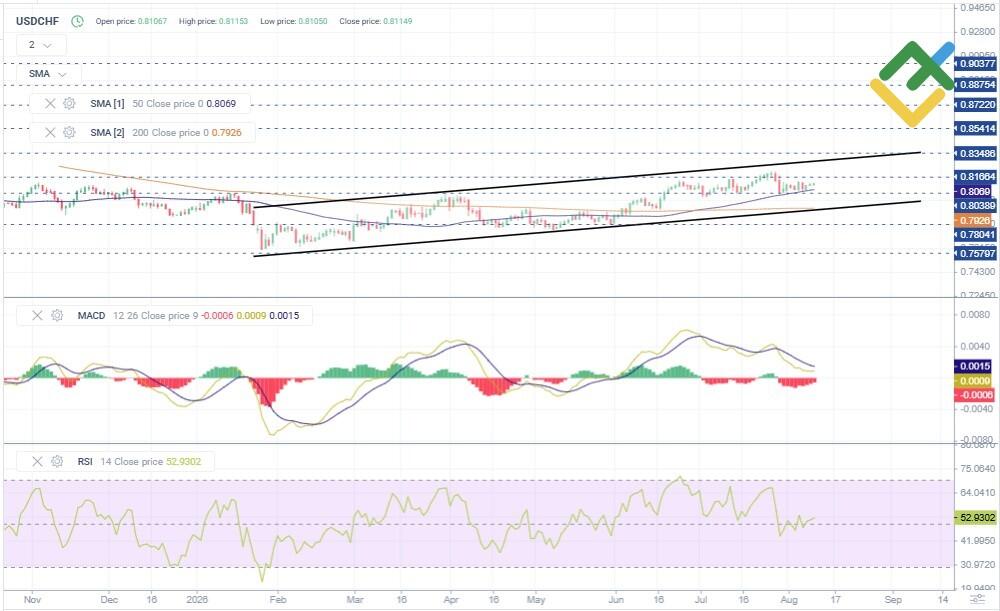
Below is USD/CHF's 12-month price forecast.
Month | Minimum, CHF | Average, CHF | Maximum, CHF |
August 2026 | 0.8030 | 0.8180 | 0.8380 |
September 2026 | 0.8100 | 0.8280 | 0.8480 |
October 2026 | 0.8180 | 0.8370 | 0.8580 |
November 2026 | 0.8250 | 0.8450 | 0.8680 |
December 2026 | 0.8320 | 0.8530 | 0.8780 |
January 2027 | 0.8380 | 0.8600 | 0.8850 |
February 2027 | 0.8300 | 0.8520 | 0.8780 |
March 2027 | 0.8240 | 0.8460 | 0.8700 |
April 2027 | 0.8180 | 0.8400 | 0.8640 |
May 2027 | 0.8120 | 0.8350 | 0.8580 |
June 2027 | 0.8200 | 0.8440 | 0.8680 |
July 2027 | 0.8280 | 0.8520 | 0.8750 |
Long-Term Trading Plan for USDCHF for 2026
Main scenario: Open long positions from the 0.80–0.81 support zone, preferably only after technical indicators confirm the bullish signal. The first target is the 0.85–0.86 range, where partial profits can be taken. If the price consolidates above this area, the next target for long positions will be the 0.87–0.90 zone.
If the price breaks below support, it is better to refrain from opening long positions and wait for a new support level to form. The preferred strategy is to use pullbacks to build long positions and take profits incrementally as key resistance levels are reached.
Analysts' USDCHF Price Projections for 2026
Analysts expect mixed trends for the USD/CHF in the second half of 2026. The currency pair may be influenced by the monetary policies of the Fed and the SNB, inflation rates, and the state of the US and Swiss economies.
CoinCodex
Price range (CHF): 0.8081–0.8631.
According to CoinCodex, the USD/CHF pair is expected to continue its upward trend in the second half of the year. In August, the average price could reach 0.8168, and by October, it could rise to 0.8265. By the end of the year, the price could reach a high of 0.8631.
Month | Minimum, CHF | Average, CHF | Maximum, CHF |
August | 0.8097 | 0.8168 | 0.8254 |
September | 0.8081 | 0.8182 | 0.8293 |
October | 0.8188 | 0.8265 | 0.8365 |
November | 0.8233 | 0.8304 | 0.8393 |
December | 0.8281 | 0.8493 | 0.8631 |
LongForecast
Price range (CHF): 0.7880–0.8360.
According to LongForecast, the USDCHF exchange rate is expected to show mixed movements. In August, the average price could be 0.8095, and by October, it could fall to 0.8000. A recovery in the exchange rate is then expected. In November, the price could reach a high of 0.8360.
Month | Minimum, CHF | Average, CHF | Maximum, CHF |
August | 0.7900 | 0.8095 | 0.8290 |
September | 0.7890 | 0.8075 | 0.8260 |
October | 0.7880 | 0.8000 | 0.8120 |
November | 0.8000 | 0.8180 | 0.8360 |
December | 0.8110 | 0.8230 | 0.8350 |
WalletInvestor
Price range (CHF): 0.78215–0.82691.
According to WalletInvestor, the USD/CHF pair may trade mixed. In August, the average price could be 0.80735, and in September, it could drop to 0.79248. A recovery in the exchange rate is expected afterward. In October, the pair could reach a high of 0.82691.
Month | Minimum, CHF | Average, CHF | Maximum, CHF |
August | 0.80088 | 0.80735 | 0.81368 |
September | 0.78215 | 0.79248 | 0.80840 |
October | 0.79090 | 0.81194 | 0.82691 |
November | 0.79902 | 0.80843 | 0.82060 |
December | 0.80292 | 0.81193 | 0.81652 |
Analysts' USDCHF Price Projections for 2027
Analysts expect mixed trends for the USD/CHF pair in 2027. The pair may be driven by the monetary policies of the Fed and the SNB, the state of the US and Swiss economies, and demand for safe-haven assets.
Note: The price ranges reflect the asset's expected volatility throughout the year. Lows and highs may not be shown in the summary tables.
CoinCodex
Price range (CHF): 0.8522–0.9649.
CoinCodex projects that the USD/CHF pair will continue its uptrend. In the first quarter, the average price could trade near 0.8760, and in the third quarter, it could rise to 0.9083. By the end of the year, the price could reach a high of 0.9649.
Quarter | Minimum, CHF | Average, CHF | Maximum, CHF |
Q1 | 0.8522 | 0.8760 | 0.8997 |
Q2 | 0.8716 | 0.8923 | 0.9130 |
Q3 | 0.8943 | 0.9083 | 0.9222 |
Q4 | 0.9064 | 0.9356 | 0.9649 |
LongForecast
Price range (CHF): 0.7630–0.8400.
According to LongForecast, the USD/CHF rate is expected to decline gradually over the course of the year. In the first quarter, the average price could be 0.8160, and in the second quarter, it could drop to 0.8020. By December, the rate could fall to an annual low of 0.7630.
Quarter | Minimum, CHF | Average, CHF | Maximum, CHF |
Q1 | 0.7920 | 0.8160 | 0.8400 |
Q2 | 0.7800 | 0.8020 | 0.8240 |
Q3 | 0.7720 | 0.7920 | 0.8120 |
Q4 | 0.7630 | 0.7890 | 0.8150 |
WalletInvestor
Price range (CHF): 0.7527–0.8180.
According to WalletInvestor, the USD/CHF price is expected to decline gradually. In the first quarter, the average price could reach 0.8063, and in the third quarter, it could drop to 0.7872. In the fourth quarter, the exchange rate could fall to a low of 0.7527.
Quarter | Minimum, CHF | Average, CHF | Maximum, CHF |
Q1 | 0.7947 | 0.8063 | 0.8180 |
Q2 | 0.7769 | 0.7954 | 0.8139 |
Q3 | 0.7770 | 0.7872 | 0.7973 |
Q4 | 0.7527 | 0.7684 | 0.7841 |
Analysts' USDCHF Price Projections for 2028
Most analysts expect the USD/CHF to decline in 2028. The exchange rate may be influenced by demand for the Swiss franc as a safe-haven asset, central bank policies, the state of the global economy, and investor risk appetite.
CoinCodex
Price range (CHF): 0.8840–0.9641.
According to CoinCodex, the USD/CHF pair will gradually decline in the first half of the year. In the first quarter, the average price could be 0.9425, and in the third quarter, it could drop to 0.8985. A recovery in the exchange rate is anticipated thereafter. In the fourth quarter, the exchange rate could be around 0.9240.
Quarter | Minimum, CHF | Average, CHF | Maximum, CHF |
Q1 | 0.9209 | 0.9425 | 0.9641 |
Q2 | 0.8952 | 0.9204 | 0.9455 |
Q3 | 0.8840 | 0.8985 | 0.9130 |
Q4 | 0.9094 | 0.9240 | 0.9385 |
LongForecast
Price range (CHF): 0.7140–0.7980.
LongForecast assumes that the USD/CHF will show mixed performance. In the first quarter, the average price could be 0.7470, and in the third quarter, it could rise to 0.7730. A decline is then expected. In the fourth quarter, the exchange rate could fall to a low of 0.7140.
Quarter | Minimum, CHF | Average, CHF | Maximum, CHF |
Q1 | 0.7190 | 0.7470 | 0.7750 |
Q2 | 0.7220 | 0.7520 | 0.7820 |
Q3 | 0.7480 | 0.7730 | 0.7980 |
Q4 | 0.7140 | 0.7365 | 0.7590 |
WalletInvestor
Price range (CHF): 0.74337–0.80768.
WalletInvestor projects that the USD/CHF pair will remain relatively stable in the first half of the year. In the third quarter, the average price may fall to 0.75991. In the fourth quarter, the exchange rate may rebound to 0.76966.
Quarter | Minimum, CHF | Average, CHF | Maximum, CHF |
Q1 | 0.76501 | 0.78450 | 0.80398 |
Q2 | 0.76123 | 0.78446 | 0.80768 |
Q3 | 0.74337 | 0.75991 | 0.77645 |
Q4 | 0.74892 | 0.76966 | 0.79039 |
Analysts' USDCHF Price Projections for 2029
Analysts are divided in their forecasts for USD/CHF quotes in 2029. The currency pair could be influenced by the policies of the Fed and the SNB, the state of the US and Swiss economies, capital flows, and demand for safe-haven assets.
CoinCodex
Price range (CHF): 0.8614–0.9463.
According to CoinCodex, an upward trend is expected for the USD/CHF over the course of the year. In the first quarter, the average price could be 0.8912, and in the second quarter, it could rise to 0.9169. By December, the price could reach a high of 0.9463.
Quarter | Minimum, CHF | Average, CHF | Maximum, CHF |
Q1 | 0.8614 | 0.8912 | 0.9209 |
Q2 | 0.8930 | 0.9169 | 0.9408 |
Q3 | 0.8959 | 0.9183 | 0.9408 |
Q4 | 0.9187 | 0.9325 | 0.9463 |
LongForecast
Price range (CHF): 0.7250–0.8040.
LongForecast projects that the average price in the first quarter could be 0.7550. By summer, the rate could reach a high of 0.8040. A slight decline is then expected. In the fourth quarter, the average price will likely return to 0.7510.
Quarter | Minimum, CHF | Average, CHF | Maximum, CHF |
Q1 | 0.7250 | 0.7550 | 0.7850 |
Q2 | 0.7340 | 0.7690 | 0.8040 |
Q3 | 0.7300 | 0.7575 | 0.7850 |
Q4 | 0.7290 | 0.7510 | 0.7730 |
WalletInvestor
Price range (CHF): 0.72341–0.77449.
WalletInvestor predicts that the USD/CHF pair will gradually decline in the first half of the year. In the first quarter, the average price could be 0.76333, and in the second quarter, it could drop to 0.74895. In the third quarter, the exchange rate could fall to a low of 0.72579. By December, the exchange rate will likely stabilize near 0.74358.
Quarter | Minimum, CHF | Average, CHF | Maximum, CHF |
Q1 | 0.75417 | 0.76333 | 0.77248 |
Q2 | 0.72341 | 0.74895 | 0.77449 |
Q3 | 0.72579 | 0.73727 | 0.74875 |
Q4 | 0.73001 | 0.74358 | 0.75715 |
Analysts' USDCHF Price Projections for 2030
Analysts expect mixed trends for the USD/CHF in 2030. The pair's performance may be influenced by central banks' monetary policies, the economic conditions in the U.S. and Switzerland, global capital flows, and demand for safe-haven assets.
CoinCodex
Price range (CHF): 0.9051–0.9561.
According to CoinCodex, the USD/CHF pair is expected to trade sideways. In the second quarter, the average price could be 0.9329, and in the third quarter, it could fall to 0.9220. In the fourth quarter, the average price could settle at 0.9209.
Quarter | Minimum, CHF | Average, CHF | Maximum, CHF |
Q1 | 0.9111 | 0.9290 | 0.9469 |
Q2 | 0.9098 | 0.9329 | 0.9561 |
Q3 | 0.9079 | 0.9220 | 0.9360 |
Q4 | 0.9051 | 0.9209 | 0.9368 |
WalletInvestor
Price range (CHF): 0.70628–0.75958.
WalletInvestor predicts that the USD/CHF price will decline. In the second quarter, the average price could reach 0.72933, and in the third quarter, it could edge lower to 0.72238. A slight recovery may follow. In December, the exchange rate will likely stabilize at 0.73505.
Quarter | Minimum, CHF | Average, CHF | Maximum, CHF |
Q1 | 0.71818 | 0.73888 | 0.75958 |
Q2 | 0.71573 | 0.72933 | 0.74292 |
Q3 | 0.70628 | 0.72238 | 0.73847 |
Q4 | 0.71957 | 0.73505 | 0.75052 |
Analysts' USDCHF Price Projections up to 2050
Long-term forecasts for the USD/CHF should be viewed with caution. The currency pair's performance will depend on the economic conditions in the US and Switzerland, interest rates, inflation, international capital flows, and changes in the global financial system.
In addition, shifts in the roles of the US dollar and Swiss franc in international transactions, the development of digital currencies, and structural changes in global trade could have a significant impact on the pair. It is impossible to account for all economic, political, and technological developments over such a long-term horizon. Therefore, forecasts extending to 2050 should be viewed as purely indicative scenarios rather than precise predictions.
USDCHF Market Sentiment on Social Media
Media sentiment reflects the overall attitude of market participants toward USD/CHF based on publications, comments, and news reports. Positive expectations for the US economy could support the pair, while increased demand for the Swiss franc as a safe-haven asset could put downward pressure on the exchange rate.
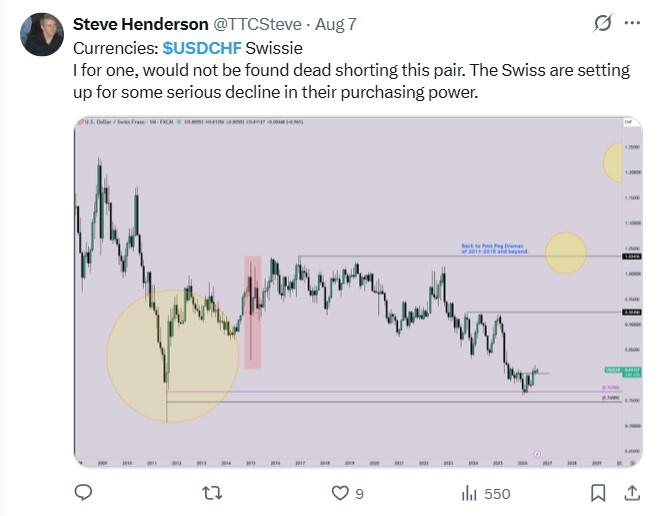
User @TTCSteve believes that opening short positions is not advisable at this time, expecting USD/CHF quotes to rise significantly.
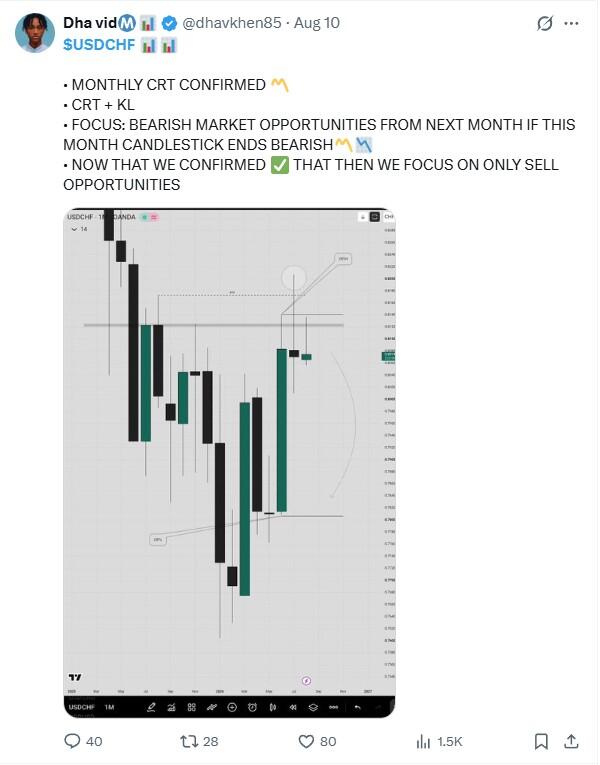
User @dahvken85 takes the opposite view, noting the formation of a bearish trend and suggesting that short positions are currently a good strategy.
Overall, market sentiment remains mixed: some users expect the USD/CHF to rebound, while others predict a decline toward key support. Before making any trading or investment decisions, it is important to conduct technical and fundamental analysis and review the latest expert analysis.
USDCHF Price History
The USDCHF pair reached its all-time high of ₣1.3868 on 18.09.2003.
The lowest price of the USDCHF pair was recorded on 10.08.2011 and reached ₣0.71829.
Below is a chart showing the USDCHF pair's performance over the last ten years. In this connection, it is important to evaluate historical data to make predictions as accurate as possible.
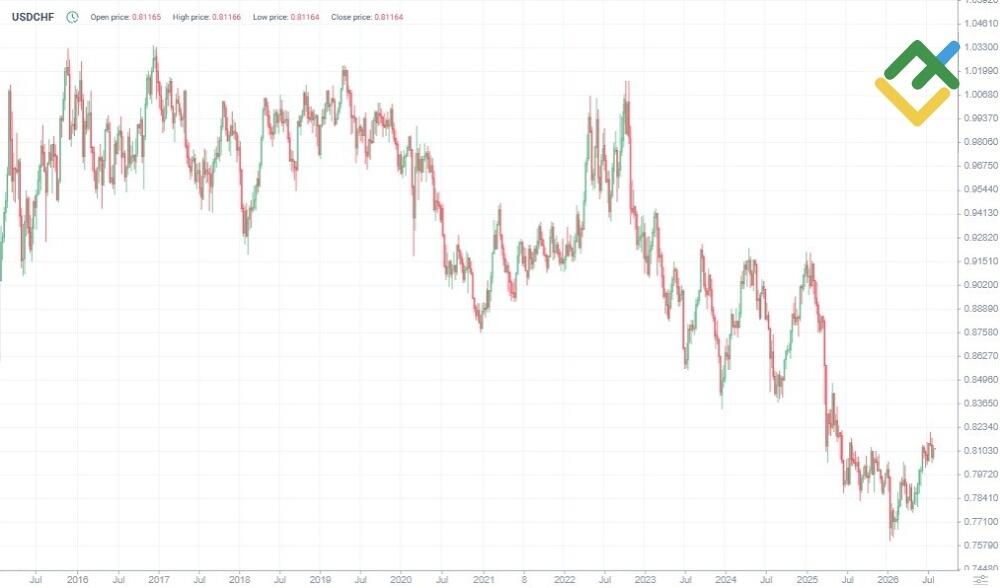
Since 2020, the USDCHF currency pair has exhibited high volatility due to global economic developments and shifts in monetary policy in the US and Switzerland:
In 2020, amid the global economic uncertainty caused by the novel coronavirus, the Swiss franc strengthened as a safe-haven currency, and the USDCHF rate declined.
In 2021, as the global economy recovered, the US dollar began to strengthen, pushing the USDCHF exchange rate higher.
In 2022, high inflation and aggressive interest rate hikes by the Fed further boosted the greenback.
In 2023–2024, the USDCHF exchange rate was driven by inflation fluctuations and expectations regarding further US monetary policy decisions.
In 2025, the pair traded within a downward channel. The Swiss franc strengthened amid geopolitical tensions and the Swiss National Bank's cautious rhetoric. By the end of the year, the pair tested the 0.7928 level.
At the beginning of 2026, the pair stood at 0.7923 and then fell to 0.7604 by the end of January amid weak US macroeconomic data. In March, the dollar recovered to 0.8042, but by mid-May, it had dropped to 0.7761. Between June and August, the price fluctuated around the 0.81162 level.
USDCHF Price Fundamental Analysis
Fundamental analysis of the USDCHF pair allows traders and investors to assess the prospects of the Swiss franc and the US dollar based on macroeconomic indicators and geopolitical factors affecting their value.
What Factors Affect the USDCHF Pair?
The USDCHF exchange rate is driven by a wide range of factors that shape the supply and demand for these currencies.
Economic indicators of the USA and Switzerland. Key economic indicators such as GDP growth, inflation rate, employment data, and consumer sentiment in both countries have a substantial impact on the currency pair.
Monetary policy of central banks. The decisions of the US Federal Reserve and the Swiss National Bank regarding interest rates, quantitative easing programs, and other monetary policy instruments directly impact the attractiveness of both currencies for investors.
Geopolitical risks and events. Global political instability, trade wars, natural disasters, and other unpredictable events can cause currency fluctuations. In times of uncertainty, investors often turn to the Swiss franc as a safe-haven currency, resulting in its appreciation.
Market sentiment. Investors' expectations of future currency movements and speculative trades can also have a short-term impact on the USDCHF rate.
Commodity prices. Switzerland, though not a major commodity exporter, can be indirectly influenced through its overall economic ties with other countries.
More Facts About USDCHF
The USDCHF pair is among the most widely traded currency pairs in the global currency market. The Swiss franc is frequently referred to as "Swissy" within the trading community. This currency pair is characterized by its volatility, which is influenced by global economic events and geopolitical developments.
The USDCHF exchange rate is driven by decisions made by the US Federal Reserve and the Swiss National Bank, as well as macroeconomic indicators such as inflation, employment, and economic growth rates in both countries. Traders and investors closely monitor this data to predict future rate movements.
The Swiss Franc's status as a safe-haven asset makes it particularly sensitive to global crises and uncertainties, which can lead to sharp fluctuations in the USDCHF price. A comprehensive understanding of these trends is paramount for achieving successful outcomes in trading this currency pair.
Advantages and Disadvantages of Investing in USDCHF
Investing in the USDCHF pair carries a degree of risk. In this regard, it is essential to carefully assess the potential benefits and drawbacks of the asset to make informed trading decisions.
Advantages
Predictability during economic turmoil. The Swiss franc has historically been regarded as a reliable currency due to its stability. During periods of global economic instability or geopolitical risks, investors buy defensive assets, leading to a strengthening of the Swiss franc.
The USDCHF market's liquidity ensures narrow spreads, reducing transaction costs and enhancing profitability.
The USDCHF pair frequently exhibits pronounced trends, facilitating the application of technical analysis and the prediction of price movements.
The regular publication of economic data from both the US and Switzerland enables traders to utilize fundamental analysis, creating the opportunity to make informed decisions and substantial profits.
Disadvantages
The Swiss franc's strong correlation with the European economy renders it susceptible to economic shifts in the eurozone.
Unforeseen political decisions or financial crises in Europe can severely harm the Swiss franc's exchange rate and diminish the profitability of USDCHF trading.
The Swiss National Bank has a reputation for its proactive currency intervention policies.
The SNB can suddenly intervene in the currency market to weaken or support the national currency, which can lead to unpredictable fluctuations and losses for traders.
The relatively low volatility of the USDCHF pair compared to other currency pairs can limit potential profits, especially for traders using high-volatility strategies.
Traders must dedicate significant time and analytical skills to monitor both US and Swiss economic news consistently.
How We Make Forecasts
When forecasting short-term and long-term USDCHF price changes, a comprehensive analysis of the following aspects is necessary:
1. Fundamental analysis encompasses the following:
Forecasts of reputable analytical agencies.
Analyzing US and Swiss economic indicators, such as economic growth rates, financial system stability, gross domestic product, interest rates, and inflation rates.
An assessment of monetary policy, including quantitative easing programs and interest rate hikes.
Assessing trade relations between the two states, in particular the balance of exports and imports, trade agreements in force, and other relevant factors.
Examining geopolitical and macroeconomic risks that could affect the exchange rate.
2. The assessment of prevailing market sentiment and public opinion on social media platforms and other online resources.
3. Technical analysis. The most effective and reliable approach involves the complex application of candlestick analysis, chart patterns, and technical indicators. This comprehensive approach enables the precise identification of pivot points, facilitating the determination of optimal entry points with minimal risk while maximizing potential profits.
Conclusion: Is USDCHF a Good Investment?
Long-term forecasts for the USD/CHF offer no clear indication of the pair's future direction. Some analysts expect the exchange rate to decline as the Swiss franc strengthens, while others anticipate further gains in USD/CHF quotes. Technical and fundamental analysis should be conducted before making any trading or investment decisions.
The USD/CHF may present opportunities for both traders and investors, but currency and macroeconomic risks should be carefully considered. Analysts' long-term projections vary significantly, so they should be viewed as potential market scenarios rather than precise predictions. Trading and investment decisions should ultimately be based on your strategy, investment objectives, and risk tolerance.
USDCHF Price Prediction FAQs
The current price of the USDCHF pair is ₣0.82211 as of 20.09.2026.
The USD/CHF is expected to trade between 0.78215 and 0.86310 in 2026. Some analysts predict that the pair will rise by December. However, periods of sideways movement and pullbacks cannot be ruled out.
Forecasts for the USD/CHF in 2027 suggest that the pair could trade within a wide range of 0.7527–0.9649. Some scenarios anticipate a steady rise through December, while others point to a decline. Overall, volatility is expected to remain high.
According to forecasts, the Swiss franc could either rise or fall. In 2030, the USD/CHF rate is expected to range between 0.70628 and 0.9561. Most experts anticipate that the franc will strengthen.
Forecasts suggest that the Swiss franc will strengthen over the long term. The USDCHF pair will gradually decline and could fall to approximately 0.70628–0.75958 by 2030. However, some analysts expect the currency pair to rise.
The further growth of the Swiss franc will depend on several key factors. If global economic uncertainty persists, demand for the Swiss franc as a safe-haven currency will continue to bolster its exchange rate. Conversely, if the global economy recovers, the Swiss franc may weaken against other currencies.
The CHF is stronger than the USD primarily due to fundamental economic differences between Switzerland and the US. Switzerland has a stable economy, low debt, and a significant trade surplus. These factors make the CHF attractive to investors looking for stability.
USD/CHF forecasts vary significantly. Some analysts expect the pair to decline as the Swiss franc strengthens, while others anticipate further gains. When determining a trading direction, it is important to consider technical signals, macroeconomic factors, and your individual risk tolerance.
The outlook for the USDCHF pair is shaped by the interest rates of the US Federal Reserve and the Swiss National Bank, economic growth rates of both countries, inflation, trade balance, and geopolitical environment. Investor sentiment and capital flows between currencies also play an important role.
Price chart of USDCHF in real time mode
The content of this article reflects the author’s opinion and does not necessarily reflect the official position of LiteFinance broker. The material published on this page is provided for informational purposes only and should not be considered as the provision of investment advice for the purposes of Directive 2014/65/EU.
According to copyright law, this article is considered intellectual property, which includes a prohibition on copying and distributing it without consent.