This article provides a comprehensive review of the USDZAR currency pair with technical and fundamental analysis, long-term forecasts, expert opinions, as well as market sentiment assessment.
This overview will help traders and investors better grasp the pair's movement, identify potential entry points, and develop an effective trading strategy.
The article covers the following subjects:
- Major Takeaways
- USDZAR Real-Time Market Status
- USDZAR Price Forecast for 2026 Based on Technical Analysis
- Analysts' USDZAR Price Projections for 2027
- Analysts' USDZAR Price Projections for 2028
- Analysts' USDZAR Price Projections for 2029
- Analysts' USDZAR Price Projections for 2030
- Analysts' USDZAR Price Projections until 2050
- Market Sentiment of USDZAR on Social Media
- USDZAR Price History
- USDZAR Price Fundamental Analysis
- More Facts About USDZAR
- How We Make Forecasts
- Conclusion: Is USDZAR a Good Investment?
- USDZAR Price Prediction FAQs
Major Takeaways
- The current price of the USDZAR pair is RN/A as of 25.10.2026.
- The USDZAR pair reached its all-time high of RN/A on N/A. The pair's all-time low of RN/A was recorded on N/A.
- The USDZAR currency pair represents the ratio of the US dollar to the South African rand.
- The US dollar is the main reserve currency in the world, while the rand is the currency of an emerging economy.
- The USDZAR exchange rate is sensitive to fluctuations in commodity prices, particularly gold and platinum.
- The US Fed's policy and the South African Reserve Bank's actions significantly influence the currency pair's performance.
- The pair's volatility can increase sharply during economic instability or geopolitical changes.
- The USDZAR pair is a popular asset among short-term traders who rely on news-driven strategies.
- The pair is often used to hedge risks associated with financial operations in African countries.
USDZAR Real-Time Market Status
The USDZAR currency pair is trading at RN/A as of 25.10.2026.
When analyzing the USDZAR pair's performance, it is essential to monitor key economic and technical indicators such as interest rates, inflation, volatility, and price change over the year. This data allows traders to make more informed decisions and evaluate the risks.
Indicator | Value |
South African interest rate | 7.00% |
US interest rate | 3.75% |
All-time low | N/A ZAR |
All-time high | N/A ZAR |
Price change over the last 12 months | -8.51% |
USDZAR Price Forecast for 2026 Based on Technical Analysis
Let's conduct a technical analysis of the weekly USDZAR chart to forecast the pair's movement over the coming year.
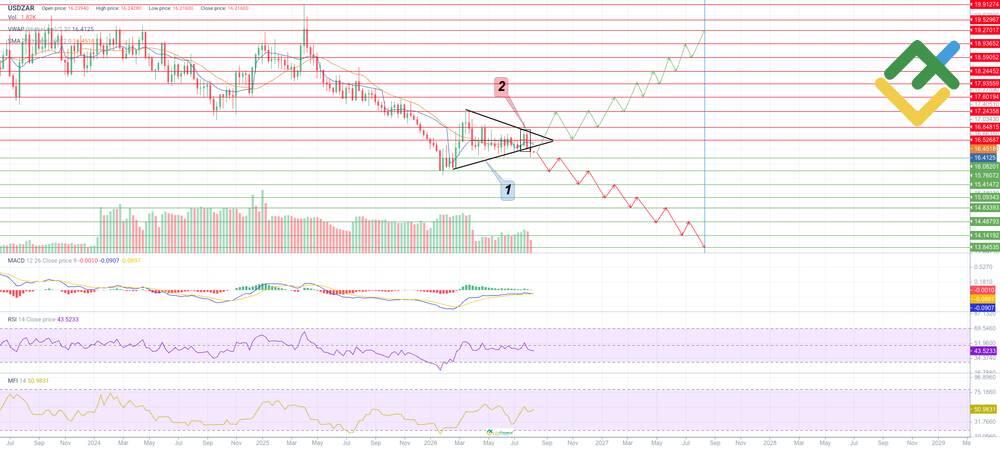
Since early August 2026, the currency pair has been falling. Technical indicators and candlestick patterns are giving mixed signals:
- A major Symmetrical Triangle (1) pattern is forming. The price broke below this pattern at 16.30 and is likely targeting the 15.09 level and below. A Bearish Engulfing candlestick pattern (2) has appeared near the key resistance level of 16.52, indicating that the downtrend may continue.
- MACD is gradually declining in the positive zone, indicating strengthening bearish momentum.
- The RSI is holding at 43 and may decline further.
- The MFI is rising, showing an inflow of liquidity into the asset.
- The VWAP and SMA20 are both above the market price, meaning the bears still have the upper hand.
Below is USDZAR's 12-month price forecast.
Month | Minimum, ZAR | Average, ZAR | Maximum, ZAR |
August 2026 | 16.05 | 16.27 | 16.50 |
September 2026 | 15.76 | 15.93 | 16.10 |
October 2026 | 15.68 | 15.89 | 16.11 |
November 2026 | 15.32 | 15.51 | 15.71 |
December 2026 | 15.21 | 15.50 | 15.79 |
January 2027 | 15.03 | 15.20 | 15.37 |
February 2027 | 14.93 | 15.20 | 15.47 |
March 2027 | 14.83 | 14.97 | 15.11 |
April 2027 | 14.48 | 14.68 | 14.89 |
May 2027 | 14.42 | 14.65 | 14.88 |
June 2027 | 14.15 | 14.46 | 14.77 |
July 2027 | 14.01 | 14.26 | 14.51 |
Long-Term Trading Plan for USDZAR for 2026
The technical analysis conducted has identified key support and resistance levels that can be used in a trading strategy for the coming year.
Trading Plan for the Year
- The downtrend is expected to continue.
- Key support levels: 16.08; 15.76; 15.41; 15.09; 14.83; 14.48; 14.14; 13.84.
- Key resistance levels: 16.52; 16.84; 17.24; 17.60; 17.93; 18.24; 18.59; 18.93; 19.27; 19.52; 19.91.
- Base scenario: Open short trades below the support level of 16.08 on increased volume, targeting the 15.76–13.84 range.
- Alternative scenario: Open long trades above the resistance level of 16.52 on increased volume, targeting the 16.84–19.91 range.
Analysts' USDZAR Price Projections for 2026
Analysts expect the South African rand to strengthen moderately. The currency pair may be influenced by the Fed's monetary policy, commodity prices, and the state of the South African economy.
LongForecast
Price range (ZAR): 15.32–16.57.
According to LongForecast, the USDZAR pair will mostly go down in the second half of the year. The price is expected to close at 15.93 in August and drop to 15.67 by September. In October and November, the asset is projected to rebound and then fall to a low of 15.32 by year-end.
Month | Open, ZAR | Min–Max, ZAR | Close, ZAR |
August | 16.54 | 15.36–16.57 | 15.93 |
September | 15.93 | 15.43–16.36 | 15.67 |
October | 15.67 | 15.57–16.05 | 15.81 |
November | 15.81 | 15.72–16.20 | 15.96 |
December | 15.96 | 15.32–15.96 | 15.55 |
WalletInvestor
Price range (ZAR): 15.09–16.80.
WalletInvestor predicts that the USDZAR pair will trade unevenly. The average price is expected to reach 16.31 in August, decrease to 15.27 in September, and then recover, hitting 16.49 by December.
Month | Average, ZAR | Minimum, ZAR | Maximum, ZAR |
August | 16.31 | 16.13 | 16.45 |
September | 15.27 | 15.09 | 15.79 |
October | 16.45 | 16.21 | 16.69 |
November | 16.19 | 15.92 | 16.61 |
December | 16.49 | 16.03 | 16.80 |
CoinCodex
Price range (ZAR): 15.28–16.57.
CoinCodex envisages a bearish trend for USDZAR. The average price is predicted to reach 16.26 in August, 15.80 in October, and 15.50 by year-end.
Month | Minimum, ZAR | Average, ZAR | Maximum, ZAR |
August | 15.99 | 16.26 | 16.57 |
September | 15.51 | 15.84 | 16.27 |
October | 15.55 | 15.80 | 16.18 |
November | 15.32 | 15.60 | 15.88 |
December | 15.28 | 15.50 | 15.70 |
Analysts' USDZAR Price Projections for 2027
Analysts differ in their forecasts for 2027. The value of the USDZAR pair may be affected by the health of South Africa's economy, inflation, interest rates, and demand for commodities.
Note: The price ranges reflect the asset's expected volatility throughout the year. Lows and highs may not be shown in the summary tables.
LongForecast
Price range (ZAR): 13.38–16.00.
LongForecast estimates that the USDZAR pair will decline in 2027. The asset is forecast to close at 14.53 in Q2, drop to 13.83 in Q3, and retreat to a low of 13.38 by year-end.
Quarter | Open, ZAR | Min–Max, ZAR | Close, ZAR |
Q1 | 15.55 | 15.07–16.00 | 15.56 |
Q2 | 15.56 | 14.31–15.56 | 14.53 |
Q3 | 14.53 | 13.62–14.80 | 13.83 |
Q4 | 13.83 | 13.38–14.44 | 13.58 |
WalletInvestor
Price range (ZAR): 15.17–17.44.
According to WalletInvestor, the USDZAR pair will rise in the first half of the year. The average value is projected to reach 16.97 in Q2. After that, the price is expected to decline, reaching a low of 15.17 in Q4.
Quarter | Average, ZAR | Minimum, ZAR | Maximum, ZAR |
Q1 | 16.02 | 15.47 | 17.23 |
Q2 | 16.97 | 15.96 | 17.44 |
Q3 | 16.29 | 16.09 | 17.42 |
Q4 | 16.33 | 15.17 | 17.04 |
CoinCodex
Price range (ZAR): 15.19–17.17.
CoinCodex predicts that the USDZAR pair will move in different directions. The average price may fall to 15.72 in Q2, climb to 16.41 in Q3, and pull back to 16.17 by year-end.
Quarter | Minimum, ZAR | Average, ZAR | Maximum, ZAR |
Q1 | 15.19 | 16.08 | 16.47 |
Q2 | 15.49 | 15.72 | 16.29 |
Q3 | 15.46 | 16.41 | 17.17 |
Q4 | 15.46 | 16.17 | 16.97 |
Analysts' USDZAR Price Projections for 2028
Analysts expect mixed trends for the USDZAR pair. Economic reforms in South Africa, the global economic situation, commodity demand, and investor sentiment may all influence the currency pair.
LongForecast
Price range (ZAR): 13.20–14.65.
LongForecast suggests the USDZAR pair will trade erratically. The price is anticipated to close at 14.17 in Q2 and decrease to 13.43 by year-end.
Quarter | Open, ZAR | Min–Max, ZAR | Close, ZAR |
Q1 | 13.58 | 13.34–14.00 | 13.54 |
Q2 | 13.54 | 13.20–14.38 | 14.17 |
Q3 | 14.17 | 13.51–14.65 | 13.72 |
Q4 | 13.72 | 13.23–14.06 | 13.43 |
WalletInvestor
Price range (ZAR): 15.48–19.27.
According to WalletInvestor, the USDZAR pair may decline in the first half of the year, averaging around 16.65 in Q2. However, the exchange rate is expected to advance thereafter, potentially reaching a high of 19.27 by December.
Quarter | Average, ZAR | Minimum, ZAR | Maximum, ZAR |
Q1 | 16.90 | 15.48 | 17.52 |
Q2 | 16.65 | 15.84 | 17.53 |
Q3 | 16.95 | 16.09 | 17.84 |
Q4 | 17.64 | 16.45 | 19.27 |
CoinCodex
Price range (ZAR): 14.32–16.95.
CoinCodex forecasts that USDZAR will trade mostly sideways. The average price may reach 15.05 in Q2, rise to 15.39 in Q3, and most likely decline to 15.20 by year-end.
Quarter | Minimum, ZAR | Average, ZAR | Maximum, ZAR |
Q1 | 14.47 | 15.09 | 16.13 |
Q2 | 14.74 | 15.05 | 16.26 |
Q3 | 14.92 | 15.39 | 15.90 |
Q4 | 14.32 | 15.20 | 16.95 |
Analysts' USDZAR Price Projections for 2029
Analysts are divided on the outlook for the USDZAR exchange rate in 2029. The pair could be influenced by South Africa's fiscal policy, foreign investment inflows, the state of the global economy, and investor risk appetite.
LongForecast
Price range (ZAR): 12.76–14.01.
LongForecast projects that the asset will remain relatively stable in the first half of the year. The price is expected to close at 13.54 in Q2 and at 13.76 in Q3. Thereafter, the value may decline, reaching a low of 12.76 by year-end.
Quarter | Open, ZAR | Min–Max, ZAR | Close, ZAR |
Q1 | 13.43 | 12.96–13.71 | 13.51 |
Q2 | 13.51 | 13.19–14.01 | 13.54 |
Q3 | 13.54 | 13.14–13.97 | 13.76 |
Q4 | 13.76 | 12.76–13.76 | 13.34 |
WalletInvestor
Price range (ZAR): 15.33–20.61.
WalletInvestor assumes the USDZAR pair will mainly grow. The average price is expected to reach 16.63 in Q1 and 18.05 by Q3. By December, the pair could hit a high of 20.61.
Quarter | Average, ZAR | Minimum, ZAR | Maximum, ZAR |
Q1 | 16.63 | 15.76 | 18.12 |
Q2 | 16.65 | 15.33 | 17.88 |
Q3 | 18.05 | 15.61 | 18.98 |
Q4 | 18.06 | 17.09 | 20.61 |
CoinCodex
Price range (ZAR): 13.47–18.08.
Analysts at CoinCodex expect the USDZAR pair to go up in the first half of the year. The average price is predicted to reach 13.82 in Q1 and rise to 15.58 in Q2. By autumn, the pair may peak at 18.08. In December, a correction may occur, dragging the price down to 16.69.
Quarter | Minimum, ZAR | Average, ZAR | Maximum, ZAR |
Q1 | 13.47 | 13.82 | 14.54 |
Q2 | 13.79 | 15.58 | 16.20 |
Q3 | 15.31 | 17.17 | 18.08 |
Q4 | 15.89 | 16.69 | 17.39 |
Analysts' USDZAR Price Projections for 2030
Analysts are divided in their forecasts for 2030. The USDZAR pair could be influenced by South Africa's economic state, external debt, energy supply stability, productivity, and global capital flows.
WalletInvestor
Price range (ZAR): 15.09–19.79.
According to WalletInvestor, the USDZAR pair may climb at the beginning of the year. The average price is estimated at 18.67 in Q1. The pair is predicted to plunge to a low of 15.09 by autumn. By year-end, the average price may rebound to 17.69.
Quarter | Average, ZAR | Minimum, ZAR | Maximum, ZAR |
Q1 | 18.67 | 16.63 | 19.71 |
Q2 | 17.96 | 16.93 | 19.79 |
Q3 | 16.04 | 15.09 | 18.71 |
Q4 | 17.69 | 15.41 | 18.89 |
Gov Capital
Price range (ZAR): 12.34–15.90.
Gov Capital forecasts that the USDZAR pair will decline gradually. The average value could reach 14.35 in Q1 and decline to 14.15 in Q2. By December, the asset is projected to fall to a low of 12.34.
Quarter | Average, ZAR | Least Possible Rate, ZAR | Best Possible Rate, ZAR |
Q1 | 14.35 | 12.79 | 15.89 |
Q2 | 14.15 | 12.53 | 15.90 |
Q3 | 13.93 | 12.42 | 15.76 |
Q4 | 13.95 | 12.34 | 15.76 |
CoinCodex
Price range (ZAR): 15.50–18.04.
According to CoinCodex, the USDZAR pair will rise steadily. The average price is expected to reach 16.80 in Q1 and 16.98 in Q2. In Q3, the price is predicted to surge to a high of 18.04. By year-end, a correction may occur, bringing the average price to 16.77.
Quarter | Minimum, ZAR | Average, ZAR | Maximum, ZAR |
Q1 | 15.50 | 16.80 | 17.13 |
Q2 | 16.24 | 16.98 | 17.60 |
Q3 | 16.17 | 17.35 | 18.04 |
Q4 | 16.32 | 16.77 | 17.84 |
Analysts' USDZAR Price Projections until 2050
Long-term forecasts for USDZAR should be viewed with caution. The state of the US and South African economies, the monetary policies of regulators, inflation, demand for commodities, the geopolitical situation, and shifts in the global financial system could all influence the exchange rate of this currency pair.
Additionally, the changing role of the US dollar in the global economy, the development of central bank digital currencies, the transition to renewable energy sources, and structural changes in South Africa's economy could have a significant impact on the price. It is impossible to account for all political, technological, and economic changes over such a long-term horizon. Thus, any projections through 2050 are purely indicative.
Market Sentiment of USDZAR on Social Media
Media sentiment reflects the overall attitude of market participants toward USDZAR based on social media posts, comments, and news. Positive expectations regarding the South African economy may bolster the rand and lead to a decline in the USDZAR pair. Negative sentiment, on the other hand, may boost demand for the US dollar and drive the currency pair higher.
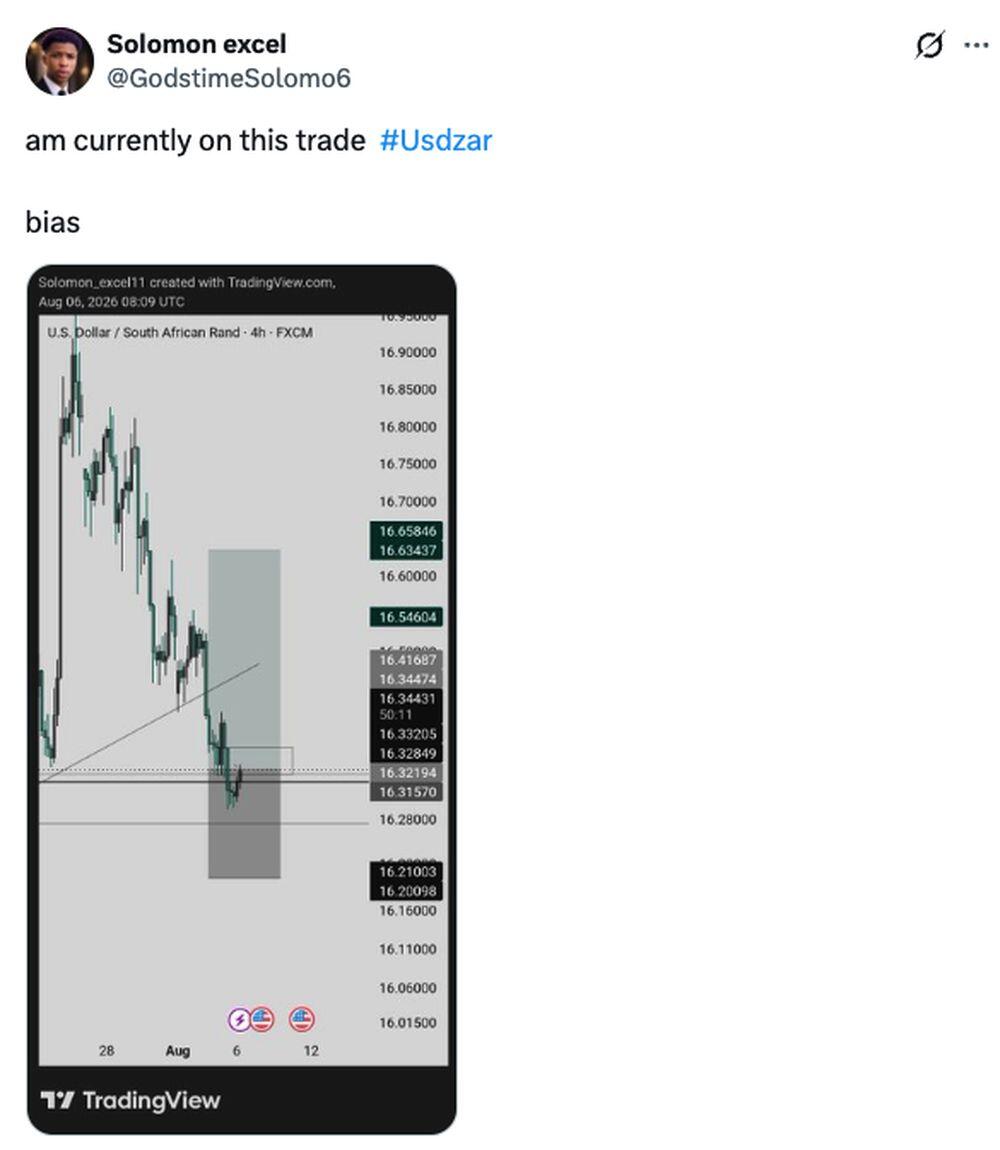
User @GodstimeSolomo6 predicts that the USDZAR exchange rate will rise to 16.65 in the near future.
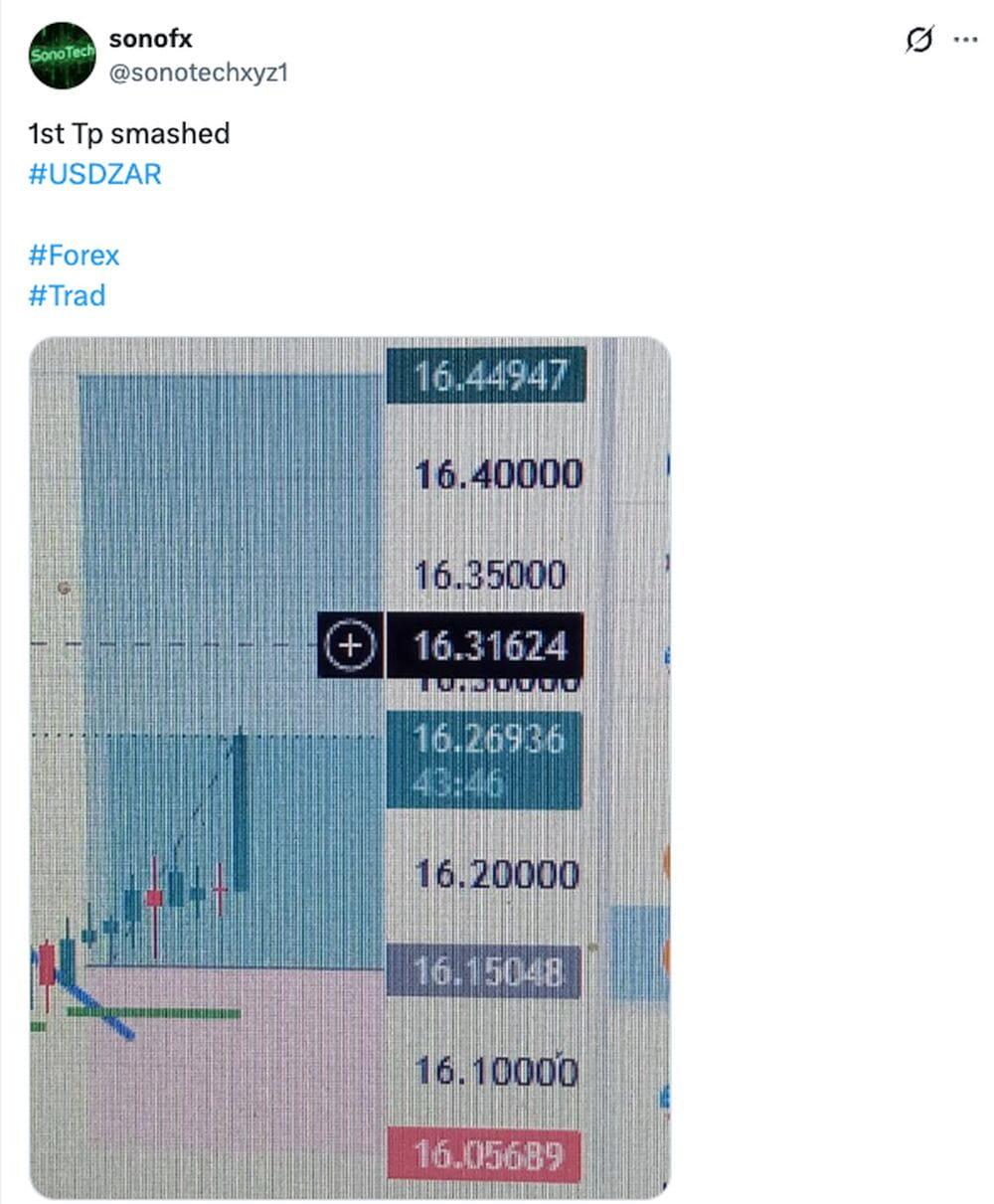
Independent trader @sonotechxyz1 forecasts that USDZAR will climb to 16.44 in the short term.
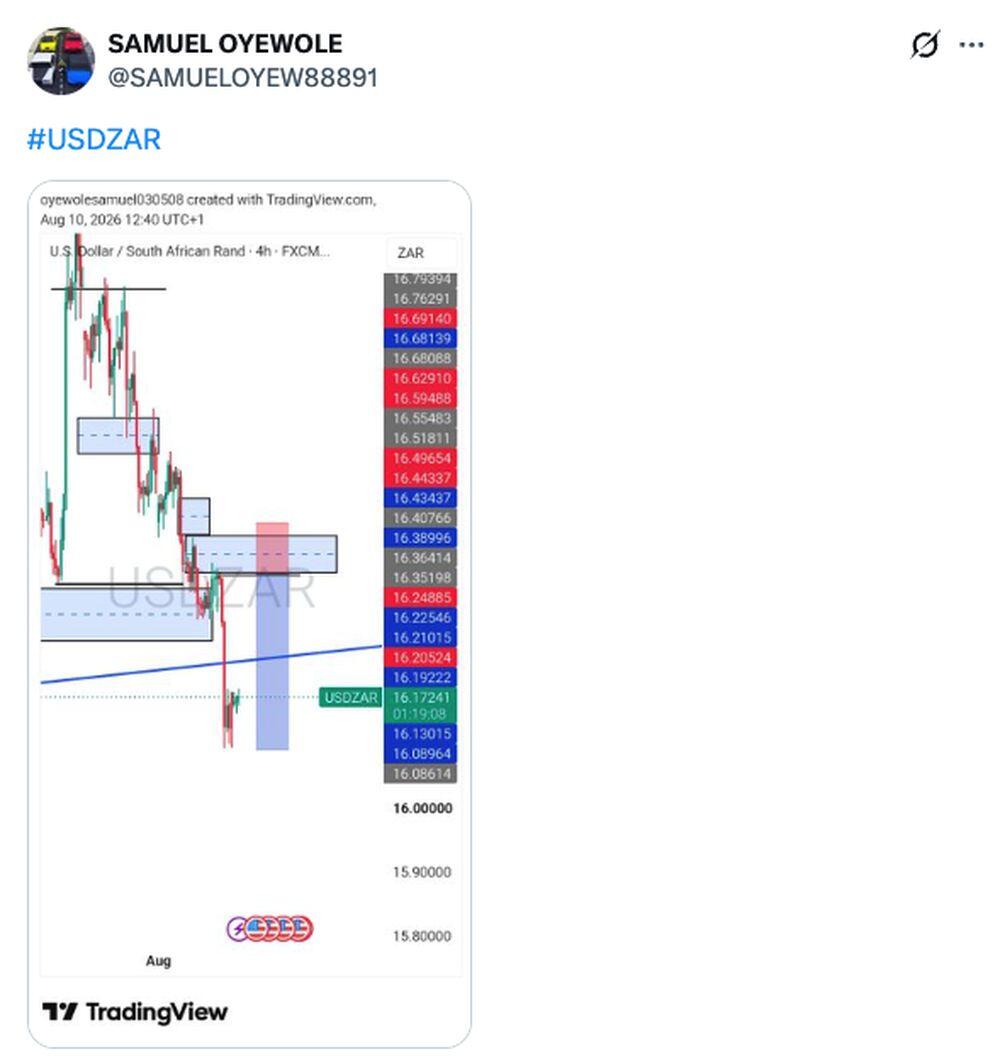
Independent expert @SAMUELOYEW88891 expects the USDZAR exchange rate to grow to 16.43 in the near future.
Most traders and investors predict that the USDZAR exchange rate will rise in the short term. However, it is crucial to conduct technical and fundamental analysis and review the latest expert insights before making any trading or investment decisions.
USDZAR Price History
The USDZAR pair reached its all-time high of N/A ZAR on N/A.
The all-time low of the USDZAR pair was recorded on N/A when the price declined to N/A ZAR.
It is crucial to evaluate historical data to make predictions as accurate as possible. The chart below shows the USDZAR pair performance over the last ten years.
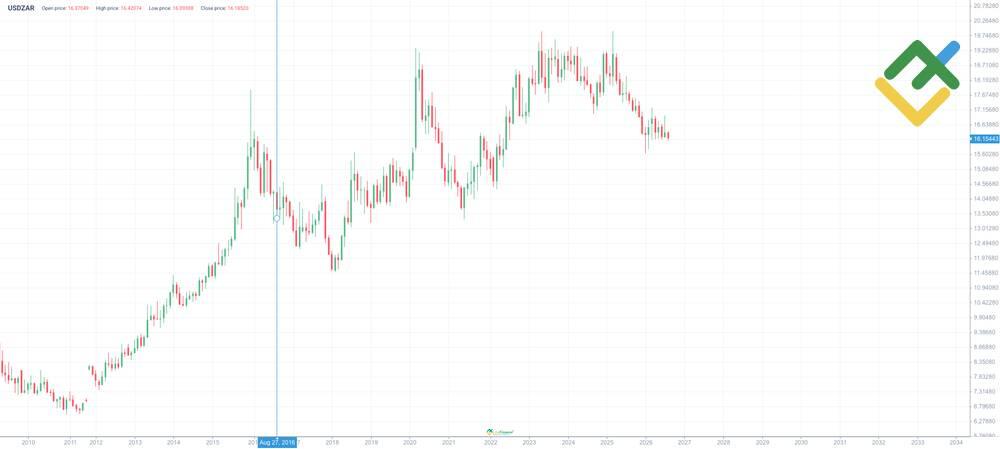
The USDZAR pair, representing the exchange rate between the US dollar and the South African rand, has a long trading history characterized by significant price fluctuations.
The exchange rate remained relatively stable in the 1980s. However, starting in the early 2000s, the rand began to weaken amid political instability and economic challenges in South Africa. By 2008, the global financial crisis triggered a sharp rise in the USDZAR pair, pushing it above the R11 mark.
Since 2015, the pair has exhibited increased volatility because it is highly vulnerable to changes in commodity prices, US Fed decisions, and political events in South Africa. In 2020, the rate exceeded R19 amid the COVID-19 pandemic. Since then, the pair has been trading in a wide range.
In 2020, the USDZAR price surged to R19.34 due to the COVID-19 pandemic. After that, it retreated to R15.02. From mid-2021 to mid-2023, the US dollar strengthened to R19.92, bolstered by global monetary policy tightening, the energy crisis, and geopolitical risks. Until the end of 2025, the USDZAR pair traded in a wide range between R19.92 and R17.03 amid high inflation, unemployment, and logistics disruptions.
In January 2026, the USDZAR pair stood at 16.55. In February, however, it fell to 15.76. In early April, the pair rebounded to 16.96. In early August, the asset dropped again, reaching 16.23.
USDZAR Price Fundamental Analysis
Fundamental analysis is crucial for understanding the economic and political factors influencing the USDZAR currency pair. It aids in assessing risks, identifying market trends, and making informed trading decisions for short-term and long-term trading.
What Factors Affect the USDZAR Pair?
The USDZAR exchange rate is determined by a range of internal and external economic factors.
- Interest rates. The difference between the US Fed and the central bank of South Africa's rates affects capital flows and asset appeal.
- Commodity prices. South Africa depends on exports of platinum, gold, and other resources. Rising prices strengthen the rand while falling prices weaken it.
- Inflation. High inflation in South Africa undermines confidence in the currency and reduces its purchasing power.
- US economic data. Labor market, inflation, and GDP reports directly affect the value of the US dollar.
- Political stability. Internal problems in South Africa reduce investor interest in the rand.
- Investors' risk appetite. During global instability, the US dollar strengthens as a safe asset.
- Geopolitics and sanctions affect trade, investment, and capital inflows into South Africa.
More Facts About USDZAR
The USDZAR currency pair indicates the exchange rate between the US dollar and the South African rand, a currency introduced in 1961 when South Africa became a republic. This pair is actively traded on Forex and is known for its volatility. Its popularity is rooted in the rand's attractiveness as a commodity currency since the South African economy depends on the export of gold, platinum, and other resources.
Traders and investors utilize the USDZAR pair for speculation, hedging, and diversifying their portfolios. This currency pair is particularly responsive to global economic and political developments. Additionally, it often serves as an indicator of sentiment in emerging markets.
Advantages and Disadvantages of Investing in USDZAR
The USDZAR currency pair can become an attractive asset for both short-term traders and long-term investors. However, it is crucial to take into account its specific features.
Advantages
- High volatility allows traders to profit from short-term rate fluctuations.
- Macroeconomic data from South Africa and the US are published frequently, which simplifies making forecasts.
- Technical and fundamental analysis. The pair can be easily analyzed.
- Suitable for various strategies. It is used in speculation, hedging, and portfolio diversification.
- Dependence on commodity prices. The increase in gold and platinum prices strengthens the South African rand.
- Availability. Most Forex brokers provide access to trading this pair.
- Variety of trading sessions. The pair is actively traded during Asian, European, and US trading sessions.
- Risk indicator for emerging markets. The pair helps estimate investment sentiment in South Africa and other developing countries.
Disadvantages
- Increased risks. High volatility can lead to significant losses.
- Political instability in South Africa frequently triggers abrupt fluctuations in the exchange rate.
- Dependence on commodities. Falling metal prices are reflected in the value of the rand.
- Limited liquidity. Slippages can occur when trading volumes are low.
- Risks of currency regulation. Unexpected interventions of the South African Reserve Bank or the US Fed are possible.
- High inflation in South Africa may lead to a devaluation of the rand.
- The lack of analysis data. Expert forecasts regarding the South African economy are rarely published.
How We Make Forecasts
We use a comprehensive approach combining technical and fundamental analysis to predict the USDZAR pair's movement.
Short-term forecasts (up to 1 month) are based on technical indicators such as the RSI, MACD, and moving averages, as well as news releases and price patterns.
Medium-term forecasts (1–6 months) take into account macroeconomic data such as interest rates, inflation, GDP data, the trade balance, and political risks.
Long-term forecasts (6 months and more) focus on geopolitical stability, commodity market trends, central banks' forecasts, and global economic scenarios. Moreover, we analyze expert opinions, media sentiment, and historical volatility and use forecasting models from credible sources.
Conclusion: Is USDZAR a Good Investment?
The USDZAR pair is highly volatile, so trading this currency pair involves elevated risks. Analysts' long-term forecasts vary significantly. Some expect the pair to decline, while others believe it will rise. The US Fed's and the South African Reserve Bank's monetary policies, the state of the country's economy, commodity prices, and global risk appetite may all influence the exchange rate.
USDZAR may primarily appeal to traders who are prepared to account for heightened volatility and macroeconomic risks. Long-term projections should be regarded as possible market scenarios, while trading and investment decisions should be made in accordance with one's own strategy and acceptable risk level.
USDZAR Price Prediction FAQs
The current price of the USDZAR pair is RN/A as of 25.10.2026.
Most analysts expect the rand to experience high volatility. The currency may strengthen in the short term thanks to economic reforms and South Africa's export revenues. However, some long-term forecasts predict a weakening of the rand due to possible domestic political problems and export restrictions.
Most analysts provide a negative outlook. The USDZAR pair is expected to decline to 15.55–15.50 by year-end. Experts believe this is due to rising prices for South Africa's key export commodities and structural reforms in the country.
According to the consensus forecast, the USDZAR may fall to 13.58. An improvement in South Africa's economy, a credit rating upgrade, and large-scale infrastructure projects are expected to drive a strong bearish trend.
Long-term forecasts are approximate. According to experts, the USDZAR pair will drop to 13.95. However, an increase to 17.69 cannot be ruled out.
The main reasons for the decline are inflation, sluggish GDP growth, political risks, budget deficit, and dependence on commodity exports. The rand is vulnerable to global volatility. Thus, when the global economy deteriorates, investors shift capital to more stable currencies.
The weakness of the South African rand is attributed to economic instability in South Africa, high government spending, low investor confidence, and the country's dependence on commodities. Therefore, any turmoil in the global market quickly affects the rand.
The rand may strengthen if the South African economy recovers, exports increase, and investor confidence improves. However, for long-term appreciation, the country will need a stable political and economic landscape, along with a reduced reliance on commodity price fluctuations.
The USDZAR pair is highly volatile and sensitive to economic and geopolitical events. Thus, the price swings provide opportunities for speculative trading. Additionally, the pair's performance helps assess investment risks in developing countries.
The outlook is influenced by interest rates, economic reports, gold and platinum prices, and the US Fed and the South African Reserve Bank policies. Moreover, geopolitics, trade wars, commodity demand, and foreign capital inflows/outflows are crucial.
Yes, macroeconomic data releases, political elections, central bank decisions, and global crises can dramatically affect the exchange rate. Investors take these events into account when making forecasts, which impacts the liquidity and short-term volatility of the USDZAR pair.
Price chart of USDZAR in real time mode
The content of this article reflects the author’s opinion and does not necessarily reflect the official position of LiteFinance broker. The material published on this page is provided for informational purposes only and should not be considered as the provision of investment advice for the purposes of Directive 2014/65/EU.
According to copyright law, this article is considered intellectual property, which includes a prohibition on copying and distributing it without consent.