Wheat is a pivotal agricultural commodity that impacts the global economy and food security. WHEAT is a popular investment for traders and investors alike. Wheat's price movements are cyclical, but the value of wheat can be affected by natural and geopolitical events.
This article provides an in-depth analysis of the price forecasts for WHEAT until 2050, complemented by technical and fundamental analysis. Our analysis will reveal which factors influence the value of wheat and whether this asset represents a lucrative investment vehicle.
The article covers the following subjects:
- Major Takeaways
- Wheat Real-Time Market Status
- Wheat Price Forecast for 2026 Based on Technical Analysis
- Analysts' Wheat Price Projections for 2027
- Analysts' Wheat Price Projections for 2028
- Analysts' Wheat Price Projections for 2029
- Analysts' Wheat Price Projections for 2030
- Analysts' Wheat Price Projections until 2050
- Market Sentiment for Wheat on Social Media
- Wheat Price History
- Wheat Price Fundamental Analysis
- More Facts About Wheat
- How We Make Forecasts
- Conclusion: Is Wheat a Good Investment?
- Wheat Price Prediction FAQs
Major Takeaways
- The current price of wheat is $703.13 as of 27.09.2026.
- Wheat reached its all-time high of $1340 on 04.03.2022. Wheat's all-time low of $225 was recorded on 13.12.1999.
- Experts are optimistic about WHEAT's outlook for the second half of 2026. Analysts expect the price to rise to $762.52–$887.42 by year-end.
- Forecasts for wheat prices in 2027 vary. According to optimistic estimates, WHEAT may climb to $762.65 by year-end. A negative scenario calls for a price drop to $626.04.
- Analysts provide a neutral outlook for WHEAT's performance in 2028–2030. Experts predict that the price will remain in the $448.55–$701.21 range during this period.
Wheat Real-Time Market Status
Wheat is trading at $703.13 as of 27.09.2026.
It is crucial to monitor the following key indicators to assess agricultural commodities, including wheat:
- Market sentiment reflects investment expectations, which influence demand and quotes.
- Price change over the year indicates the stability of the asset and the current trend.
- Stocks are a balance between global supply and demand.
- Export volumes show a country's competitiveness in the global market.
- Supply helps predict price trends.
Indicator | Value |
Price change over the year | 32.60% |
Global wheat ending stocks | 283.00 million metric tons |
Consumption | 806.10 million metric tons |
Supply | 810.00 million metric tons |
Trade volume | 215.00 million metric tons |
Wheat Price Forecast for 2026 Based on Technical Analysis
Let's conduct a technical analysis of the weekly WHEAT chart to forecast its long-term price movement.
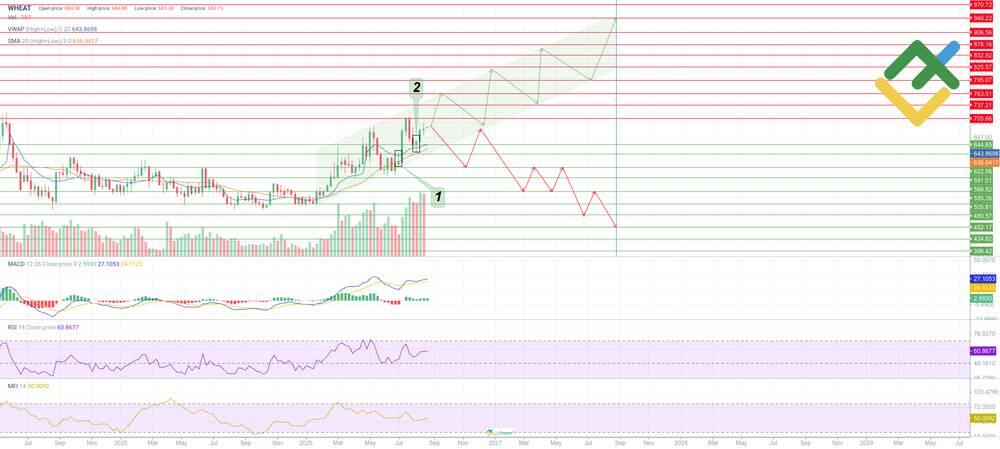
In August 2026, the price began to rise again within an emerging uptrend. Technical indicators and candlestick patterns are mostly giving bullish signals:
- An Inverted Hammer candlestick pattern (1) formed on the weekly chart near the support level of 591.01, indicating a potential bullish reversal. The price then rose to the resistance level of 705.66. After that, the price pulled back to 644.65, where a Hammer pattern (2) developed. This pattern signals a potential resumption of the bullish trend.
- MACD is moving sideways in positive territory, highlighting the ongoing buying pressure.
- The RSI is gradually rising and holding at 61. The potential for further gains remains.
- The MFI is also gradually increasing, reflecting an inflow of liquidity.
- The VWAP price and the SMA20 line are both below the market price, suggesting that bulls retain the upper hand.
The following table presents a forecast for WHEAT prices for the next 12 months:
Month | Minimum, $ | Average, $ | Maximum, $ |
September 2026 | 674.06 | 716.74 | 759.43 |
October 2026 | 729.43 | 749.62 | 769.81 |
November 2026 | 700.59 | 719.05 | 737.51 |
December 2026 | 690.21 | 754.81 | 819.41 |
January 2027 | 784.81 | 806.72 | 828.64 |
February 2027 | 768.66 | 781.92 | 795.19 |
March 2027 | 734.05 | 756.54 | 779.04 |
April 2027 | 730.59 | 799.80 | 869.02 |
May 2027 | 820.57 | 840.18 | 859.79 |
June 2027 | 804.42 | 818.26 | 832.10 |
July 2027 | 794.03 | 816.53 | 839.03 |
August 2027 | 828.64 | 873.05 | 917.47 |
Long-Term Trading Plan for WHEAT for 2026
The technical analysis of the weekly WHEAT chart has revealed key support and resistance levels that can be used in a trading strategy for the coming year.
Trading Plan for the Year
- The uptrend is highly likely to continue in the near term.
- Key support levels: 644.65, 622.56, 591.01, 566.82, 535.26, 505.81, 480.57, 452.17, 424.82, and 396.42.
- Key resistance levels: 705.66, 737.21, 763.51, 795.07, 825.57, 852.92, 878.16, 906.56, 940.22, and 970.72.
- Main long-term scenario: Open long trades above the key resistance level of 705.66 on increased volume, targeting the 737.21–970.72 range. Time horizon: 12 months.
- Alternative long-term scenario: Open short trades below the key support level of 644.65 on increased volume, with potential targets in the 622.56–396.42 range.
Analysts' Wheat Price Projections for 2026
Analysts predict that wheat prices will rise in the second half of 2026. Harvests in the major exporting countries, steady demand, and geopolitical tensions may influence price trends. According to forecasts, the price may reach $762.52–$887.42 by year-end.
WalletInvestor
Price range: $702.32–$842.87.
According to WalletInvestor, the average WHEAT price may reach $731.67 in September, rise to $774.67 in November, and then slide to $762.52 by year-end.
Month | Minimum, $ | Average, $ | Maximum, $ |
September | 723.56 | 731.67 | 803.16 |
October | 716.15 | 753.99 | 842.87 |
November | 702.32 | 774.67 | 808.53 |
December | 739.56 | 762.52 | 842.77 |
Gov Capital
Price range: $683.06–$976.16.
Gov Capital estimates that the average price of wheat will reach $758.95 in September. In the second half of the year, the price is expected to fluctuate widely between $683.06 and $976.16. In December, the price is projected to average $887.42.
Month | Minimum, $ | Average, $ | Maximum, $ |
September | 683.06 | 758.95 | 834.85 |
October | 740.01 | 822.23 | 904.45 |
November | 726.23 | 806.92 | 887.61 |
December | 798.68 | 887.42 | 976.16 |
Analysts' Wheat Price Projections for 2027
Estimates for wheat prices in 2027 vary. Rising consumption in developing countries and investments in logistics could support prices and push them to $762.65 by year-end. At the same time, a bumper harvest in the EU could put pressure on the market. A negative scenario calls for a decline to $626.04.
Note: The price ranges reflect the asset's expected volatility throughout the year. Lows and highs may not be shown in the summary tables.
WalletInvestor
Price range: $594.61–$827.90.
WalletInvestor suggests that the average price of WHEAT will reach $767.70 in March 2027, fall to $611.09 in June, and then rebound in the second half of the year, hitting $762.65 in December.
Quarter | Minimum, $ | Average, $ | Maximum, $ |
Q1 | 725.09 | 767.70 | 793.27 |
Q2 | 594.61 | 611.09 | 746.63 |
Q3 | 637.95 | 658.07 | 715.44 |
Q4 | 736.87 | 762.65 | 827.90 |
Gov Capital
Price range: $561.05–$1,050.61.
Gov Capital, in contrast, expects WHEAT to follow a bearish trend in 2027. The average price is projected to reach $802.71 by mid-year and drop to $626.04 by December.
Quarter | Minimum, $ | Average, $ | Maximum, $ |
Q1 | 716.80 | 832.47 | 1,050.61 |
Q2 | 665.94 | 802.71 | 936.06 |
Q3 | 606.61 | 693.49 | 871.01 |
Q4 | 561.05 | 626.04 | 771.61 |
Analysts' Wheat Price Projections for 2028
In 2028, market volatility may increase. Geopolitical developments and climate change will influence prices. The base scenario is negative: wheat prices are expected to fall to $533.78–614.64 over the year.
WalletInvestor
Price range: $585.41–$833.00.
WalletInvestor anticipates a decline in the price of WHEAT in 2028. The average price may reach $774.22 in March and drop to $748.79 in June. The downtrend is likely to continue in the second half of the year, bringing the average price down to $614.64 by December.
Quarter | Minimum, $ | Average, $ | Maximum, $ |
Q1 | 722.95 | 774.22 | 833.00 |
Q2 | 627.61 | 748.79 | 778.35 |
Q3 | 611.39 | 638.21 | 756.72 |
Q4 | 585.41 | 614.64 | 669.83 |
Gov Capital
Price range: $428.04–$686.63.
According to Gov Capital, the average price of WHEAT will reach $573.90 in March 2028 and drop to $569.82 in June. In the second half of the year, the value is expected to range from $532.07 to $533.78.
Quarter | Minimum, $ | Average, $ | Maximum, $ |
Q1 | 475.55 | 573.90 | 678.32 |
Q2 | 478.30 | 569.82 | 644.34 |
Q3 | 428.04 | 532.07 | 686.63 |
Q4 | 462.39 | 533.78 | 595.03 |
Analysts' Wheat Price Projections for 2029
Long-term forecasts point to a possible decline in prices in 2029. Advances in agricultural technology may boost production efficiency, but rising resource costs could offset this effect. Experts estimate that the wheat price will reach $514.16–536.33 in December.
WalletInvestor
Price range: $486.76–$818.30.
WalletInvestor forecasts that the average price of WHEAT will hit $669.92 in March 2029, decrease to $631.11 in June, climb to $668.46 in Q3, and fall to $514.16 in Q4.
Quarter | Minimum, $ | Average, $ | Maximum, $ |
Q1 | 543.73 | 669.92 | 701.21 |
Q2 | 600.04 | 631.11 | 818.30 |
Q3 | 599.42 | 668.46 | 702.75 |
Q4 | 486.76 | 514.16 | 666.51 |
Gov Capital
Price range: $463.88–$639.86.
Gov Capital forecasts mixed trends for WHEAT in 2029. The average price may reach $548.64 in March and decline to $533.04 in June. In the second half of the year, the price is expected to rebound to $536.33–$561.61.
Quarter | Minimum, $ | Average, $ | Maximum, $ |
Q1 | 473.20 | 548.64 | 639.86 |
Q2 | 479.73 | 533.04 | 615.71 |
Q3 | 463.88 | 561.61 | 617.77 |
Q4 | 475.40 | 536.33 | 617.77 |
Analysts' Wheat Price Projections for 2030
Fundamental factors are expected to play a key role in 2030. Population growth and the expansion of the bioenergy sector may sustain demand for wheat. Analysts expect prices to range from $543.10 to $578.09 in December.
WalletInvestor
Price range: $455.29–$701.21.
According to WalletInvestor, WHEAT prices will range between $647.05 and $648.47 in the first half of 2030. In the second half of the year, a downward reversal may occur, and the price may slide to $543.10 in December.
Quarter | Minimum, $ | Average, $ | Maximum, $ |
Q1 | 514.21 | 647.05 | 701.21 |
Q2 | 588.96 | 648.47 | 695.88 |
Q3 | 533.89 | 567.27 | 666.12 |
Q4 | 455.29 | 543.10 | 591.26 |
Gov Capital
Price range: $448.55–$638.54.
Gov Capital estimates that the average price will reach $527.32 in March 2030, drop to $520.73 in June, and rebound in Q4, potentially reaching $578.09 in December.
Quarter | Minimum, $ | Average, $ | Maximum, $ |
Q1 | 460.24 | 527.32 | 591.94 |
Q2 | 448.55 | 520.73 | 580.05 |
Q3 | 450.29 | 510.73 | 591.30 |
Q4 | 461.51 | 578.09 | 638.54 |
Analysts' Wheat Price Projections until 2050
It is extremely difficult to forecast wheat prices for 2040–2050 due to numerous unpredictable factors.
Climate change is causing uncertainty about future crop yields. New agricultural technologies, including vertical farms and genetic engineering, may significantly alter production and demand.
The market will also be influenced by geopolitics, demographic changes, and population migration. Moreover, the energy transition and carbon regulations can change resource and logistics costs.
Thus, over such a long time horizon, traditional forecasting models based on historical data become less reliable.
Market Sentiment for Wheat on Social Media
Media sentiment reflects the overall mood of traders and investors as expressed in social media posts, comments, and analytical articles. Positive sentiment may indicate anticipated growth in WHEAT, while negative sentiment may suggest that bearish expectations prevail. However, sentiment alone does not determine future price movements.
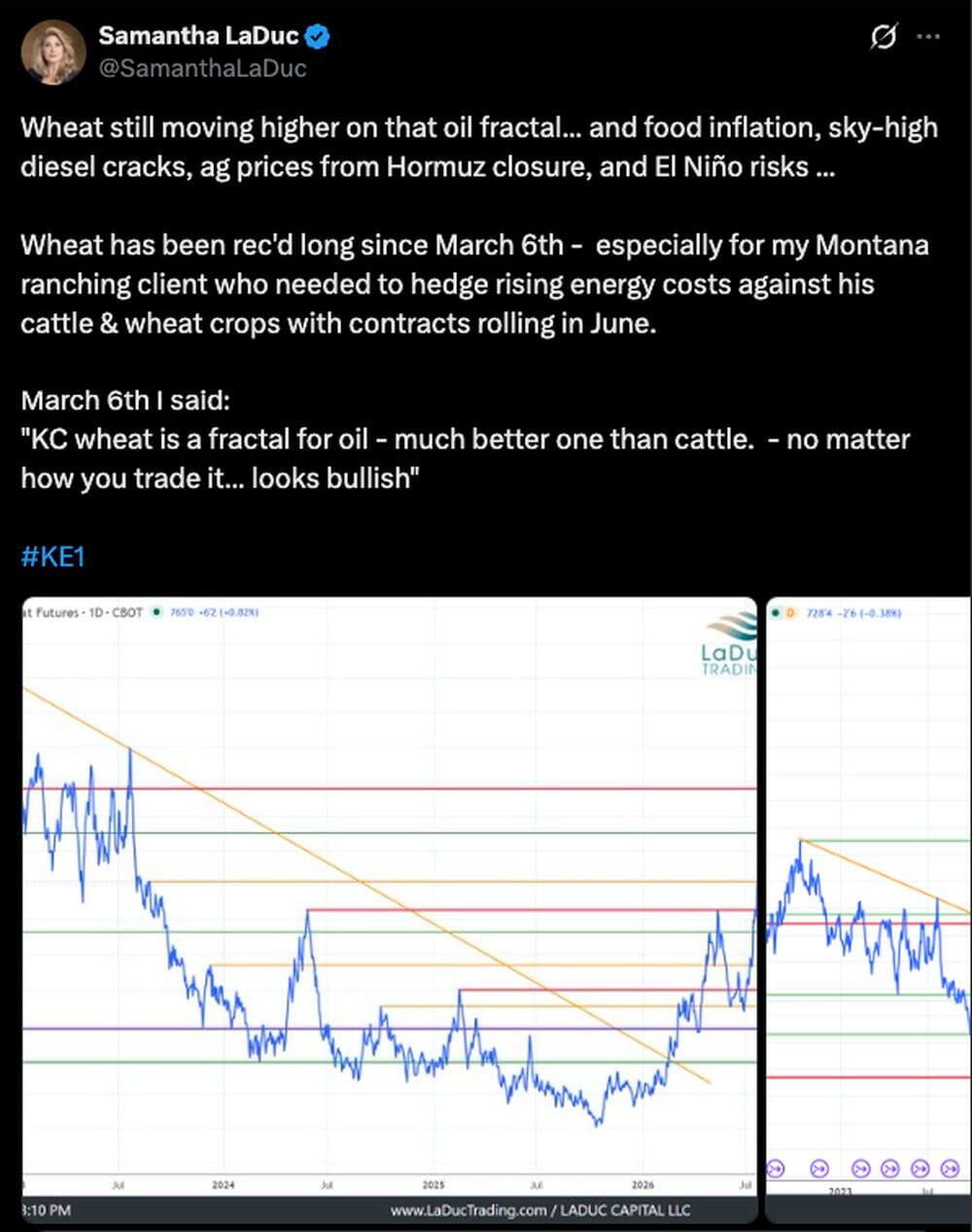
For example, @SamanthaLaDuc, a user on the X (formerly Twitter) social media platform, expects wheat prices to rise to $820.40–$872.20 in the near term. In the medium term, the asset is projected to reach $1,025.00.
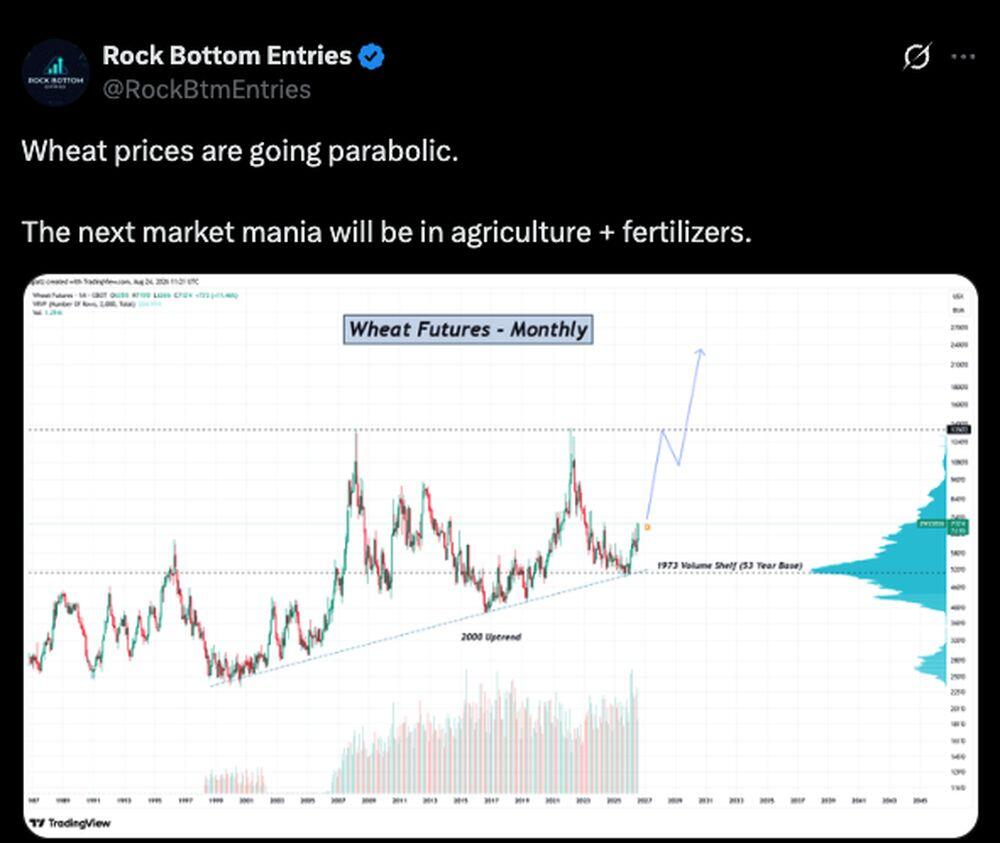
Trader @RockBtmEntries also expects wheat prices to grow. In the medium term, the price is estimated to reach $1,350.00 or higher.
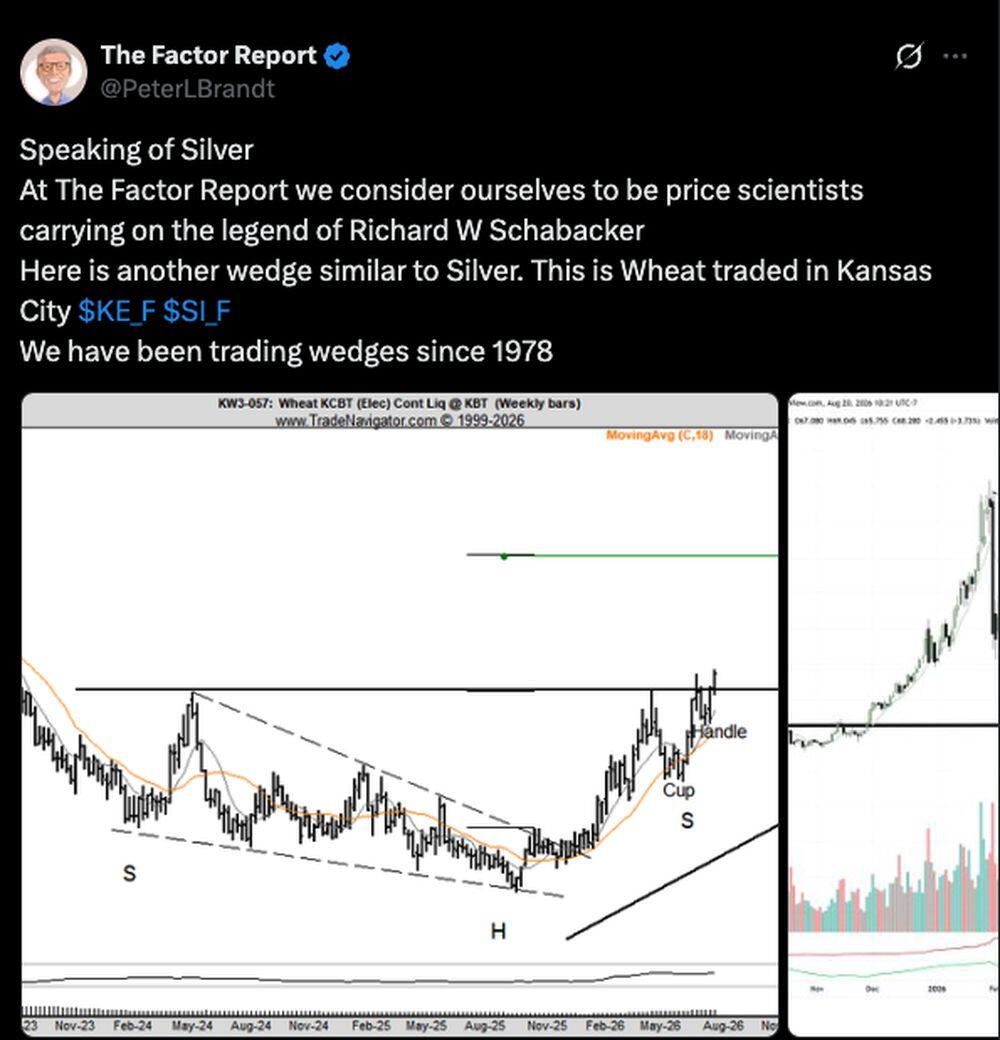
User @PeterLBrandt agrees with other market participants' positive expectations and anticipates that wheat prices will climb to $1,014.20.
Overall, posts on the X social media platform indicate that market sentiment regarding the future outlook for wheat is predominantly positive.
Wheat Price History
Wheat reached its all-time high of $1340 on 04.03.2022. The lowest price of wheat was recorded on 13.12.1999 and reached $225.
Below is a chart showing the performance of wheat quotes over the last ten years. In this connection, it is important to evaluate historical price data to make predictions as accurate as possible.
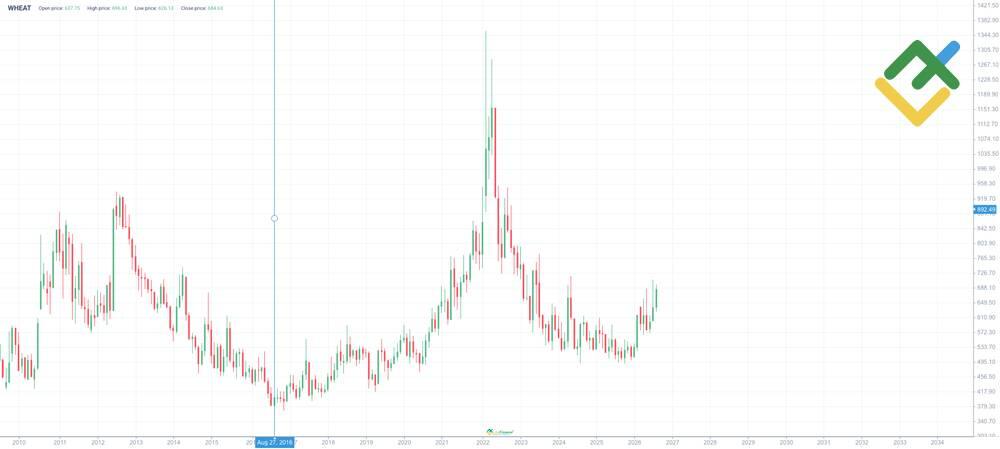
- In July 2020, the price was $520 as the COVID-19 pandemic caused panic in the food market, spurring the WHEAT price on increased demand.
- In May 2022, wheat soared to $1,300 amid armed conflict in Eastern Europe, which restricted exports from the Black Sea. The shortage caused futures to spike in price.
- In March 2023, wheat quotes tumbled to $700 as the Black Sea Grain Initiative resumed shipments and the wheat market stabilized.
- In June 2024, the wheat rate was at $723 as US drought damaged the crop, sharply increasing the value of WHEAT on global exchanges.
- In July 2025, the price of wheat traded near $553, as global stocks rose and exports recovered, weighing on WHEAT prices.
- In January–August 2026, the price traded in the $505.88–$710.38 range. The price opened the year at $505.88 and climbed to $687.38 in May. Then the price fell to $570.88 in June and rebounded to $710.38 in July. In August, the wheat price settled at $685.63.
Wheat Price Fundamental Analysis
The price of WHEAT is determined by the balance of natural, economic, and political factors.
What Factors Affect the WHEAT Rate?
The price of wheat depends on the following factors:
- Weather conditions. Droughts, floods, or frosts can significantly reduce harvest volumes, directly affect the supply, and drive the price of wheat.
- Supply and demand. Population growth and food consumption, including bread and fodder, push the WHEAT exchange rate higher.
- Geopolitical factors. Wars, trade sanctions, or export duties (e.g. in the Black Sea region) disrupt global supplies.
- Production costs. Higher fuel, fertilizer, and farm machinery prices increase the cost of growing wheat.
- Stocks. Excessive global stocks keep prices down, while shortages cause a spike in wheat quotes.
More Facts About Wheat
Wheat is a staple crop that provides food for billions of people. This grain is used in the production of bread, pasta, feed, and biofuels. The global production of wheat is primarily based in Russia, the US, Canada, the EU, and Ukraine. It is traded on exchanges such as CBOT as futures measured in bushels. Due to its sensitivity to energy costs, weather, demand, and geopolitical factors, wheat is considered a volatile asset. Its price reflects the balance between harvest and consumption, making it a strategically significant asset for traders and investors seeking to capitalize on fluctuations in the agricultural market.
Advantages and Disadvantages of Investing in WHEAT
Wheat is an attractive investment due to its role in the global economy. However, it is essential to assess all potential risks.
Advantages
- High demand. Wheat is the basic food supply, and the demand remains stable even in crises.
- Liquidity. CBOT futures are actively traded, and you can easily sell or buy wheat.
- Diversification. Wheat is a perfect asset for a balanced investment portfolio.
- Reaction to global events. Weather conditions and geopolitical factors create conditions for speculation.
- Availability. Wheat is trading on exchanges (CBOT, KCBT, MGEX), open to investors.
Disadvantages
- Volatility. Wheat prices can change dramatically due to weather, wars, or political factors.
- Seasonality. Crop cycles create instability throughout the year.
- Competition with other agricultural assets. Other grains such as corn and rice may reduce demand for wheat.
- Storage costs. Physical wheat requires warehouses and is costly for investors to store.
- Regulation. Export restrictions also affect the market; the consequences of such decisions are difficult to predict.
WHEAT represents a promising asset for portfolio diversification, but requires investors to assess volatility risks and fundamental factors.
How We Make Forecasts
Wheat price forecasts are based on a comprehensive study of the market and relevant data.
Short-term price forecasts up to a month employ technical analysis, examining current CBOT futures quotes, trading volume, and technical indicators.
Medium-term forecasts for 3–12 months are based on fundamental analysis, taking into account seasonal cycles, geopolitical factors like export restrictions, and USDA inventory reports.
Long-term wheat projections until 2050 rely on changes in global demand, climate change, and advances in agricultural technology.
This approach helps predict wheat price trends accurately, offering traders and investors valuable insights to make more informed decisions.
Conclusion: Is Wheat a Good Investment?
Wheat continues to be a valuable asset for portfolio diversification, particularly when commodity markets exhibit elevated volatility. An analysis of market trends, technical indicators, and expert forecasts indicates a significant increase in wheat prices in the coming years.
However, investors should exercise caution by considering seasonal and climate-related risks. In the short to medium term, WHEAT has the potential to generate solid returns. However, it is essential to conduct fundamental and technical analysis before making any investment decisions.
Wheat Price Prediction FAQs
The current WHEAT price is $703.13 as of 27.09.2026.
In 2026, grain market trends will be shaped by crop yields, weather conditions, logistics, and the export policies of major producers. Market participants will closely monitor supply-demand dynamics, as any supply disruptions could heighten volatility and affect global food markets.
Russia ranks first in terms of wheat exports, followed by the US, Canada, and Australia. These countries are the major exporters, significantly influencing wheat prices.
Wheat remains a strategically valuable commodity. Its prospects in the medium term are robust as demand is expected to grow, especially from Asia and Africa, which will keep investors attracted to the asset in the future.
The wheat price decreases during periods of high crop yields, increased export quotas, and weakened global demand. The strengthening of the US dollar, saturation of stocks, and strong competition between exporters for wheat imports to Asia and Africa also push the price down.
The wheat price can grow against lower yields due to droughts, geopolitical risks, or export restrictions. Another factor is an increase in demand from the food sector, particularly in the face of inflation and disrupted supply chains.
The price of wheat is $703.13.
Prices can decline due to improved yields, lower demand from key importers, and rising inventories. Currency factors, particularly the strengthening of the US dollar, and a general decline in commodity prices in the global market are also among significant factors.
In 2026, wheat prices may vary between $528.38 and $842.14. Forecasts suggest that prices may fall in certain months but recover in the second half of the year, particularly if harvest expectations deteriorate or export demand increases.
The outlook for grain prices remains uncertain due to weather conditions, crop yields, and the global trade landscape. Volatility is expected to remain high, with prices likely to range from $347.24 to $866.87, depending on market conditions and the balance of supply and demand.
Price chart of WHEAT in real time mode
The content of this article reflects the author’s opinion and does not necessarily reflect the official position of LiteFinance broker. The material published on this page is provided for informational purposes only and should not be considered as the provision of investment advice for the purposes of Directive 2014/65/EU.
According to copyright law, this article is considered intellectual property, which includes a prohibition on copying and distributing it without consent.