Modern trading platforms allow a trader to generate a report for open and closed positions and cancelled pending orders, calculate a statement, and draw a profit and loss curve in a couple of clicks. Such information is available for download in various formats so that the trader can present it in a convenient form for future reference. Why do you need to keep trading records?
Attention test – table of questions for positions
If a trader keeps a trading journal in the form of a flowchart or tests with questions, they get rid of one of the main problems - entry errors due to inattention.
A trading algorithm can not always be translated into a programming language, but the rules for entering a trade, exiting a trading position, setting orders to limit losses and take profit can always be described on paper.
When writing a report by hand or entering information in a spreadsheet, the person uses five types of memory.
Regularly filling in the columns of the journal and checking the presence of all the conditions for opening a position, even a beginner will soon learn to make trades completely on autopilot.
A simple example of filling in a table with trading system rules based on the intersection of two moving averages, with a confirmation filter in the form of the RSI oscillator:

The system configured to enter during a rollback, checks the position of the RSI after the moving averages intersect and waits for the moment to complete the trade when the indicator curve moves to the overbought zone. At point 1, the conditions are not met, thus in the last column the trade is cancelled:
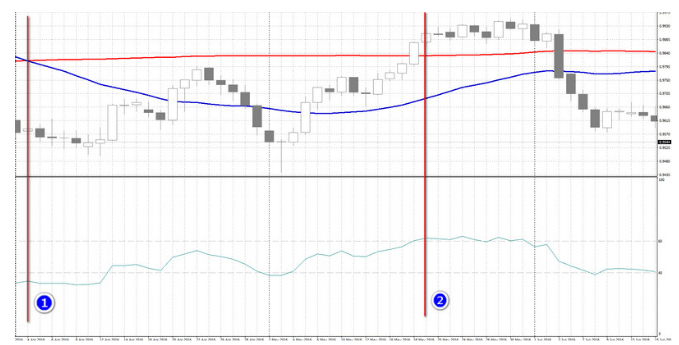
The trader keeps track of the situation to point 2, the previously completed columns remain unchanged (the moving averages intersect), the RSI enters the overbought zone - the last column changes, and the sell trade is completed.
As practice shows, just opening the chart of quotations increases the pulse and raises pressure, especially for beginners. In a situation where you want to take a weighted decision and correctly place an order, figuratively speaking, the cardiogram of your heart looks like the movement of quotes after the publication of news about the Fed meeting on rate hike. In such moments, you need to be distracted from the market. Journal pages and columns with verification of trade conditions will become a reliable assistant to a trader embraced by emotions.
Usually, the trading system signal is predicted in one candlestick of the working timeframe, and if the trader does not work on minutes, there should be enough time for filling the journal.
Comments column – why is it important
The trading science advises not to make amendments to the strategy on the run. The trading algorithm must be observed clearly until a predetermined loss level is reached, at which point it must be stopped and optimized. Any change in the strategy before it is put on the market should be tested, and the results subjected to careful analysis - and only after this, you can make a decision about implementing the optimized parameters and settings in real trading.
However, this rule is constantly broken by experienced traders and beginners - the annoyance of the lost profit, regret about the stop signals that trigger when the price turned in the direction of the position forces traders to change something daily and hourly.
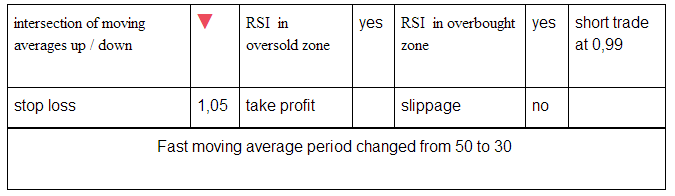
If it is ain't broke, don't fix it. When your constant changes to your trading strategy lead to losses, return to the zero point. Your journal's Comments columns will help in this. In it, the trader should note all deviations from the rules and describe in detail the reasons motivating them to change the trading system.
Filling out an additional column does not take much time, it's better to start describing the changes right after the trade is completed, hot on the heels of the changes.
The trade result column with comments will impartially use the language of figures to justify or show the harm of your innovations.
How to sum up a trade
The trading strategy must be tested before being used on a real account. If a trader uses a set of indicators, then the test process is automated in a special application to the terminal. Testing of systems with complex rules that can not be described by Boolean logic has to be done manually.
Testing is carried out not only to determine the profitability of the strategy, although this is a priority task but also to determine the benchmark parameters for the subsequent real trade:
- percentage of profitable and unprofitable deals in a row, the period of maximum drawdown and profit factor
Each trade, from the moment of its opening, participates in the calculation of the above parameters, which are constantly compared with the test ones for discrepancies for the worse. This is the reason to pause trading and optimize the parameters of your trading strategy.
Trading is a creative process of finding new ideas. In parallel to the trading process, traders study books, get acquainted with analytical materials, often get new ideas, but have no time for their realization. The journal can become a repository of trading ideas and interesting thoughts, which later, when summing up, can illuminate the trader to create new strategies.
P.S. Did you like my article? Share it in social networks: it will be the best "thank you" :)
Useful links:
- I recommend trying to trade with a reliable broker here. The system allows you to trade by yourself or copy successful traders from all across the globe.
- Use my promo code BLOG to get a 50% deposit bonus on the LiteFinance platform. Simply enter this code in the appropriate field when funding your trading account.
- Telegram chat for traders: https://t.me/litefinancebrokerchat. We are sharing the signals and trading experience.
- Telegram channel with high-quality analytics, Forex reviews, training articles, and other useful things for traders https://t.me/litefinance

The content of this article reflects the author’s opinion and does not necessarily reflect the official position of LiteFinance broker. The material published on this page is provided for informational purposes only and should not be considered as the provision of investment advice for the purposes of Directive 2014/65/EU.
According to copyright law, this article is considered intellectual property, which includes a prohibition on copying and distributing it without consent.