At its core, cryptocurrency is a virtual currency that exists only online. It has no physical form, but you can still use it to pay for goods, send money to other people, or trade it. Unlike traditional currencies, most cryptocurrencies are not issued by a central bank. They are created and circulated according to the rules of the network they run on.
The first and best-known cryptocurrency, Bitcoin, appeared in 2009. Since then, the cryptocurrency market has grown to include thousands of coins and other digital assets, and its total market capitalization has repeatedly passed one trillion dollars. Hundreds of millions of people worldwide now use crypto wallets, so cryptocurrency is no longer a fringe experiment but a global financial phenomenon. This article explores what cryptocurrency is, how it works, whether it is safe for beginners, and how to trade crypto.
The article covers the following subjects:
Major Takeaways
- Cryptocurrency is a digital asset that exists virtually and uses cryptography to secure transactions.
- Most cryptocurrencies are based on blockchain technology, which is a distributed ledger in which all transactions are recorded in blocks and stored simultaneously on thousands of computers.
- Bitcoin is the first and most well-known cryptocurrency, created in 2009 by an anonymous developer or group of people operating under the pseudonym Satoshi Nakamoto.
- Transactions on decentralized blockchain networks do not require a traditional financial intermediary, such as a bank. Money is transferred directly from one user to another on a peer-to-peer basis. However, each transaction incurs a network fee.
- New coins are created through mining (Proof-of-Work) or staking (Proof-of-Stake). These are the two main mechanisms for validating cryptocurrency transactions and adding new blocks.
- Cryptocurrencies are highly volatile, and crypto prices can swing sharply within hours due to news, regulatory decisions, or shifts in market sentiment.
- Digital assets are stored in crypto wallets, either hot wallets that stay online or cold wallets that work offline.
- There are tens of thousands of cryptocurrencies in the world: from Bitcoin and Ethereum to thousands of altcoins with different functions and purposes.
What Is Cryptocurrency in Simple Terms
Imagine a virtual wallet with digital coins. You can send them to a friend anywhere in the world in a couple of minutes. There are no bank fees for the transfer, but you pay a small network fee, which goes to miners or validators. No government or bank can freeze your funds if you keep them in a decentralized wallet and hold the private keys. Stablecoins such as USDC or USDT are an exception, because their issuers can freeze addresses at the request of regulators.
The main idea behind cryptocurrency is to let people move money directly, without intermediaries. Every transaction is recorded in a public ledger that anyone on the network can see, which makes fraud and double-spending much harder. Satoshi Nakamoto designed the system in response to the 2008 financial crisis, wanting money to belong to people rather than to banks or governments.

Crypto vs Fiat Money: Key Differences
The main differences between cryptocurrency and traditional fiat money:
Cryptocurrency | Fiat Money |
Has no physical form | Exists as coins and banknotes |
Not controlled directly by a government or a bank | Issued and regulated by a central bank |
Peer-to-peer transfers, with a small network fee | Transfers go through banks or payment systems, which charge their own fees |
Transactions are recorded on a public blockchain | Transactions are visible only to the bank and the parties involved |
The rate is set by the crypto market and reacts strongly to regulatory news | The rate is set on the currency market, where central banks can exert significant influence |
Pseudonymous: addresses are public but not always linked to a person | Banks and other regulated financial institutions identify their clients |

Fiat money is legal tender and is accepted almost everywhere. Cryptocurrency payments are becoming more common, although they have not replaced traditional payment methods, and not all merchants take them.
Speed is another key difference. A bank transfer can take three to five days, while a blockchain transaction usually goes through in a few minutes to an hour, depending on how busy the network is. At peak times, transfers slow down, and fees can rise tenfold.
Is Cryptocurrency Safe?
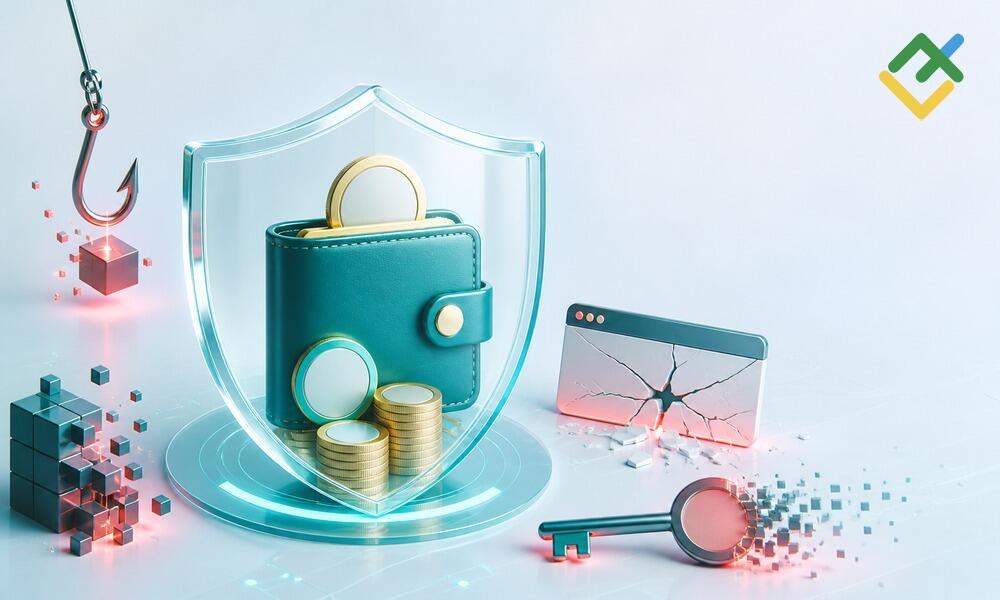
Safety is one of the first things beginners ask about, and the honest answer is both yes and no.
From a technical standpoint, blockchain is very reliable. Changing even a single entry would mean taking control of more than half the network's computer power at once, which is prohibitively expensive in practice. Transactions are protected by cryptography, a set of mathematical algorithms that make forged signatures practically impossible.
At the same time, there are several risks involved:
- Crypto scams. You can be defrauded by fake cryptocurrency exchanges or short-lived projects.
- Loss of access. If you forget your password or lose your seed phrase, the secret code used to recover a wallet, you will lose access to your crypto assets forever. No one will be able to get them back.
- Hacks and data breaches. Hackers attack crypto exchanges and digital wallets. Billions of dollars have been stolen over the history of the crypto industry.
- Volatility. The price can drop by 30–50% in a single day. This is not a bank deposit with a guaranteed return.
- Stablecoin freezes. Issuers of USDC, USDT, and other stablecoins can freeze funds at specific addresses at the request of regulators or law enforcement agencies.
In short, the technology itself is secure. Users still have to look after their own keys, choose platforms carefully, and remember that some assets, like stablecoins, are not fully decentralized.
How Does Cryptocurrency Work?
To understand how cryptocurrency works, you need to grasp three key concepts, namely blockchain, the consensus mechanism (mining or staking), and crypto wallets.
Blockchain Technology
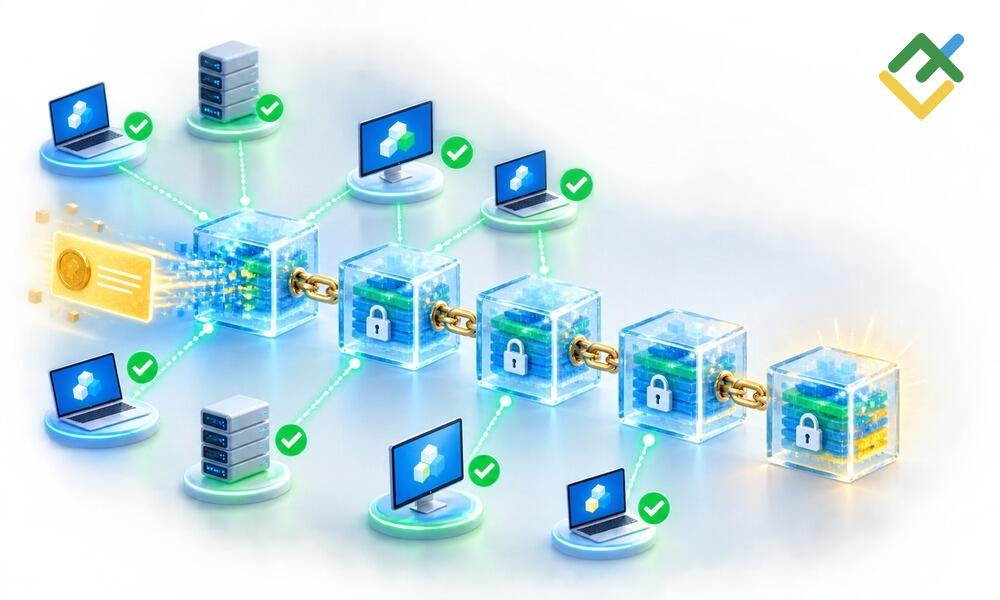
A blockchain is a public ledger that records every transaction. Imagine a huge book that thousands of people around the world keep at the same time. Each new page, called a block, holds a set of crypto transactions, and once a page is full, it is attached to the previous one, forming a chain of blocks. That is exactly what the word blockchain means.
A key feature of blockchain is that transactions can only be recorded in accordance with the network's rules. It is impossible to alter or delete information that has already been recorded. All previous blocks are mathematically secured. If someone attempts to falsify data, other computers on the network will detect this and reject the change.
How a blockchain transfer works, step by step:
- You send 0.1 Bitcoin.
- Your transfer is broadcast to the network.
- Miners or validators verify the transfer.
- Once verified, the transfer goes into a new block.
- The block is added to the chain, and the transfer is complete.
The entire chain is stored on all computers in the network simultaneously, making the blockchain transparent and resistant to hacking.
When you send cryptocurrency, the transaction first goes into a pool of unconfirmed transactions, a queue of payments waiting to be checked. Miners or validators then verify transactions from this pool, making sure that you have enough funds and that nothing violates the network's rules. Only then does the transaction go into a new block and become a permanent part of the ledger. On major cryptocurrency networks, this takes anywhere from a few seconds to several minutes. Bitcoin adds a new block roughly every ten minutes, while Ethereum is much faster. When the network is busy, both waiting times and fees can increase considerably.

How Transactions Are Verified: Mining and Staking
Where do cryptocurrencies come from? New coins are created in two main ways: mining (Proof-of-Work) and staking (Proof-of-Stake).
What is cryptocurrency mining? It is the process of creating new cryptocurrency with the computing power of specialized machines. Miners compete to solve a complex mathematical problem, and the first one to find the answer receives a reward in new coins.
Think of the network as a giant puzzle. Miners race to fit the next piece into place, and whoever gets there first receives Bitcoin or another cryptocurrency. The more computing power your equipment has, the better your chances. As the cryptocurrency industry has matured, though, mining Bitcoin now requires industrial-scale farms with expensive hardware, so it is no longer a realistic option for a beginner.
Staking is the main alternative to mining. Staking and farming both let you earn income from coins you already own, but they work by different rules and carry different risks. Instead of solving puzzles, you lock up your coins in the network and receive a reward for helping to validate transactions. The more you stake, the more you earn. It works a little like a bank deposit, except that the interest comes from the network itself rather than from a bank.
Both methods serve the same purpose: to maintain the blockchain, record transactions, and ensure network security.
Proof-of-Work (PoW) is a system where computing power itself serves as the proof. Miners solve complex problems and consume large amounts of electricity in the process. Bitcoin and some altcoins run on this algorithm. PoW provides a high level of security, but it has been criticized for being energy-intensive.
Proof-of-Stake (PoS) is a low-energy alternative. Instead of mining, validators lock up their coins as collateral, and the network picks them to create blocks in proportion to the size of their stake. This requires far less electricity, which is why the approach keeps gaining ground. Ethereum, for example, moved from PoW to PoS in 2022, and new Ether now comes only through staking.
Private Keys, Public Keys and Crypto Wallets
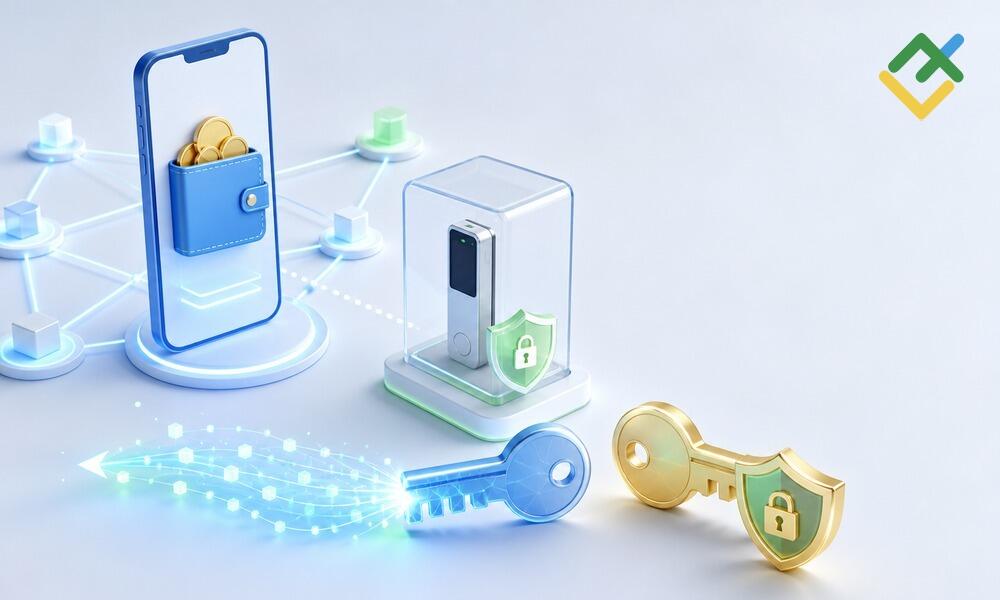
To use cryptocurrency, you need a crypto wallet. It is usually not a physical object but a program or a device that stores your keys.
Every wallet has two keys:
- A public key is your address on the network, something like a bank card number. You can safely share it so that other people can send you coins.
- A private key is what actually gives you access to your money. Never show it to anyone. Whoever knows your private key can withdraw all your crypto holdings.
Types of wallets:
Type | Example | Pros | Cons |
Hot wallet | An exchange wallet or a mobile app | Convenient, fast, available 24/7 | Less secure, exposed to hacking |
Cold wallet | A hardware device such as Ledger or Trezor | Maximum security | Less convenient, you have to buy the device |
A seed phrase is a set of 12 to 24 random words generated when you create a wallet. It is a master key that restores access to your funds even if you lose your device. Keep your seed phrase in a safe place and never show it to anyone.
For most people, the best approach is to use both types of wallet: keep a small amount in a hot wallet for everyday use and the bulk of your funds in cold storage.
Types of Cryptocurrency
Nowadays, there are tens of thousands of cryptocurrencies, and they can be divided into several categories:
- Coins run on their own blockchain. Examples: Bitcoin (mining, PoW), Ethereum (staking, PoS), Litecoin (mining, PoW). Coins serve as a medium of exchange or as a store of value.
- Tokens are created on an existing blockchain through smart contracts, and each project sets its own rules for issuance and distribution. Tokens usually give access to a platform's features. The UNI token, for example, lets holders vote on changes to the Uniswap exchange.
- Altcoins are all cryptocurrencies other than Bitcoin.
- Stablecoins are cryptocurrencies pegged to a fiat currency, usually the US dollar. Examples include USD Coin (USDC) and Tether (USDT). Their price stays close to one dollar, which makes such assets convenient for payments. However, their issuers can freeze funds at specific addresses at the request of a regulator or law enforcement.
What Is Bitcoin, the First Cryptocurrency?
Bitcoin is the first and most prominent cryptocurrency. It was launched in 2009 by Satoshi Nakamoto, whose identity remains unknown to this day.
Bitcoin was revolutionary because it introduced a system where:
- No banks or intermediaries are needed.
- Transactions cannot be forged or reversed.
- The supply is capped at 21 million coins, so no one can issue more.
The Bitcoin price is known for its volatility. It started at a few cents, climbed to $69,000, dropped to $15,000, and started rising again. In 2010, someone famously paid 10,000 Bitcoins for two pizzas. At today's prices, those coins would be worth well over a billion dollars.

How to Buy and Store Cryptocurrency
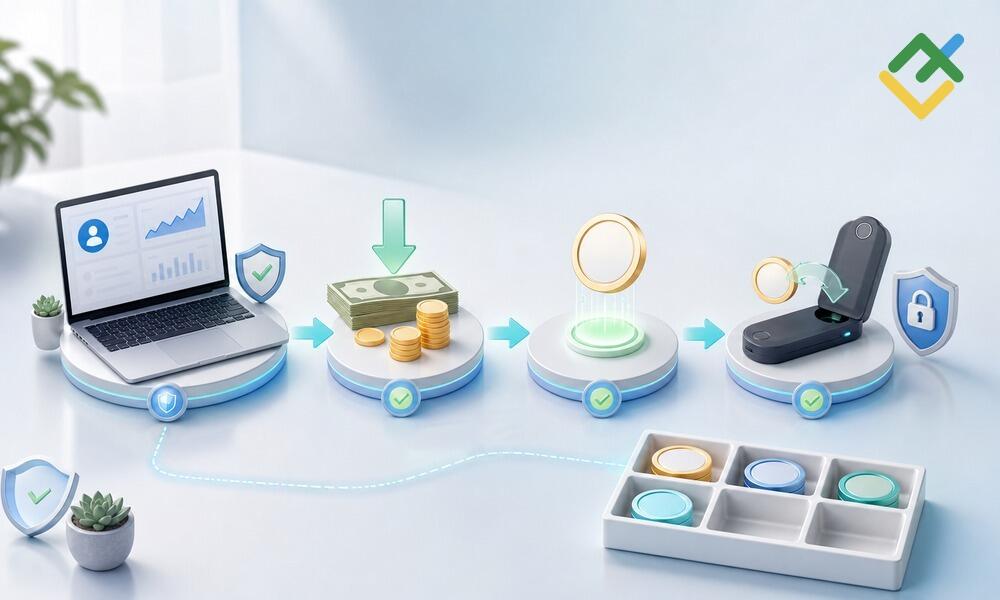
The process is simple:
- Choose a platform. You can use a crypto exchange or a traditional broker that offers access to crypto. Some countries restrict certain exchanges, so check what applies in your region.
- Fund your account. Deposit dollars, euros, or another fiat currency.
- Pick a coin. If you are not sure what crypto to buy, major assets like Bitcoin or Ethereum are the usual choice.
- Buy. You can take a whole coin or a fraction of one, for example 0.001 BTC.
- Move crypto to a wallet. If you plan to hold for a long time, do not leave your coins on the exchange. Send them to your own wallet, ideally a cold one.
Storage options:
- On an exchange. Convenient for trading, but risky: exchanges can be hacked and may impose regional restrictions.
- In a hot wallet (mobile app).Convenient for everyday payments.
- In a cold wallet (hardware device). The safest option for holding large amounts long term.
Important: Never keep all your crypto on a single exchange. Spread it across several places to reduce the risk. Moreover, some exchanges freeze accounts in certain jurisdictions, so always stay tuned to regulatory news.
Cryptocurrency Trading
Cryptocurrency trading involves buying and selling digital assets for profit. The main cryptocurrency trading strategies fall into two categories:
- Long-term investing, often called HODL, means buying and holding while you wait for the price to rise. It suits people who believe in a project's future.
- Active trading means making money on price swings. It takes knowledge, time, and emotional stability.
Earnings depend on your strategy, the size of your position, and a fair amount of luck. Some people have turned $100 into $10,000 in a year, while others have lost everything in a day. Crypto carries higher risk than the stock market, and the potential returns are higher too.
For beginners, it is best to start with a demo account. You trade with virtual money, so you can see how everything works without risking anything. Crypto trading takes discipline, analysis, and emotional control.
How Crypto CFD Trading Works
A crypto CFD is a contract for difference. You do not buy Bitcoin or Ethereum. You simply make an agreement with a broker.
Advantages of CFD trading:
- No crypto wallet to set up and no private keys to protect.
- You can go long if you expect the price to rise, or short if you expect it to fall.
- Leverage lets you trade positions much larger than your deposit.
Risks of CFD trading:
- Leverage in crypto magnifies losses as well as profits. At high leverage, a single trade can wipe out your deposit.
- You do not own cryptocurrency itself, only a contract based on its price.
- Spreads and fees can eat into your returns.

Cryptocurrency Regulation
Crypto taxation and regulation are among the most complicated parts of the subject. Rules differ widely from country to country and keep changing.
- In the US, income from selling cryptocurrency is subject to capital gains tax. The SEC has been cracking down on fraudulent projects and has filed lawsuits against several major exchanges to protect crypto investors.
- In Europe, the MiCA regulation sets common rules across the EU, including requirements for stablecoin issuers, exchanges, and other crypto companies.
- In China, mining and trading are banned, though the country continues to develop its own digital currency, the digital yuan.
- Elsewhere, approaches range from a complete ban to a light-touch regulatory framework.
In most countries, you owe tax on crypto if you:
- sell it for fiat currency such as dollars or euros;
- exchange one cryptocurrency for another;
- earn income from mining or staking.
The safest course is to consult a tax professional in your country. Rules change often, and ignorance of the law is no excuse. Furthermore, access to exchanges and crypto services can be limited by sanctions or local law. Therefore, check whether the platform you plan to use is available in your region.

Conclusion
Cryptocurrencies are a class of financial assets that exist only in digital form, and many of them let you make payments without a bank or another financial intermediary. Most run on blockchain, a distributed ledger that stores a record of every transaction. Bitcoin, Ethereum, and thousands of other assets make up a cryptocurrency ecosystem where you can make payments, invest, and trade.
Cryptocurrency investing can yield high returns, but it also carries significant risks, such as volatility, scams, hacks and security breaches, and regulatory uncertainty. Stablecoins add one more risk, since their issuers can freeze funds at specific addresses. Thus, approach cryptocurrency with caution: start small, learn the basics, use a demo account before trading with real money, and never invest more than you can afford to lose.
Cryptocurrency FAQs
Yes. You can exchange it for fiat through crypto exchanges, P2P platforms, or exchange services. The rate depends on supply and demand, and the money you receive can be withdrawn to a bank card or account in accordance with applicable restrictions.
The technology itself is secure, but beginners face real risks, from fraud and exchange hacks to losing access to their wallet. Start with established platforms, keep large amounts in a cold wallet, never share your private keys, and remember that stablecoin issuers can freeze funds at the request of regulators.
Mining is the process of creating new coins in Proof-of-Work networks: computers solve mathematical problems, and the miner receives a reward. Today, mining Bitcoin requires expensive equipment and consumes a lot of energy. In Proof-of-Stake networks, staking is used instead of mining.
Beginners can earn through long-term investing (buying and holding), active trading, or staking. Start with a demo account, learn the basics, invest only what you can afford to lose, spread your money across several assets, and keep an eye on regulatory changes in your country.
Price chart of BTCUSD in real time mode

The content of this article reflects the author’s opinion and does not necessarily reflect the official position of LiteFinance broker. The material published on this page is provided for informational purposes only and should not be considered as the provision of investment advice for the purposes of Directive 2014/65/EU.
According to copyright law, this article is considered intellectual property, which includes a prohibition on copying and distributing it without consent.