Inflation influence on exchange rates
Forex exchange rates are determined by central banks’ monetary policies. If investors expect that monetary policy will be tightened (restrictive policy), they buy a currency, while expansionary (softened) monetary policy makes them sell it. The central bank’s decision may be affected by various factors, including global risks, domestic macroeconomic statistics, political situation, or financial markets’ turbulence. However, under normal conditions, it’s inflation that should be considered to understand a regulator’s further actions.
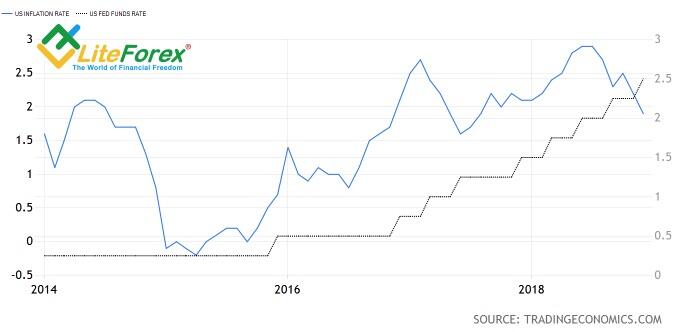
In economic terms, inflation is a rise in general prices of goods and services for a long period or an excessive increase in the stock of paper money leading to its depreciation. It would be logical to suppose that inflationary growth results in a lower purchasing power of a currency and its lower rates. In practice, all is different. As a rule, growing consumer prices in the USA initiate mass purchases of the USD, and vice versa. Why? Investors expect that FED will tighten monetary policy to suspend the growth of inflation. Any central bank’s main task is to control inflation. It’s called “targeting”. The level of 2% is considered to be an optimal inflation value. If there’s a reason to think this level will be exceeded, the regulator raises rates. On the contrary, if the base indicator cannot reach the target on its own, monetary policy may be expected to be softened.
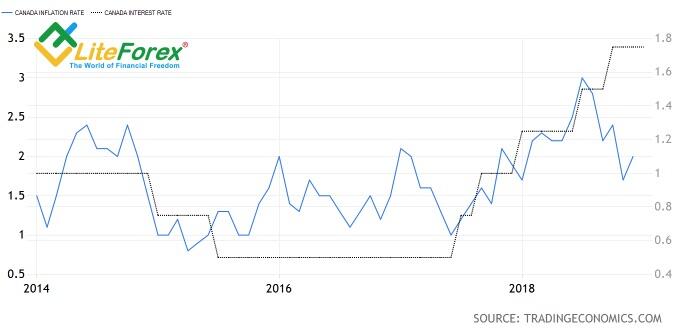
Central banks sometimes go too far. Not only does excessive monetary restriction make inflation turn, it also increases recession risks: financial resources become expensive, which results in smaller investment volumes. Similar things are now taking place in the USA and Canada. Fed and Bank of Canada decided to pause normalization as inflation started slowing down. Their actions over the past years may have been too active.
US inflation dynamics and Fed rates
Source: Trading Economics.
Canada’s inflation dynamics and BoC rates
Source: Trading Economics.
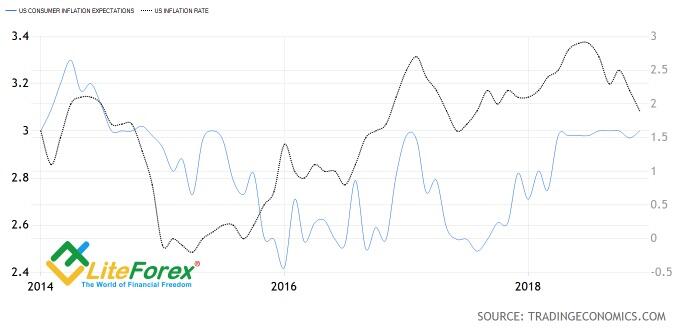
It seems nothing can be easier: just follow inflation, make forecasts concerning the central bank’s actions based on its dynamics and open positions in this or that currency. All’s right, but inflation is far from being static, just like the market. For example, Fed started a new cycle of monetary policy tightening when it was far from the target. The regulator has to anticipate events not to allow consumer prices to grow uncontrollably. Forecasts play an important role in examining and understanding the regulator’s point of view. They are based on the inflation expectations of consumers, producers, or the central bank itself. The US indicator is currently “at anchor”, which makes Fed more flexible in the process of normalization.
US inflation expectations and CPI
Source: Trading Economics.
Thus, to forecast this or that central bank’s future monetary policy and, consequently, currency rates, one needs to have a clear understanding of where and how fast inflation will be moving in the medium- and long term. The question isn’t easy at all and baffles from time to time not only investors but also regulators themselves. However, if the answer was too easy to find, all would be rich. But it’s the destiny of the select few.
P.S. Did you like my article? Share it in social networks: it will be the best "thank you" :)
Useful links:
- I recommend trying to trade with a reliable broker here. The system allows you to trade by yourself or copy successful traders from all across the globe.
- Use my promo code BLOG to get a 50% deposit bonus on the LiteFinance platform. Simply enter this code in the appropriate field when funding your trading account.
- Telegram chat for traders: https://t.me/litefinancebrokerchat. We are sharing the signals and trading experience.
- Telegram channel with high-quality analytics, Forex reviews, training articles, and other useful things for traders https://t.me/litefinance
Price chart of EURUSD in real time mode

The content of this article reflects the author’s opinion and does not necessarily reflect the official position of LiteFinance broker. The material published on this page is provided for informational purposes only and should not be considered as the provision of investment advice for the purposes of Directive 2014/65/EU.
According to copyright law, this article is considered intellectual property, which includes a prohibition on copying and distributing it without consent.