What if you have a regular job and you really want to become a trader? How to study trading efficiently when you’re always lacking time? Asked these questions? The answers are in the article.

General tips on combining trading and an office job efficiently
Trading in financial markets and a regular job, for example, in an office, are not necessarily mutually exclusive. Not all traders, who generate more or less steady income in Forex, could leave their jobs and fully engage in Forex trading. From this article, you will learn the ways to combine regular work and trading in Forex. However, for a start, let’s define some fundamental factors you need to understand.
So, first, Forex trading is a kind of craft, and only a professional can earn money there. If you have ideas, like you would “make a quick score” or “outsmart the market”, discovering the way to predict where the price will go (i.e. actually, “win over the market”, that most beginners dream about), ignore these ideas. That’s all nonsense. If you are a regular trader, it would make no sense to combine trading and anything else. Do you know many professional football players, who juggle playing football with anything else? I don’t mean the incomes from advertising; of course, it is not a regular job. Will a successful artist work somewhere else? They hardly will, as well. What am I driving at? At the idea that you’ll need time.
Give yourself time to study all aspects of trading. If you are not yet (!) a regular trader, you shouldn’t show off by your trades, look for super strategies or super advisers (trading robots), which will spare you from the long, and sometimes rather boring, process of improving your skills. Treat Forex trading seriously right from the beginning and try to understand that there won’t be a miracle – you will manage to earn there and fulfill your dreams only provided you have become a true professional. That ALWAYS takes some time.
Second, combing Forex trading and office work should provide results (if, you’ve decided to become a trader, of course). What do I mean? I’ll give an example. To stay in office and, instead of working, to argue about working/not working methods, share the screenshots of your successful trades (only the profitable, of course), waste your time on looking for simple ways to make profits from Forex (news trading, trading robots, “secret strategies of market makers that got on the Internet directly from Wall Street”) - all that won’t give any results. You won’t learn anything, you’ll just waste your time. All these activities are good only in one aspect – try and realize that they are not efficient. That is human nature – to seek “quick results”, but professional skills are not developed quickly. I so much wish to be wrong, but you will hardly find an example to refute this. On the other hand, reading books on trading, looking for complete strategies (to practice and choose what suits you best; but you will still have to develop something of your own), and trading with them is a good way of combining. Professionalism in Forex is developed only with practice. That has already been in some article that, form theoretical knowledge about Forex trading, you need only the principle of pricing, so as not to waste your time at the beginning on different useless approaches like predictions, based on “lunar phases” and the same unreal stuff. All the rest is lots of practice, followed by developing (through the same practice) “your own style” (what kind of positions and trading methods suit you, personally). Then, when you already have your trading strategy, you should add the rules of money management. You can take any industry or sector: wholesale and retail trade, medicine, sport – everywhere there is the same algorithm. First, theory is studied: what is to be done, and how everything works. Next, one starts practicing, namely, practicing the basics: an entrepreneur won’t take loans and stock up for all the money right from the beginning; a doctor won’t be let to operate a real person; and an athlete doesn’t try to achieve a master of sports results at the beginning (just imagine, what if everything were vice versa). And then, having already studied and practiced the basics of a profession, one adds something of their own. If you remember this, you can shorten your way to becoming a trader.
Third, if you accept the two previous paragraphs, you shouldn’t expect your studying to be easy. You will have spent a lot of time on trading; you are likely to get rather exhausted, juggling trading and other activities. So, I advise you to try trading for a couple of months and find out whether you will like it or not. Will you get interested in studying this craft? Are you willing to spend your time on it? Because you will need quite a lot of time and efforts to achieve any results. In addition, you will get very tired. Is trading worth all of that?

If you are, having carefully considered everything, still willing, let’s see general points relating to the combining of your currently main business and Forex trading.
Selecting trading session
Trading in general is often misunderstood. A beginner usually thinks a trader to be someone who is sitting in front of the computer for eight hours a day, trying to enter as many trades and make as much money as possible. Of course, there are such traders, but the key point for them is selectiveness. A position is opened only at the best moment and under the best possible conditions.
The best conditions for a trader are the highest liquidity and volatility in the market. That is when there are many other traders, and price swings are rather wide. So, you need to start with finding out, when these conditions emerge.
I recommend all traders to trade during the European and US sessions. If you want to combine, you should choose the one that won’t coincide with you primary job. For example, a trader lives in Paris and works from 9.00 till 18.00, so they can trade a little at the US session. If the work is by shifts (2 on, 2 off), the European session will also suit during the days off.
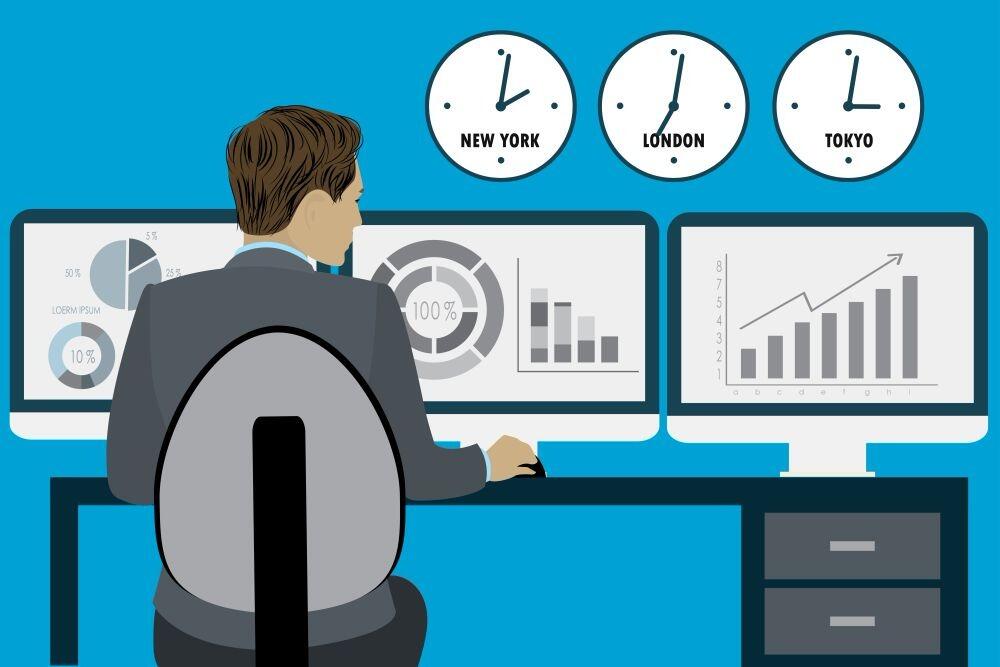
Trading at the Asian or the Pacific sessions, as a rule, doesn’t provide anything except for expectations – price swings are narrow, the liquidity is low. So, if you are home from work and decide to trade for some more time, you are likely to gain nothing good and just waste your time. In addition, one should sleep at night, rather than trade :)
Besides, you need to allocate your time in in the way, that it won’t affect your efficiency and doing your house choirs. The matter is that trading itself is rather time- and energy-consuming. Trading in the financial markets it is not only about opening position, but about thorough analysis as well.
Trading during lunch break
Another, quite common, way to trade for those, who are regularly employed. A full lunch break is about of one hour, it is often enough time to take the right decision. I should correct myself, if you are a reckless scalper, I wouldn’t recommend you spending the whole break on entering multiple trades; as I’ve said before, trading is rather exhausting. And if you devote your every lunch break to active trading, you will burn out sooner or later; and stop enjoying trading, your work, and your life.
Lunch break is good for trading in the middle-term, when you analyze a few currency pairs, open a few positions (if there is an opportunity to open), and shut down the terminal. This way, you practice analyzing the market and trading, gain experience, and save up your time and energy.
Of course, if you trade during your lunch break, need a mobile gadget, to enter your trades. You’d better not use your office computer to avoid conflicts with your managers in future.
Pending Orders
If you’ve decided on your trading method, and it doesn't suggest entering multiple trades, you may not be tied to any particular trading session. You can analyze currency pairs, interesting for you, in the evening or in the morning, put pending buy or sell orders (you shouldn’t also forget about risk management) and go to work.
During the day, the price can “trigger” your pending orders and open the needed positions. Of course, in this case, you should put stop-losses and take-profits. So, you can partially automate your trading and “monitor” the market even when you physically can’t open or close positions.
This approach can well be matched by, for example, different “breakout” strategies, based on a sharp rise in volatility. Knowing, during what trading sessions the main price moves start, you put an order, a stop-loss, and a take-profit, before they start, and can safely work in the office. And at the end of your working day (or at lunch break, if you have the Internet access) you can check how the trade has been executed.
Such strategies don’t depend on a certain timeframe, as you trade a certain “concept” in the market, not the whole situation in the price chart.
This approach will suit any trader at the beginning and enable to develop the skill of systematic trading according to clear rules of your trading strategy.
Switch to middle-term and long-term trading
This way suits just everybody, but it requires a trader’s patience. Most beginners prefer only short-term trading, when they open and close positions within one or a few more days.
You can consider different “slow” strategies with an opportunity to hold the positions opened for a few weeks or even months. Traders in this case don’t have to monitor the market all the time and watch the situation every few minutes. There, trading can also be partially automated due to setting stop-loss and take-profit.
You can study the market situation once a day, and that will be enough to stay informed. Stop-losses and take-profits are rather big-sized there, the timeframes to trade start form D1.

This approach will suit calm and unhasty people, who won’t feel a desire “to check the market” every five minutes. Otherwise, if it is not about you, you will get too nervous, and that is not about being efficient in your primary job or a right trading approach.
If you’d like to enter more trades, then you should trade during a certain session in shorter timeframes within one or two hours.
Summing up all the above, I’d note, that you shouldn’t quit your regular job, unless you “stand on your own two feet” - you’ll understand it yourself when you really do. The ways, suggested in the article, will help you combine your daily activities and trading until you become independent financially.
P.S. Did you like my article? Share it in social networks: it will be the best "thank you" :)
Useful links:
- I recommend trying to trade with a reliable broker here. The system allows you to trade by yourself or copy successful traders from all across the globe.
- Use my promo code BLOG to get a 50% deposit bonus on the LiteFinance platform. Simply enter this code in the appropriate field when funding your trading account.
- Telegram chat for traders: https://t.me/litefinancebrokerchat. We are sharing the signals and trading experience.
- Telegram channel with high-quality analytics, Forex reviews, training articles, and other useful things for traders https://t.me/litefinance

The content of this article reflects the author’s opinion and does not necessarily reflect the official position of LiteFinance broker. The material published on this page is provided for informational purposes only and should not be considered as the provision of investment advice for the purposes of Directive 2014/65/EU.
According to copyright law, this article is considered intellectual property, which includes a prohibition on copying and distributing it without consent.