Cryptocurrency is a buzzword in the tech realm. The first cryptocurrency was Bitcoin, followed by Ethereum, which came to be known as the second generation of blockchain technology after Bitcoin. There are new cryptocurrencies entering the blockchain world, with EOS being one such cryptocurrency actively challenging Ethereum's capabilities.
There are two extra benefits that Ethereum offers over Bitcoin, such as the ability to run decentralized applications (dApps) and power the next generation of the decentralized internet. Ethereum is one of two blockchain “supercomputers” which can process smart contracts and has been in existence for a shorter period than EOS, yet it currently has greater interest from skilled developers.
Here, we’ll go over the key differences between the EOS blockchain and Ethereum, as well as which crypto token you should invest in.
The article covers the following subjects:
What Is Ethereum?
The most popular smart contract platform is Ethereum, which is also the backbone of most DeFi apps. Many coins on the market are built using Ethereum as ERC-20 tokens, and this shows just how important blockchain technology is to the overall crypto market.
The reason Ethereum killers such as EOS exist is due to natural competition, and because Ethereum does have weaknesses that make it difficult to scale. Current solutions for ETH network congestion include stablecoin and DeFi apps moving to other blockchain protocols, or Ethereum developers scrambling to address issues in the near future.
What Is EOS?
EOS is a crypto token that can be used for transactions. It's an alternative to ETH and has many benefits. The EOS platform provides a series of services that allows you to create and execute smart contracts. It is much more efficient than Ethereum's design, as it uses replicated parts of a computer system.
What Is EOS Trying to Achieve?
Daniel Larimer, the CTO behind EOS, is convinced that Ethereum can’t deliver the performance people want. He argues that regular people don’t care about decentralization as much, but care more about performance.
EOS is trying to limit the requirements people need in order to create dApps. EOS wants to make it easier for people to create dApps, which is why their chief rival is ETH.
EOS requires less coding than Ethereum, is easier to learn how to use and navigate, and provides more base features. These are crucial because most people do not have the technical knowledge required to create an Ethereum smart contract. Larimer claims that one day, EOS will handle millions of transactions per second (TPS). Today they are focusing on 1,000 to 8,000 TPS.
How Does EOS Work?
Developers can buy computer resources for the blockchain, earning tokens for using it. This computer power can be used in the DeFi economy to create more projects.EOS is supported by Dan Larimer, the co-founder of the software developing company Block.one, which created the cryptocurrency. Meanwhile, while Ethereum’s developer community is taken more seriously than EOS, there isn’t any one person as strong behind ETH.
What Is the Difference Between Ethereum and EOS?
There are many differences between EOS and Ethereum, but there are also some similarities. In the following sections, we’re going to break down what they are, as well as their strengths and weaknesses.

Concepts and Creation
Ethereum is a crypto-based platform which was created by Vitalik Buterin. The original ETH blockchain now exists as Ethereum Classic (ETC), and most of the development community's efforts go into maintaining the current blockchain, called Ethereum.
In the DAO, a decentralized organization, Ethereum's Serenity will be rolling out soon. This will help increase scalability for ETH 2.0, which is coming soon. EOS is an Ethereum-based cryptocurrency that later floated to its own protocol after launching on the blockchain. EOS was created by Block.one platform, with Dan Larimer as co-founder.
EOS tokens were one of the most successful ICOs, raising billions in capital through crowdfunding. Several newer coins are trying to compete with Ethereum for market share, but it is EOS that stands the most chance of succeeding.
Transactions and Speed
Ethereum's transactions are becoming more and more popular, with new dApps growing at a rapid pace. Still, Ethereum transactions have been facing controversy as fees skyrocket. You need ETH to make transactions on DeFi projects and trading.
The EOS network currently has a limited number of dApps, which means that it can handle high speeds with low costs. While this can be a good thing for EOS, as the space is in less demand right now, it also means that in order to take advantage of its full potential, changes need to happen soon.
Governance
Ethereum works on a hybrid Proof-of-Work/Proof-of-Stake system, with the intention of eventually relying solely on Proof-of-Stake consensus. Ethereum imposes restrictions on developers to prevent any changes or disagreements, delegating major decisions to forks.
EOS will use a consensus model that helps avoid the need to depend on mining or staking. They also plan on using a constitution, which allows users to be subject to a single set of rules and regulations.
Supply and Distribution
The Ethereum supply is currently being debated by people in the crypto world. Some people say there isn't a limit on how much Ether can be mined, but Bitcoin caps their supply at 21 million coins. Currently, there are over 110 million ETH in circulation, which might cause debate about the supply of ETH. Ethereum has a larger market capitalization due to lower total supply and higher prices per coin.
EOS is a cryptocurrency with a supply of 1 billion tokens. 60% of these tokens are distributed to investors, 20% are held in reserve for the EOS development team, and 10% are set aside for block producers. Block producers play an important role in the EOS ecosystem by verifying transactions and maintaining the blockchain. They are rewarded with EOS tokens for their work.
Use Cases and Target Market
Ethereum and other cryptocurrencies might seem like they are only assets for investors, but that is only a piece of what the technology offers. The real opportunity in both cryptocurrencies is in the blockchain protocol that developers can build upon. Developers can build whatever their imaginations come up with, protocol allowing.
There are many aspects of both Ethereum that makes it an excellent choice for building decentralized applications. Ethereum, however, has more activity in this arena over EOS currently.
EOS and Ethereum Historical Price Action Reviewed
As you can see in the chart below, Ethereum has outperformed EOS significantly throughout its short history. There is little historic price action, so take the visual information with a grain of salt.
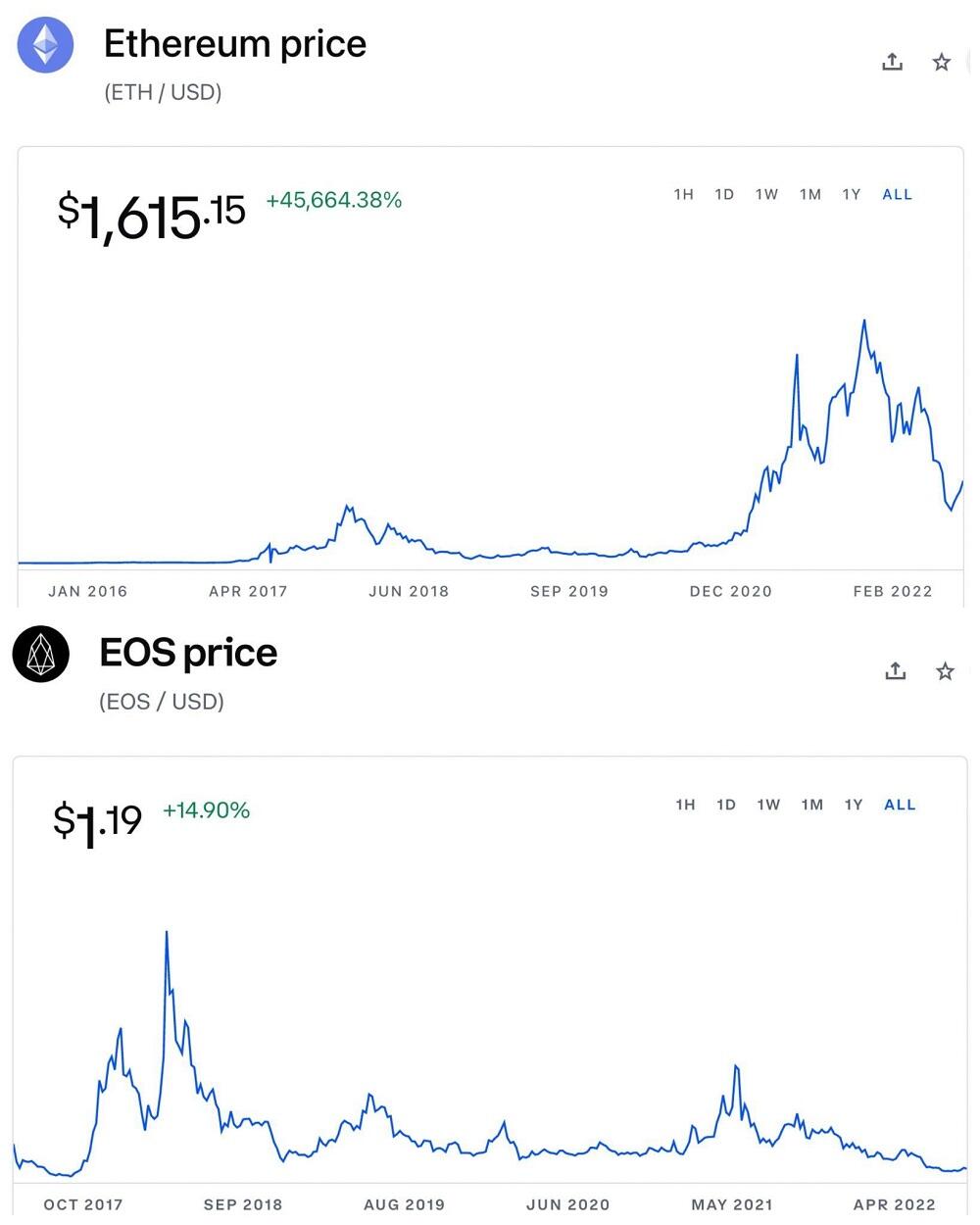
Ethereum has surpassed its all-time high, and its price is now much higher. It seems to be less volatile than EOS, because EOS only recently broke out of its downtrend.

Ethereum had a downtrend breakout a lot earlier, resulting in a huge and steady uptrend. EOS may have the same rise next, so it could potentially be more profitable in the short-term.
Therefore, ETH may never lose its number two spot.
Ethereum 2.0 – Solving Scalability and Other Issues?
Ethereum 2.0 is an upgrade of Ethereum, also known as Eth2 or Serenity. The upgrade intends to improve the ETH network’s speed, scalability, and efficiency so that the blockchain can handle more transactions than before.
But the Ethereum Foundation says that Ethereum 2.0 is just a network upgrade, instead of an entirely new system. Now, Ethereum 1.0 has been renamed the “execution layer,” which contains smart contracts and regulations. Meanwhile, Eth2 has become the “consensus layer,” which guarantees that devices on the network act in line with those policy sets. The name Ethereum 2.0 still refers to this upgrade.
The full release of Ethereum 2.0 is not estimated to happen until at least 2023, following the first phase's launch in 2020. Known as the Beacon Chain, this is critical for Ethereum’s transition to a Proof-of-Stake consensus process. The second phase, known as the “merge,” will bring together the Beacon Chain with the Ethereum main net during the 3Q-4Q of 2022.
Shard chains will help grow the Ethereum network. Instead of resolving all transactions on a single blockchain, shard networks distribute them among 64 different chains.
This means that an Ethereum node will start to require less hardware because less data will need to be kept on a system.
EOS and Ethereum Price Predictions
The ETH price and the EOS price are important factors to take into consideration when making an investment. People expect Ethereum to reach tens of thousands in the future. The short-term predictions are that Ethereum will be near $3,500 per token.

The EOS blockchain has less mainstream buzz than the Ethereum network, so its price predictions are few and far between. However, experts predict the coins to reach as much as a thousand times their current value.
Is EOS Better Than Ethereum?
Several people compare EOS to Ethereum, as they both aim to decentralize organizations and currencies and create a more transparent financial world. There is an argument that EOS is superior, but it may not be possible to make a clear comparison between the two projects.
Some people believe that EOS, which is much younger than Ethereum, can help it get around some of its problems.
ETH is still a work in progress. When it goes through sharing and Plasma, Ethereum may be able to reach tens of thousands of TPS. Vitalik Buterin believes that the current version of Ethereum is too slow — he thinks Ethereum will get much faster after these two updates.
However, at their core they have different models: with Ethereum developers must pay gas fees, but with EOS, users of smart contracts must pay the gas fee.
Ethereum is working on scaling, but may have issues with backward compatibility. EOS may not have such troubles. So, ETH is more difficult to adopt because it requires a programming language, Solidity. EOS doesn't require the use of a third-party programming language, so its widespread acceptance may lead to its adoption over Ethereum.
EOS has the ability to speed up changes, where Ethereum systems do not. In EOS, a smart contract can be updated, but there is a risk of messing up the system.
Blockchains are evolving. They will have more competition, including from EOS and Ethereum.
Conclusion
Ethereum and EOS are the most popular blockchain platforms. The EOS coin is said to be a more powerful alternative to Ethereum. It is second in size only to Ethereum and has been dubbed ”the Ethereum killer”. But since Ethereum is so large, it will be difficult for the EOS coin to replace ETH.

As a result, EOS has the potential to outperform Ethereum in the short run. This may make it more profitable for investments, but there is no way to predict which will be better over time.
If Ethereum doesn't lower the prices for transactions, it will be difficult for it to continue to exist with high standards of performance. If EOS can think of a way to keep up with Ethereum's success, then EOS might overtake Ethereum as the ultimate decentralized application platform.
The competition is nowhere near over between EOS and ETH.
EOS vs. Ethereum FAQs
EOS and ETH are both blockchain platforms that offer a lot of features and potential. They are both very popular in the cryptocurrency world and have a lot to offer users.
EOS is a newer platform that has been designed specifically for scalability. It can handle a lot more transactions than Ethereum can, and it doesn't require miners to validate transactions. Ethereum, on the other hand, has been around for longer, and it has a more proven track record. It also has a large and active developer community working on it. Ethereum also offers a wider range of features than EOS does at the moment.
While both platforms have their own strengths and weaknesses, it's hard to deny that EOS has made some serious progress in recent months.
One of the biggest advantages that EOS has over ETH is its scalability. While Ethereum can currently process around 15 transactions per second, EOS is designed to handle millions of transactions per second. This is thanks to its unique Delegated Proof-of-Stake consensus mechanism, which allows it to process transactions much faster than Ethereum.
Another advantage that EOS has is its governance model. Unlike ETH, which is decentralized in nature, EOS has a more centralized governance model that gives its developers more control over the platform.
Of course, there are also some disadvantages to using EOS. These disadvantages do not yet allow EOS to surpass Ethereum.
EOS is a smart contract platform that enables developers to build decentralized applications (dApps) on its blockchain. One of the key features of EOS is its scalability: it can handle many transactions per second, which makes it suitable for large-scale applications.
Another advantage of EOS is its governance model. While Ethereum uses a Proof-of-Work (PoW) consensus algorithm, which is energy-intensive and slow, EOS uses a delegated Proof-of-Stake (DPoS) consensus algorithm, which is more efficient and faster.
These advantages are the basis for a great future for the coin.
There are a few key differences between the two platforms that could give EOS an edge in the long run.
For one, EOS is designed to be more scalable than Ethereum. It can handle many more transactions per second and doesn't require users to pay gas fees. EOS also has a different governance model than Ethereum. Rather than being decentralized like Ethereum, EOS uses a Delegated Proof-of-Stake (DPoS) system, which gives users more control over how the platform is run.
EOS is similar to Ethereum in many ways, but there are also some key differences. Here are some of the things that make EOS stand out:
- EOS has a faster block time than Ethereum.
- EOS uses a different consensus mechanism than Ethereum.
- EOS has no transaction fees.
- EOS has scalability built into its design.
- EOS has a well-funded development team.
It's been a tough few months for EOS. The once high-flying cryptocurrency has lost over 90% of its value since June, and is now trading at around $1. That's a far cry from its all-time high of over $22, reached just six months ago.
The EOS network uses the ERC-20 token standard from Ethereum and offers several improvements over Ethereum. One major difference between the two platforms is that EOS uses a delegation model for its consensus algorithm, while Ethereum uses a proof-of-work (PoW) model. Under the delegation model, block producers are chosen by the EOS community, and they produce blocks in round-robin fashion. This means that block production is not monopolized by a few large miners, as is the case with Ethereum.
Today, EOS is valued $0.0933.
There are many factors to consider when selecting between ETH and EOS. Some important factors include the team behind each project, the technology, and the community. The ETH team is experienced and has a strong track record. The EOS team is also experienced, but they have less of a track record. At the same time, the EOS technology is newer and unproven, but the ETH community is large and active. Based on all of these factors, it seems like ETH is the better investment. However, EOS has a better shot, giving holders a unique chance to multiply their investments.
Price chart of EOSUSD in real time mode
The content of this article reflects the author’s opinion and does not necessarily reflect the official position of LiteFinance broker. The material published on this page is provided for informational purposes only and should not be considered as the provision of investment advice for the purposes of Directive 2014/65/EU.
According to copyright law, this article is considered intellectual property, which includes a prohibition on copying and distributing it without consent.