The stock market is a constantly evolving system where the decisions and emotions of millions of investors influence price movements. These movements are typically described as either bull markets or bear markets.
These terms refer to more than just rising or falling prices. They reflect broader economic trends, investor sentiment, and the cyclical nature of financial markets. Understanding the difference between a bull market and a bear market is essential for building effective investment strategies.
This article explores the key differences between bull and bear markets, the factors that drive them, and the trading strategies best suited to each market environment.
The article covers the following subjects:
Major Takeaways
- The terms "bull" and "bear" are believed to have originated from the way these animals attack. A bull drives its horns upward, symbolizing rising prices, while a bear swipes downward with its paws, representing a declining market. This imagery became firmly embedded in financial terminology during the 18th century.
- A bull market is a prolonged period of steady growth in asset prices. It is characterized by investor optimism, increased trading volume, and economic expansion. Such a period can last for months or even years, despite short-term corrections.
- A bear market is a sustained period of decline in asset prices, typically by 20% or more from previous highs. It is marked by investor pessimism and shrinking investment, and often coincides with an economic recession.
- Bull markets generally favor growth-oriented strategies and long-term investing, while bear markets often require a more defensive approach, including opening short trades and holding safe-haven assets. Regardless of market conditions, discipline, analysis, and sound risk management remain essential.
What Does Bearish and Bullish Mean in the Stock Market?
Bull and bear markets are among the most important concepts in finance. They reflect both the overall direction of asset prices and the sentiment driving investor behavior. So, what are bullish and bearish in trading?
A bull market is a prolonged upward trend, particularly in the stock market. It is typically marked by strong investor optimism, confidence in the economic outlook, and a steady increase in market value.
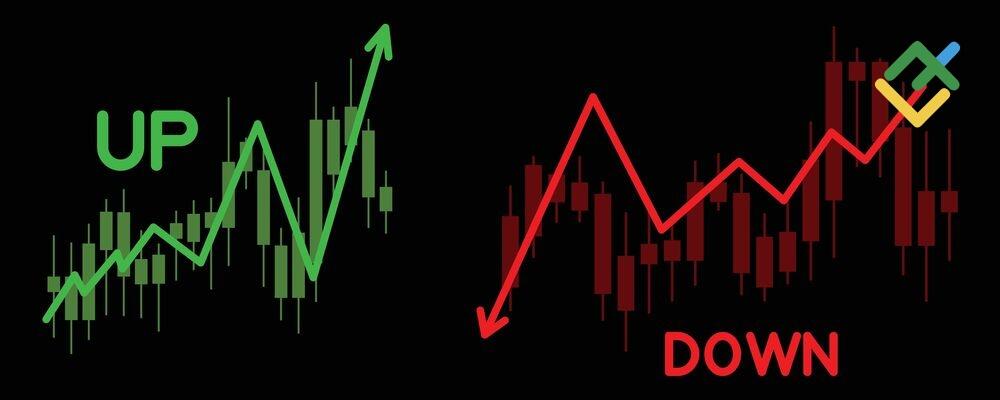
A bear market, on the other hand, is a sustained downward trend characterized by falling prices and a prevailing pessimism among investors.
Bull and bear markets are more than just price trends. They reflect the state of the economy and psychology of market participants, influencing individual stocks, entire sectors, market indices, and the broader market.
Identifying whether there is a bull or bear market is essential for shaping investment strategies and managing risk effectively.
Where Do the Terms "Bull" and "Bear" Come From?
The origins of the terms "bull" and "bear" are rooted in the way these animals attack. A bull thrusts its horns upward, making it a fitting symbol of rising prices and upward market momentum. A bear, by contrast, attacks with downward swipes of its paws, reflecting declining prices. Over time, these contrasting movements became closely associated with the two main market directions.
However, the origins of these terms were not limited to animal symbolism. In 18th-century England, the word "bear" was linked to an old saying: "Do not sell the bear's skin before you have caught it." The phrase referred to the practice of selling goods before actually owning them. Over time, the term "bear" came to describe market participants who expected prices to decline.
The term "bull" emerged as the counterpart to "bear" and came to describe investors who expected prices to rise. Its association with upward movement made it a natural symbol of a growing market, helping to cement its place in the language of finance. Today, the image is deeply embedded in financial culture, with the famous Charging Bull sculpture on Wall Street standing as a lasting symbol of market strength, optimism, and growth.
More than simple market symbols, the bull and the bear capture the opposing forces that shape investor behavior: greed and fear. Bull markets thrive on optimism and confidence, while bear markets are driven by caution and concerns about future losses. Recognizing these emotional drivers can provide valuable insight into market sentiment and potential changes.
What Is a Bull Market?
A bull market is a period of sustained growth in asset prices, whether in stocks, bonds, or cryptocurrencies, although the term is most commonly used in relation to the stock market. It is generally defined as a rise of at least 20% from a recent low and is typically accompanied by strong investor confidence and optimistic expectations for future market performance.
Basically, a bull market is a period when most market participants, from individual traders to institutional investors, expect further economic growth and are actively buying assets. A bull market can last anywhere from a few months to many years.

Notably, a bull market does not mean prices rise without interruption. Short-term pullbacks of 5–10% are common and are often seen by investors as buying opportunities rather than reasons to exit the market. Bull markets also tend to be marked by higher trading volumes during rallies and lower volatility during periods of decline.
Under these conditions, investors often adopt a "buy the dip" strategy, viewing short-term declines as temporary setbacks. Understanding bullish and bearish markets is essential, as they shape not only investment returns but also broader market sentiment.
What Causes a Bullish Trend?
Bull markets are typically driven by a combination of economic, financial, and psychological factors. When these forces align, they create favorable conditions for sustained price growth. The key drivers of a bull market include:
- Low interest rates. When central banks cut interest rates, the borrowing costs decrease. Companies can get cheaper loans to grow their businesses, and investors start looking for higher-yielding instruments than bank deposits. As a result, some capital flows into the stocks of specific companies or index funds, boosting liquidity in the stock market.
- Strong economic indicators. Economic growth, low unemployment, rising consumer spending, and an increased PMI fuel corporate earnings growth. Strong business performance, in turn, bolsters investor optimism and supports demand for stocks.
- Innovation and technological progress. Breakthrough technologies and the rapid growth of emerging industries can act as powerful catalysts for market gains. Developments such as the internet, digital technologies, and artificial intelligence have spurred some of the strongest market rallies in recent decades. As leading companies in these sectors grow, their rising valuations can help lift the broader market.
- Fiscal stimulus. Government support measures, including tax cuts, subsidies, and public spending programs, can boost economic activity and consumer demand. In turn, this creates a more favorable environment for business growth and rising asset prices.
- Positive investor sentiment. As prices continue to climb, investor confidence tends to strengthen. Fear of missing out (FOMO) draws new participants into the market, increasing demand for assets and stimulating further gains. This often creates a self-reinforcing cycle that helps sustain the upward trend.
Furthermore, a bullish market often begins even before the economy fully recovers from a recession. Investors focus not only on real-time indicators but also on bullish expectations, which is why the market often moves ahead of economic data. Being aware of these factors enables investors to better assess market prospects and make more informed decisions.
Is Bullish Good or Bad?
Most people would say that a bull market is a good thing. Rising stock prices boost portfolio values, strengthen investor confidence, and create more opportunities to profit. For beginners in particular, it may seem like making money becomes much easier when the market is moving upward. Yet despite its advantages, a bull market also brings certain risks.
The benefits of a bull market include rising stock prices, easier access to capital for businesses, and stronger economic growth. Investor confidence encourages companies to expand, attracts investment, and supports innovation. Bull markets positively impact retirement savings, as pension funds often invest part of their portfolios in equities.

However, there are also drawbacks:
- A prolonged bull market can lead to market bubbles, where asset prices significantly exceed their fundamental value.
- Continued growth often undermines investor caution and may result in panic selling.
- A bull market can mask structural problems in the economy, such as excessive lending or overheating in certain segments of the stock market.
- Investors who enter the market at the peak of the uptrend may face significant losses when the cycle shifts and a bear market emerges.
Therefore, a bull market cannot be definitively called an exclusively positive phenomenon. Although it creates favorable opportunities to generate returns, it also requires discipline and a measured approach to risk management. Market growth does not guarantee trend continuation, so even during periods of optimism, it is vital to remain vigilant and adhere to a long-term strategy.
Examples of Historic Bull Markets
The history of financial markets is replete with examples of bull markets, each of which was propelled by its own economic and technological drivers:
- The Roaring Twenties bull market (1921–1929). One of the most famous bull markets in US history. It was fueled by rapid industrial expansion, the electrification of the economy, and easy access to credit. Stock prices surged, and many investors bought shares on margin using borrowed money.
- The post-World War II bull market (1949–1956). At the time, this was the longest bull market on record. Economic recovery, strong job growth, and rising consumer spending drove the rally. During this period, the Dow Jones Industrial Average more than doubled.
- The dot-com boom (1995–2000). A classic technology-driven bull market. The rapid growth of the internet fueled strong demand for technology stocks. Many startups attracted substantial investment despite having little or no profit. Investor optimism was exceptionally high, and the NASDAQ Composite gained roughly 400% over five years.
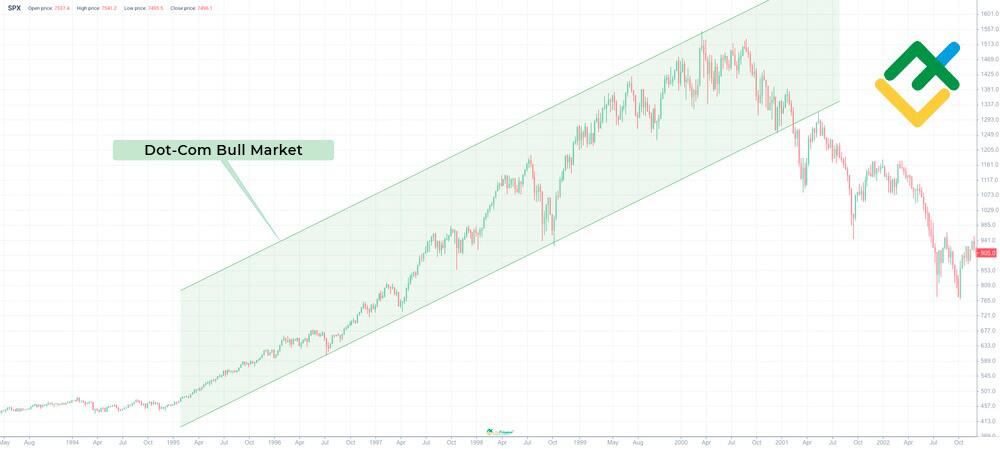
Dot-Com Bull Market
The 2009–2020 bull market. One of the longest bull markets in modern history. It began after the 2008 global financial crisis and was supported by low interest rates, Federal Reserve quantitative easing programs, and the strong performance of major technology companies. Innovation, digitalization, and globalization helped sustain the market's long-term growth.
The post-pandemic bull market (2020–2021). Following the market slump caused by the COVID-19 pandemic, stocks rebounded rapidly. Massive fiscal and monetary stimulus, accelerated digital transformation, and the widespread adoption of remote work boosted the valuations of many technology and healthcare companies. As a result, several major stock indices reached new record highs.
What Is a Bear Market?
A bear market is a period of continuous decline in financial markets, typically by at least 20% from recent highs. It is considered the opposite of a bull market and reflects the prevalence of negative sentiment.
A bear market is not a short-term correction, but rather a prolonged downturn that can last for months or even years. Bear markets are often characterized by a slowdown in economic growth, rising unemployment, and declining business activity.
During bearish market conditions, investor confidence dwindles. Market participants turn more guarded, economic data deteriorate, companies cut costs, and selling activity intensifies. The increase in market supply puts additional pressure on prices and may speed up their decline.
A bear market is not only a price drop but also a serious psychological test for investors. However, like any phase of the market cycle, it is temporary and eventually gives way to a new period of growth.
Despite falling prices, a bear market can present opportunities for long-term investors willing to buy sound assets at lower prices and hold them, anticipating a future increase.
What Causes a Bearish Trend?
Bear markets are typically caused by macroeconomic factors, shifts in investor sentiment, and external shocks. The main causes of a bear market include:
- Economic slowdown. Recession, declining GDP, increased unemployment, and reduced consumer spending negatively impact companies' financial performance. A decrease in corporate profits typically leads to a drop in stock prices, as investors become less interested in them.
- Rising interest rates. To combat inflation, central banks may lift interest rates. As a result, borrowing costs increase, economic activity slows down, and bonds and other fixed-income securities become more appealing compared to stocks. This can lead to capital outflows from the stock market.
- Financial crises. Burst market bubbles, banking problems, and liquidity crises often trigger steep price drops. Such events undermine investor confidence and intensify market pressure.
- External shocks. Geopolitical conflicts, natural disasters, pandemics, and other unforeseen events can trigger panic selling and cause market sentiment to deteriorate sharply. In times of uncertainty, investors often reduce their holdings of risky assets, further exacerbating the decline.
- Loss of investor optimism. When signs of an economic slump or worsening corporate financial performance emerge, market sentiment can shift rapidly. Optimism gives way to caution, and sellers begin to outnumber buyers, reinforcing the bearish momentum.
Rarely does a single factor drive a bear market. Economic weakness alongside high interest rates can create a challenging environment for businesses, adding to downward pressure on stock prices.
In such conditions, technical analysis reveals a downward trend with key support levels breached. Investors are modifying their trading strategies and focusing on capital preservation and risk management. At the same time, long-term market participants may use dollar-cost averaging (DCA) to gradually build positions in high-quality assets at lower prices, anticipating future recovery.
Examples of Historic Bear Markets
Bear markets have played as important a role in financial history as bull markets. Although their causes, scale, and duration varied, each had far-reaching consequences for investors and the global economy:
- The Great Depression (1929–1932). One of the most severe bear markets in US history. The Dow Jones Industrial Average lost nearly 89% of its value as a result of the stock market crash, widespread bank failures, and a deep economic downturn. The crisis highlighted the devastating impact a major financial collapse can have on markets and the broader economy.
- The Dot-Com Bubble Burst (2000–2002). After the rapid rise of internet stocks in the late 1990s, the market underwent a sharp correction. Many technology companies failed to meet lofty investor expectations, triggering a sell-off that drove the NASDAQ down by nearly 78%. The downturn marked the end of the dot-com boom and weighed on the market for years.
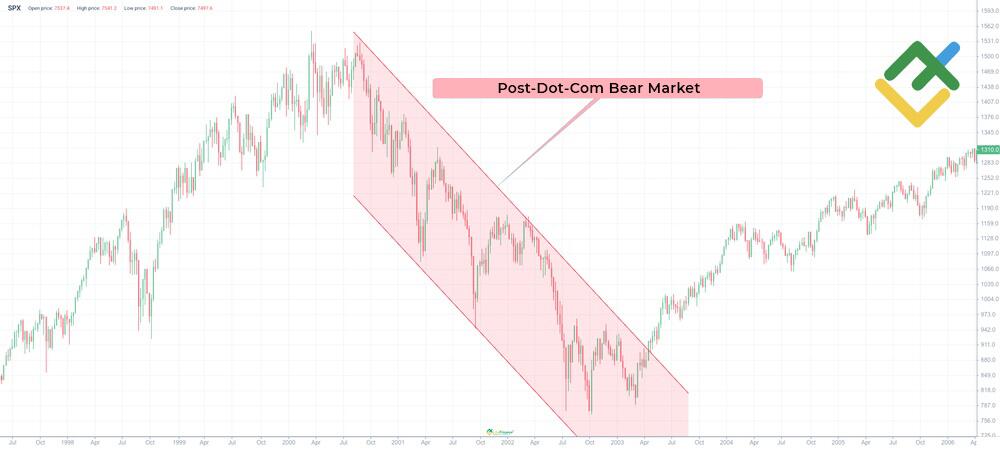
Post-Dot-Com Bear Market
- The Global Financial Crisis (2007–2009). Triggered by the collapse of the US housing market and the ensuing financial crisis, this bear market spread across the global economy. The bankruptcy of Lehman Brothers intensified panic, and the S&P 500 fell by more than 50% from its peak. Although it lasted only about 17 months, it was among the deepest bear markets in modern history.
- The COVID-19 Bear Market (2020). The outbreak of COVID-19 triggered one of the fastest market declines on record, with major indices falling roughly 30–35% within weeks. Unlike previous bear markets, this one was caused by an external shock rather than underlying economic imbalances. Massive fiscal and monetary stimulus helped markets recover quickly and begin a new bull market.
Bullish vs Bearish: Key Differences
It is crucial to grasp the difference between bearish and bullish markets to navigate the stock market with confidence. Each of these phases is characterized by its own trends, sentiment, and strategies.
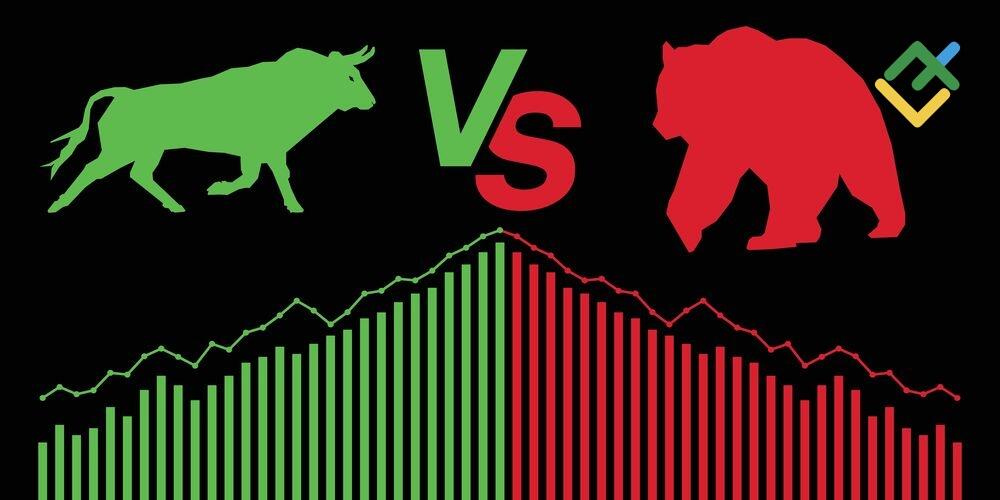
The table below outlines the key differences between the two market trends:
Parameter | Bull Market | Bear Market |
Market sentiment | Optimism, greed | Fear, pessimism |
Stock prices | A 20% increase from the lows | A 20% drop from the highs |
Economy | Economic growth, low unemployment | Economic downturn, recession |
Interest rates | Often low or stable | Can be high or rising |
Trading strategies | Buying on pullbacks, holding | Short trades, defensive stocks, cash |
Duration | 2–7 years on average (the longest bull market lasted 11 years) | 6–18 months on average (the shortest bear market lasted 2 months) |
Volume | Rising trading volume during an increase | Rising trading volume during a decrease |
How to Invest in a Bull Market
Investors should adapt their strategy to the corresponding market phase. In a bull market, the saying "the trend is your friend" often proves true. As stock prices rise steadily, investors typically increase their exposure to equities to benefit from the market's upward momentum.
One common strategy is to invest regularly using dollar-cost averaging, which helps mitigate the impact of poor timing when entering the market. Many investors also prefer blue-chip stocks and index funds, focusing on sectors with high growth potential.
Investor optimism underpins demand for assets, so trading strategies in a bull market typically involve holding positions for longer periods. To assess the strength of a trend, traders use technical analysis tools, such as moving averages, the Relative Strength Index (RSI), and chart and candlestick patterns.
During an uptrend, the primary goal is to increase capital. However, even under favorable conditions, it is essential to be mindful of the risks. To reduce portfolio volatility, investors often include bonds and other fixed-income securities in their portfolios.
Bullish sentiment typically persists as long as economic data and corporate earnings continue to bolster market confidence. However, one common mistake among novice investors is the belief that economic growth guarantees profits. Even in the midst of a steady uptrend, it is important to stick to an investment plan and follow risk management rules.
How to Invest in a Bear Market
During a bear market, preserving capital often becomes investors' primary objective. As market conditions deteriorate, many investors shift toward more defensive assets and place greater emphasis on risk management.
One common approach is to increase allocations to cash and defensive stocks, particularly in sectors such as utilities and healthcare. Some investors also use short-selling strategies to profit from falling prices. Given the potential for sharp market declines, effective risk management becomes especially important during this period.

Even in a bear market, dollar-cost averaging remains a viable long-term strategy. Lower asset prices allow investors to buy assets at more attractive valuations over time. However, this approach requires a long investment horizon and the ability to withstand short-term market volatility.
Bearish sentiment is often accompanied by panic selling, which can create opportunities for investors to buy assets at discounted prices. To assess market conditions, investors commonly examine trading volume, support and resistance levels, trend indicators, and other technical analysis tools.
Investment decisions during bear markets are often guided by broader economic conditions, interest rate trends, and expectations for future economic growth. Many financial advisors recommend avoiding emotionally driven decisions and resisting the urge to sell assets during periods of market panic. In such environments, discipline, a long-term perspective, and effective risk management are essential for navigating market volatility.
Conclusion
Understanding bull and bear markets is an essential part of smart investing. These phases follow one another, reflecting changes in the economy, investor sentiment, and price trends.
Bull and bear markets help determine the current stage of the market cycle and select an appropriate investment strategy. A bull market creates opportunities for capital growth, while a bear market requires greater attention to risk management and investment discipline.
When making investment decisions, it is essential to consider the current market environment. History shows that periods of sustained growth are often followed by corrections and market downturns. At the same time, the performance of individual stocks can differ significantly from broader market trends. Major indices such as the Dow Jones Industrial Average have repeatedly experienced cycles of growth and decline over time. Ultimately, long-term investment success depends on a well-defined financial plan and the ability to adapt to changing market conditions.
Remember that all investing involves risk, and past performance does not guarantee future results. To enhance your trading experience, make full use of the tools and features available on the LiteFinance platform.
Bull and Bear Markets FAQs
Investors use a variety of indicators to identify market trends. One of the most widely used is the 200-day moving average. When most stocks trade above this level and major indices continue to reach new highs, it often signals a bull market. Conversely, a decline of 20% or more from recent highs is generally considered a sign of a bear market.
Both approaches have their pros and cons. Bear markets can offer attractive buying opportunities because prices are lower, although there is always a chance they could fall further. Bull markets may feel safer since prices are already trending higher, but investors often end up paying more. To avoid trying to time the market, many investors use dollar-cost averaging (DCA) and invest regularly regardless of market conditions.
To buy bullish vs bearish depends on your investment strategy and time horizon. Traders often turn to short selling to profit from a falling market. Bearish investors, on the other hand, frequently view market downturns as an opportunity to gradually build up positions. At the same time, capital preservation and risk management remain top priorities.
Moving averages, the RSI, and the MACD indicator are frequently used in technical analysis to assess market trends. For example, a 50-day moving average above the 200-day moving average is generally considered a sign of an uptrend. Increased trading volumes can serve as additional confirmation: rising volumes amid climbing prices often indicate the strength of a bull market, while growing volume amid falling prices indicates a strengthening of bearish sentiment.
Price chart of EURUSD in real time mode

The content of this article reflects the author’s opinion and does not necessarily reflect the official position of LiteFinance broker. The material published on this page is provided for informational purposes only and should not be considered as the provision of investment advice for the purposes of Directive 2014/65/EU.
According to copyright law, this article is considered intellectual property, which includes a prohibition on copying and distributing it without consent.