What is Forex rebate, and why does a trader need a rebate service? How can you reduce your spread costs?
Rebate is similar to the cashback option. It allows a trader to compensate for a part of the trading costs. In general terms, it works like this. A trader registers for free on the rebate service website, follows the affiliate link to the broker's website, opens an account, trades, and pays the spread (markup) to the broker/market.
The broker shares a part of the commission (spread/markup) received from the trader to the rebate service for the clients it attracted. The rebate service shares a part of the affiliate earnings with the trader. Everybody is happy.
Read on this article, and you will know how rebate service works, what benefits to provides to the trader and the broker, and how you can receive such compensation. In the end, I will explain a real example of registering and connecting a trading account to a rebate service.
The article covers the following subjects:
Read a step-by-step guide to how you can compensate for a part of the spread you pay.
What is rebate, and how does a trader benefit from it?
A detailed instruction
Did you know that the trading costs can be partially reduced? I mean that you can get back some of the money you pay to the broker as the spread (markup). Moreover, it is entirely free for a trader. And if there is such an opportunity, why not use it?
You will learn from this overview:
- What spread rebate, its advantages, and risks for a trader.
- The way you can rebate a part of the spread costs and how much you can actually return (practical calculations).
- Detailed instruction on how you open an account via a rebate service: a step-by-step guide with a real example.
Rebate: the way to save your money
Rebate is a return of a part of the spread paid to the broker. This is quite a general definition, which I want to explain. Spread is the difference between the buy and the sell price of an asset. In the case of the STP or ECN order processing model, it is formed by the liquidity provider or the market state.
Using the rebate, the trader gets back only that part of the spread that is the broker's commission (markup, which is a kind of broker's margin on the spread).
Rebate is paid regardless of whether the trade generates a profit or a loss. The frequency of payments is different, depending on the conditions offered by the broker/rebate service (site). It can be accrued daily (on the closed trading day), weekly, monthly. The calculation formula is also different, according to the trading account type.
For example, it could be a percentage of the spread or a fixed sum for each traded lot. Some brokers offer different rebate bonuses according to the trading turnover. For example, you get back some amount of the money spent if your trade turnover is less than 10 lots per month. If you trade more than 10 lots in a month, you can rebate more money.
Rebate can be provided by:
- Directly by the broker. It is similar to a cashback service, and you can find the information in the section on promotional and bonus programs.
- Another resource, like an independent rebate service, which cooperates with many brokers.
However, you can’t simultaneously participate in the rebate program provided by your broker and register an account through a rebate site. You will have to choose between these two options, and each of them has its advantages.
Most commonly, you can rebate more of your costs by operating directly with the broker. That is because there is no additional intermediary in the affiliate chain, so you do not have to share your earnings. The advantages of a rebate service:
- The division of the trader’s cash flows. In the first case (working only with the broker), the trader’s funds (the deposit and the rebate) are controlled by the broker. In the second case, the rebate is accumulated on the account opened on the rebate site.
If the broker is a kitchen, and the trader has problems with the money withdrawal, he/she can at least withdraw the rebate. It is small comfort, but still.
- The rebate site serves as a consolidation platform. The rebate service can cooperate with dozens of brokers that post both trading and rebate conditions on the platform. That is, all trading conditions are collected here, and a trader only needs to analyze them instead of surfing dozens of websites.
On the other hand, is this information always relevant and up to date on such a platform? Besides, the trader, in this case, can’t see other advantages or disadvantages of a particular broker.
- Rebate service works as a ranking and analytical platform. It means such a platform ranks brokers with the best trading conditions, best rebate offers.
The brokers’ rating is based on the traders ‘ comments. Are those ratings objective? It is a rhetorical question.
- Compensation fund. Some rebate services declare a compensation fund that insures the trader against the possible loss of investment. However, the source of such a fund is not specified. I, for example, haven’t heard anything about the payments provided by such funds.
- Some rebate services provide free legal support. The owners of such platforms promise to help in every possible way and defend the trader’s interests if there is a conflict with the broker.
At first, it seems that it is more beneficial to participate in a spread rebate program of a rebate service. The rebate sites seem suitable for all investors. However, most of the stated advantages are only in theory.
How do rebate sites work?
In general, the cooperation model of the rebate service, the broker, and the trader works like this:
- Trader registers a profile on the rebate site. The profile serves for the further monitoring of the rebate statistics on all accounts. Some rebate platforms accrue money to the account opened together with the profile (Personal profile balance). The trader can withdraw the money or transfer it to the broker's trading account. Cash is credited directly to the trading account via the link through the ID code on other platforms.
- The trader follows the affiliate link to the broker’s website, which cooperates with the rebate platform. The client opens a real trading account, goes through the verification, and starts trading.
- In accordance with the rebate offer, the trader returns a part of the spread costs. How much money is compensated, where and how - it is specified in offer conditions.
How much money can you rebate? Forex brokers offer different conditions. The rebate conditions may also differ for separate forex trading accounts with the same broker. I will give two examples.
Example 1. Broker A offers compensation for 70% of the spread on the Classic account, 80% of which is received by the trader. In other words, the broker pays 70% of the spread to the rebate service, 80% of this amount goes to the trader's account (these conditions are usually indicated on the rebate website). The rebate is calculated in the following way:
- The trader trades 0.25 lots a day. For 20 working days of the month, the turnover will be 5 lots.
- For the EURUSD pair with 1 lot of 100,000 units, the pip price will be $10 (for 4-digit quotes!).
- The spread starts from 2 pips (it is the minimum value).
The trader’s spread costs for 20 days will be: 5 * 10 * 2 = $100. This is the amount the trader would pay working directly with the broker. 70 * 0.8 = $56 – the rebate amount. The trader’s actual transaction cost will be $44.
Example 2. Broker B offers to rebate $8 for each traded lot on the Classic account. The trader receives 80% of the rebate. Here, the calculation formula is even simpler.
Traders costs for the turnover of 5 lots is $100 (see in the previous example). The rebate amount is $40 (5*8). The trader receives $32 (40*0.8). The actual trading costs are $68.
The examples are approximate. And you don’t have to calculate everything manually. However, when you choose the rebate service or the broker on the rebate site, you should study at least reference figures to compare different offers.
Almost all rebate sites have calculators. However, they do not consider floating spreads. They take into account the minimum fixed spread. That will do for comparison, but actual rebate amounts won’t be the same as the figures produced by online instant cash calculators.
Benefits of the rebate for the broker and the trader
There is a natural question. Why should a broker share the commission with the trader or with the rebate service? However, forex rebates work to the broker’s advantage as well.
Advantages of the rebate for the broker:
- Marketing tool. Human psychology works so that all sorts of promotions and loyalty programs work more effectively than just a price reduction (in this case, the spread). In other words, it is not enough just to reduce the spread; you also need to offer the trader extra benefits introducing broker so that he/she feels special.
- Encouragement to trade more. It is another psychological aspect that encourages the trader to increase volumes. The more traders trade, the more they reduce the costs, and the profits increase as a result. Also, using the rebate forex, the broker can stimulate traders to work with less popular or higher risk assets by offering them a higher compensation level.
- Outsourcing. Each broker is interested in attracting as many active traders as possible. Affiliate programs and rebates are those business model tools that are outsourced. Intermediaries are engaged in attraction and marketing, bringing traders, while brokers share their commission with them.
Advantages of the rebate for a trader
You do not pay any commissions or membership fees. You need a little money to control the rebate service account, in all the other terms, the trader only benefits.
- It saves up money. Of course, trading involves substantial risk. However, in terms of cash rebates, a trader loses nothing. The registration on a rebate site is free.
- It helps you realize the strategy that could be losing without a rebate. I mean trading strategies where the spread makes up a significant share of trading costs:
- Scalping. For example, if the spread is two points, the expected profit will be at least three points. If you rebate 50%, you will be able to lower the limit.
- Algorithmic trading with high-frequency strategies, including grid trading.
- Trading exotic currency pairs, featuring high spreads because of low liquidity.
- Psychological support. A loss can be a great stress for many traders. The rebate, which is also accrued on losing trades (so, it reduces the loss), is a sort of consolation prize.
How to choose a rebate service (selection parameters):
- The required broker is among the service partners. A potential trader can choose a broker from the rebate service monitoring. However, I would recommend starting from the opposite side. The spread rebate is not the main criterion for choosing a broker.
Therefore, first, decide who you are ready to work with and only then look for a company in the list of rebate services. It is especially acute for active traders. If your broker is not on the list of rebate service partners, it doesn’t mean that your broker will yield you a loss and is not suitable.
- Rebate conditions. A common mistake is to think the greater is the compensation amount, the better. On the one hand, a large rebate amount may indicate that the rebate service has so many clients that it can afford to lose most of its earnings.
On the other hand, it can be a fraud to attract potential traders to a broker in the rebate site ranking. So, you should also note if you can receive the rebate daily – already in a day, you will understand if the figures are real and it is a win ratio.
- The fact of payments. If you want to refer to the comments, you should use only specialized forums. It is even more reliable to check the payments yourself, on your experience with a small amount of money.
- Follow your interests and go with your gut feeling.
Rebate services that work with LiteFinance are FxCash, Traders Union, Premium Trading, Globe Gain. You can rebate a part of costs through side services and participation in a referral system with your broker. Basically, a rebate service with your broker works similarly, but you adjust the cashback on the broker’s website. You can read more here.
Rebate FAQs
Major differences are:
- Terms of the partnership agreement between a broker and a rebate service. The amount of money the broker returns to the trader (a fixed amount or % of the trader's spread), the frequency of compensation payments (every day, once a week, etc.) - all this ultimately indirectly affects the rebate amount, which is the main criterion for choosing a service.
- Conditions of compensation payments by the rebate service. The question is about the “greed” of the rebate service: how much of its commission the service is willing to share with a trader.
- Additional benefits for the clients of a rebate service. Additional bonuses from the broker to the clients registered through a service. As a rule, the benefits are not material. For example, a 125% welcome bonus instead of 100% when registering directly.
- I would also add the service reliability, as a trader may not receive the compensation dealing with an unscrupulous rebate service.
First of all, I will repeat again that the trader does not bear financial risks. You do not have to pay any commissions or fees. In the worst case, you won’t get the compensation, but you won’t lose what you already have. But still, there are some risks:
- The risk of wasting time. You study the terms of compensation, go through verification, and in the end, get nothing.
- Reputation risk. Verification involves the transfer of personal data to the service. From a security point of view, this is reasonable, but servers are sometimes hacked. And there are other ways of getting the trader's personal data to third parties.
The more intermediaries are engaged, the greater the risk that your personal data could be stolen.
- The risk of getting carried away with excitement, the pursuit of rebate/cashback, forgetting about risk management.
Of course, you should have different passwords for the personal profiles with a broker and a rebate service.
Read the compensation conditions and calculation formula again. The examples given in the previous sections are approximate and do not take into account many peculiarities. For instance, with a floating spread, you can calculate the rebate amount in a spreadsheet editor (by uploading the history), but is there any point in wasting time?
Next, you follow a standard procedure: contact the rebate service’s technical support with your question, make screenshots of each reply and every step. If necessary, you can contact your broker. Please note that rebate services’ operation is not regulated, so there is no point in relying on regulators.
No, they aren’t. It won’t be reasonable based on the swap nature. Swap appears due to the difference in the interest rates, and the rebate is a part of the broker’s commission fees.
It is a controversial question. The wording “Rebate is a partial compensation of the spread” is simplified (as, for example, no one talks about CFD trading on Forex, omitting this term). The spread that the trader sees is the difference between buying and selling an asset + "markup,” broker's commission.
The broker is willing to share a part of the commission. It is a useful marker for a trader if the broker is trustworthy. If the broker’s markup is 50%, and you are promised to rebate 80% of the spread, you should ask yourself if it is a kitchen. If it is not a kitchen, then what is the broker's markup on the spread if the company is ready to give out such a difference?
A separate account is tied to a particular rebate service:
- You can open two accounts with one broker using the affiliate links of two rebate services. The rebate will come from one service to the first account; another service will send you a cashback to the second account.
- You can’t attach the same account to two different rebate services.
- You can open any number of accounts with any number of brokers through the same rebate service.
If you have really received a 100% rebate, inform us about what broker or service provides such cashback. There can be a 100% rebate in theory, but it is more like a promotion being a marketing tool. Nobody is willing to give out the entire profit.
As long as you trade for a net (unused) bonus, you can’t rebate the spread costs. Once the bonus turns into your own funds, you can count on a rebate.
Brokers, which cooperate with the rebate services, can offer their own cash back programs. But you can’t combine both types of compensation on the same account. Which is better? It is up to you to decide.
Some traders do not want to spend time on additional registration; others like the rebate conditions better – there is no single recommendation.
There is such an opportunity, but the procedure is different for each particular case. For one rebate platform, it is enough to enter the partner ID in the accounts of the service and the broker. The other platform requires to open a new account (although it is not clear how to deal with the history in the previous account). In any case, this issue can be solved - support will always help.
From theory to practice: how to open a LiteFinance account through the FxCash rebate service
I chose this rebate service for several reasons: LiteFinance is a FxCash partner. FxCash is a popular rebate service.
To open an account with LiteFinance through the FxCash rebate service, you need to go through the following steps:
Step 1. Sign in on the FxCash main page (the "Sign Up" button). Alternatively, you can choose the Brokers item in the top menu and find LiteFinance. In addition to the broker's current news and spread return conditions, there is a sign-up button.
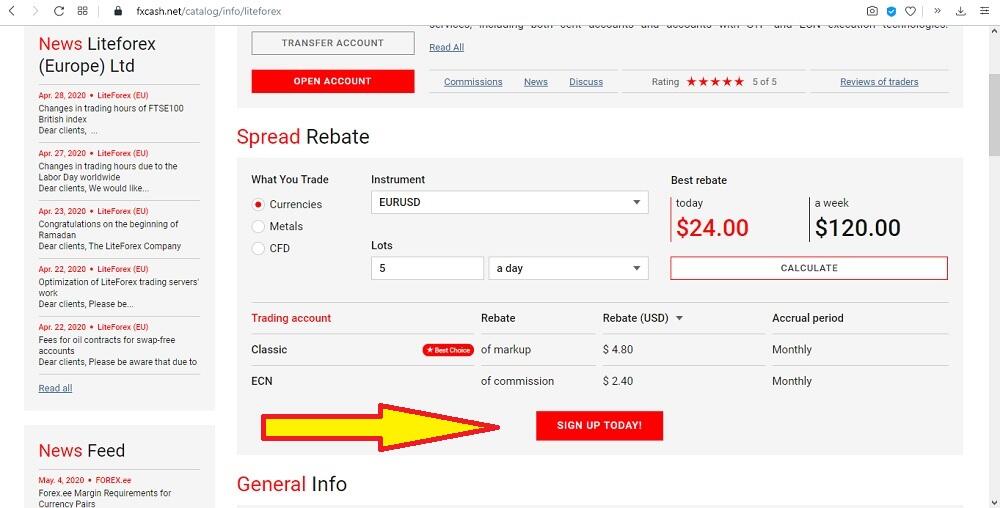
You can learn more about the rebate provided by LiteFinance and FxCash here.
Step 2. Enter your Email and phone number on the registration page. You will receive an SMS code to your phone number. Enter the code, and you will receive a letter to your email with a link to follow and confirm your account activation. You can also restore your forgotten password via email.
Step 3. Find LiteFinance on the left menu and follow the link.
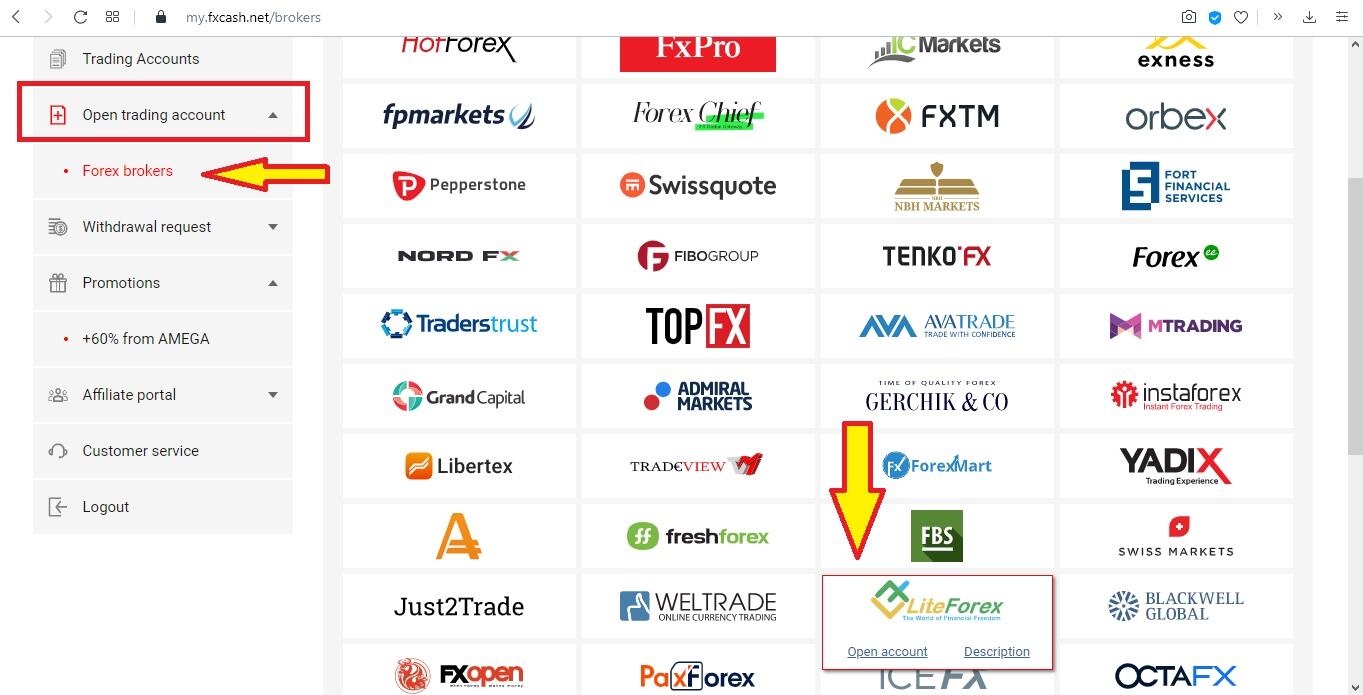
Open a real trading account on the LiteFinance website. Next, you should go through the verification both with the LiteFinance, and the FxCash. I won’t describe the procedure here, you should simply follow the instructions.
Step 4. Enter the number of the trading account opened with the LiteFinance in the “Trading accounts” section.
That’s it. Now your LiteFinance trading account is attached to the rebate service personal profile. You will receive the rebate to your trading account if you actively trade.
You can add any number of accounts; the frequency of payments depends on each account’s conditions (daily, rebate, weekly, monthly). You withdraw the money through payment systems. There is a daily withdrawal limit if you are not verified.
Conclusion.
Rebate is an opportunity for a trader to partially compensate for trading costs. You shouldn’t expect to rebate large funds, but partial compensation of costs is better than nothing. I don’t risk anything when you sign up on a rebate website.
The only dilemma is which rebate to select: rebate from the broker or from a different service. If you still have questions or need help with calculation/choosing a service, write in the comments!
Price chart of EURUSD in real time mode

The content of this article reflects the author’s opinion and does not necessarily reflect the official position of LiteFinance broker. The material published on this page is provided for informational purposes only and should not be considered as the provision of investment advice for the purposes of Directive 2014/65/EU.
According to copyright law, this article is considered intellectual property, which includes a prohibition on copying and distributing it without consent.