Planning is the basis for achieving goals; the absence of a written trading plan leads to chaos and losses. If a person does not have a clear algorithm of actions and does not know how to act in a particular situation, they will hardly achieve their goals. The aim of investment planning is to develop a course of action that will help one get the desired result as quickly as possible with the minimum losses, risk level, or costs.
The article covers the following subjects:
Major Takeaways
- An investment plan defines your investment goals and time horizons, as well as your strategy and acceptable level of risk.
- Clear rules can help you avoid emotional decisions and act consistently.
- The plan should cover the selection of investment instruments, the amount of capital allocated, and risk management principles.
- Regularly reviewing investment performance allows you to adjust your strategy in a timely manner.
- Beginners are advised to start with straightforward investment instruments and avoid investing funds whose loss could significantly affect their financial situation.
- An investment plan is useful for both long-term investing and active trading in financial markets.
What Are Investment Plans?
A personal investment plan is a document that defines the investor's strategic financial goals and the algorithm for achieving them. This is an individual investment path that can be adjusted and refined as goals are achieved.
Go through the following steps to make up your trading plans:
- Define your goals. What are your trading plans and goals? An investment plan should have a global goal and local, intermediate ones. Intermediate targets are needed to control and analyze the result. The strategic goal is achieved in stages, and at each stage, you should ask yourself if everything is going according to plan. Do you need to change or adjust anything? Goals can mean reaching a certain level of consistent profitability, gaining experience, etc.
- Determine the time horizon. What is your time horizon? You need to understand when your goal will be achieved, whether it is long-term or short-term.
- Assess your current financial situation. What tools will you use? What strategies will you employ? What start-up capital do you need to achieve the goal?
- Determine your maximum risk tolerance. What is the potential risk level and how to reduce it? The trading plan should consider possible roadblocks and ways to solve them, as well as actions in case of force majeure.
If you need, you can supplement and change the structure of your investment plan.

How to Make Your Personal Investment Plan?
A personal investment and trading plan is a kind of road map that includes several points:
- Various combinations of risk and money management techniques that allow you to predict an unpleasant situation, avoid it, or exit with minimal losses. It is not necessary to strictly follow established or classical entry rules and exit rules, the risk of losing money can be justified. It is important to be flexible and understand possible consequences.
- If you deviate from the planned strategy or reevaluate targets, you should develop an extended plan. In theory, you should test a strategy on a demo account with default settings before launching it in real Forex trading. Most trading platforms have built-in testers. If the actual result is different from testing statistics, you should decide what to do next. For example, you can exit the Forex market, optimize the strategy, or rebalance your portfolio.
- Reliable sources of information.
- Behavior strategies in different emotional states, ways to control your emotions.
- Actions in case of force majeure.
All these points are obvious, although many people ignore them. A lack of a plan becomes a reason for mistakes made because of poor self-management and panic.

Define Goals
A clearly defined and measurable goal is already half the battle. Once you understand what you want to achieve and by when, you can develop a step-by-step plan for reaching it. You may have several related goals that form a sequence, with each one bringing you closer to the ultimate objective.
Types of investment goals:
- Primary and associated.
- General and particular. General goals are relevant for all investors. Particular targets are personal and serve to solve the problems of each particular investor.
- Tangible and intangible. A tangible objective is financially consistent profitability. Intangible ones are experience, satisfaction, interest, and so on.
- Strategic and tactical. Strategic goals are long-term. Tactical targets are short-term.
Examples of investment planning goals include increasing personal capital, creating a financial cushion, improving your standard of living, passive income, pension, retirement pay, knowledge, and experience to share with others, and so on.
Note! Money itself can’t be a goal. It is a tool that helps you gain the freedom of action. The goal could be making money to buy something or invest in something. It is wrong to focus on only making big profits, money must work.

Understand Your Current Financial Situation
Your financial targets must be real. If the average yield on financial indices is 50% per annum and you want to earn $2,000 over the same period, your deposit should be no less than $4,000. You should also understand that the actual return could be less or your Forex (foreign exchange) trading investment will yield a loss. Invest only the money that you can lose without suffering. You must not use borrowed money in Forex trading, I mean bank loans, you can use leveraged Forex trades or debt derivatives.
Determine Your Risk Tolerance
The maximum investment risk is the amount an investor is prepared to lose due to an inaccurate forecast or other unfavorable factors.
Types of investment risks:
- Economic risks. They are associated with macroeconomic risks, individual economies, and companies.
- Operational risks. They are associated with the relationship between the participants in the transaction, the storage of assets, etc.
- Legal risks. They are associated with changes in laws. These risks also include political risks.
- Social risks. They are associated with different behavioral factors, actions of Forex market makers, etc.
The major investment risk is currency risk, the risk of losing trades because of a movement in the exchange rate due to economic, legal, or social reasons.

Decide What to Invest in
In addition to the classic options (bank deposit, gold, mutual funds, real estate), there are also exchange and over-the-counter markets. Exchange market assets: stocks, bonds, ETFs, futures for oil, gold, currencies, etc. The disadvantage of trading these assets is the high entry threshold and exchange fees.
In over-the-counter markets, Contracts for Difference (CFDs) are traded. For example:
- Major currency pairs, including USD. For instance, EURUSD, USDJPY, GBPUSD, and so on.
- Commodities, such as oil, gold, and other precious metals.
- Cross rates are the currency pairs that do not include the USD, for example, NZDCAD, AUDNZD.
- Stock assets, such as US stock indexes, European indices, and stocks of world’s companies, including blue chips.
- Cryptocurrencies.
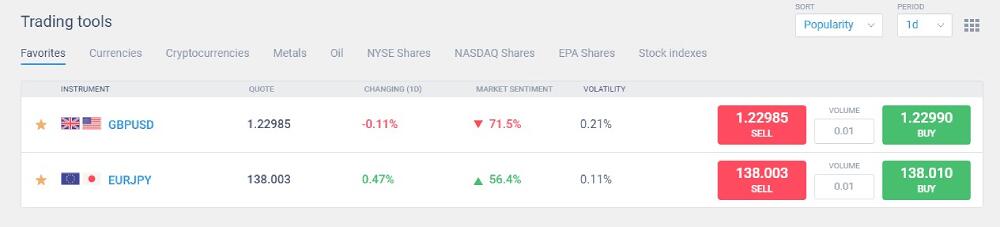
You can learn about the OTC markets from the article Forex basics for beginners.
If you don't want to study the peculiarities of active trading, you could take advantage of social trading. In social trading, the investor's account is attached to the account of an active trader, and all trades are copied automatically.
Advantages of social trading:
- The investor sets the social trading parameters of risk control. Much risk means high profit. Actual trading is carried out by the trader, who charges a commission for profitable trades.
- The investor can watch the trading process, and get experience.
- Social trading is a kind of money management but the investor's money is controlled solely by the investor.
You can find the answers to the questions about social trading in the FAQ section.
Monitor Your Progress
Set a major goal and break it into intermediate steps. Systematically evaluate intermediate results and adjust the basic plan as needed.
Tools for monitoring and self-control of results:
- Trader diaries or trade journals. They are software that allows you to record and analyze trading results. The intermediate market analysis allows you to find errors and correct further actions.
- Mobile apps. They are mobile versions of Forex trading platforms. If you are not next to your computer right now, set alerts on the desktop platform, and they will remind you to check your intermediate results.
- Excel. Any spreadsheet editor will allow you to group data and make a comparative Forex market analysis of Forex trading performance.
The key to success in achieving the goal is discipline and self-confidence.
Best Strategy for Forex Investment Planning
The basis of a Forex currency pairs investment plan is an investment strategy. It defines the algorithm of actions to achieve the goal. A trading system must answer the following questions:
- What is the current Forex market situation?
- What can happen in the Forex market in a particular period?
- How can you use this information and make a forecast?
When developing an investment plan, a trader should consider the following points:
- Which Forex trading asset best suits your personal preferences. Consider volatility level, spread, need for leverage, etc.
- What risk management parameters are suitable for the trading system. Risk level per one trade and overall risk level (acceptable stop length), optimal trade size, Martingale ratio application, etc.
- What Forex trading technical tools, fundamental analysis instruments, price chart types, and timeframes you will apply.
- Forex trading entry and exit signals. Actions in case of force majeure.
Types of investment strategies:
- Scalping Forex trading. High-frequency trading in short-term timeframes.
- Swing-trading. It is trading on corrections, suggesting entering trades in the trend direction at the best prices when the correction finishes. You can read more in the article devoted to Swing Trading.
- Intraday trading. It is speculative trading using the most liquid assets that are moderately volatile with tight spreads.
- Medium- and long-term strategies. The aim is to make profits on strong price movements. Trades are held for a few days, weeks, or months.
- Investment portfolio management. For example, you can invest in professional traders via social trading platforms. An investor forms a portfolio of the accounts of Forex traders who employ various strategies for risk diversification and attaches the investor’s account to them. Trades are copied automatically. You can read more in the article Forex PAMM vs Social Trading. What do investors choose PAMM accounts or social trading?
If you have your own original financial trading plan or strategy, share it in the comments.

Explore and Follow Trends
There are three basic trading strategies :
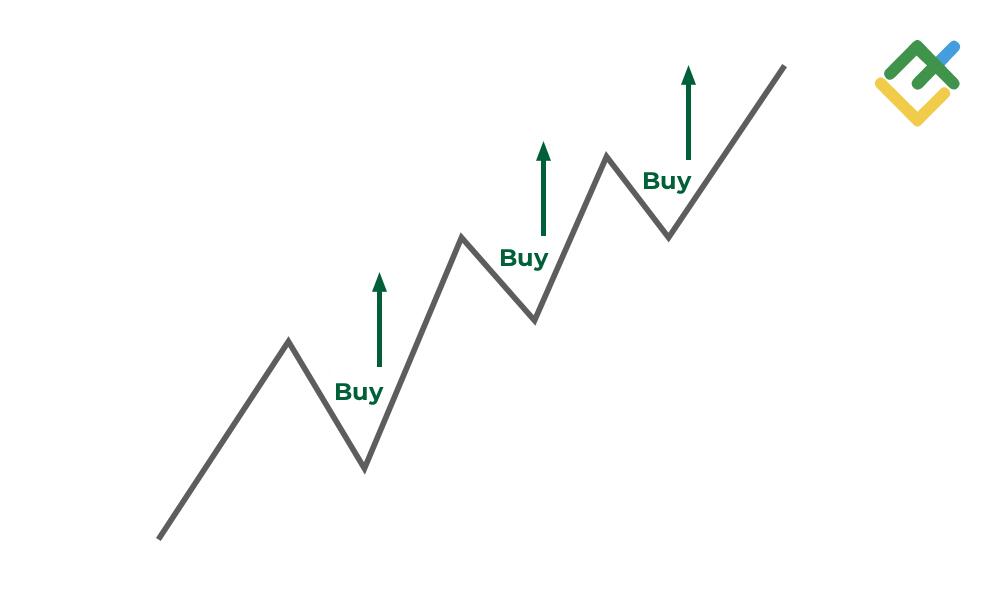
1. Trend following Forex trading plan. One identifies the trend start and spot corrections. Major tools are Elliott wave analysis, Fibonacci levels, and oscillators.
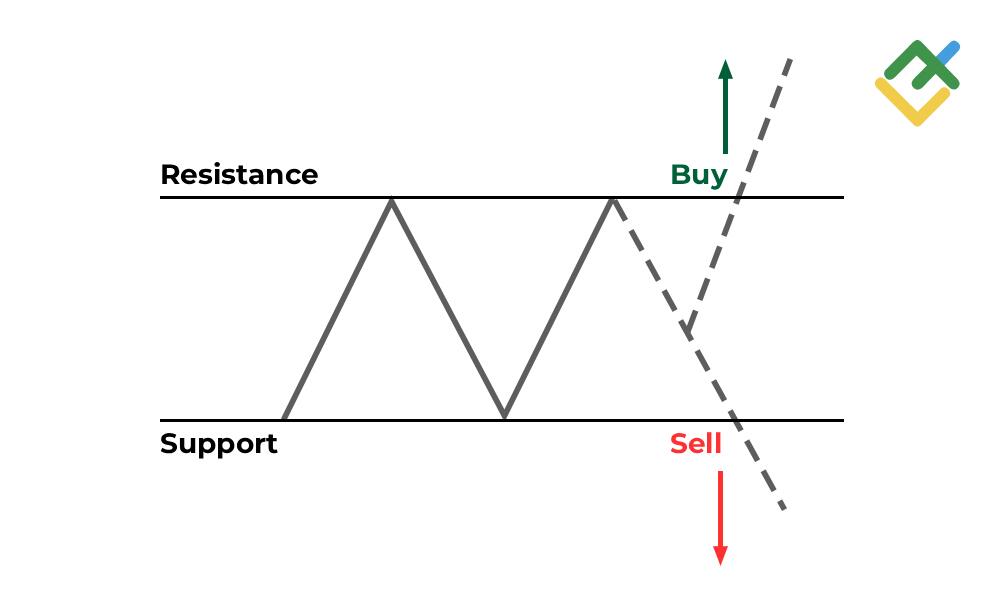
2. Support/resistance level breakouts. The trend direction doesn't matter. You enter Forex trading when the price breaks out a strong level and starts a strong movement. You can use charting tools, price action patterns, and trend indicators.
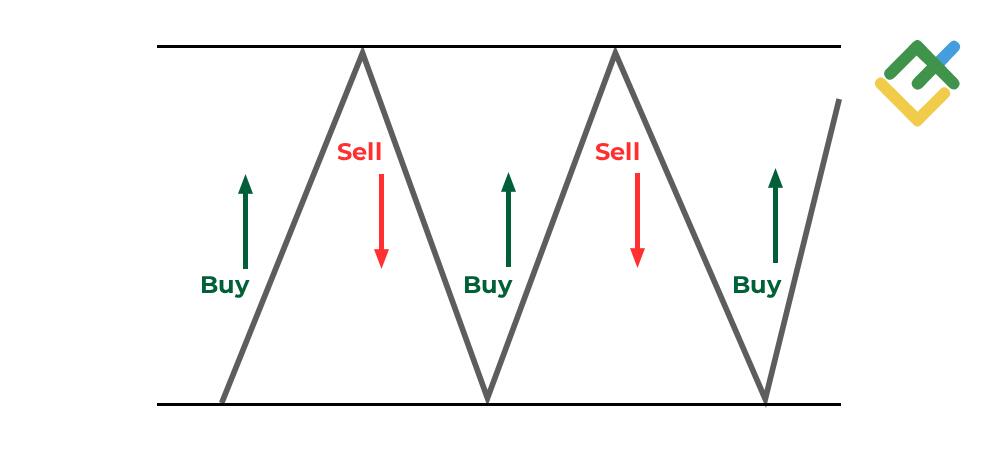
3. Channel Forex trading. The strategy is based on the idea that the price always tends to its average value. The broader the channel, the more chance to make a profit. Main tools are levels and channel indicators.
The best Forex strategy for newbies, in my opinion, is long-term Forex trend trading when you enter a trade at the beginning of the trend. First, you analyze long-term time frames, daily and weekly. You should spot the moment when the price exits flat and starts trending. Read more in the article about Trend vs Flat.
Carry Trade
A carry investment plan suggests borrowing a lower-value asset and investing in a high-interest rate asset. For instance, you take a bank loan at 3% per annum and invest in stocks with a yield of 8% per annum. Your profit is 5%. Similarly with currencies: a loan is taken in a low-interest rate currency and invested in a currency with a higher interest rate.
Forex carry trading involves several steps:
- Study the currency pair's specifications in the trading platform. You need to find the one for which there is a positive swap for a short or long position. The trade is opened only in the direction of a positive swap (long or short).
- Analyze the long-term trend. The aim is to break even and protect the trade with a stop loss at the entry level. A carry trade involves adding a positive swap to your account daily. The longer the position stays open without being stopped out, the greater your profit will be. Therefore, do not trade pairs with high volatility and look for an uptrend on the H4-D1 time frame or higher.
Advantages of carry trading:
Relatively low investment risk. If the price has advanced from the entry level so much that a stop can be set at breakeven, the trade is risk-free. Don't forget about the spread.
Daily income as long as central banks' interest rates do not change.
You do not need to monitor the chart all the time if the trade is protected with a stop-loss order.
Drawbacks of carry investment plan:
- Relatively low yield. To increase the profit from your trading plan, you need the maximum leverage. It increases risks in the beginning.
- Small choice of assets. The swap is negative for almost all currency pairs.
You can read more about carrying trading plan in the article What is Carry Trade and How does It Work?
Day Trading
A day trading investment plan, or intraday trading, is a strategy that suggests entering and exiting trades within the same broker session.
Typical features of a day Forex trading plan:
- You trade in short- and medium-term time frames M30-H1.
- Currency pairs are more suitable than stocks or commodity market assets. Currencies move up and down within the channel, and one could go both long and short.
- The most common tools for day trading plans are channel and trend indicators, support/resistance levels, and patterns.
A day Forex trading plan doesn't suggest applying long-term strategies, but it is good for training, as it teaches beginners and other traders to take responsibility for their actions.
Advantages of day trading:
- No swap.
- You have time to analyze the chart before making trading decisions.
Sometimes scalping, high-frequency trading in M5-M15, is referred to as intraday trading. I do not recommend scalping to beginners. If you want to include it in your investment plan, read the article devoted to Forex Scalping.
Drawbacks of an intraday trading plan:
- You need to monitor the chart from time to time.
- For earnings corresponding to the average income for the region, a large deposit or leverage must be involved in the transaction, which increases the risks. You also need to take the time to look for multiple signals.

Fundamental Investing
Fundamental trading plans suggest entering a trade on the release of important economic news or reports. The tools of fundamental strategies are the economic calendar, market sentiment, financial reporting calendar, screeners, compounding calculator, and so on.
Advantages of fundamental trading:
- It is suitable for long-term trading plans. Fundamental analysis allows forecasting long-term macroeconomic trends and prospects of individual economies or companies.
- Fundamental analysis considers market psychology, so it predicts market moves more accurately.
Fundamental trading plans work better in the stock market. For example, one could buy a company's stocks following a positive financial report.
Drawbacks of fundamental analysis:
- In the short term, the publication of news and reports can increase volatility and slippage. Trades could be exited with a stop loss, so news trading is considered a risky strategy.
- You need good analytical skills. You should define the trend direction and also consider the forecast.
Fundamental Forex trading plans are more suitable for most traders with professional skills. Beginners should exit all trades at the moments of important news releases. You can read more in the article about What is fundamental analysis.
Conclusion
A beginner investor should know:
- Do not try to invest if you have no trading plan. A lack of a trading system will result in losses.
- An investment plan is based on the target profit, timing, strategies and tools, investment object and deposit, and risk management.
- An investment plan should be divided into several stages, and intermediate targets should be defined. When you complete a stage, you should assess the strengths and weaknesses and decide what to change. An investment plan could be corrected and adjusted.
The best Forex investment is an investment in your knowledge. Set goals, gain experience, don't give up, and luck will surely smile at you. Successful investment!
Forex Investment Plan FAQs
Beginners are better off starting with straightforward investment instruments whose price movements are easier to understand. Before purchasing any assets, it is important to establish an investment plan, assess your risk tolerance, and avoid investing funds you cannot afford to lose.
Yes, most beginners consider Forex riskier than investing in stocks due to its high volatility, leverage, and the need to monitor the market closely. Stocks are generally better suited to long-term investing.
Forex traders' income depends on their experience, strategy, capital, and market conditions. Many traders do not earn a stable daily income, and periods of profit may alternate with losing streaks. Trading performance is best assessed over several months rather than over a single day or week.
A goal with a specific amount and date, a time horizon, a review of your income, expenses, and emergency fund, your risk tolerance as a percentage, and an asset allocation by class. Plus rebalancing rules, a contribution schedule, and an allowance for costs and taxes.

The content of this article reflects the author’s opinion and does not necessarily reflect the official position of LiteFinance broker. The material published on this page is provided for informational purposes only and should not be considered as the provision of investment advice for the purposes of Directive 2014/65/EU.
According to copyright law, this article is considered intellectual property, which includes a prohibition on copying and distributing it without consent.