Analysis of the prospects of cryptocurrency technologies: problems and capacity
What is the future of cryptocurrency? Someone sincerely believes in the price of the BTC rising to $100,000, although why it’s about price prospects, and not technology, is a rhetorical question. It is also unclear how to calculate the real cost of a cryptocurrency, if not a single startup is working properly, which means that it is impossible to evaluate the economic effect from investments. Someone thinks cryptocurrency another pyramid, and partly it is so. If we draw an analogy with the collapse of the dot-coms, one can see a lot in common, though it confirms the fact that blockchain has some future. The technology itself has, the future a particular cryptocurrency remains a question. I propose to reflect on this subject.
Is there a future for cryptocurrencies?
“Is there a future for computers and the Internet?”, “Is there a future for dot-coms”? “Is there a future for cryptocurrencies?” All these questions have a lot in common. Computer and cryptocurrency technologies began to emerge long before they reached the peak of popularity. Similarly, they had supporters and skeptics, their ups and downs, change of leaders and directions of development. At the dawn of the Internet, the idea of implementing the World Wide Web seemed impossible, likewise, the implementation of blockchain technology also seems impossible. And yet, despite the seemingly great prospects for cryptocurrencies (confirmed by the interest of large investors), there are many obstacles in front of them that make their success unclear.
I suggest in this subjective review try to answer the following questions:
- Cryptocurrency and dot-coms: what is common between technology markets.
- What prevents the development of cryptocurrency technology and whether there are ways to solve these problems.
- What can be useful cryptocurrency technology, if it ever works in full force.
- Will cryptocurrency replace fiat money?
- Is there a future for cryptocurrency and blockchain.
Cryptocurrencies and blockchain: advanced technology or bubble of the decade?
An interesting fact: in many sources, analysts, answering the question about the future of cryptocurrency, for some reason try to predict the price. But it is logical that the price directly depends on how interesting, applicable in practice and integrated into everyday life blockchain technology can become. Therefore, the practical significance of this technology depends on how secure, understandable, convenient, safe, inexpensive it will be. Take, for example, Bitcoin or Ripple. These are payment systems with their own unique technologies that have been in existence for more than a year. And yet they still cannot compete with either Visa or MasterCard, or electronic wallets, or SWIFT.
Cryptocurrencies and dot-coms
Cryptocurrencies are often compared with tulip fever, drawing an analogy between two assets, the price of which grew like an avalanche and eventually collapsed. This analogy seems to me to be wrong: at the base of both “pyramids” lie fundamentally different assets.
If the price of a tulip bulb grew in price due to demand while it remained an ordinary bulb (the physical properties of an asset remained unchanged), then cryptocurrency is an asset that is improving every year. No one can yet calculate the economic effect of the introduction of technology and therefore it is impossible to say which price should be equilibrium. The market capitalization of cryptocurrency is growing not only because there is demand, but also from investors' expectations that blockchain will become a new global technological breakthrough.
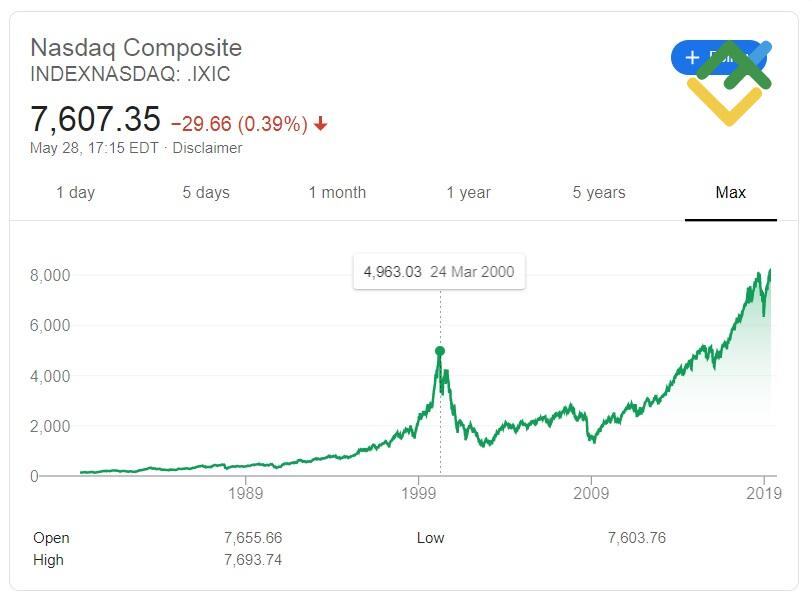
The dot-com bubble began to form in 1995. The growing popularity of the Internet at that time led to the creation of hundreds of Internet companies that offered to use it as a tool for marketing, commerce and, ultimately, income. It was a kind of innovative idea – to transfer real business to the Internet, thereby reducing costs and increasing the reach of the audience. It turned out to be so convincing that even world-famous corporations got carried away with it, singling out a separate budget for the development of this area. The end came in March 2000.

The reasons for the dot-com crash include the following:
- Substitution of concepts. The Internet is a tool for carrying out a business process, but it cannot be the business model itself. In other words, the Internet is an auxiliary tool that simplifies and cheapens communications. Start-up developers actively promoted the idea of Internet companies as an independent business. The result is logical: the lack of return showed unprofitable investments and the pyramid collapsed. Are there many startups among more than 2000 cryptocurrencies that are now able to start giving profit?
- Revaluation of existing Internet technology, inconsistency of practical results with expectations, which led to an overestimation.
- Uncontrolled speculation and fraud (improper use of funds of investors). The dot-coms involved Citigroup, Merrill Lynch, Cisco, JDS, WorldCom (the company whose bankruptcy turned out to be the third largest in US history).
It is worth noting that despite the collapse of the NASDAQ index, now the Internet is used exactly as the 1995-2000 model suggested. On the wreckage of the dot-coms, Amazon, eBay, and other companies that actually implemented the idea of moving commerce to the Internet grew up.
Something similar is now observed in the world of cryptocurrency. The emerging blockchain technology, like the Internet for 1995, is something new, raw and incomprehensible as applicable. More precisely, there are ideas of application and large corporations are still involved in the cryptocurrency world, the price is still growing like an avalanche and there are still hundreds of dummy start-ups that will disappear as many start-ups disappeared in the year 2000.
Based on the experience of 2000, it can be assumed that in the future cryptocurrency technology will still be in demand, but for this to happen a fundamental structural reformatting of the market should occur. And the decrease in capitalization by 80% in January 2018 is not such an adjustment.
And the main question: is cryptocurrency technology not overpriced as dot-coms were? Maybe blockchain is no better than Excel or a regular database? How to determine the real cost of a cryptocurrency startup, if none of them is fully functional, does not show economic efficiency and the price is formed only due to the cost of mining (for the ones that have it) and supply/demand? Selected questions: what stablecoins are and how they work is described in more detail in this review.
What prevents the cryptocurrency market from becoming full-fledged and what prevents its integration into everyday life:
1. Many fans of easy money. Why develop your own platform and look for professionals, if you can hire programmers who will make a shell, then invest as much money in marketing, make a profit and abandon the project? It is logical that in this situation the label of the pyramid was fixed upon cryptocurrencies.
2. Legislation. More precisely, its absence. Cryptocurrencies are a radically different area requiring appropriate rules. In the meantime, society is trying to fit them under existing legislation, which is a priori impossible. Therefore, some countries have taken the path of least resistance: what cannot be settled and controlled should be prohibited. It's easier.
3. Anonymity. The strength of the cryptocurrency is its weakness. Until the middle ground is found, which allows to control financial flows, until the issues of taxation and financing of prohibited operations are resolved, the future of cryptocurrencies remains vague.
4. Technical problems. Decentralization, transaction security, and the inability to interfere with blockchains in theory should have been the main advantages of cryptocurrencies. Some interesting facts:
- Ethereum Classic separated from Ethereum after disagreements had arisen in the platform team and the idea was proposed to roll back transactions. This was the first precedent that showed that blockchain data could be rolled back manually.
- Some of the top 30 cryptocurrencies have a company that leads them. For example, Ripple, IOTA. What kind of decentralization are we talking about?
- In the entire history of cryptocurrency, the amount of money stolen from exchanges amounted to $1.35 billion. 59% of this amount was stolen during 2018. For the first 4 months of 2019, about $ 69 million has already been stolen.
- After the death of the owner of the QuadrigaCX exchange, access to almost 26.5 thousand BTC coins, 1 billion XRP, 429 thousand ETH, 200 thousand LTC was lost. In early 2018, cryptocurrency billionaire Matthew Mellon died, access to XRP in the amount of about $500 million was lost forever. And it's not so much about money, as that the access to the coins the amount of which is limited is lost. This problem has not been solved yet.
Also, technical problems include scaling problems, non-observance of development dates and updates provided by the roadmap, etc.
5. Lack of awareness of people, mistrust, doubt. People simply do not know about cryptocurrencies. Or, if they heard, they couldn’t understand/didn’t want to the essence of the technology and labeled them yet another pyramid. Society has always opposed the scientific and technical progress, so this fact is not surprising. One can fix it. We need to show people the practical importance and usefulness of the technology, but how many years it will take to do this?
Crypto has been around for 12 years and it still has not found widespread practical application.
But it is not all that bad. As in the case of dot-coms, cryptocurrency is interesting to many institutional investors and corporations. Many of them could not find anything interesting among the existing proposals and preferred to develop their own system based on blockchain. Some interesting examples:
- In 2015, one of the first to turn to cryptocurrency technology was Citibank. Then cryptocurrencies was not so popular, so the developers of the bank decided to create their own internal payment system on blockchain in order to simplify the conduct of clearing, factoring and other transactions. Unfortunately, there is no information about the bank’s success in this direction.
- In 2019, the American bank JPMorgan announced the creation of the JPM Coin, a stablecoin with reference to the US dollar. The goal is to accelerate operations in the B2B segment. When will it be tested is still unknown.
- Further in February 2019, one of the largest Spanish banks, BBVA, went on to issue the first bond on its own blockchain platform. Issued in the amount of 35 million euros for a period of 6 years, it was transferred to the insurance company Mapfre, under the terms of the smart contract, the investment will be directed to financing environmental projects supported by the bank. Two months earlier, in December, the bank issued its first loan of 150 million euros using blockchain.
- Jaguar Land Rover became interested in IOTA technology in April 2019 and is now testing platform-based smart contracts. It is assumed that the program developed on blockchain will be a smart wallet embedded in cars. With the help of the service, drivers will be able to transmit information about the condition of roads and their load. In return, they will receive tokens that can be spent on charging electric vehicles (there is no information about gasoline).
- In May 2019, it was reported that Facebook was developing a new payment system and its own stablecoin. No details available here.
For some large corporations, blockchain is no longer the future, but the present. Amazon offers blockchain tools to companies that don’t want to develop distributed systems themselves. Among the clients of the corporation are medical companies where blockchain is used to manage payments between hospitals, clients and insurance companies.
Anheuser-Busch InBev, one of the largest brewing companies in the world from Belgium, takes part in a project where clients of the company download data to blockchain, after which they can make purchases by scanning the phone. The project aims to develop business in Africa where local farmers do not have bank accounts.
BP plc (formerly British Petroleum) is one of the founders of the Vakt blockchain platform, the task of which is to digitize contracting and billing to speed up the processes. Investments amounted to more than $20 million.
Cargill (US agricultural giant) in 2017 began working with Intel, whose blockchain technology allows us to track the product’s path to its source. An interesting idea for those who are interested in organic products. A similar platform is being developed by Nestle. Diseases transmitted by products annually cost the US $55 billion, not counting brand reputation risk. Tracing the origin of ingredients (especially those used in the production of food for children) will in theory reduce costs and become a competitive advantage.
There is also investing in blockchains of Google, Microsoft, Siemens, UBS, Visa, Walmart.
Cryptocurrency is only a tool for making transactions and transferring information within the network. The main value is blockchain-environment in which all these communications take place. Its scope is all that surrounds us and what can be translated into digital technology:
- Instant exchange of information, wherever the counterparties are located.
- Database storage without the need for servicing bulky servers.
- Providing all kinds of services, ranging from the provision of audio, video, software content, ending with all sorts of informational assistance, trade.
- Maintenance of a business model. Document circulation, financial, business communications within the company can be built on blockchain. Dropbox and other similar services will be a thing of the past, remote work will become even more efficient.
- Introduction of remote control systems ("Internet of Things"), the collection of statistical data.
And one of the most frequent questions regarding the use of cryptocurrency: can it replace future fiat currencies. In my opinion, this is unlikely for several reasons:
- The problem of emission and money supply. Almost all cryptocurrencies have a limited emission, that is, their number cannot exceed the predetermined amount. In the real economy, emissions are a tool for stimulating, covering the deficit and managing the money supply, which in turn allows you to control the price level. Unmanaged emission of cryptocurrencies will not be able to perform this function.
- The problem of centralization. Fiat money is controlled by Central Banks. Supporters of cryptocurrency carry out the following analogy: once the Internet has deprived the monopoly of the telephone industry, that means that the cryptocurrency can deprive the same monopoly of banks. I do not agree. First, not a single Central Bank, for which currency is a tool for managing the economy, will not take such a step. Secondly, the Internet has no owner, the cryptocurrency has it and is quite real. The only possible compromise – the developer and controlling blockchain owner will be the Central Bank itself.
- The problem of backing. Fiat currencies are backed by the country's obligations to sell real assets for it. If assets are scarce, devaluation occurs. Cryptocurrencies are not backed by anything.
- The problem of availability of technology in underdeveloped countries. African countries or, for example, India are unlikely to be able to switch to calculations in cryptocurrency. And I doubt that in such countries cryptocurrency will work with fiat money simultaneously.
After the complete depreciation of the national currency in Venezuela, they decided to switch to a controlled cryptocurrency. It is rather a curious exception, which has not resolved the problem of the country. Another exception is Japan, which recognized the BTC in 2017 as a means of payment, but the yen is still the national currency.
By the way, here I would like to draw attention to an interesting idea: the money of the Mt.Gox exchange (one of the largest bankruptcies of the cryptocurrency history) is in the hands of the Japanese manager, who may well influence the market in the needed direction. Another interesting idea was expressed in 2017 by investor and hedge fund manager James Altusher: in his opinion, the United States has long been buying secret cryptocurrency for a long time in the hope of taking control of the cryptocurrency market in the future.
I will try to formulate what the future of cryptocurrency depends on and what stages of technology development I see.
The future of cryptocurrency depends on:
- Interaction of representatives of the cryptocurrency community and public authorities. A positive example is the policy of China, where the cryptocurrency space for entrepreneurship NEO is created in partnership with the regulator.
- Real evaluation of the possibilities opened up using blockchain. And while with this big questions.
Is there a future for cryptocurrency? Generally speaking, there is. More precisely, the future is not cryptocurrencies themselves, but blockchain technology, which gradually integrates into the existing system of communications and economics. I see several stages in the development of a cryptocurrency system:
1. Forming a speculative demand. Some statistics:
From January to May 2019, the market has been replenished with more than 150 new cryptocurrency projects, which, only those in the CoinMarketCup rating (the rest should not be counted), are now just over 2,200.
In 2018, more than 1,000 platforms ceased to exist. In 60% of cases, the reason is the loss of interest in the project, about 20% is fraud, 20% are other reasons. Learn more about the reasons for each startup described here: deadcoins.com.
According to a study by the Invest in Blockchain analytical website, conducted in the second half of 2018, only 36 of the TOP-100 cryptocurrencies have a working product that has material value. By working product, we mean an actively used application available in the alpha version (beta testing is not taken into account) and having at least one update. From cryptocurrency below TOP-100, less than 10% of startups have a working application.
Now cryptocurrencies are of purely speculative interest, fueled by volatility of 3-10% per day. While you can make money on lovers of "free cheese" – while the new ICO and IEO are held, there will be pampas and hamsters hairstyle. For most developers, the goal is to “cut down the money,” as evidenced by the number of junk startups. Only when those willing to invest in the air decrease, will the transformation of the market begin. I think that this stage will last at least another 2-3 years.
2. Reformatting the market. Investors will become more prudent: non-working projects will disappear, working will finally be able to offer the company a working product. Something will happen that happened to dot-coms in due time – most of the platforms will disappear, but those that survive will be able to turn into the new Amazon or eBay.
At this stage, a constructive dialogue will begin between the developers, investors on the one hand, and representatives of the authorities and legislation on the other. The leadership of the countries, having seen the real possibilities of blockchain and the efficiency of the technology, will be forced to compromise. Separate legislation for cryptocurrency will be developed, jointly financed projects will appear.
For investors, cryptocurrencies will become a kind of analogue of gold: they will perform not only the role of an investment tool, but also the role of a link in blockchain (the role of digital money).
3. Integration. Gradually, payment systems based on blockchain will replace classical banking systems, various kinds of projects using cryptocurrencies will appear (electronic exchanges, the Internet of Things, etc.). Cryptocurrencies will cease to be something fantastic and will no longer be associated with deception and pyramids. They will not be able to completely replace fiat money, only by becoming another investment tool and an auxiliary tool in the digital world.
Unfortunately, it is impossible to make a forecast about the price of cryptocurrency. It is safe to say that after the transformation of the market and equilibrium price will be established, but no one will say whether it will be higher than it is now, or, on the contrary, the market capitalization will decrease several times. But blockchain is the latest innovative technology, the development of which will not stop, especially considering how much money, resources and efforts have already been invested in it. So, we are on the threshold of a new technological era.
It will be interesting to hear the opinions of LiteFinance blog readers: how do you see the future of cryptocurrency and blockchain technology?
P.S. Did you like my article? Share it in social networks: it will be the best "thank you" :)
Useful links:
- I recommend trying to trade with a reliable broker here. The system allows you to trade by yourself or copy successful traders from all across the globe.
- Use my promo code BLOG to get a 50% deposit bonus on the LiteFinance platform. Simply enter this code in the appropriate field when funding your trading account.
- Telegram chat for traders: https://t.me/litefinancebrokerchat. We are sharing the signals and trading experience.
- Telegram channel with high-quality analytics, Forex reviews, training articles, and other useful things for traders https://t.me/litefinance
Price chart of BTCUSD in real time mode

The content of this article reflects the author’s opinion and does not necessarily reflect the official position of LiteFinance broker. The material published on this page is provided for informational purposes only and should not be considered as the provision of investment advice for the purposes of Directive 2014/65/EU.
According to copyright law, this article is considered intellectual property, which includes a prohibition on copying and distributing it without consent.