Forex IB commissions are payments that introducing brokers receive for referring traders to a broker. IBs do not handle trade execution themselves but focus on connecting traders with brokerage firms. Forex introducing broker commissions can take various forms, including rebates, one-time fixed payments, and a percentage of the markup.
For IBs, an affiliate program can be a source of passive or even primary income that can be pursued alongside trading. Meanwhile, referrals get cashback and free professional consultations.
This guide explains how IB commissions are calculated, what factors determine their amount, what affiliate programs exist, and which calculation models are most common in Forex.
The article covers the following subjects:
Major Takeaways
- An IB, or introducing broker, is a brokerage's partner who refers new traders, assists them, and provides advice. Their primary role is to train and support the clients they bring in. In return, the IB earns a commission from the broker.
- The terms for paying IB commissions are clearly set out in the IB agreement. For example, it may specify the minimum time a referred trader must hold a position or how commissions are calculated on hedged positions.
- The partner's commission depends on the asset type, the account, and the compensation model. Under CPA, the partner receives a one-time fixed payment for each referred client. Revenue Share pays a percentage of the broker's revenue, that is, the markup and the commissions paid by the trader. Rebate pays a fixed amount for each lot the referral trades. Hybrid models combine these approaches.
- Partners can build a multi-level network of sub-IBs. The broker then pays the partner a percentage of the revenue generated by the sub-IBs they referred.
- To be assigned to an IB, a trader must register through a referral link. The same applies to a sub-IB joining an IB. The link is available in the Client Profile section on the Forex broker's website.
How Forex IB Commissions Work
Every Forex broker aims to attract as many clients as possible. Regardless of the trading results, traders pay either a spread with a markup or a fixed commission.
A markup is a hidden charge that a broker adds on top of the price it receives from a liquidity provider. It can widen the spread or shift the asset price itself. With the spread, the chain looks like this:
- The broker receives quotes from the interbank market with the raw market spread.
- The broker adds a markup of a few pips to that spread.
- As a result, the trader sees a wider spread in the trading terminal.
The markup is one of the ways a Forex broker earns money for its brokerage services. The broker shares part of this revenue with those who bring in new clients, that is, introducing brokers (IBs).
How a Forex introducing broker program works:
- An IB registers on the broker's website. Their Client Profile includes a dedicated affiliate section with a referral link and free marketing tools for attracting traders.
- The IB then brings in traders who register with the Forex broker through that referral link. This is the only way a trader is assigned to the IB: without the link, no commission is paid.
- The trader opens positions and pays the spread. The broker collects the markup and shares part of it with the IB.
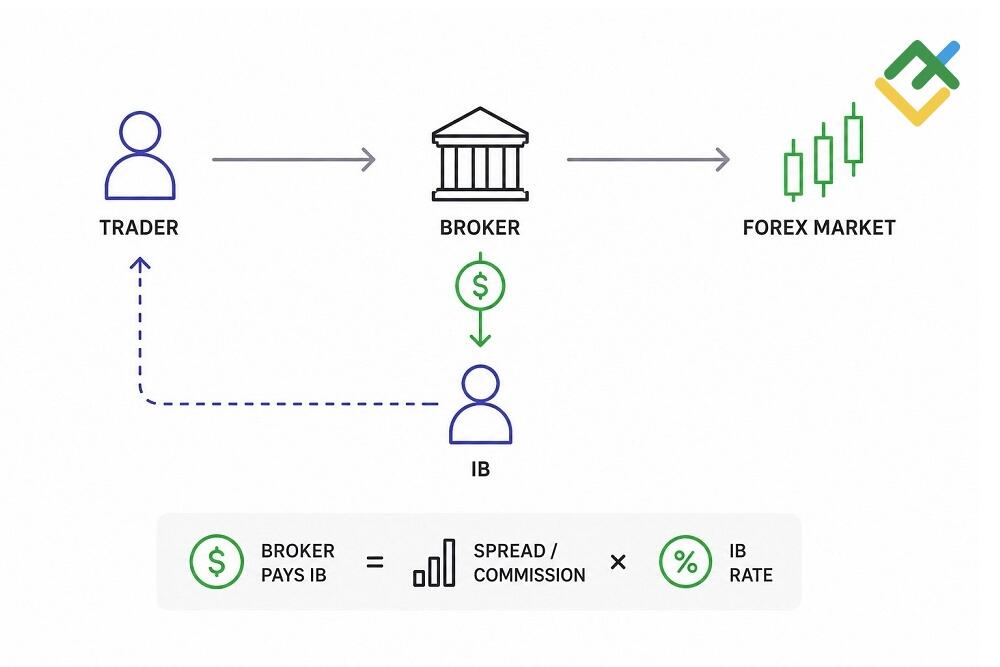
Example of how one IB program model works
Introducing brokers do best when their referred traders are active and profitable. A losing streak can push a trader to quit altogether, while a profitable one usually makes them trade more. Either way, it affects the IB's commission, assuming a percentage-based model.
Therefore, the primary role of an introducing broker is to provide individual support and advice to each attracted trader and to expand the broker's client base.
Who Actually Pays the IB Commission
IB commission in Forex is not free money from the broker. It is funded by the trading costs the end user, the trader, pays.
Important: A brokerage firm may set the same trading conditions for clients who sign up directly and for those who come through a referral link. Under such conditions, being referred does not mean paying a wider spread to cover the IB partner's commission. All traders pay the same spread.
In other words, all traders share the cost of IB commissions, including those who sign up with the broker directly. With the same trading conditions on both sides, direct registration can be less advantageous, as a referred trader also receives advisory support from the IB and can earn cashback from them.
Forex IB Commission Models Compared
An introducing broker may receive compensation based on various models, depending on the terms of the affiliate program. Let's take a look at the main commission structures:
CPA (Cost Per Action) or CPS is a fixed payment for each referred customer who meets the minimum requirements. These include registering, completing verification, making an initial deposit, and executing a minimum number of trades.
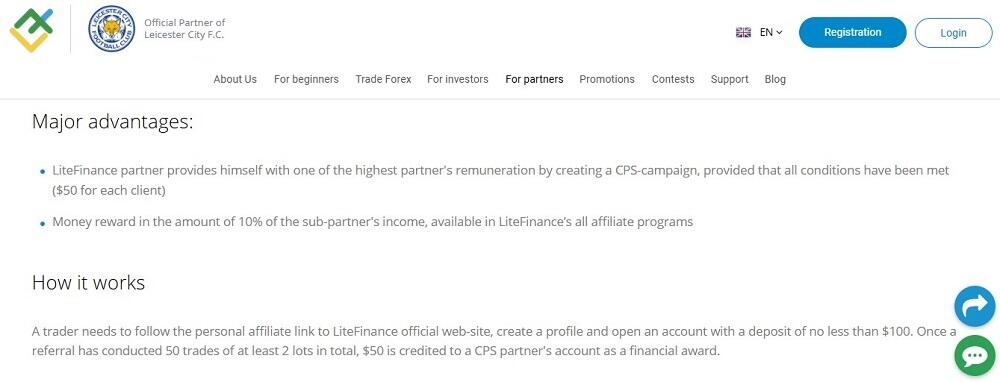
- RevShare, short for revenue share, is a classic long-term model under which an IB earns a percentage of the commissions or spread markup a referred client pays on every trade.
- CPL (Cost Per Lead) is a fixed payment for a registration or for a potential client's contact details, with no deposit required.
- Hybrid (hybrid commission model) is a mix of CPA and RevShare. The partner gets a small fixed amount for a deposit and then a percentage of what the client pays afterward.
- Tiered/Volume-Based (progressive model) is a structure where the payout grows once a client reaches a certain trading volume or another KPI. A base rate applies up to a set number of lots, and a higher rate applies above that threshold. This pushes IBs to bring in not just new clients, but clients who actually trade.
- Lot Rebate (payment per lot or volume) pays the IB a fixed amount for every lot a client trades, regardless of the spread the broker collects.
- Sub-IB (multi-level model) pays an IB for recruiting other partners, known as sub-brokers, and then shares a percentage of the revenue those partners generate.
The table below lists the main IB commission models. Let's compare them based on their key features.
Feature | CPA/CPS | RevShare | CPL | Hybrid | Lot Rebate |
What the IB is paid for | For a qualified client who meets the set conditions | For a share of the commissions or spread the client generates | For a lead, meaning a registration or contact details | For a qualified client plus a share of their later revenue | For every lot the referred client trades |
Payout format | Fixed amount | Percentage | Fixed amount | Fixed amount + percentage | Fixed amount |
Type of IB income | One-off | Recurring | One-off | Recurring + one-off | Recurring |
Speed of traffic monetization | Fast | Slow at first | Fast | Medium/slow | Medium |
Risk for the IB | The client may never meet the broker's conditions for a payout | The client may stop trading early | The lead may turn out to be low quality | Carries the risks of both CPA and RevShare | Clients may trade low volumes |
Main advantage | Fast and straightforward fixed monetization | High long-term earning potential | Lowest conversion barrier | Balance of fast and long-term income | Direct and transparent dependence on trading volume |
Main drawback | No extra income from very active traders | Hard to forecast income early on | Low rate and strict lead quality control | Complex calculation system | Dependence on clients' trading activity |
Rebate per Lot
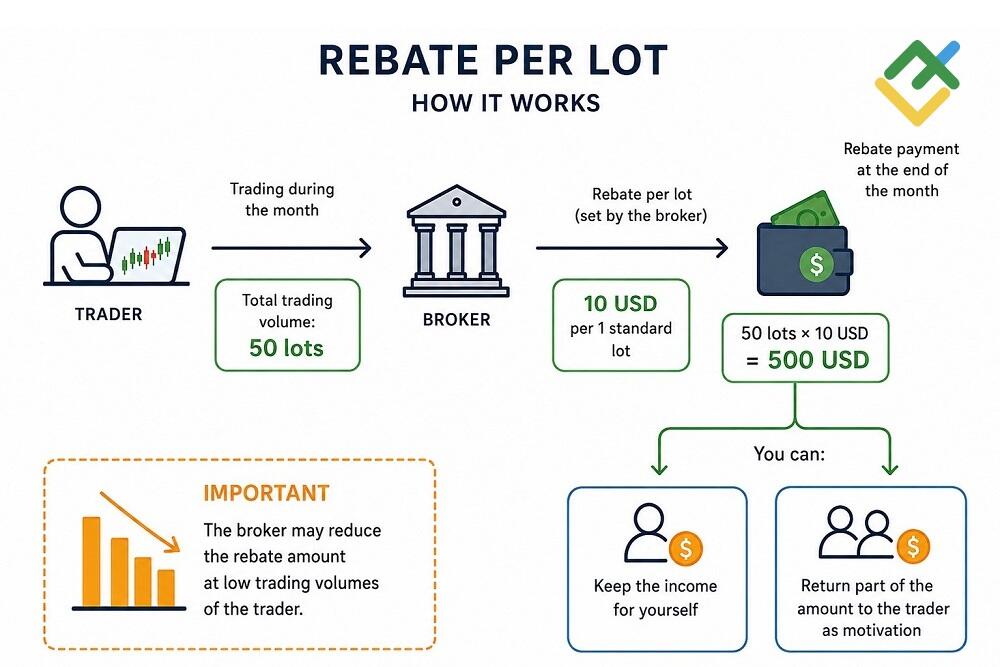
Rebate per Lot pays the IB a set amount for every lot the referred trader closes. The amount of the rebate is calculated based on the number of lots traded.
Example. A broker sets a rebate of $10 per standard lot. Over a month, a trader opens and closes positions totaling 50 lots, regardless of their profitability. At the end of the month, the broker pays 50 lots × $10 = $500. You can keep that income or return a part of it to the client to encourage more active trading. The broker may lower the rate per lot if the trader's volume stays low.
Revenue Share
Under the revenue share model, the IB earns a share of the broker's revenue from the traders they bring in. The amount of the commission depends on the traders' activity and the terms of the affiliate program.
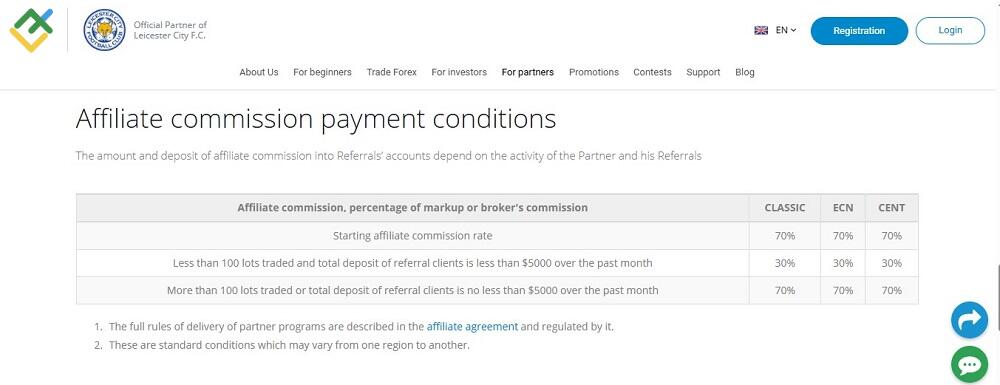
Example. This month, the clients you referred paid a total of $1,000 in commissions and markups. The program sets the rate for the first month at 70%, so you earn $700. If your referrals trade fewer than 100 lots next month and deposit less than $5,000, the rate drops to 30%. It goes back up to 70% as soon as they meet the conditions again.
CPA and Hybrid
With CPA, you are paid once for every referred trader who meets the minimum requirements. Say the trader has to deposit $500 or more and place at least 5 trades, each open for longer than five minutes. If they meet that, your reward will be $50.
In the hybrid model, the one-time payment is smaller, for example, $10. On top of that, you receive a percentage of the markup the trader pays.
Tiered Commission Structures: Master IB and Sub IB
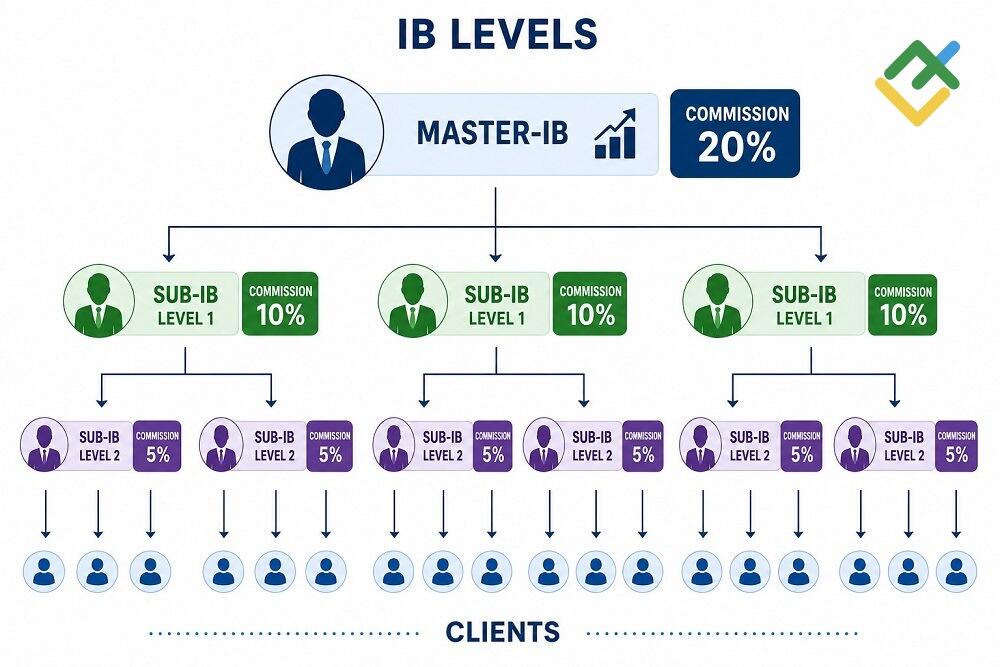
This is a multi-level model built for the financial markets. A master IB brings in not just end traders but other partners as well, known as sub-IBs, and earns a percentage of what those partners make.
The hierarchy is structured as follows:
- A master IB is a top-tier partner who builds their own network of sub-partners. The broker pays them the highest commission rate.
- A sub-IB is a partner who registers through a master IB's referral link. They bring in end traders, earn a base or average commission rate, and profit as long as those clients stay active.
- Clients (traders) trade and pay spreads and commissions. The broker draws on that money to pay everyone in the partner chain.
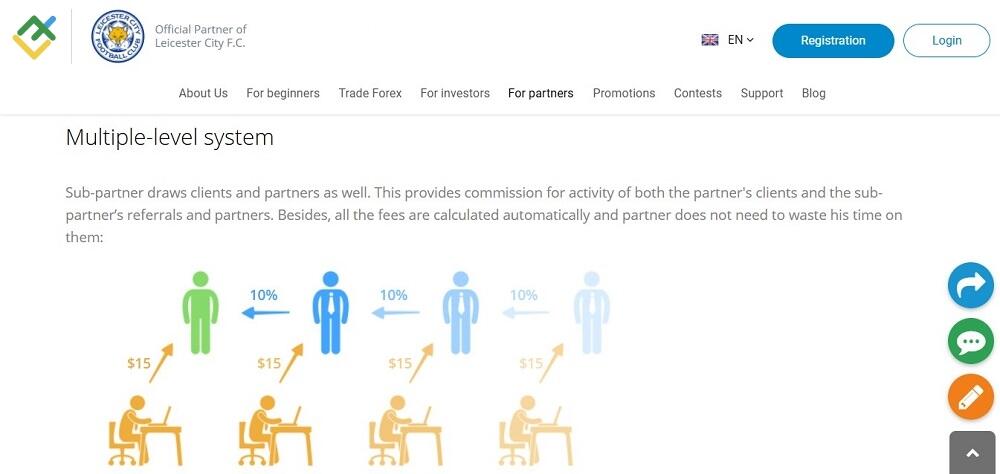
Example. Two sub-brokers each bring in 10 referrals and earn the maximum rate, $15 per referral based on trading volume. That gives each sub-broker $150. The master IB brought in no referrals directly, but both sub-brokers signed up through their link. The broker therefore pays the master IB 10% of the two sub-brokers' combined commission, which comes to $30.
How Much Do Forex IBs Actually Earn?
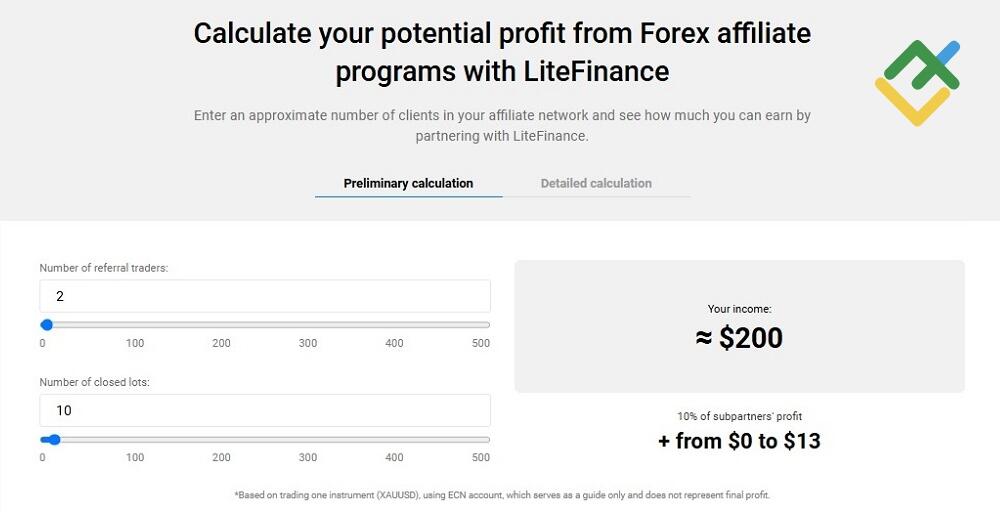
In theory, there is no upper limit on earnings. However, you can only increase your income by expanding your network of referrals and/or sub-brokers.
A broker cannot set spreads that are too wide or uncompetitive, or widen them artificially, because traders would simply move to brokers with lower costs. That is why there is a cap on how much commission per lot the broker is willing to share with a partner.
Furthermore, the broker can set strict requirements for the minimum monthly trading volume across a partner's referred clients. If those requirements are not met, the commission is reduced.
What Determines IB Commission Rate
The introducing broker's commission depends on the terms of the affiliate program and the trading activity of the referred clients. The amount of the commission is determined by the following factors:
- Reward model. This may be a fixed one-off commission for every referred trader who meets the basic conditions, a percentage of the trader's costs over their whole time with the broker, or a fixed payment for each lot traded.
- Monthly trading volume of the referred trader. The more a client trades, the more they pay in markup, and the more the broker can pass on to the partner. Some brokers, however, apply a sliding scale. The rate might be 70% of the markup on the first 100 lots in a month and 50% on the next 100. Brokers may also set a minimum activity threshold that referrals have to reach for the partner to keep their rate the following month.
Example. The current commission rate for this month is 70% of the markup. If your referred clients trade less than 100 lots between them over the month, or the total amount of their deposits is less than $5,000, the IB commission rate drops to 30% of the markup the following month.
- Asset class. Commissions can differ depending on what the client trades, whether that is a liquid currency pair such as EURUSD, a volatile cryptocurrency, futures, or CFDs.
- Client account type. On ECN accounts with tight spreads, the IB receives a share of the fixed commission charged per trade or per lot. On standard accounts, the payout is usually calculated from the markup applied to each trade.
- Multi-level network. If an IB brings in other partners, known as sub-IBs, their total income can grow through a percentage of what those sub-IBs earn.
An IB's income also depends on how much of the commission they choose to return to their referrals as cashback. In the LiteFinance Affiliate Profile, for instance, a partner can set the cashback rate anywhere from 0 to 100%. Returning all or part of the commission lets the IB offset some of the spread for the referred client and build that client's loyalty, which in turn helps the referral network grow.
Another tool available to IB partners is copy trading. When a referred client copies the trades of professional traders, they pay those traders 10–30% of the profits earned. The IB receives a percentage of this commission.
How to Compare Forex IB Programs
Forex IB programs vary in terms of conditions, compensation models, and available tools. When selecting a suitable program, it is essential to consider your goals, the methods you use to attract traders, and how you engage with your audience.
To pick the right IB program, start by answering these questions:
- What are the terms of affiliate programs? Is the broker willing to support new partners, or does it set the bar high? You will find the answer in the Affiliate Agreement on the broker's website.
- How much time can you give to bringing in referrals and keeping them active? Decide what matters more: steady passive income or one-off payments. A network of sub-partners and referrals takes time to build, but it can pay more than a CPA model.
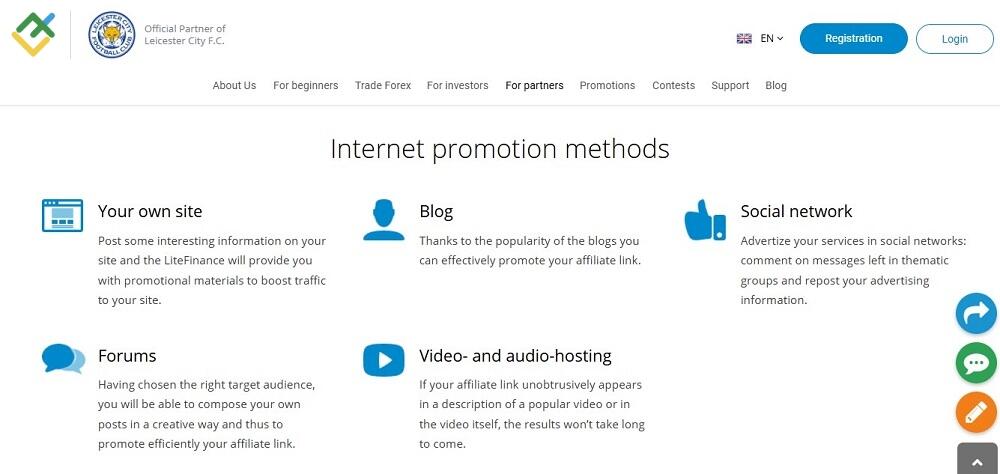
- What is your plan? Think about which channels you will use to reach traders and whether the broker offers the tools to work with them.
Here are the key factors and risks to weigh up when choosing an IB program:
Criterion | Meaning | Risks and Potential Issues |
Reward model (CPA) | Suits traffic arbitrage where ad spend needs to pay off quickly | Strict requirements for the referral's minimum first deposit and trading volume |
Reward model (Revenue Share) | Builds passive long-term income, a good fit for owners of niche blogs, Telegram channels, and signal services, as well as active traders | Client trades shorter than 2–3 minutes or with a move of less than 3 pips often go unpaid. Other catches are possible too, so read the Affiliate Agreement carefully |
Broker regulation | Tier 1 and Tier 2 licenses (FCA, CySEC, ASIC, DFSA) | Offshore brokers (St Vincent, Vanuatu) can block a partner account without explanation |
Permitted geos | The list of countries and jurisdictions where the broker can legally accept traders | Payouts blocked on traffic from the US, Canada, or the EU if the broker holds no local license |
Marketing tools | Multilingual landing pages, banners, widgets and promo codes, plus ready-made materials for print and email campaigns | Outdated promo materials that convert poorly on today's web and mobile traffic |
Affiliate account functionality | The ability to track each acquisition channel separately, broken down by geo and other criteria | Delays in updating commission statistics, weekly, for instance, which make it impossible to stop a loss-making campaign in time |
Withdrawal terms | Minimum threshold, payout frequency (weekly or monthly), availability of crypto withdrawals | Lengthy traffic checks by the broker to confirm the trader met the conditions, plus a minimum withdrawal threshold |
Conclusion
The CPA program suits those who can drive large volumes of traffic through contextual or targeted ads, who have no personal contact with their audience, and who work on the assumption that most beginners will stop trading fairly quickly.
The hybrid model is a good fit if you run a blog, a Telegram channel, or training courses. Loyal clients who keep trading over time bring you a steady income, and you still get paid upfront.
A multi-level sub-broker system gives you an extra source of steady passive income.
Check out LiteFinance affiliate programs and join a team of professionals. You can sharpen your skills on a demo account.
Forex IB Commissions FAQs
An introducing broker can earn up to $15 per standard lot. The amount of the commission depends on the account type and the trading volume of the clients referred. In a multi-level affiliate network, the IB also receives a percentage of the sub-partners' earnings.
With the CPA model, the IB is paid once the referred client meets the set conditions, such as funding an account or placing a certain number of trades. With Revenue Share, the IB earns a percentage of what the client spends on trading for as long as they stay active.
A master IB is a partner who builds a multi-level network and earns commissions from the traders and sub-partners they bring in. A sub-IB is a lower-level partner who signs up through a master IB's referral link and brings in traders of their own.

The content of this article reflects the author’s opinion and does not necessarily reflect the official position of LiteFinance broker. The material published on this page is provided for informational purposes only and should not be considered as the provision of investment advice for the purposes of Directive 2014/65/EU.
According to copyright law, this article is considered intellectual property, which includes a prohibition on copying and distributing it without consent.