Alibaba is one of the largest companies in the e-commerce and cloud technology sectors. However, its shares remain under pressure amid stricter regulations, technology export restrictions, and economic turbulence in China. Despite these external challenges, the company continues to develop strategic business areas and invest in cloud infrastructure, AI technologies, and international projects.
Although Alibaba shares have declined, analysts remain moderately positive about the long-term outlook. Fundamental factors such as growing global market share and business model diversification are the main drivers of BABA's recovery and sustainable growth.
The article covers the following subjects:
- Major Takeaways
- BABA Real-Time Market Status
- BABA Stock Forecast for 2026 Based on Technical Analysis
- Analysts' BABA Stock Price Projections for 2027
- Analysts' BABA Stock Price Projections for 2028
- Analysts' BABA Stock Price Projections for 2029
- Analysts' BABA Stock Price Projections for 2030
- Analysts' BABA Stock Price Projections until 2050
- Market Sentiment for BABA (Alibaba) on Social Media
- BABA Price History
- Alibaba Fundamental Analysis
- More Facts About Alibaba
- How We Make Forecasts
- Conclusion: Is BABA a Good Investment?
- Alibaba Stock Prediction FAQs
Major Takeaways
- The current price of BABA stands at $100.37 as of 24.06.2026.
- The highest BABA price of $319.32 was reached on 27.10.2020, while the all-time low of $57.2 was set on 29.09.2015.
- Analysts are divided on Alibaba's 2026 outlook, reflecting a wide range of scenarios for the stock's trajectory, with forecasts ranging from a potential advance to $103.92–$105 to a downside scenario implying a decline to $73.33.
- Leading forecasting platforms believe the BABA stock price will climb to $147 by 2027. However, some experts anticipate a drop to $86.01.
- Some analysts predict the price to soar to $300 by 2030, while others expect it to settle at $119.52.
- Long-term forecasts for Alibaba shares vary. Some experts project that BABA will surge to $441 by 2037. Other analysts, on the other hand, foresee a decrease to $83.01 by 2040.
BABA Real-Time Market Status
BABA is trading at $100.37 as of 24.06.2026.
To assess Alibaba's current performance, investors should monitor key metrics such as market capitalization, trading volume, and dividends. These metrics help determine investor interest in the asset, its actual value, risk tolerance, and upside potential.
Indicator | Value |
Market cap | $273.4 billion |
Average trading volume | 12.03 million shares |
All-time high | $319.32 |
Price change over the last 12 months | 17.3% |
Shares outstanding | 2.235 billion shares |
Dividend yield | 1.6% |
BABA Stock Forecast for 2026 Based on Technical Analysis
Let's perform a technical analysis of the weekly Alibaba chart to forecast the stock price movement over the year.
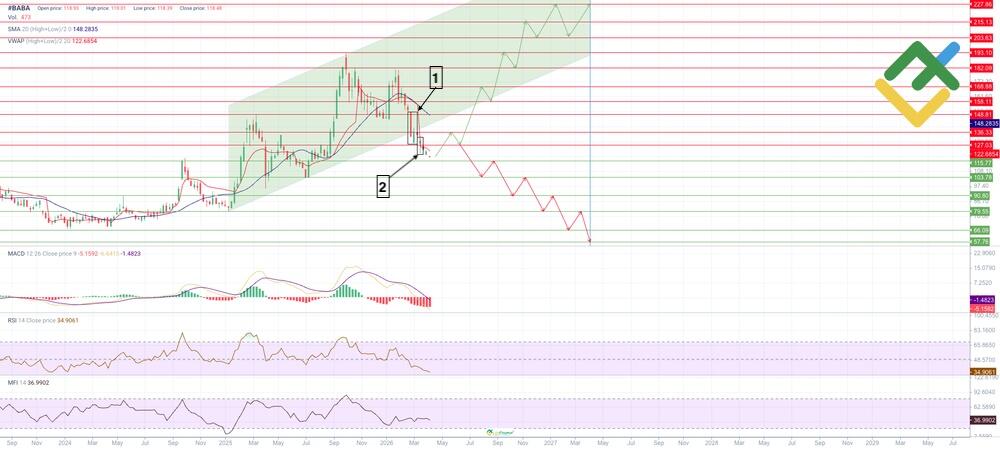
In late January 2026, Alibaba's stock price briefly rebounded to $182.09 before turning lower again. Technical indicators and candlestick patterns are giving mixed signals:
- A Bullish Counterattack candlestick pattern (1) formed near the $127.03–$136.33 range, indicating that buyers are trying to regain lost ground. After that, a Hammer pattern (2) appeared, signaling a potential upward reversal.
- The MACD is moving sideways in negative territory, indicating continuing bearish pressure.
- The RSI is falling. The reading is hovering around 34 and could drop further. A correction cannot be ruled out.
- The MFI is rising, showing an inflow of liquidity into the asset.
- The VWAP indicator and the SMA20 line are above the market price, indicating that bears are still in control of the market.
The table below shows the forecast for the BABA stock over the next 12 months.
Month | Minimum, $ | Average, $ | Maximum, $ |
April 2026 | 115.10 | 120.23 | 125.36 |
May 2026 | 124.66 | 130.85 | 137.04 |
June 2026 | 127.84 | 132.79 | 137.75 |
July 2026 | 126.07 | 145 | 163.94 |
August 2026 | 158.28 | 164.47 | 170.67 |
September 2026 | 156.16 | 173.50 | 190.84 |
October 2026 | 180.93 | 188.54 | 196.15 |
November 2026 | 179.16 | 196.50 | 213.84 |
December 2026 | 201.46 | 209.24 | 217.03 |
January 2027 | 215.26 | 222.17 | 229.08 |
February 2027 | 203.23 | 216.32 | 229.42 |
March 2027 | 201.81 | 213.66 | 225.52 |
Long-Term Trading Plan for #BABA for 2026
The technical analysis has revealed key support and resistance levels that can be used for creating a trading strategy for the coming year.
Trading Plan for the Year
- The stock price is expected to decline to $115.77–$103.78 and then reverse upward.
- Key support levels: $115.77, $103.78, $90.80, $79.55, $66.09, and $57.76.
- Key resistance levels: $127.03, $136.33, $148.81, $158.11, $168.88, $182.09, $193.10, $203.63, $215.13, and $227.86.
- Base scenario: Open long trades above the key resistance level of $127.03 when trading volume is high. Short-term targets are in the $136.33–$148.81 range and higher. Long-term targets are in the $158.11–$227.86 range.
- Alternative scenario: Open short trades below the key support level of $115.77 on increased volume, with potential targets in the $103.78–$57.76 range.
Analysts' BABA Stock Price Projections for 2026
Analysts are divided on Alibaba's 2026 outlook. Some cite weakness in China's consumer sector and regulatory risks, while others expect a partial recovery in the second half. The stock is projected to trade between $69.00 and $177.90.
LongForecast
Price range: $69–$133.
LongForecast expects BABA shares to decline in the first half of the year, reaching $75 in July and recovering to $105 by December.
Month | Open, $ | Min–Max, $ | Close, $ |
April 2026 | 124 | 100–133 | 112 |
May 2026 | 112 | 95–124 | 103 |
June 2026 | 103 | 81–103 | 88 |
July 2026 | 88 | 69–88 | 75 |
August 2026 | 75 | 75–93 | 86 |
September 2026 | 86 | 81–95 | 88 |
October 2026 | 88 | 82–96 | 89 |
November 2026 | 89 | 84–98 | 91 |
December 2026 | 91 | 91–113 | 105 |
StockScan
Price range: $69.62–$177.90.
According to StockScan, BABA may advance to $158.70 in May. However, a bearish trend is expected to begin in the second half of the year, dragging the price down to $73.33 by December.
Month | Average, $ | Minimum, $ | Maximum, $ |
May 2026 | 158.70 | 144.60 | 177.90 |
June 2026 | 143.10 | 139.60 | 160.30 |
July 2026 | 130.30 | 125.20 | 165.70 |
August 2026 | 133.30 | 129.90 | 144.60 |
September 2026 | 128.60 | 120.90 | 153.10 |
October 2026 | 119.90 | 102.90 | 139.40 |
November 2026 | 91.23 | 76.84 | 122.10 |
December 2026 | 73.33 | 69.62 | 102.60 |
CoinCodex
Price range: $72.21–$143.24.
CoinCodex predicts an uneven price trajectory. The average value is projected to reach $130.27 in June and slide by autumn. By December, the asset is estimated to settle at $103.92.
Month | Minimum, $ | Average, $ | Maximum, $ |
April 2026 | 98.14 | 110.56 | 122.33 |
May 2026 | 94.20 | 104.49 | 118.70 |
June 2026 | 117.94 | 130.27 | 143.24 |
July 2026 | 104.22 | 117.91 | 141.19 |
August 2026 | 103.35 | 108.21 | 117.76 |
September 2026 | 91.23 | 98.56 | 107.96 |
October 2026 | 72.21 | 82.90 | 98.13 |
November 2026 | 76.69 | 89.96 | 106.24 |
December 2026 | 100.31 | 103.92 | 107.82 |
Analysts' BABA Stock Price Projections for 2027
Predictions for 2027 diverge. The stock's performance will likely depend on the pace of China's economic recovery, growth in its cloud business, and investor sentiment toward the Chinese tech sector. The price is expected to fluctuate widely between $4.14 and $184.00.
Note: The price ranges below reflect the expected volatility of the asset over a year. The minimum and maximum prices may not be displayed in the tables.
LongForecast
Price range: $105–$184.
According to LongForecast, the stock price will trade between $105 and $139 in the first half of the year, surging to a high of $184 in Q3, and pulling back to $147 in December.
Quarter | Open, $ | Min–Max, $ | Close, $ |
Q1 | 105 | 105–134 | 124 |
Q2 | 124 | 116–139 | 129 |
Q3 | 129 | 129–184 | 165 |
Q4 | 165 | 118–165 | 147 |
StockScan
Price range: $4.14–$108.10.
StockScan estimates that the Alibaba stock price will trade in a bearish trend in 2027 amid high volatility. The asset is anticipated to plunge to a low of $4.14 in Q3. Afterward, it may rebound, averaging at $30.45 in December.
Quarter | Average, $ | Minimum, $ | Maximum, $ |
Q1 | 49.95 | 36.15 | 108.10 |
Q2 | 31.06 | 29.79 | 67.36 |
Q3 | 26.48 | 4.14 | 55.17 |
Q4 | 30.45 | 23.47 | 54.72 |
CoinCodex
Price range: $82.48–$139.61.
CoinCodex foresees a decline in BABA's price in 2027. The average value is expected to reach $103.33 by the end of Q1 and slide to a low of $82.48 in December.
Quarter | Minimum, $ | Average, $ | Maximum, $ |
Q1 | 94.36 | 103.33 | 139.61 |
Q2 | 91.71 | 100.87 | 118.44 |
Q3 | 97.12 | 102.98 | 117.57 |
Q4 | 82.48 | 86.01 | 101.81 |
Analysts' BABA Stock Price Projections for 2028
Forecasts for 2028 are also mixed. Competition in the Chinese e-commerce sector may limit BABA's stock price growth. However, some analysts anticipate a stock price recovery in the second half of the year.
LongForecast
Price range: $85–$180.
LongForecast projects the stock will open the year at $147.00, climb to $180 by mid-year, and then decline to $85 in Q4 due to a market correction.
Quarter | Open, $ | Min–Max, $ | Close, $ |
Q1 | 147 | 144–175 | 162 |
Q2 | 162 | 128–180 | 139 |
Q3 | 139 | 93–164 | 116 |
Q4 | 116 | 85–116 | 92 |
StockScan
Price range: $1.50–$62.39.
According to StockScan, volatility will be elevated in 2028. The BABA price is projected to tumble to a low of $1.50 early in the year. After that, it is expected to recover, reaching a high of $62.39 by autumn.
Quarter | Average, $ | Minimum, $ | Maximum, $ |
Q1 | 1.86 | 1.50 | 40.93 |
Q2 | 60.75 | 1.88 | 60.95 |
Q3 | 46.24 | 22.58 | 62.39 |
Q4 | 29.45 | 22.87 | 46.53 |
CoinCodex
Price range: $79.51–$133.86.
CoinCodex predicts the average price may reach $85.45 by the end of Q1 and $88.48 by mid-year. By year-end, the asset is estimated to hit a high of $133.86.
Quarter | Minimum, $ | Average, $ | Maximum, $ |
Q1 | 79.51 | 85.45 | 90.14 |
Q2 | 80.25 | 88.48 | 103.47 |
Q3 | 84.70 | 102.70 | 126.49 |
Q4 | 96.27 | 100.72 | 133.86 |
Analysts' BABA Stock Price Projections for 2029
Forecasts for 2029 vary widely. Some analysts predict BABA to rise above $200, fueled by the expansion of Alibaba's international business and new technological developments, while others suggest the bearish trend will continue.
LongForecast
Price range: $92–$152.
According to LongForecast, the stock price may increase to $107.00 in the first half of the year, reach a high of $152 in Q3, and then pull back to $106.00 by December.
Quarter | Open, $ | Min–Max, $ | Close, $ |
Q1 | 92 | 92–135 | 125 |
Q2 | 125 | 98–135 | 107 |
Q3 | 107 | 98–152 | 141 |
Q4 | 141 | 98–148 | 106 |
StockScan
Price range: $19.55–$49.61.
StockScan anticipates a bearish trend. The stock price is expected to fall to a low of $19.55 by autumn and settle at $26.92 by December.
Quarter | Average, $ | Minimum, $ | Maximum, $ |
Q1 | 35.78 | 28.94 | 49.61 |
Q2 | 25.31 | 23.44 | 38.55 |
Q3 | 29.89 | 19.55 | 31.86 |
Q4 | 26.92 | 24.09 | 32.86 |
CoinCodex
Price range: $93.96–$219.62.
CoinCodex estimates that BABA shares will rebound in 2029. The average price is set to reach $159.41 in Q1, dip to $135.23 in Q2, and then climb again, hitting a high of $219.62 by December.
Quarter | Minimum, $ | Average, $ | Maximum, $ |
Q1 | 93.96 | 159.41 | 168.21 |
Q2 | 117.63 | 135.23 | 155.36 |
Q3 | 123.09 | 181.08 | 208.85 |
Q4 | 172.46 | 179.66 | 219.62 |
Analysts' BABA Stock Price Projections for 2030
Forecasts for Alibaba shares in 2030 diverge. The development of the company's technology initiatives, the state of the Chinese economy, and global investor interest in the e-commerce sector could all influence the stock price.
StockScan
Price range: $1.05–$47.15.
According to StockScan, the average price may reach $38.46 in Q1 and drop to $19.81 in Q2. By the end of the year, the asset is predicted to drop to a low of $1.05. Volatility is expected to be strong.
Quarter | Average, $ | Minimum, $ | Maximum, $ |
Q1 | 38.46 | 28.81 | 47.15 |
Q2 | 19.81 | 21.28 | 35.39 |
Q3 | 34.04 | 1.77 | 36.74 |
Q4 | 2.05 | 1.05 | 42.31 |
CoinCodex
Price range: $83.24–$205.15.
CoinCodex suggests BABA will gradually go down. The asset is projected to drop to $145.5 by mid-year and reach a low of $83.24 by year-end.
Quarter | Minimum, $ | Average, $ | Maximum, $ |
Q1 | 143.11 | 153.59 | 205.15 |
Q2 | 108.61 | 145.50 | 160.55 |
Q3 | 105.19 | 115.46 | 165.20 |
Q4 | 83.24 | 119.52 | 124.34 |
CoinPriceForecast
Price range: $259–$301.
CoinPriceForecast offers a more optimistic outlook, predicting that the average price will rise to $259 in early 2030 and reach $276 by mid-year.
Year | Open, $ | Mid-Year, $ | Close, $ |
2030 | 259 | 276 | 301 |
Analysts' BABA Stock Price Projections until 2050
Long-term forecasts for Alibaba shares remain highly uncertain. Regulatory changes, the pace of technological development, competition, and the state of the global economy may all influence the BABA stock price. Therefore, projections for 2040–2050 should be treated with caution.
CoinPriceForecast anticipates a bullish trend. The stock price is projected to climb to $399 by 2035 and $441 by 2037.
StockScan experts, in contrast, provide a more conservative forecast, predicting that the price will reach $83.01 by 2040 and rise to $237.40 by 2050.
Year | CoinPriceForecast, $ | StockScan, $ |
2035 | 399 | 19.67 |
2037 | 441 | - |
2040 | - | 83.01 |
2045 | - | 168.80 |
2050 | - | 237.40 |
Market Sentiment for BABA (Alibaba) on Social Media
Media sentiment surrounding BABA shares may impact short-term price movements. Positive discussions on social media tend to fuel price gains, while negative posts lead to high volatility and price consolidation.
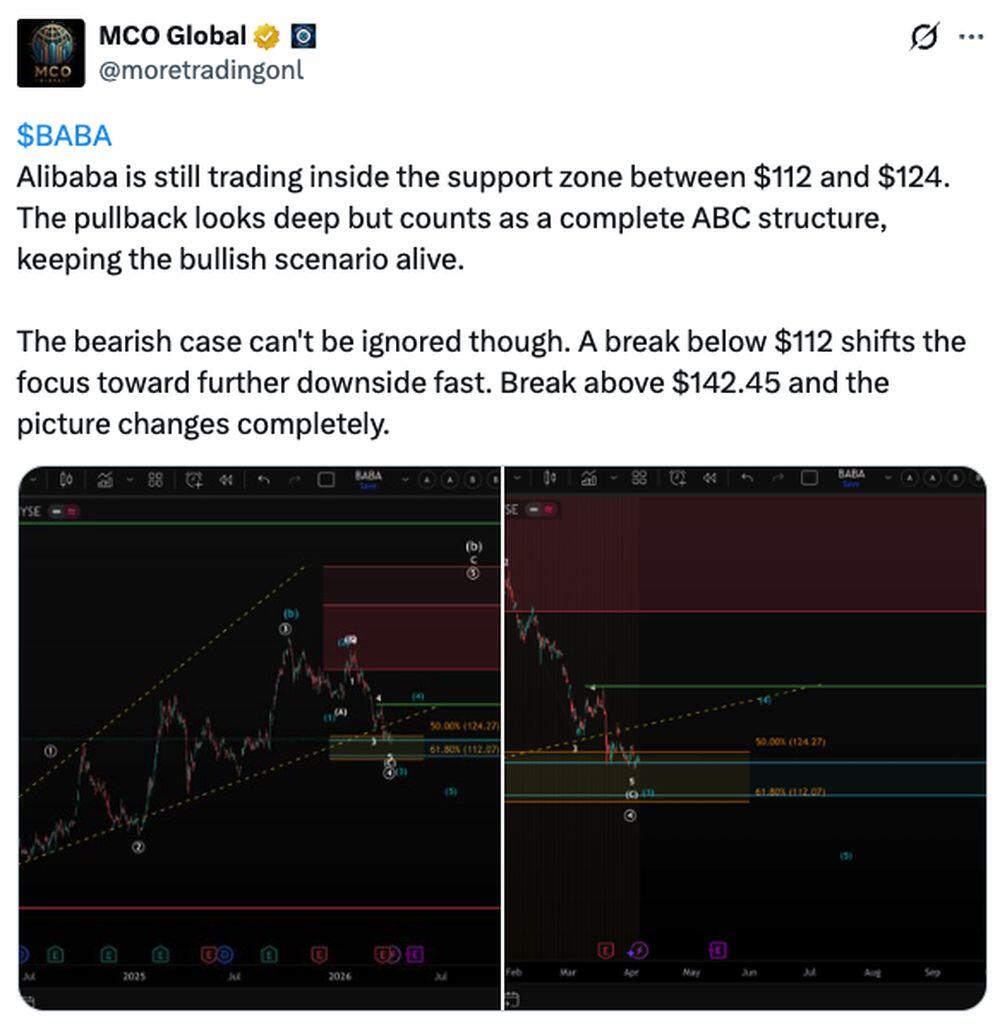
User @moretradingonl expects BABA's price to rise in the long term if it exceeds the $142.45 level. Should the stock break below $112, the bearish trend may continue.
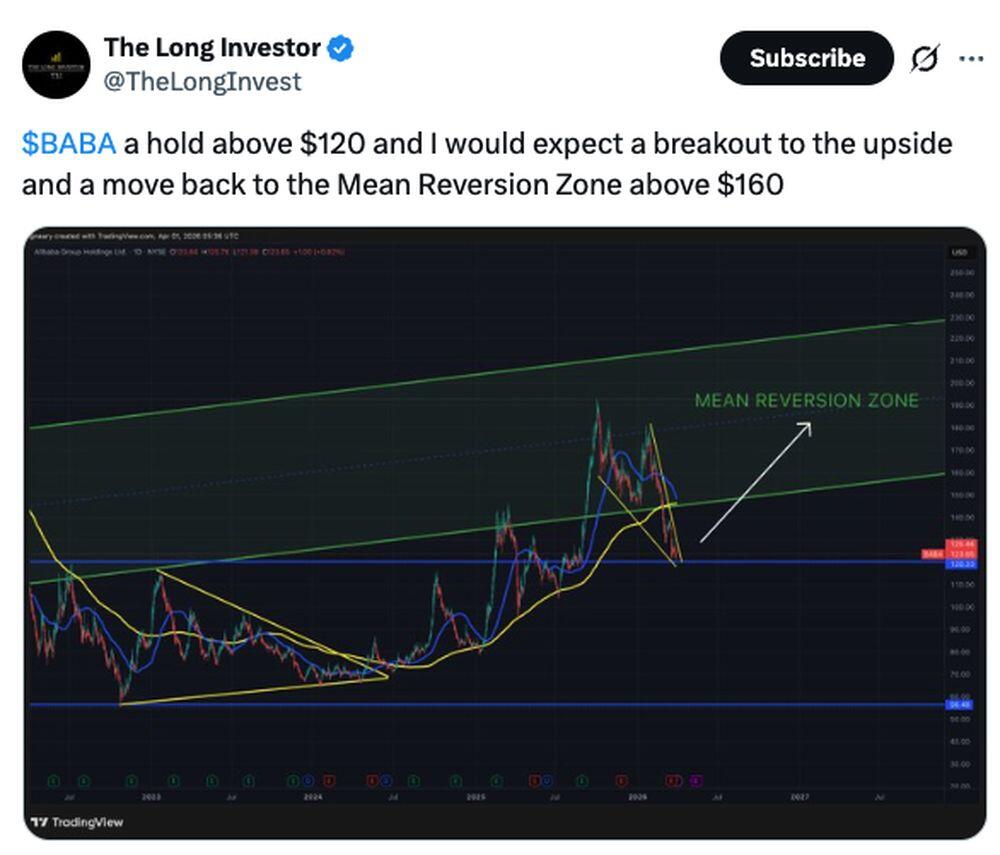
Independent trader @TheLongInvest predicts that BABA's price will grow to $160 if it stays above $120.
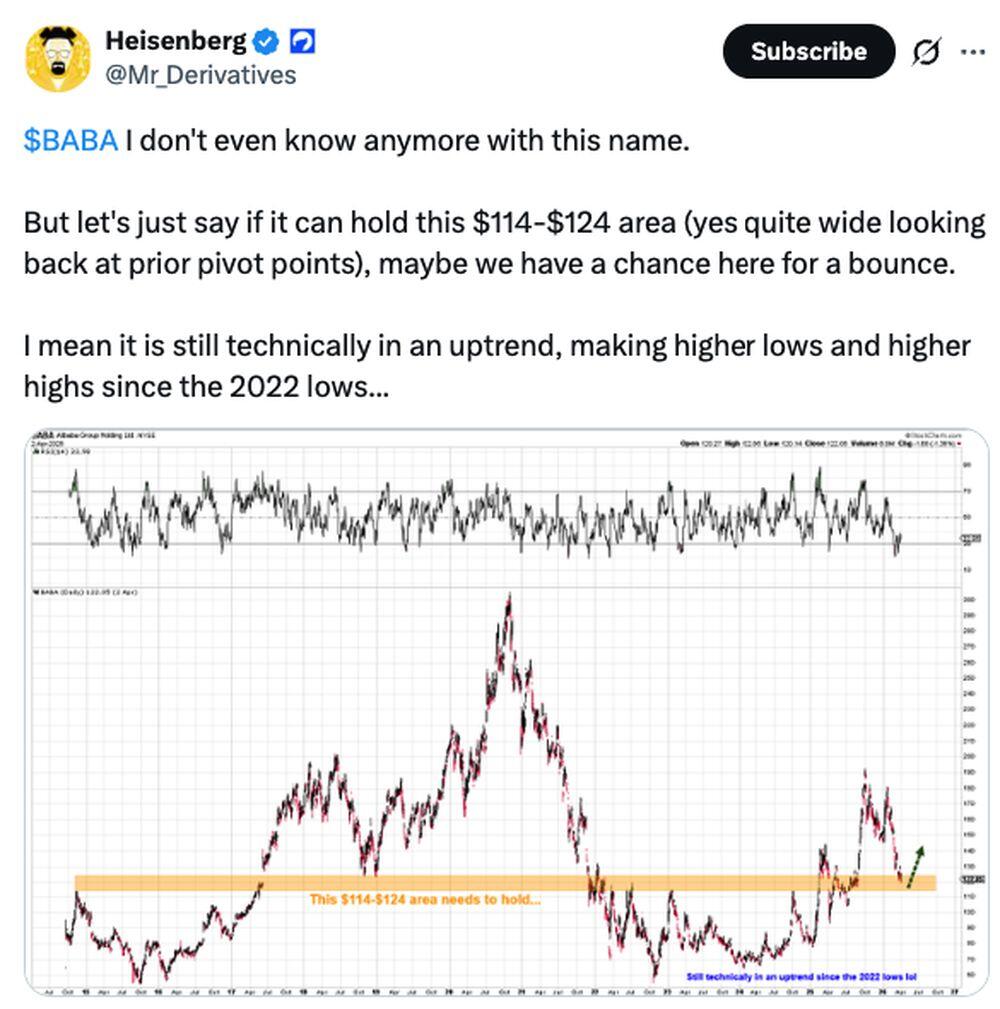
Independent analyst @Mr_Derivatives suggests that Alibaba's stock will resume its uptrend if bulls manage to hold the support zone of $114–$124.
Most users expect the BABA stock price to appreciate as long as it trades above the key support zone of $112–$124. It is essential to conduct technical and fundamental analysis and review the latest market data before making any trading or investment decisions.
BABA Price History
The highest BABA price of $319.32 was recorded on 27.10.2020. The lowest price of 57.2 was set on 29.09.2015.
It is crucial to evaluate historical data to make the forecasts as accurate as possible. The chart below shows the BABA price performance over the last ten years.
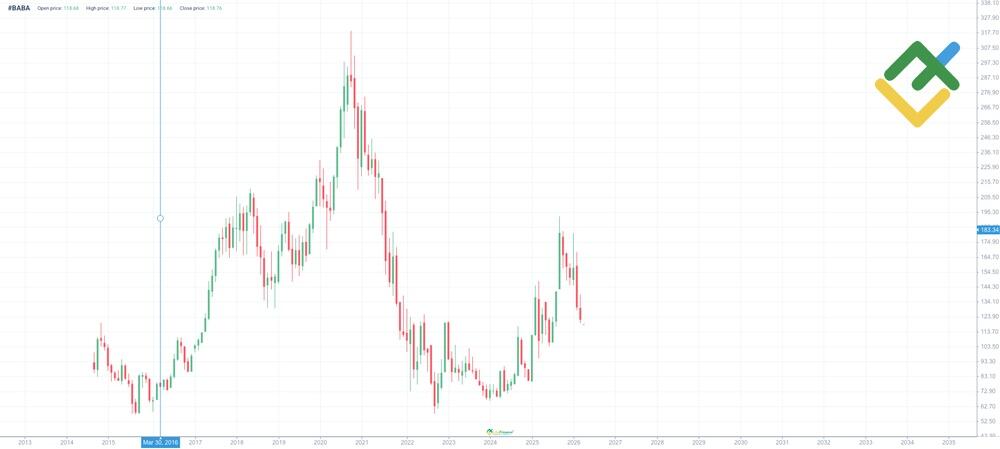
- In 2014, Alibaba went public, with its shares climbing soon after the IPO and consolidating above the initial levels.
- In 2017–2019, prices gradually strengthened due to the expansion of online trading.
- In 2020, the stock reached a historic high of over $300 amid rapid growth in e-commerce and digital services.
- In 2021–2022, tighter regulations in China caused a sharp decline in the share price.
- In 2023–2024, the price traded in a sideways channel.
- In 2025, the asset broke out of consolidation and formed a new bullish trend.
- In late January 2026, the price rose to $181.05. However, in early April, the stock fell to $118.90 due to negative macroeconomic indicators in China.
Alibaba Fundamental Analysis
Fundamental analysis of Alibaba’s stock helps investors understand the key factors affecting its price, including macroeconomic conditions, the state of the Chinese economy, the development of the company's technology and strategy, and the competitive landscape. Analyzing financial reports, investments in cloud technology, and global demand trends helps assess the company's prospects and determine its attractiveness for long-term investments.
What Factors Affect the Alibaba Stock?
The Alibaba stock price is determined by many fundamental factors that must be taken into account to analyze its performance:
- Economic situation in China. GDP, inflation rate, and macroeconomic stability significantly affect the company's operations.
- Global trade relations. Political and economic ties between China and other countries affect the demand for Alibaba's goods and services.
- Cloud technology development. Investments in cloud computing and its success impact the company's long-term growth.
- Financial performance of the company. Revenue, earnings, profitability, and debt load determine the stock price.
- Competition. Competition with companies such as JD.com and Amazon puts pressure on the stock price.
- Regulation in China. Government decisions related to data control and anti-monopoly measures often affect market capitalization.
- Innovation and diversification. Business expansion and development of new segments, such as fintech and logistics, bolster the stock.
- Consumer trends. Changes in online consumption affect the company's revenues.
More Facts About Alibaba
Alibaba Group Holding Limited is China's largest e-commerce company, founded in 1999 by Jack Ma. Founded as an online marketplace for small businesses, it is now a diversified conglomerate operating in cloud technology, digital payments, logistics, media, and entertainment.
The company's value growth is driven by its successful development of online commerce, domestic market dominance, and strategic expansion into international markets. Alibaba is actively investing in innovations such as cloud computing through the Alibaba Cloud platform and the development of artificial intelligence, which strengthens its position in the technology sector.
The popularity of the Alibaba stock among traders is attributed to its high liquidity, impressive growth rate, and prospects in China's rapidly developing economy. Investors see the company as an opportunity to capitalize on the steady trend of digitalization and increasing demand for online services both in Asia and around the world.
Advantages and Disadvantages of Investing in Alibaba
Alibaba has attracted the attention of many investors due to its growth prospects in global e-commerce and a wide range of businesses, including cloud technology and logistics. However, like any large corporation, investing in Alibaba poses risks, including competition, changes in legislative policy, and possible fluctuations in market value.
Advantages of Investing in Alibaba Stocks
- Leadership in e-commerce. Alibaba holds a dominant position in online commerce, controlling most of the Chinese market and expanding actively internationally.
- Business diversification. In addition to e-commerce, the company is developing cloud technologies (Alibaba Cloud), logistics (Cainiao), digital payments (Alipay), and media. This reduces the company's dependence on a single sector and increases its sustainability.
- Innovation and technological development. Continuous investments in artificial intelligence, big data, and cloud technologies strengthen the company's competitiveness in the global market.
- China's economy. Alibaba benefits from a rising middle class and increased consumption in China, the largest e-commerce market.
- High growth potential. The company's global expansion and technological innovation create prospects for long-term stock price appreciation.
Disadvantages of Investing in Alibaba Stocks
- Regulatory risks. The Chinese government's strict control, including restrictions on the activities of technology giants, could negatively affect the stock price.
- Dependence on the Chinese economy. Despite its international presence, most of the company's revenue comes from the Chinese market, which is prone to economic downturns.
- Stock volatility. Significant price fluctuations due to regulatory volatility and market sentiment make Alibaba's stock risky for short-term investments.
- Strong competition. Alibaba faces intense competition in the domestic market from JD.com and Pinduoduo, and in the international market from Amazon and other players.
- Global tensions. Trade wars and political disagreements between China and other countries may affect the company's operations and investor interest.
Investing in Alibaba suits those who prioritize long-term prospects and are prepared to embrace the associated risks.
How We Make Forecasts
Our forecasts are based on a thorough analysis of various factors affecting Alibaba's stock price.
- To make short-term forecasts, we use technical indicators such as moving averages (SMA, EMA), the RSI, and MACD, along with chart trends.
- Medium-term forecasts are based on fundamental analysis. We review Alibaba's financial reports, changes in revenue, earnings, operating expenses, and the impact of external factors such as regulatory policies in China and the global economy.
- Long-term forecasts rely on the company's strategic outlook. We assess technological innovations, business diversification plans, growth potential in international markets, and investments in promising technologies such as cloud solutions and artificial intelligence.
A comprehensive approach combining technical, fundamental, and strategic analysis enhances the accuracy of our forecasts. However, it is impossible to predict all the factors that will influence the price in the future. Therefore, traders should not neglect to conduct their own analysis before making decisions.
Conclusion: Is BABA a Good Investment?
Alibaba's investment appeal is a rather complex issue. On the one hand, fundamental metrics such as a low P/E ratio and massive cash reserves make the stock extremely undervalued. On the other hand, BABA's stock price is heavily influenced by geopolitical conflicts and regulatory risks, making it difficult to predict in the long term.
Alibaba's stock is a good choice for long-term investors prepared for significant drawdowns and negative news. However, BABA stocks are better suited for short-term trading due to political uncertainty in China and high volatility.
Alibaba Stock Prediction FAQs
The current price of BABA stands at $100.37 as of 24.06.2026.
Alibaba's stock is expected to advance to $147 in 2027, fueled by strong cloud revenue growth and a recovery in consumer demand. However, the stock may decline amid trade disputes and geopolitical uncertainty.
Long-term investors ready to weather periods of volatility may consider buying shares now, as they are heavily undervalued. However, traders should exercise caution, as the current downtrend has not yet ended and prices may fall even further.
For a corporation like Alibaba, any decline is relative. Short-term corrections may occur due to regulatory factors, but a sustained downturn is unlikely given the company's strong market position and its central role in China's digital economy.
Alibaba's annual return has rebounded to 17.3%, reflecting its successful adaptation to changing market conditions. This improvement is supported by steady growth in operating profit and the expansion of its cloud business, reinforcing its position as a leader in the digital sector.
Investing in Alibaba can be profitable for long-term investors, given its scalability, innovation, and leadership in key segments. However, it is important to consider the risks associated with volatility and regulatory changes.
The decline in stock prices is related to regulatory uncertainty in China, weakening economic growth, and strong competition, putting pressure on the market and creating additional risks for short-term investors.
BABA consistently recovers from price declines thanks to Alibaba's strong revenue growth. Buying interest tends to emerge at lower levels, often driving a sustained uptrend. So, the stock's recovery is just a matter of time.
Alibaba's stock price hinges on multiple factors. The asset is mostly influenced by the macroeconomic situation in China, regulatory policies, revenue and profit margins, competition in the sector, and global investment trends.
Alibaba is actively investing in new technologies, expanding its international presence, and diversifying its business, allowing it to remain competitive even in a volatile market.
Price chart of BABA in real time mode

The content of this article reflects the author’s opinion and does not necessarily reflect the official position of LiteFinance broker. The material published on this page is provided for informational purposes only and should not be considered as the provision of investment advice for the purposes of Directive 2014/65/EU.
According to copyright law, this article is considered intellectual property, which includes a prohibition on copying and distributing it without consent.