The closure of the Strait of Hormuz has turned into a battle for survival between the global and Iranian economies. As a result, oil prices and US stock indices are rising, leaving the EUR/USD pair at a crossroads. Will central banks step in to ease the situation? Let’s discuss this topic and make a trading plan.
The article covers the following subjects:
Major Takeaways
- Iran is being forced to make concessions to the US.
- Oil prices and stock indices are rising.
- The ECB is deliberately playing a hawkish bluff.
- Short positions on the EUR/USD pair can be opened below 1.169.
Weekly Fundamental Forecast for Dollar
When the US struck Iran, time initially appeared to favor Tehran. The operation was seen as costly and ineffective, while rising fuel prices weighed on Republican approval ratings. However, the subsequent US blockade of the Strait of Hormuz shifted the dynamics. Pressure is now mounting on Iran, with storage constraints becoming more apparent and alternative export routes, such as rail shipments to China, offering only limited relief. Against this backdrop, Donald Trump has increased leverage over Tehran, prompting renewed signals of willingness to negotiate and contributing to a "two steps forward, one step back" pattern in the EUR/USD pair.
In essence, the Middle East conflict has evolved into a test of economic resilience. The key question is which side can withstand the pressure longer — the global economy or Iran's. Historically, the global economy has proven more resilient to shocks than initially expected, as seen in the eurozone's ability to absorb previous trade tensions. As long as oil and gas prices remain below extreme levels, global growth may slow but not collapse. The more pressing question is whether Iran's economy can endure sustained pressure from restricted energy exports.
Shipping Traffic Through Strait of Hormuz
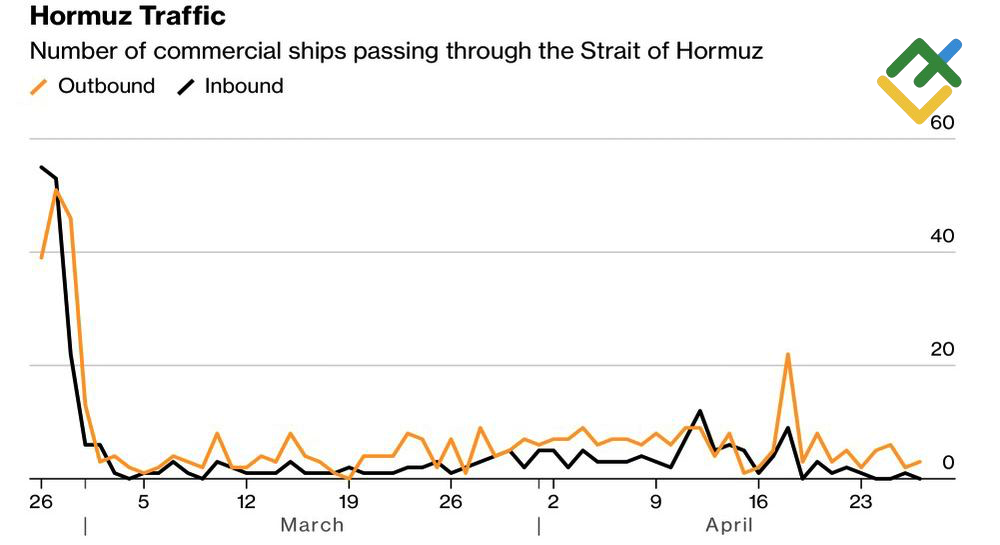
Source: Bloomberg.
Judging by Tehran's latest statements, the country's economy is starting to feel the pinch. With nowhere to store oil and no desire to cut production, the only option is to back down. For now, the US is rejecting Iran's proposals, claiming that Iran intends to control the Strait of Hormuz anyway. Meanwhile, investor confidence that the ceasefire will lead to peace rather than a resumption of hostilities, combined with disruptions in oil supplies, is driving rallies in the S&P 500 and Brent. As a result, the EUR/USD pair will either rise amid declining demand for the US dollar as a safe-haven asset or drop due to the risks of an energy crisis in the eurozone.
At first glance, central banks seem to be making life easier for the single currency. Due to the potential acceleration of inflation linked to high oil prices, most central banks are expected to raise rates. The Fed, on the other hand, is likely to keep rates at current levels, though there is some probability of a cut. In theory, this divergence in monetary policy should boost the EUR/USD pair.
Market Expectations for Central Banks' Interest Rates
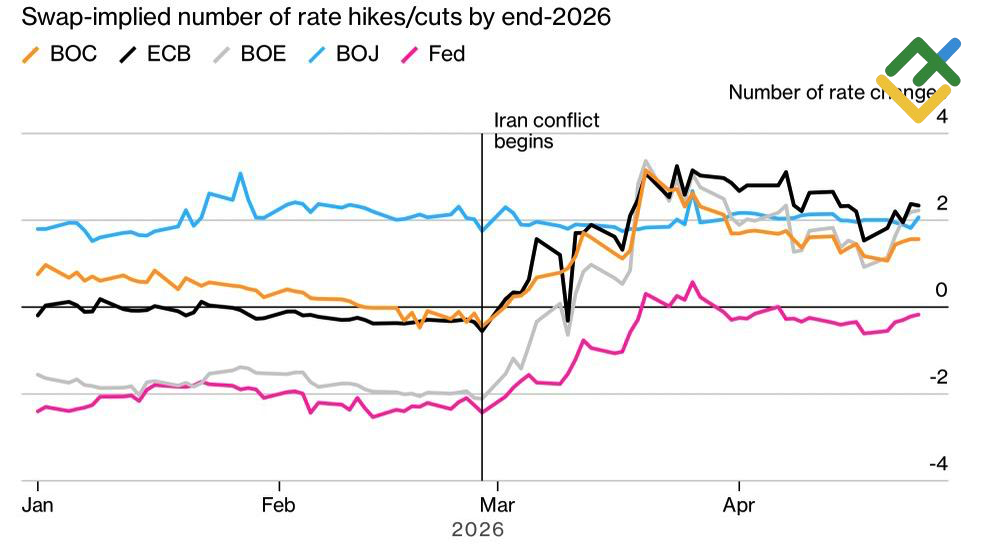
Source: Bloomberg.
The point is that tightening monetary policy under current conditions risks being self-defeating. The EU economy is already under strain, and raising rates could amplify that pressure. Against this backdrop, markets have begun to view the ECB’s current rhetoric as a hawkish bluff. A rate hike in April appears unlikely, and even a move in June is far from certain.
Weekly Trading Plan for EUR/USD
Investors are bracing for a signal of a deposit rate hike in early summer. If this does not happen, the euro may collapse. A drop in EUR/USD quotes below the support level of 1.169 will provide an opportunity to increase short positions established at 1.173. The battle for this level and 1.176 is not yet over. If the pair returns above these levels, one can consider buying the euro.
This forecast is based on the analysis of fundamental factors, including official statements from financial institutions and regulators, various geopolitical and economic developments, and statistical data. Historical market data are also considered.
Price chart of EURUSD in real time mode

The content of this article reflects the author’s opinion and does not necessarily reflect the official position of LiteFinance broker. The material published on this page is provided for informational purposes only and should not be considered as the provision of investment advice for the purposes of Directive 2014/65/EU.
According to copyright law, this article is considered intellectual property, which includes a prohibition on copying and distributing it without consent.