Treasuries are still being purchased, and non-residents are reducing their hedging of US asset holdings. A Fed rate cut after September is not guaranteed. What does this mean for the US dollar? Let's discuss this topic and make a trading plan for the EURUSD pair.
The article covers the following subjects:
Major Takeaways
- The EURUSD pair failed to break above 1.17.
- Risk hedging by non-residents is decreasing.
- The Fed does not promise to cut rates after September.
- Short trades can be considered if the euro falls below 1.165.
Weekly US Dollar Fundamental Forecast
If the market does not follow the expected trajectory, there is a higher probability of a sudden shift in the opposite direction. The EURUSD pair has tested the resistance level of 1.07 again, and bulls are repeatedly failing to break through it. The recent challenges experienced by buyers raise questions about the actual state of the US dollar, casting doubt on commonly held perceptions about its weakness. Non-resident purchases of US Treasuries reached $508.1 billion in the first half of the year, and a reduction in hedging ratios indicates that it is premature to abandon the greenback.
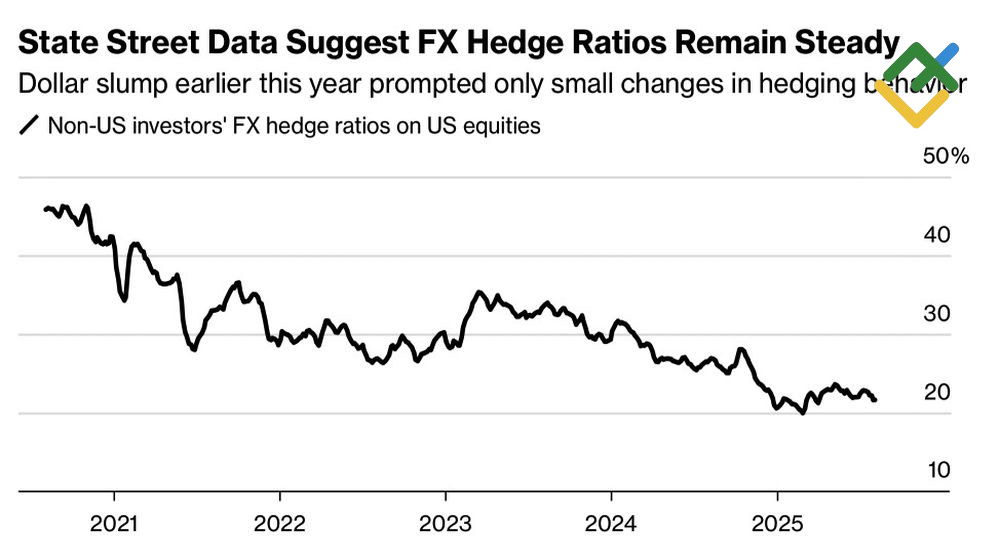
According to State Street Markets, foreign investors are shifting their focus away from risk hedging strategies for US assets. The hedging ratio decreased from 23.6% in May to 21.6%. The indicator has returned to the levels seen before US Independence Day. Non-residents are less confident than before that the US dollar will continue to collapse after its 10% decline in the first half of the year.
FX Hedge Ratio on US Equities
Source: Bloomberg.
The market has serious doubts that Jerome Powell will use the stage in Jackson Hole to announce a change in the Fed's outlook. A year ago, the Fed chief hinted at a rate cut. Many believe history will repeat itself, and the timing appears to be ideal. However, the data contradicts the central bank's leadership. After the July FOMC meeting, he commented on the robust state of the labor market and the potential for rising inflation. However, employment statistics from May to July and anchored consumer prices suggest otherwise.
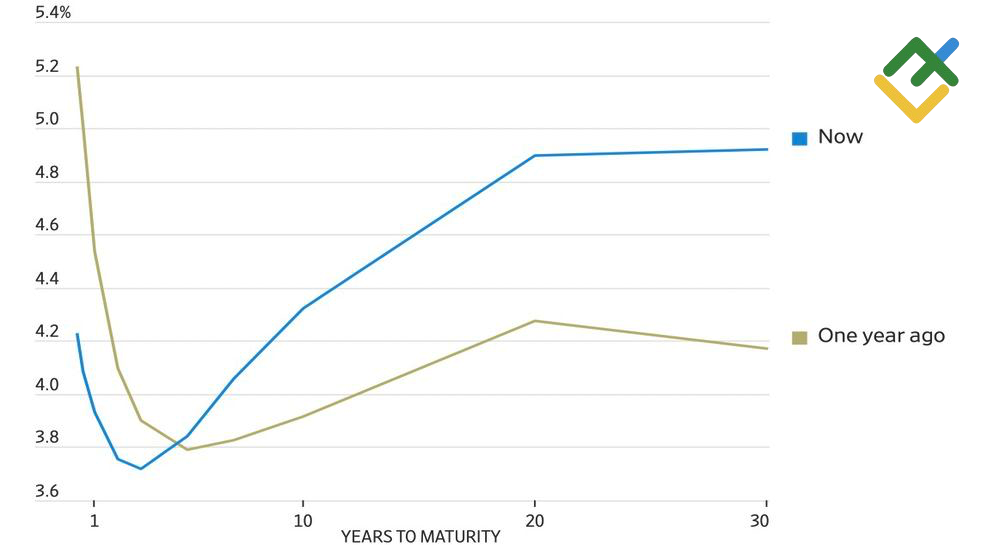
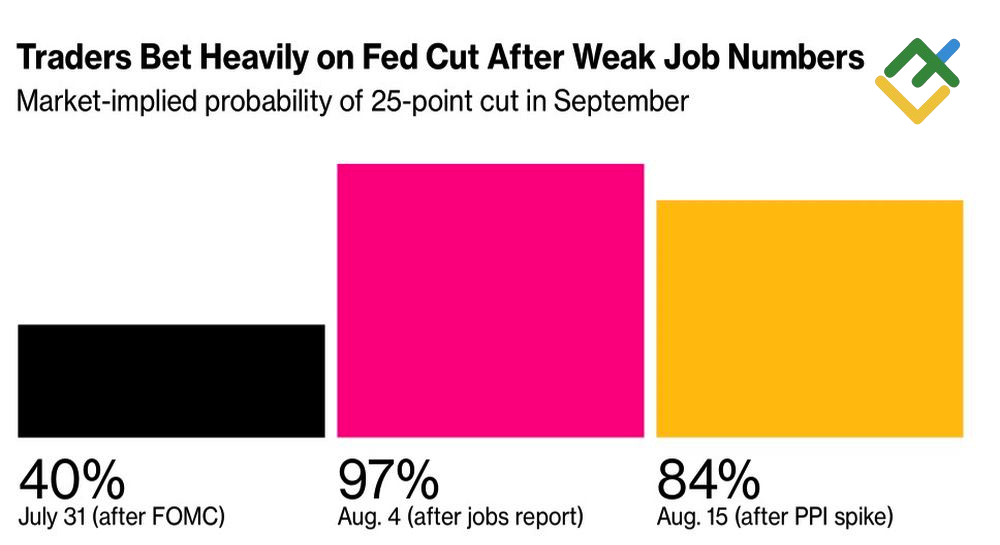
The rise in the yield curve, along with the 84% probability of the Fed resuming its monetary expansion cycle in September, indicates that the federal funds rate will be cut at the next FOMC meeting. However, the US regulator's subsequent steps remain uncertain. The US administration's demand for a 50 bps cut at the September meeting and a 150–175 bps cut overall can be set aside for the time being.
US Yield Curve
Source: Wall Street Journal.
Market Expectations for Fed Rate Cut
Source: Bloomberg.
Several negative factors have already been factored into the US dollar rate, including the flight of non-residents from the US debt market, increased hedging volumes, and large-scale easing of monetary policy by the Fed. Many concerns about the US dollar have not come to fruition. Is it time for a correction in the EURUSD pair?
The long-term outlook for the pair is bullish, driven by the acceleration of eurozone GDP in 2026, influenced by fiscal stimulus, the global economy's adaptation to tariffs, the US administration's strategy to weaken the US dollar, and investors' strategic diversification of their portfolios toward European securities. However, bears may still have one last opportunity to impact the EURUSD pair.
Weekly EURUSD Trading Plan
The main currency pair's failure to maintain above 1.165 will heighten the risk of a correction, thereby creating an opportunity to open short positions on the EURUSD pair in the short term.
This forecast is based on the analysis of fundamental factors, including official statements from financial institutions and regulators, various geopolitical and economic developments, and statistical data. Historical market data are also considered.
Price chart of EURUSD in real time mode

The content of this article reflects the author’s opinion and does not necessarily reflect the official position of LiteFinance broker. The material published on this page is provided for informational purposes only and should not be considered as the provision of investment advice for the purposes of Directive 2014/65/EU.
According to copyright law, this article is considered intellectual property, which includes a prohibition on copying and distributing it without consent.