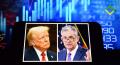
The US government did not want the conflict in the Middle East to escalate, but the operation "Project Freedom" launched by Donald Trump forced Iran to terminate the ceasefire. Oil prices rose, while the EUR/USD pair fell. Let's discuss this topic and make a trading plan.
The article covers the following subjects:
Major Takeaways
- Iran has violated the ceasefire.
- Oil prices have risen to record highs since the outbreak of the war.
- The EU acknowledges a stagflationary shock.
- Short trades on the EUR/USD pair can be opened if the price breaks through 1.1675 and 1.165.
Weekly Fundamental Forecast for Dollar
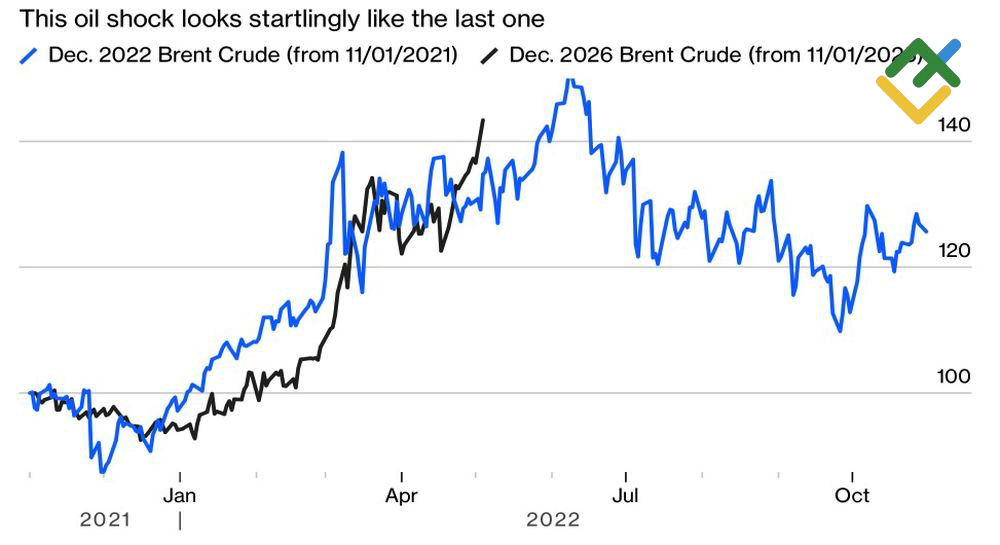
A ceasefire without a clear path to a lasting peace is likely to break down sooner or later, leading to renewed hostilities. Iran's reported attack on US ships and United Arab Emirates oil infrastructure, in response to Donald Trump's "Project Freedom," is another example of how fragile such truces can be. Brent crude oil for December delivery has surged to its highest level since the start of the conflict in the Middle East, with price action closely resembling patterns seen four years ago. This development poses additional headwinds for EUR/USD quotes.
Oil Prices at Outbreak of Conflicts in Ukraine and Middle East
Source: Bloomberg.
As the ceasefire dragged on, the US faced a choice between a protracted war—one it did not want to wage—and a lousy agreement. Rumors that Donald Trump was considering a plan for new airstrikes against Iran seemed nothing more than empty threats. By resuming hostilities, Tehran demonstrated that it is not afraid and has no intention of surrendering. Now the US administration is forced to either respond with force or swallow the bitter pill and declare its commitment to a diplomatic resolution of the conflict.
The first option could boost Brent prices to record highs. The current situation differs from the events of 2022. It is much worse. Russia found workarounds and managed to sell oil despite Western sanctions. For the Persian Gulf countries, doing the same is virtually impossible. Global oil reserves will eventually be depleted, and prices will skyrocket. The eurozone, which is heavily dependent on energy, will suffer severely. European Commissioner for Economy and Productivity Valdis Dombrovskis acknowledged that the bloc is in the grip of a stagflationary shock, despite Christine Lagarde's efforts to reassure the public and downplay such concerns.
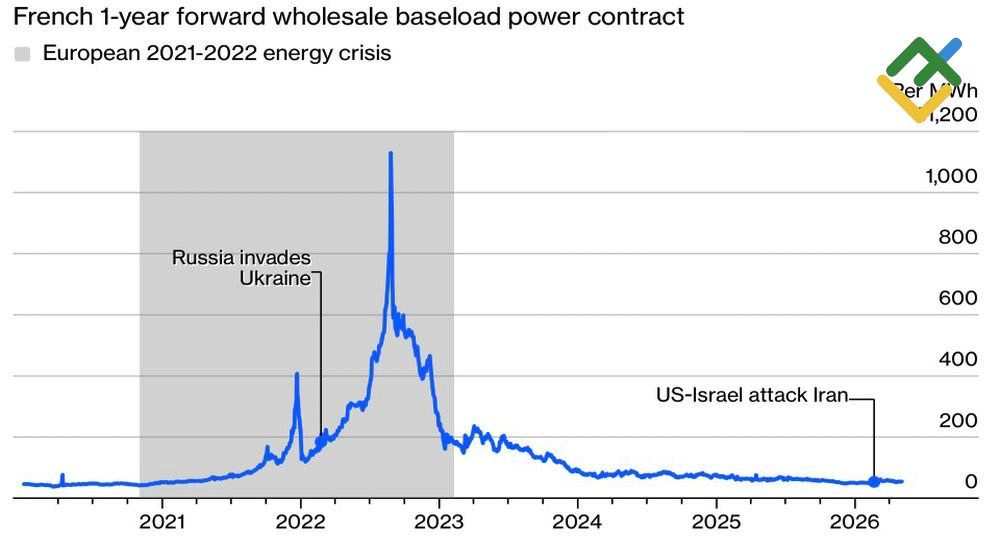
Does this mean that the euro will repeat its performance of four years ago and fall below parity with the US dollar? So far, such a scenario seems unlikely given the current state of the natural gas market. In Europe, natural gas prices are several times lower than they were in 2022.
Natural Gas Prices in Europe
Source: Bloomberg.
At the same time, Bundesbank President Joachim Nagel has joined the growing number of Governing Council officials advocating for a hike in the ECB's deposit rate in June, while New York Fed President John Williams argues that the federal funds rate should be lowered at some point. At first glance, the divergence in monetary policy is plain to see, and the EUR/USD should increase.
However, that is not the case. Investors are more concerned about geopolitical factors and safe-haven assets, and under such conditions, it is difficult to find anything that can outperform the US dollar.
Weekly Trading Plan for EUR/USD
The escalation of the conflict in the Middle East and the resulting rise in oil prices suggest that short positions opened at 1.176 and 1.1715 on the EUR/USD pair were a sound decision. If the support levels of 1.1675 and 1.165 are pierced, more short trades can be considered.
This forecast is based on the analysis of fundamental factors, including official statements from financial institutions and regulators, various geopolitical and economic developments, and statistical data. Historical market data are also considered.
Price chart of EURUSD in real time mode

The content of this article reflects the author’s opinion and does not necessarily reflect the official position of LiteFinance broker. The material published on this page is provided for informational purposes only and should not be considered as the provision of investment advice for the purposes of Directive 2014/65/EU.
According to copyright law, this article is considered intellectual property, which includes a prohibition on copying and distributing it without consent.