Investors understand that expectations of a reduction in the federal funds rate to less than 3% are overestimated. The Fed is much more cautious and can withstand pressure from the US administration. Let's discuss this topic and make a trading plan for the EURUSD pair.
The article covers the following subjects:
Major Takeaways
- The derivatives market was betting on the Fed lowering its rate to 3%.
- The FOMC forecast shows a target rate of 3.4%.
- The narrowing gap in expectations is helping the US dollar.
- Long trades on the EURUSD pair can be considered at 1.175 and 1.1785.
Weekly US Dollar Fundamental Forecast
Markets have become immune to Donald Trump's escapades, and trade uncertainty has subsided. Monetary policy is under the spotlight again. However, in reality, it has not worked as well as many had hoped. Indeed, prior to the September FOMC meeting, the EURUSD pair was actively purchased on expectations of a reduction in the federal funds rate, but then it was time to sell the news and play catch-up.
Those who closely follow the financial markets may know that there are investor expectations for the Fed's rate and FOMC forecasts. They often do not coincide. At the same time, the "Don't fight the Fed" principle forces the markets to adjust their views. This is precisely what is happening now.
Market Expectations and FOMC Forecast for Fed Interest Rate
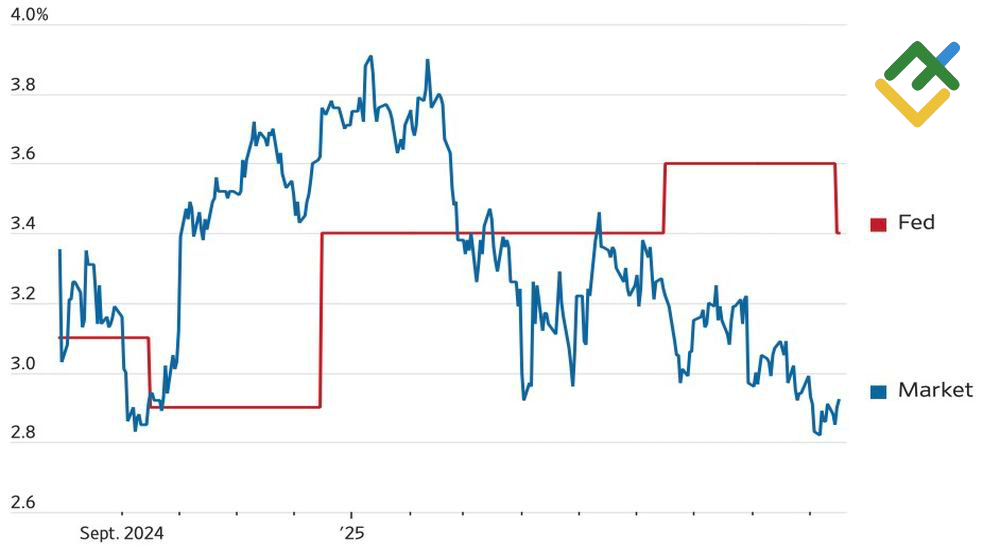
Source: Wall Street Journal.
Before the FOMC meeting, the derivatives market was expecting the federal funds rate to fall below 3% at the end of the cycle. The FOMC's revised projections showed 3.4%. The difference of 40-50 basis points is significant enough for the futures market to start reversing its outlook. The Fed will not necessarily have to aggressively ease monetary policy to save the limping labor market. Judging by the latest statistics on unemployment claims, there is no sign of panic.
What began as profit-taking on long trades in the EURUSD pair has turned into a chasing game. When the Fed announces its plans, the market adjusts its views. As a result, the major currency pair has been falling for the fourth day in a row, which seems counterintuitive given the different rates of monetary expansion in Washington and Frankfurt. Actually, this process is temporary, just like the euro's pullback against the US dollar.
US Dollar and S&P 500 Index Performance
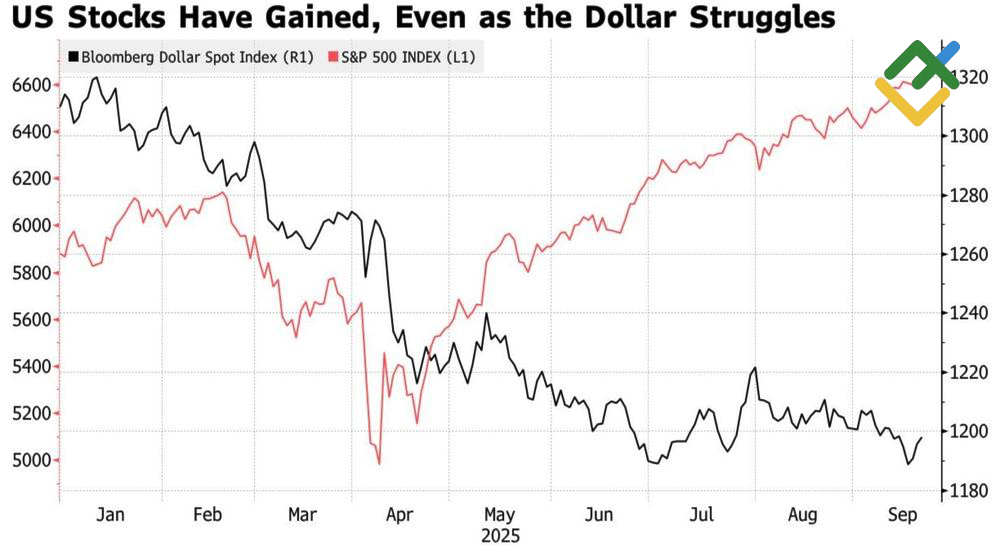
Source: Bloomberg.
Notably, rapidly growing US stock indices are not buoying the EURUSD pair. According to Citi, the process of de-dollarization is a mere myth. An analysis of the balance of payments indicates that non-residents are not fleeing US-issued assets but continue to purchase them. At the same time, they are hedging the risks of a weakening greenback by selling it. This process, coupled with the unwinding of long speculative positions on the USD index, gives Citi reason to predict that the euro will strengthen to 1.2 by the end of 2025.
The market is indeed revising its views. This includes those related to the US administration's pressure on the Fed. The pressure turned out to be less intense than expected because there was only one dissenting voice. As a result, instead of weakening, the US dollar strengthened.
Weekly EURUSD Trading Plan
Adjusting expectations does not mean changing the global outlook. Therefore, the EURUSD pair's upward trend is intact. On the other hand, catching falling knives is an extremely dangerous strategy. A safer approach would be to buy the euro when it returns above the key resistance levels of 1.175 and 1.1785.
This forecast is based on the analysis of fundamental factors, including official statements from financial institutions and regulators, various geopolitical and economic developments, and statistical data. Historical market data are also considered.
Price chart of EURUSD in real time mode

The content of this article reflects the author’s opinion and does not necessarily reflect the official position of LiteFinance broker. The material published on this page is provided for informational purposes only and should not be considered as the provision of investment advice for the purposes of Directive 2014/65/EU.
According to copyright law, this article is considered intellectual property, which includes a prohibition on copying and distributing it without consent.