The European Central Bank needs to act decisively while avoiding premature rate hikes. At first glance, the Federal Reserve's task appears more straightforward. However, the cumulative effects of inflation could still undermine its efforts. Let’s analyze the situation and develop a trading plan for the EUR/USD pair.
The article covers the following subjects:
Major Takeaways
- The blockade of the Strait of Hormuz continues.
- Inflation expectations in Europe are rising.
- The Fed should remain vigilant.
- Short and long trades on the EUR/USD pair can be opened at 1.1675 and 1.1745, respectively.
Weekly Fundamental Forecast for Dollar
The US administration expects Iran to back down amid the economic crisis. Tehran believes that the US will retreat due to rising oil prices and fears of a global recession. Donald Trump considers blocking the Strait of Hormuz a more acceptable option than bombings or the US withdrawal from the conflict zone in the Middle East. The problem is that the cumulative effect could lead to major upheavals in the oil market. This is exactly what the EUR/USD bears are waiting for.
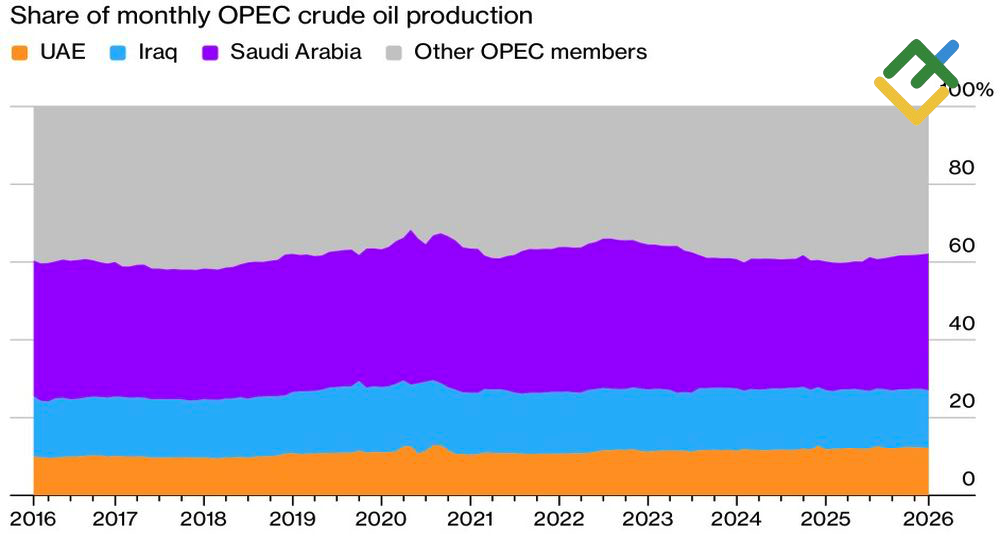
Brent and WTI continue to set the tone in financial markets. The United Arab Emirates' decision to leave OPEC shocked investors no less than rumors of the ECB's hawkish bluff. Abu Dhabi intends to ramp up crude production. Its oil output capacity is estimated at 4.8 million bpd, but due to cartel quotas, only 3.4 million bpd is currently produced. Nevertheless, given the closure of the Strait of Hormuz, the UAE's decision had little impact on the market. The country is unlikely to have sufficient stockpiling capacity, just as Iran currently lacks it.
Crude Production by OPEC Countries
Source: Bloomberg.
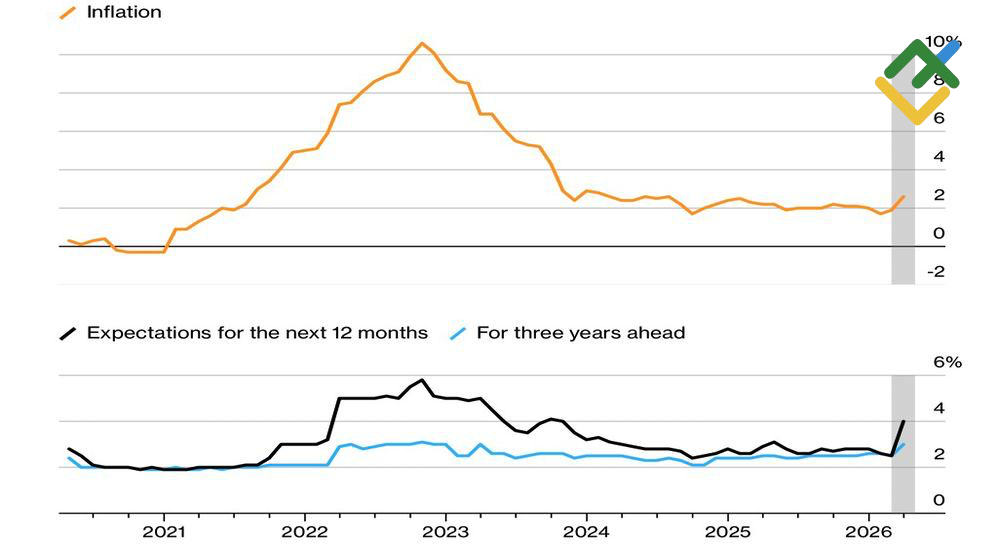
Oil prices are under upward pressure, increasing the risk of faster inflation. European consumers' 12-month inflation expectations have risen from 2.5% to 4%. In this environment, the European Central Bank must act decisively, but avoid rushing into rate hikes. Christine Lagarde risks repeating the mistake of Kazuo Ueda, whose unclear guidance on policy tightening contributed to yen weakness.
European Inflation and Inflation Expectations
Source: Bloomberg.
The futures market expects the European Central Bank to make two rate hikes, with some chance of a third. Bloomberg analysts believe there will be just one hike. Against this uncertainty, the euro has come under pressure.
While the ECB faces the threat of stagflation and is frantically trying to figure out what to do with interest rates in such a situation, the Fed's task appears simpler at first glance. The US economy is more resilient to the oil crisis, and higher inflation may once again be short-lived. In this situation, the best solution would be to wait and see what the Fed plans to do at the end of April.
In reality, it is risky to assume that the CPI surge will be only temporary. Over the past six to seven years, the global economy has already faced multiple major shocks — the pandemic, the conflict in Ukraine, trade tensions under Donald Trump, and now instability in the Middle East. The cumulative impact could raise concerns about a return to conditions reminiscent of the 1970s, marked by galloping inflation and double-dip recession.
Weekly Trading Plan for EUR/USD
Amid these conditions, consolidation in the EUR/USD pair appears natural. Investors are waiting for signals from central banks and geopolitical developments. If the pair breaks through the 1.1675 support level, a sell-off could follow; if it surges above the 1.1745 resistance level, long trades can be considered.
This forecast is based on the analysis of fundamental factors, including official statements from financial institutions and regulators, various geopolitical and economic developments, and statistical data. Historical market data are also considered.
Price chart of EURUSD in real time mode

The content of this article reflects the author’s opinion and does not necessarily reflect the official position of LiteFinance broker. The material published on this page is provided for informational purposes only and should not be considered as the provision of investment advice for the purposes of Directive 2014/65/EU.
According to copyright law, this article is considered intellectual property, which includes a prohibition on copying and distributing it without consent.