The oil market continues to respond to any news from the Middle East. However, rising US exports and falling Chinese imports are making it fundamentally stronger. Let's discuss this topic and develop a trading plan for Brent.
The article covers the following subjects:
Major Takeaways
- Iran is threatening to walk away from the negotiating table.
- Donald Trump promises an agreement next week.
- Market imbalances are narrowing due to China and the US.
- Short trades can be considered with targets of $84.5 and $79.
Weekly Fundamental Forecast for Oil
The oil market continues to believe Donald Trump, even though his words may turn out to be yet another fantasy. The US president's statements that negotiations with Iran are continuing, hostilities between Israel and Hezbollah have ceased, and the Strait of Hormuz will reopen as early as next week have forced Brent to lose ground due to rumors of yet another collapse in negotiations.
Brent crude posted its best daily rally in the past month on reports that Tehran may withdraw from negotiations if armed clashes in the Middle East continue. This includes Israeli attacks on Beirut, which is under Hezbollah control. Moreover, Iran and its allies could block not only the Strait of Hormuz but also an alternative oil route—the Bab el-Mandeb Strait. This would be a tailwind for Brent prices.
The situation risks escalating from critical to catastrophic, yet the Brent is falling, reacting sensitively to Donald Trump's comments. In fact, Brent's fundamentals have improved significantly since the start of the armed conflict in the Middle East.
Chinese Oil Imports
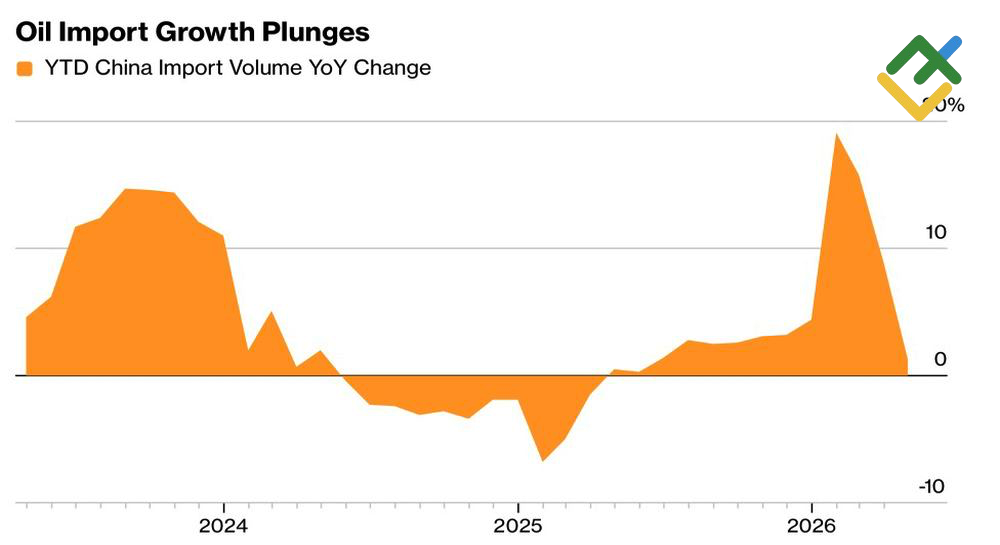
Source: Bloomberg.
First and foremost, China played a key role. Before the airstrikes on Iran in late February, China served as a sort of safety net for Brent. Its insatiable appetite for oil underpinned global demand growth and prevented prices from falling significantly. However, the surge in prices above $100 per barrel and China's active shift toward electric vehicles provided grounds for a sharp reduction in imports. Goldman Sachs estimates this at 2 million bpd, which is equivalent to a $ 10-per-barrel drop.
Asia's search for alternative oil supplies allowed the US to increase crude exports to a record 5.6 million bpd in May. The country was selling WTI crude, which is usually cheaper than Brent, enabling it to be transported to any region.
Thus, the decline in Chinese imports, coupled with the increase in US oil exports, helped the market avoid disaster. Nevertheless, global inventories are declining at a record pace and approaching critical levels. The closure of the Bab el-Mandeb Strait will only accelerate this process further. Brent may resume an upward trend. OPEC+ analysts assert that it will take months to repair the damaged energy infrastructure in the Persian Gulf.
The second week of June will be pivotal for the oil market. If Donald Trump's claims about the full reopening of the Strait of Hormuz come to nothing, the market will stop believing him, and crude prices will likely skyrocket.
Weekly Trading Plan for Brent
The US-Iran agreement, on the other hand, will allow traders to increase their existing short positions in Brent, which were established at $98.6, with targets of $84.5 and $79.
This forecast is based on the analysis of fundamental factors, including official statements from financial institutions and regulators, various geopolitical and economic developments, and statistical data. Historical market data are also considered.
Price chart of UKBRENT in real time mode

The content of this article reflects the author’s opinion and does not necessarily reflect the official position of LiteFinance broker. The material published on this page is provided for informational purposes only and should not be considered as the provision of investment advice for the purposes of Directive 2014/65/EU.
According to copyright law, this article is considered intellectual property, which includes a prohibition on copying and distributing it without consent.