The S&P 500 Index has long been regarded as a reliable barometer of US economic health, and its forecasting is a critical component of strategic decision-making for institutional and retail investors. The index is influenced by a myriad of evolving factors, including the introduction of new technologies, shifts in global trade relations, and the advancement of world economies.
Given the volatility of financial markets, predicting the S&P 500 index's performance for 2026, 2027, 2028, and beyond necessitates a comprehensive analysis of numerous factors, ranging from macroeconomic data to corporate reports. This review analyzes key trends and factors that shape the SPX's trajectory, providing investors with data-driven forecasts.
The article covers the following subjects:
- Major Takeaways
- S&P 500 Real-Time Market Status
- S&P 500 Price Forecast for 2026 Based on Technical Analysis
- Analysts' S&P 500 Price Projections for 2027
- Analysts' S&P 500 Price Projections for 2028
- Analysts' S&P 500 Price Projections for 2029
- Analysts' S&P 500 Price Projections for 2030
- Analysts' S&P 500 Price Projections until 2050
- S&P 500 (SPX) Market Sentiment on Social Media
- S&P 500 Price History
- S&P 500 Index Fundamental Analysis
- More Facts About S&P 500
- How We Make Forecasts
- Conclusion: Is the S&P 500 a Good Investment?
- S&P 500 Price Prediction FAQs
Major Takeaways
- The current price of the S&P 500 index is $7 655.3 as of 19.09.2026.
- The S&P 500 price reached its all-time high of $7812.6 on 13.08.2026. The index's all-time low of $336.91 was recorded on 04.06.1982.
- The 500 largest publicly traded US companies included in the S&P 500 account for around 80% of the total capitalization of the US stock market, providing broad sector exposure and diversification.
- Since 1970, the index has delivered an average annual total return of approximately 11.2% (with dividends reinvested), making it a benchmark for long-term portfolio strategies.
- The S&P 500 composition is reviewed quarterly, and the index is weighted by market capitalization.
- The index is mainly made up of companies in IT (about 30%), healthcare (about 13%), finance (around 13%), consumer goods (about 11%), and other sectors.
- The largest ETF, SPY, has an expense ratio of 0.09%, while the ES futures contract on the CME provides nearly 24-hour liquidity for trading and hedging.
- Over the past 40 years, the average intra-year drawdown has been about 14%; the largest annual decline was 37% (in 2008), and the biggest single-day drop was 20.5% (in 1987).
- Analysts offer mixed forecasts for the S&P 500 index in 2026. While some expect the index to decline, others anticipate substantial growth. Current projections put the S&P 500 in a range of $5,774.63–$9,961.00.
- Most forecasts for 2027 are bullish, with the index expected to trade between $6,186.91 and $18,918.00. The strongest gains are projected for the second and third quarters.
- In 2028, the S&P 500 could experience a decline or move sideways before resuming its upward trend. By 2030, forecasts put the index in a range of $9,548.67–$16,796.00.
- Long-term forecasts through 2050 are largely optimistic. The average S&P 500 price could reach around $29,346 by the end of 2040 and approach $82,734 by the end of 2050.
S&P 500 Real-Time Market Status
The S&P 500 Index is trading at $7 655.3 as of 19.09.2026.
It is imperative for investors to monitor the following key metrics of the S&P 500 Index to ensure profitable investing:
- Market capitalization is a measure of the total value of the stocks that make up the index.
- EPS is a measure of the total earnings per share of the S&P 500 Index, a metric provided by Standard & Poor's that indicates the total earnings per share (EPS) of the largest US companies within the S&P 500 index.
- The P/E ratio is the price-to-earnings ratio of the companies included in the S&P 500 index.
- The S&P 500 Shiller CAPE ratio, also known as the cyclically adjusted price-to-earnings ratio, measures the current price of the S&P 500 relative to the 10-year inflation-adjusted average earnings.
- The S&P 500 Dividend Yield is calculated by dividing the dividends per share of the S&P 500 over the past 12 months by the closing price of the S&P 500 for the month, and it reflects the dividend yield for the S&P 500 index only.
- The VIX Index, also known as the Volatility Index, measures the implied expected volatility of the US stock market.
Metric | Value |
Market capitalization | $70.3 trillion |
EPS | $326.52 |
P/E ratio | 23.85 |
Shiller CAPE ratio | 41.18 |
S&P 500 Dividend Yield (m/m) | 0.102% |
VIX | 15.03 |
S&P 500 Price Forecast for 2026 Based on Technical Analysis
The SPX continues to trade within an uptrend. The index is above both the SMA50 and SMA200, with the SMA50 remaining above the SMA200, indicating that buyers still have the upper hand.
The MACD lines are pointing upward, while the histogram signals strengthening bullish momentum. The RSI is around 64, suggesting that the index has not yet entered significantly overbought territory.
The nearest support level lies in the $7,080–$7,100 range, followed by the $6,500–$6,600 area. The resistance level is located near the current highs and the upper boundary of the ascending channel. The uptrend may continue in the coming months, although temporary corrections cannot be ruled out.
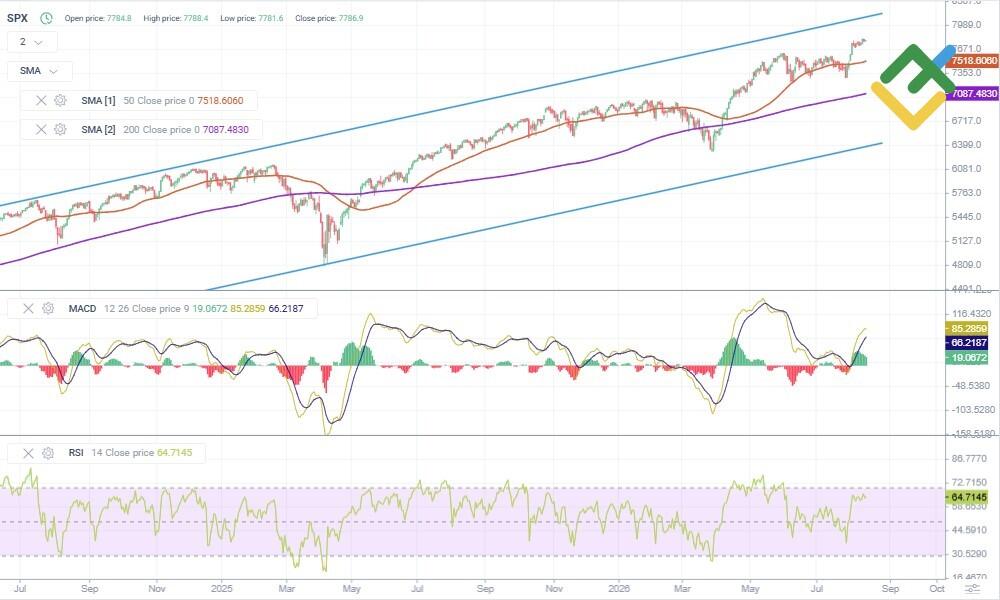
The table below shows the 12-month forecast for the S&P 500 index:
Month | Minimum, $ | Average, $ | Maximum, $ |
September 2026 | 7,350 | 7,600 | 7,850 |
October 2026 | 7,480 | 7,750 | 8,050 |
November 2026 | 7,600 | 7,900 | 8,200 |
December 2026 | 7,750 | 8,100 | 8,450 |
January 2027 | 7,900 | 8,250 | 8,600 |
February 2027 | 8,000 | 8,400 | 8,750 |
March 2027 | 8,150 | 8,550 | 8,900 |
April 2027 | 8,300 | 8,700 | 9,050 |
May 2027 | 8,450 | 8,850 | 9,200 |
June 2027 | 8,600 | 9,000 | 9,400 |
July 2027 | 8,750 | 9,150 | 9,550 |
August 2027 | 8,900 | 9,300 | 9,700 |
Long-Term Trading Plan for SPX for 2026
Main Strategy: Consider opening long positions from the $7,080–7,100 support zone, preferably after technical indicators confirm a bullish signal. The first target is the current high, where you can take partial profits. The remainder of the position can be left open in anticipation of further gains.
If the SPX breaks below the $7,080–$7,100 support zone, the correction could extend toward $6,500–$6,600. Long positions may also be considered in this area once technical indicators confirm an upward reversal. Overall, the preferred strategy is to use pullbacks to build long positions and take profits incrementally as key resistance levels are reached.
Analysts' S&P 500 Price Projections for 2026
Analysts expect the SPX to experience mixed trends through the end of 2026. The asset's price may be influenced by Fed decisions, inflation, the US economy, and corporate earnings reports.
CoinCodex
Price range: $5,774.63–$6,570.53.
According to CoinCodex, the SPX price will continue to decline. In September, the average price could reach $6,401.61, and by November, it could drop to $6,039.67. A slight recovery is expected in December. The lowest price is projected to be $5,774.63 in November.
Month | Minimum, $ | Average, $ | Maximum, $ |
September | 6,232,01 | 6,401.61 | 6,570.53 |
October | 6,157.59 | 6,318.57 | 6,531.03 |
November | 5,774.63 | 6,039.67 | 6,252.59 |
December | 6,027.91 | 6,077.70 | 6,132.82 |
LongForecast
Price range: $7,510.00–$9,961.00.
According to LongForecast, the SPX is expected to rise. In September, the average price could reach $8,171.00, and by November, it could rise to $8,466.00. Prices are expected to peak at $9,961.00 in December.
Month | Minimum, $ | Average, $ | Maximum, $ |
September | 7,510.00 | 8,171.00 | 8,861.00 |
October | 7,593.00 | 8,164.00 | 8,735.00 |
November | 7,873.00 | 8,466.00 | 9,059.00 |
December | 8,466.00 | 9,309.00 | 9,961.00 |
CoinPriceForecast
Price range: $7,496.00–$8,812.00.
According to CoinPriceForecast, the SPX will continue to rise through the end of 2026. In December, the price could reach $8,812.00.
Year | Mid-Year, $ | Year-End, $ |
2026 | 7,496.00 | 8,812.00 |
Analysts' S&P 500 Price Projections for 2027
Most analysts expect the SPX to rise in 2027. However, some forecasts suggest a sharp correction in the second half of the year. US economic growth, the labor market, and major companies' earnings may drive S&P 500 prices.
Note: The price ranges reflect the asset's expected volatility throughout the year. Lows and highs may not be shown in the summary tables.
CoinCodex
Price range: $6,186.91–$18,918.00.
According to CoinCodex, the SPX price is expected to rise in the first half of the year. In the second quarter, the price could reach a high of $18,918.00. A decline is then expected. In the fourth quarter, the average price could drop to $11,078.67.
Quarter | Minimum, $ | Average, $ | Maximum, $ |
Q1 | 6,186.91 | 6,434.69 | 6,635.55 |
Q2 | 6,541.96 | 11,447.06 | 18,918.00 |
Q3 | 11,496.00 | 14,143.33 | 16,876.00 |
Q4 | 9,979.16 | 11,078.67 | 12,871.00 |
LongForecast
Price range: $8,753.00–$12,573.00.
According to LongForecast, the SPX will remain in an uptrend. In the first quarter, the average price could be $9,468.00, and by the fourth quarter, it could rise to $11,536.33. By the end of the year, the price could reach a high of $12,573.00.
Quarter | Minimum, $ | Average, $ | Maximum, $ |
Q1 | 8,753.00 | 9,468.00 | 10,229.00 |
Q2 | 8,934.00 | 9,673.67 | 10,486.00 |
Q3 | 9,468.00 | 10,445.00 | 11,354.00 |
Q4 | 10,345.00 | 11,536.33 | 12,573.00 |
CoinPriceForecast
Price range: $10,047.00–$10,311.00.
According to CoinPriceForecast, the SPX is expected to continue rising. By mid-year, the price could reach $10,047.00, and by December, it could rise to $10,311.00.
Year | Mid-Year, $ | Year-End, $ |
2027 | 10,047.00 | 10,311.00 |
Analysts' S&P 500 Price Projections for 2028
Analysts expect mixed performance for the SPX in 2028. The US presidential election, Treasury yields, and expectations for the Fed's future monetary policy could all influence the index's trajectory.
CoinCodex
Price range: $7,422.51–$13,142.00.
CoinCodex expects the SPX to trade in a downtrend. In the first quarter, the average price could reach $12,512.33, and by the third quarter, it could drop to $9,353.67. In December, prices could fall to an annual low of $7,422.51.
Quarter | Minimum, $ | Average, $ | Maximum, $ |
Q1 | 11,383.00 | 12,512.33 | 13,142.00 |
Q2 | 8,889.67 | 10,636.48 | 12,288.00 |
Q3 | 8,809.14 | 9,353.67 | 10,220.00 |
Q4 | 7,422.51 | 8,030.74 | 8,846.60 |
LongForecast
Price range: $9,905.00–$13,420.00.
LongForecast projects that the SPX will rise in the first half of the year. In the third quarter, the price could reach a high of $13,420.00. A correction is then expected. In the fourth quarter, the average price could fall to $10,785.33.
Quarter | Minimum, $ | Average, $ | Maximum, $ |
Q1 | 10,191.00 | 11,109.33 | 12,042.00 |
Q2 | 10,205.00 | 11,374.00 | 12,407.00 |
Q3 | 10,899.00 | 12,188.67 | 13,420.00 |
Q4 | 9,905.00 | 10,785.33 | 12,542.00 |
CoinPriceForecast
Price range: $10,502.00–$10,662.00.
According to CoinPriceForecast, the SPX will continue to rise moderately. By mid-year, the price could reach $10,502.00, and by year-end, it could reach $10,662.00.
Year | Mid-Year, $ | Year-End, $ |
2028 | 10,502.00 | 10,662.00 |
Analysts' S&P 500 Price Projections for 2029
Most analysts expect the SPX's uptrend to continue. The index's performance is likely to be influenced by US fiscal policy, consumer spending, and investment by major technology companies.
CoinCodex
Price range: $7,622.43–$10,668.00.
According to CoinCodex, the SPX is expected to trade largely sideways in the first three quarters. Growth is expected in the fourth quarter. By December, prices could reach a high of $10,668.00.
Quarter | Minimum, $ | Average, $ | Maximum, $ |
Q1 | 7,648.62 | 7,914.28 | 8,527.76 |
Q2 | 7,711.22 | 8,149.23 | 8,658.32 |
Q3 | 7,622.43 | 7,923.92 | 8,333.37 |
Q4 | 8,368.70 | 9,645.39 | 10,668.00 |
LongForecast
Price range: $10,701.00–$15,243.00.
According to LongForecast, the SPX will trade in a sideways range during the first half of the year. An uptrend is expected starting in the fall. In the third quarter, the average price could reach $12,350.67. By the end of the year, prices could reach a high of $15,243.00.
Quarter | Minimum, $ | Average, $ | Maximum, $ |
Q1 | 10,701.00 | 11,751.67 | 12,993.00 |
Q2 | 10,846.00 | 11,684.00 | 12,538.00 |
Q3 | 11,063.00 | 12,350.67 | 13,694.00 |
Q4 | 11,979.00 | 13,543.67 | 15,243.00 |
CoinPriceForecast
Price range: $11,470.00–$12,102.00.
According to CoinPriceForecast, the SPX price will continue to rise gradually. By mid-year, the price could reach $11,470.00, and by year-end, the price could climb to $12,102.00.
Year | Mid-Year, $ | Year-End, $ |
2029 | 11,470.00 | 12,102.00 |
Analysts' S&P 500 Price Projections for 2030
Most analysts expect the SPX to rise in 2030. The index's performance may be influenced by corporate earnings, labor market conditions, and the pace of share buybacks.
CoinCodex
Price range: $9,548.67–$16,796.00.
According to CoinCodex, the SPX is expected to rise throughout the year. In the first quarter, the average price could be around $9,996.29, and in the third quarter, it could rise to $13,113.33. By the end of the year, the price could reach a high of $16,796.00.
Quarter | Minimum, $ | Average, $ | Maximum, $ |
Q1 | 9,548.67 | 9,996.29 | 10,574.00 |
Q2 | 10,029.00 | 10,434.67 | 11,600.00 |
Q3 | 11,579.00 | 13,113.33 | 14,346.00 |
Q4 | 12,196.00 | 14,395.67 | 16,796.00 |
CoinPriceForecast
Price range: $12,701.00–$13,129.00.
According to CoinPriceForecast, the upward trend for the SPX will continue. By mid-year, the price could reach $12,701.00, and by December, it could rise to $13,129.00.
Year | Mid-Year, $ | Year-End, $ |
2030 | 12,701.00 | 13,129.00 |
Analysts' S&P 500 Price Projections until 2050
Long-term forecasts for the S&P 500 should be viewed with caution. The index's performance can be influenced by economic cycles, Fed monetary policy, technological advancements, and structural changes in the US stock market. Such projections should therefore be regarded only as potential indicators of the index's future direction.
According to CoinPriceForecast, the S&P 500 could reach $15,818.00 by the end of 2033 and rise to $18,104.00 by the end of 2036.
CoinCodex offers a more optimistic outlook. Its forecast puts the index's average level at around $29,346.00 by 2040, with the S&P 500 potentially rising to $82,734.00 by the end of 2050.
Year | CoinPriceForecast, $ | CoinCodex, $ |
2033 | 15,818.00 | – |
2036 | 18,104.00 | – |
2040 | – | 29,346.00 |
2050 | – | 82,734.00 |
S&P 500 (SPX) Market Sentiment on Social Media
Media sentiment reflects the overall attitude of market participants toward the S&P 500 based on news reports, publications, and market commentary. Positive sentiment can support further price gains, while negative expectations may contribute to a decline. Monitoring market sentiment can help assess the short-term outlook for the SPX and serve as an additional tool when making trading decisions.
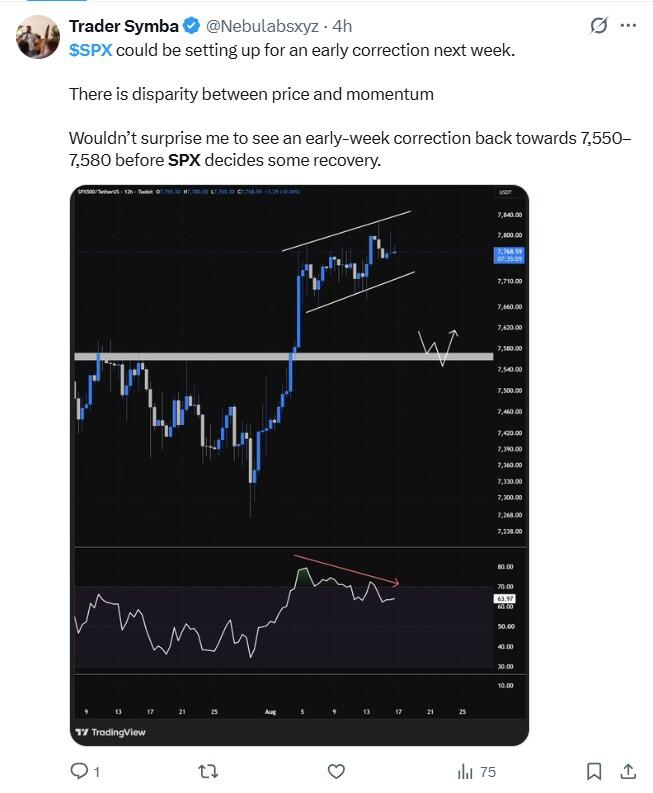
User @Nebulasxyz expects a short-term correction following the rally. The author anticipates a decline in prices before potential upward momentum.
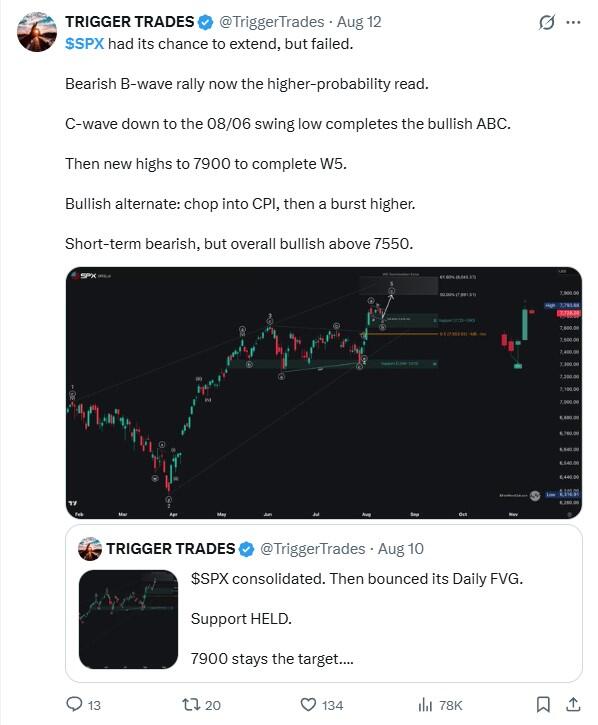
User @TriggerTrades also expects a temporary pullback, suggesting that after the correction, prices may rise and continue to hit new highs.
Overall, sentiment toward the SPX remains moderately positive. Users anticipate temporary declines but expect the uptrend to continue. However, before making any trading or investment decisions, conduct technical and fundamental analysis and review the latest expert analysis.
S&P 500 Price History
The S&P 500 (SPX) index reached its all-time high of $7812.6 on 13.08.2026. The lowest price of the S&P 500 (SPX) index was recorded on 04.06.1982 when the index declined to $336.91.
Below is a chart showing the performance of SPX over the last ten years. In this connection, it is important to evaluate historical data to make predictions as accurate as possible.
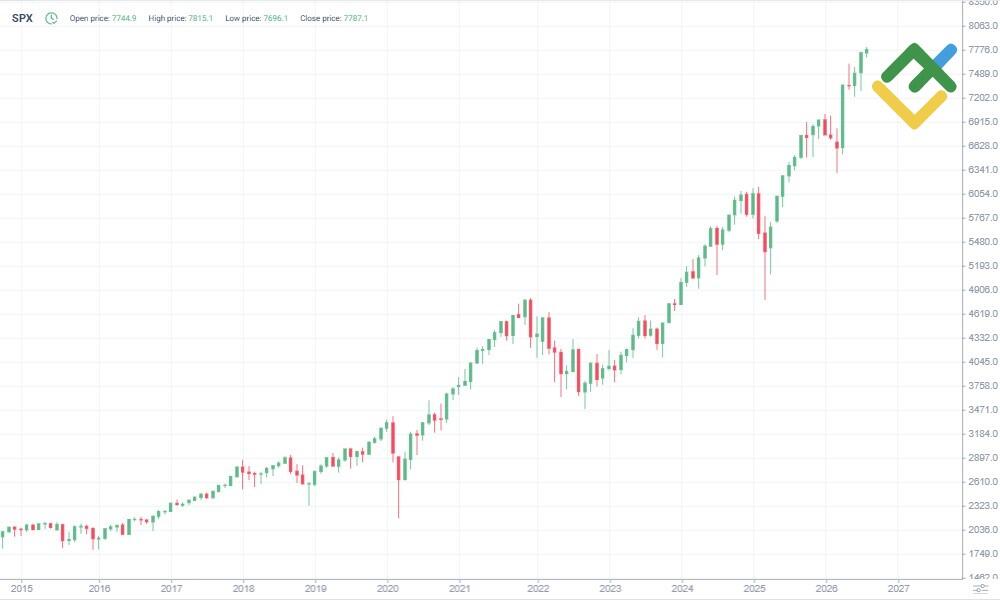
- March 2020. The index crashed due to the COVID-19 pandemic and the global economic shutdown. Concerns about corporate earnings, supply chain disruptions, and rising unemployment led to a massive sell-off and a spike in volatility.
- October–November 2022. The price reached a swing low amid the Fed's aggressive monetary policy tightening. Elevated inflation and rising interest rates weighed on stocks, after which the market began to gradually stabilize.
- November 2021–January 2022. The downward reversal followed the historic highs, when investors began to factor in the winding down of stimulus measures and the upcoming rise in interest rates.
- April 2025. A short-term correction occurred amid fears of an economic slowdown and uncertainty regarding regulatory policy. Profit-taking exacerbated the decline, but the losses were quickly recovered.
- January–July 2026. The index rose to an all-time high of $7,010.60 in January and pulled back to $6,315.10 in March amid hawkish rhetoric from the Fed, growing inflation, and the US-Iran conflict in the Middle East. By the end of May, the index had recovered its losses and set a new high, climbing to $7,618.70. In mid-August, the price continued to rise.
S&P 500 Index Fundamental Analysis
A fundamental analysis of the S&P 500 Index provides investors with a detailed understanding of its real market value. This analysis encompasses evaluating economic data, corporate reports, and other macroeconomic factors that influence the index's movement. Investors employ fundamental analysis to assess the index's long-term growth potential and determine its current price.
What Factors Affect the SPX Price?
Before making any investment decisions, investors should scrutinize the following factors to gain a strategic advantage in managing their investments in the S&P 500 Index.
- Economic climate. The overall economic indicators, including GDP, employment rates, and inflation, can have a substantial impact on the returns of companies included in the index.
- Political landscape. Shifts in tax policy, trade agreements, or political stability can lead to significant fluctuations in value.
- Corporate reports and earnings. The financial results of major companies, particularly those with substantial weighting in an index, play a crucial role in shaping the index's price.
- Investor sentiment. Market optimism or pessimism can trigger significant changes in stock prices, even if the fundamentals remain unchanged.
- Monetary policy. Central bank decisions on rates or other measures to stimulate the economy directly affect the value of the index.
- Global factors. Global economic trends, including supply and demand, directly affect companies and their value.
More Facts About S&P 500
The S&P 500 is widely regarded as the best single gauge of large-cap US equities. Developed by Standard & Poor's in 1957, it encompasses 500 prominent US companies listed on public exchanges. The index's primary objective is to offer investors a comprehensive view of the US stock market and the broader economy. The index's selection criteria, which include market capitalization, liquidity, and industry affiliation, contribute to its reliability as an indicator of broader market trends.
A key feature of the S&P 500 is its diversification. It includes companies from various sectors of the economy, such as information technology, healthcare, financials, and consumer staples. This diversification helps mitigate volatility and reduce risk for investors.
The index plays a key role in investment strategies, often serving as a benchmark for funds, including index funds and ETFs. The index's influence on global financial markets is significant, and its performance is frequently highlighted in economic news and analyses.
Advantages and Disadvantages of Investing in the S&P 500
The S&P 500 Index is an attractive investment vehicle for a wide range of investors, from novice to experienced, seeking sustainable capital growth. However, it is essential to carefully consider the potential benefits and risks associated with trading this instrument.
Advantages
- Diversification. The S&P 500 Index includes the 500 largest US companies, providing broad diversification that reduces dependence on the position of one or a few companies.
- Long-term growth. Historically, the index has shown steady growth over decades, making it attractive to long-term investors.
- Transparency and accessibility. The index is open to analysis due to readily available information, and a low entry threshold allows even beginner investors to participate in trading.
- Passive investing. This approach utilizes funds that track the performance of the index, allowing investors to benefit from market movements without the hassle of manual trading.
Disadvantages
- Market risks. The general state of the market, which is subject to volatility and crises, can affect returns.
- Limited growth in the short term. Investing in the index is not suitable for those seeking immediate profits, as its trading strategy is oriented towards long-term goals.
- Lack of control over individual stocks. Investors cannot customize a portfolio by excluding inefficient companies.
- Geography. The index focuses on the US market, which may not reflect global economic trends.
How We Make Forecasts
The following factors are important for predicting both short- and long-term changes in trading instruments such as the S&P 500 index:
1. Fundamental analysis, which includes:
- evaluation of forecasts from leading analytical firms;
- assessment of companies included in the index, e.g., their market cap, revenues and expenditures, earnings per share, business profitability, return on investment, etc.;
- estimates of the S&P 500 index market cap, total EPS, P/E ratio, S&P 500 dividend yield, and the volatility index (VIX);
- evaluation of news and statements related to the index;
- analysis of geopolitical and macroeconomic risks.
2. An analysis of market sentiment and public opinions on social media.
3. Technical analysis. The most effective and conservative research model includes a combination of candlestick, chart, and indicator analysis. This method has been proven effective in identifying price reversals. It allows investors and traders to determine optimal entry points and profit targets while eliminating risks.
Conclusion: Is the S&P 500 a Good Investment?
The S&P 500 may remain an attractive investment for long-term investors. The index is well diversified and comprises many of the largest US companies. At the same time, forecasts point to periods of moderate volatility, with growth phases potentially followed by significant corrections.
Most of the long-term forecasts reviewed point to further growth in the S&P 500, although analysts' projections vary considerably. The index's performance may be influenced by the state of the US economy, Federal Reserve policy, corporate earnings, and overall market sentiment. The S&P 500 may therefore suit investors prepared to weather temporary pullbacks and stay focused on long-term capital appreciation.
S&P 500 Price Prediction FAQs
The current price of SPX is $7 655.3 as of 19.09.2026.
Long-term forecasts suggest the S&P 500's upward trend will continue. However, corrections and consolidation periods are possible. Before making trading or investment decisions, conduct technical and fundamental analysis and review the latest market insights.
Estimates for 2026 vary significantly. According to the consensus forecast, the index is expected to range from $5,774 to $9,961. Some experts predict a decline in the index.
Most forecasts for 2027 point to growth in the S&P 500, although high volatility cannot be ruled out. Prices are expected to range from $6,186.91 to $18,918. The fastest growth is projected for the second and third quarters.
According to forecasts, the S&P 500 index will trade between $9,548.67 and $16,796 in 2030. Forecasts suggest a predominantly upward trend, with the most pronounced growth expected in December.
Over the past 10 years, the S&P 500 has delivered a return of approximately 256.15%, highlighting the index's strong long-term growth and the US stock market's historically solid performance.
Investing in the S&P 500 may offer attractive long-term returns, as most forecasts point to continued growth. However, projections vary widely, so investment decisions should reflect your risk tolerance, investment horizon, and ability to withstand potential market corrections.
Price chart of SPX in real time mode

The content of this article reflects the author’s opinion and does not necessarily reflect the official position of LiteFinance broker. The material published on this page is provided for informational purposes only and should not be considered as the provision of investment advice for the purposes of Directive 2014/65/EU.
According to copyright law, this article is considered intellectual property, which includes a prohibition on copying and distributing it without consent.