One might have expected rising geopolitical risks, accelerating inflation, and the growing likelihood of Fed tightening to replace the fear of missing out with a fear of losses. Yet this shift has not materialized so far. Let's discuss these topics and develop a trading plan for the S&P 500 index.
The article covers the following subjects:
Major Takeaways
- The S&P 500 has put new record highs on hold.
- SpaceX IPO expectations have fueled a pullback.
- Tech companies to ramp up spending.
- Consider buying the S&P 500, targeting $7,700 and $8,200.
Monthly Fundamental Forecast for S&P 500
The S&P 500 index ended its nine-week winning streak as the fear of missing out (FOMO) gave way to concerns about potential losses. Whether the pullback was triggered by renewed airstrikes on Iran, rising inflation fears, or fading excitement over a potential SpaceX IPO no longer matters. What matters is that investors were given an opportunity to buy the dip, and they took it.
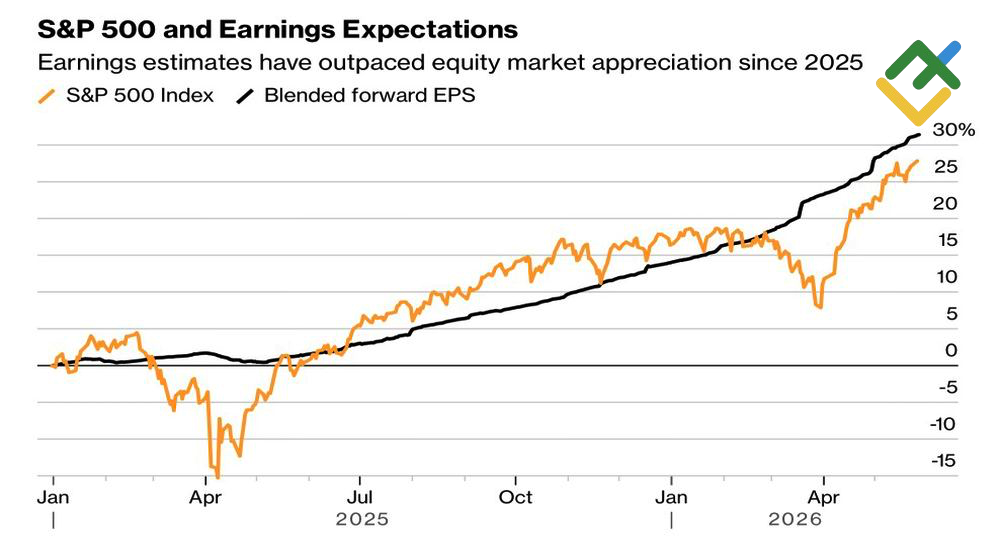
The rise of the VIX volatility index above the key 20 level may have been driven by the escalation of tensions in the Middle East. Rystad Energy warned that Brent crude could surge to $150 per barrel if Iran retaliated against the US. However, few investors appeared to take that scenario seriously. The airstrikes were widely seen as a show of force and a way to increase pressure on Iran to reach a deal. Moreover, since April, the S&P 500 has shown little sensitivity to geopolitical developments. Instead, investors have focused on strong corporate earnings and the resilience of the US economy.
S&P 500 Performance vs. Forward EPS Expectations
Source: Bloomberg.
Investors poured into chipmakers' stocks, driving the Philadelphia Semiconductor Index 90% above its January low by early June. After such a strong rally, some profit-taking was inevitable. The S&P 500's pullback was also likely triggered by investors raising cash ahead of a potential SpaceX IPO. It is difficult to attribute the decline to inflation hitting a three-year high of 4.2%, as the probability of a federal funds rate hike in 2026 has already fallen from 76% to 54% and is likely to decline further as Brent crude prices retreat amid signs of de-escalation in the Middle East.
The market has largely shaken out weak hands. SpaceX's $75 billion IPO was a success, and investors quickly stepped in to buy the dip. Attention is now turning to the company's debut on the secondary market. According to Polymarket, there is a 60% chance that the stock will soar from $135 to $150–$200 on its first trading day.
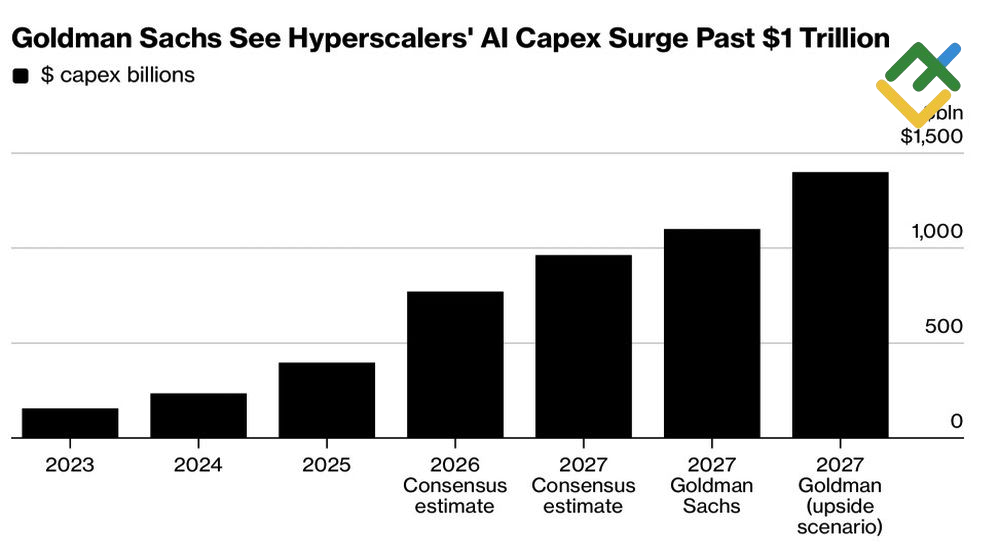
Big Tech Companies' Expenditures
Source: Bloomberg.
While aerospace is emerging as a new area of interest for investors, Big Tech is unlikely to surrender its leadership role. Goldman Sachs believes Wall Street is underestimating the scale of the AI investment boom, projecting spending of $1.4 trillion by 2027 versus the current consensus forecast of $920 billion. Such an increase would support further earnings growth and could help drive the S&P 500 index to new record highs.
Monthly Trading Plan for S&P 500
Strong corporate earnings, a resilient US economy, the continued strength of US equities, and the Fed's reluctance to raise rates are likely to propel the S&P 500 index toward 7,700 and 8,200. Recommendation: Buy.
This forecast is based on the analysis of fundamental factors, including official statements from financial institutions and regulators, various geopolitical and economic developments, and statistical data. Historical market data are also considered.
Price chart of SPX in real time mode
The content of this article reflects the author’s opinion and does not necessarily reflect the official position of LiteFinance broker. The material published on this page is provided for informational purposes only and should not be considered as the provision of investment advice for the purposes of Directive 2014/65/EU.
According to copyright law, this article is considered intellectual property, which includes a prohibition on copying and distributing it without consent.