Traditionally considered a safe-haven currency, the yen has faced significant challenges in recent years. As a result, the USDJPY pair, representing the balance of power between the US and Japanese economies, has turned into a battleground for bulls and bears. Given these developments, what lies ahead for this currency pair? Which factors are likely to exert the most influence on its trajectory?
This article provides predictions for the USDJPY exchange rate for 2026, 2027, 2028, and beyond. These forecasts are shaped by various factors, including macroeconomic trends, geopolitical developments, and technological innovation.
The article covers the following subjects:
- Major Takeaways
- USDJPY Real-Time Market Status
- USDJPY Price Forecast for 2026 Based on Technical Analysis
- Analysts' USDJPY Price Projections for 2027
- Analysts' USDJPY Price Projections for 2028
- Analysts' USDJPY Price Projections for 2029
- Analysts' USDJPY Price Projections for 2030
- WalletInvestor
- Analysts' USDJPY Price Projections up to 2050
- USDJPY Social Media Sentiment
- USDJPY Price History
- USDJPY Price Fundamental Analysis
- More Facts About USDJPY
- How We Make Forecasts
- Conclusion: Is USDJPY a Good Investment?
- USDJPY Price Prediction FAQs
Major Takeaways
The current price of the pair is ¥155.951 as of 18.09.2026.
The USDJPY pair reached its all-time high of ¥358.4 on 10.01.1971. Its all-time low of ¥75.57 was recorded on 31.10.2011.
Forecasts for 2026 remain mixed. Some analysts expect USD/JPY to decline to ¥144.00–¥147.46, while others see potential for a rise to ¥167.21. The wide range of estimates reflects continued uncertainty in the currency market.
USD/JPY is expected to rise in 2027. The pair is projected to trade within a range of ¥144.70–¥175.93.
Forecasts for 2028–2030 vary considerably. Some experts expect the pair to gradually decline to ¥156.42–¥166.79 by 2030. However, a move toward ¥202.50 is also possible.
Projections for 2040–2050 should be treated with caution. USD/JPY could be influenced by changes in US and Japanese monetary policy, economic growth, geopolitical developments, inflation, and structural changes in the global financial system.
USDJPY Real-Time Market Status
The USDJPY currency pair is trading at ¥155.951 as of 18.09.2026.
The key metrics below will help traders assess the current state of the USDJPY pair in the market.
Interest rate is the cost of borrowing money, expressed as a percentage of the loan amount. It influences both investment and consumer spending.
The national consumer price index (CPI) (YoY) measures inflation by tracking yearly changes in the cost of a standard basket of goods and services.
Economic growth (GDP) (YoY) gauges the increase in a country's goods and services over a year.
The employment rate reflects the proportion of the working-age population that is employed. A high employment rate indicates a healthy economy.
The unemployment rate is the share of the working-age population that is unemployed but actively looking for work. A low unemployment rate indicates a strong labor market.
Balance of trade is the difference between exports and imports of goods and services.
Foreign exchange reserves refer to the holdings of foreign currencies and gold that a country uses to stabilize its currency and finance imports.
External debt is the total amount a country owes to foreign lenders.
Metric | Value (Japan) | Value (US) |
Interest rate | 1.00% | 3.75% |
Consumer price index (CPI) | 1.7% | 3.5% |
Economic growth (GDP) | +0.7% | +1.5% |
Employment rate | 64.4% | 61.5% |
Unemployment rate | 2.5% | 4.2% |
Trade balance | -407.0 billion JPY | -73.26 billion USD |
Gold reserves | 846 tonnes | 8,133.5 tonnes |
External debt | 761.469 trillion JPY | 30.196 trillion USD |
USDJPY Price Forecast for 2026 Based on Technical Analysis
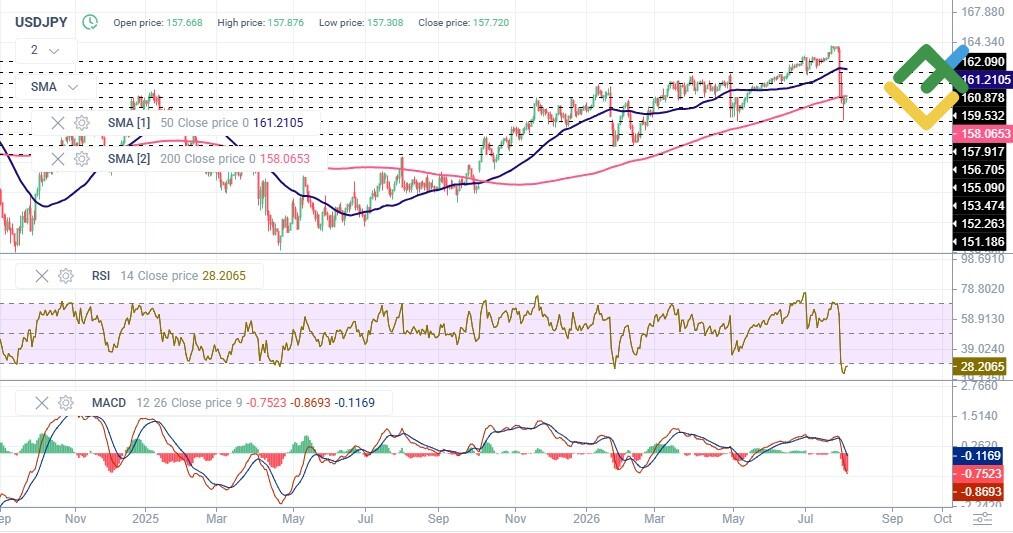
After a prolonged rally, USD/JPY has started to decline sharply. The pair has fallen back below the SMA50 but remains near the SMA200, which serves as key support.
The RSI has fallen to 28, indicating oversold conditions and a potential upward rebound. The MACD has moved into negative territory, signaling strengthening bearish momentum.
The nearest support is located in the ¥156–¥157 zone, with another support area at ¥153–¥154. Resistance is forming at ¥160–¥162. The pair could enter a recovery phase in the coming months. However, for further growth, the price needs to consolidate above the key resistance.
Below is USDJPY’s 12-month price forecast.
Month | Low, ¥ | Average price, ¥ | High, ¥ |
August 2026 | 155.8 | 158.2 | 161 |
September 2026 | 154.2 | 157 | 160.5 |
October 2026 | 152.8 | 156.2 | 159.8 |
November 2026 | 153.5 | 157.4 | 161.2 |
December 2026 | 155 | 159 | 163 |
January 2027 | 156.5 | 160.5 | 164.5 |
February 2027 | 157.2 | 161.8 | 165.8 |
March 2027 | 158 | 162.5 | 166.5 |
April 2027 | 157 | 161 | 165 |
May 2027 | 156 | 160.2 | 164 |
June 2027 | 157.5 | 161.5 | 165.5 |
July 2027 | 159 | 163 | 167 |
Long-Term Trading Plan for USDJPY for 2026
The USD/JPY strategy for 2026 involves opening long positions from the nearest support zone at ¥156–¥157, with potential targets at ¥160–¥162. Long positions can be considered if the MACD shows strengthening momentum and the RSI exits the oversold zone.
If the recovery proves weak and the pair continues to decline, a deeper drop to ¥153–¥154 is possible. Traders can also open long positions from this zone and add to them during local pullbacks.
Analysts' USDJPY Price Projections for 2026
Analysts expect mixed performance in the second half of the year. Some experts forecast a decline, while others see potential for further growth. USDJPY could be influenced by decisions from the Bank of Japan and the Fed, inflation, and other macroeconomic indicators.
CoinCodex
Price range: ¥147.46–¥157.93.
According to CoinCodex, USD/JPY is expected to decline. The average price could be around ¥155.68 in August. By November, the pair could fall to a low of ¥147.46. A modest recovery to ¥151.77 is expected in December.
Month | Low, ¥ | Average price, ¥ | High, ¥ |
August | 152.69 | 155.68 | 157.93 |
September | 149.88 | 151.57 | 153.21 |
October | 150.34 | 153.13 | 154.48 |
November | 147.46 | 149.34 | 150.69 |
December | 150.4 | 151.77 | 153.47 |
LongForecast
Price range: ¥144.00–¥160.00.
According to LongForecast, USD/JPY is expected to decline and then recover. The average price could be ¥155.00 in August and fall to ¥147.00 by October. In December, the pair could rise to ¥151.50. The price is expected to hit a low of ¥144.00 in October.
Month | Low, ¥ | Average price, ¥ | High, ¥ |
August | 150 | 155 | 160 |
September | 148 | 152.5 | 157 |
October | 144 | 147 | 150 |
November | 146 | 148.5 | 151 |
December | 149 | 151.5 | 154 |
WalletInvestor
Price range: ¥157.08–¥167.21.
According to WalletInvestor, USD/JPY is expected to remain in an uptrend. The average price could be ¥157.96 in August and rise to ¥165.30 by October. A modest correction is expected afterward. In December, the pair is projected to settle at ¥163.65.
Month | Low, ¥ | Average price, ¥ | High, ¥ |
August | 157.18 | 157.96 | 159.19 |
September | 157.08 | 160.48 | 163.86 |
October | 162.24 | 165.3 | 167.21 |
November | 160.01 | 162.18 | 164 |
December | 161.49 | 163.65 | 165.34 |
Analysts' USDJPY Price Projections for 2027
Most analysts expect USD/JPY to rise in 2027, although opinions differ on how fast the pair could grow. USD/JPY could be influenced by decisions from the Bank of Japan and the Fed, inflation, interest rate trends, and conditions in global debt markets.
Note: The price ranges reflect the asset's expected volatility throughout the year. Lows and highs may not be shown in the summary tables.
CoinCodex
Price range: ¥144.70–¥175.93.
According to CoinCodex, USD/JPY is expected to rise gradually in the first half of the year. The average price could be ¥150.35 in the first quarter and reach ¥151.13 in the second. However, the uptrend is expected to accelerate toward year-end. By December, the pair could reach a high of ¥175.93.
Quarter | Low, ¥ | Average price, ¥ | High, ¥ |
Q1 | 144.7 | 150.35 | 154.74 |
Q2 | 148.06 | 151.13 | 154.29 |
Q3 | 148.42 | 152.07 | 155.37 |
Q4 | 150.75 | 162.78 | 175.93 |
LongForecast
Price range: ¥148.00–¥165.00.
LongForecast analysts expect USD/JPY to rise gradually. The average price could be around ¥152.50 in the first quarter and climb to ¥153.33 by mid-year. The uptrend is expected to continue afterward. By December, the pair could reach a high of ¥165.00.
Quarter | Low, ¥ | Average price, ¥ | High, ¥ |
Q1 | 148 | 152.5 | 156 |
Q2 | 150 | 153.33 | 157 |
Q3 | 155 | 159 | 163 |
Q4 | 157 | 162.33 | 165 |
WalletInvestor
Price range: ¥160.14–¥171.26.
According to WalletInvestor, the USD/JPY rate will rise gradually. The average price could be around ¥163.23 in the first quarter and increase to ¥166.43 in the third quarter. By the end of the year, the pair could reach a high of ¥171.26.
Quarter | Low, ¥ | Average price, ¥ | High, ¥ |
Q1 | 161.35 | 163.23 | 166.09 |
Q2 | 160.14 | 164 | 166.92 |
Q3 | 162.07 | 166.43 | 170.46 |
Q4 | 161.42 | 165.62 | 171.26 |
Analysts' USDJPY Price Projections for 2028
Analysts have mixed forecasts for USD/JPY in 2028. Some expect the pair to decline, while others see potential for further growth. The pair could be influenced by economic growth, inflation, and central bank decisions.
CoinCodex
Price range: ¥160.19–¥175.84.
According to CoinCodex, USD/JPY is expected to decline gradually. The average price could be ¥169.12 in the first quarter and fall to ¥165.30 in the second. By year-end, the pair could recover to ¥167.96.
Quarter | Low, ¥ | Average price, ¥ | High, ¥ |
Q1 | 164.09 | 169.12 | 175.84 |
Q2 | 161.18 | 165.3 | 169.97 |
Q3 | 160.19 | 165.05 | 170.14 |
Q4 | 165.24 | 167.96 | 170.16 |
LongForecast
Price range: ¥144.00–¥163.00.
According to LongForecast, USD/JPY is expected to decline. The average price could be ¥156.67 in the first quarter and fall to ¥152.17 in the second. After a modest correction, the downtrend is expected to resume. By year-end, the pair could fall to a low of ¥144.00.
Quarter | Low, ¥ | Average price, ¥ | High, ¥ |
Q1 | 150 | 156.67 | 163 |
Q2 | 148 | 152.17 | 157 |
Q3 | 149 | 154.67 | 160 |
Q4 | 144 | 148.33 | 151 |
WalletInvestor
Price range: ¥168.67–¥190.37.
According to WalletInvestor, USD/JPY is expected to remain in a steady uptrend. The average price could be around ¥171.47 in the first quarter and increase to ¥175.13 in the second quarter. By the end of the year, it may reach a high of ¥190.37.
Quarter | Low, ¥ | Average price, ¥ | High, ¥ |
Q1 | 168.67 | 171.47 | 176.9 |
Q2 | 172.26 | 175.13 | 179.26 |
Q3 | 173.45 | 177.42 | 185.58 |
Q4 | 176.67 | 185.14 | 190.37 |
Analysts' USDJPY Price Projections for 2029
Analysts are divided on the outlook for USD/JPY in 2029. Some expect the pair to rise gradually, while others anticipate high volatility. USD/JPY could be influenced by central bank decisions, global economic conditions, and demand for safe-haven assets.
CoinCodex
Price range: ¥155.81–¥170.22.
CoinCodex analysts expect USD/JPY to rise gradually. The average price could be ¥161.01 in the first quarter and climb to ¥162.42 in the second. The uptrend could continue thereafter, with the pair reaching a high of ¥170.22 by year-end.
Quarter | Low, ¥ | Average price, ¥ | High, ¥ |
Q1 | 155.81 | 161.01 | 168.47 |
Q2 | 157.5 | 162.42 | 165.61 |
Q3 | 163.62 | 165.93 | 169.57 |
Q4 | 163.07 | 167.67 | 170.22 |
LongForecast
Price range: ¥149.00–¥173.00.
According to LongForecast, USD/JPY is expected to strengthen gradually despite high volatility. The average price could be ¥154.67 in the first quarter and climb to ¥157.33 in the second. The uptrend is expected to continue in the second half of the year. By December, the pair is projected to stabilize around ¥165.67.
Quarter | Low, ¥ | Average price, ¥ | High, ¥ |
Q1 | 149 | 154.67 | 159 |
Q2 | 151 | 157.33 | 164 |
Q3 | 153 | 159 | 165 |
Q4 | 159 | 165.67 | 173 |
WalletInvestor
Price range: ¥167.92–¥196.85.
According to WalletInvestor, USD/JPY is expected to rise after a prolonged correction. The average price could be ¥176.58 in the first quarter and decline to ¥174.98 in the second. The trend is then expected to turn bullish. By December, the price will likely reach a high of ¥196.85.
Quarter | Low, ¥ | Average price, ¥ | High, ¥ |
Q1 | 167.92 | 176.58 | 180.24 |
Q2 | 168.48 | 174.98 | 180.23 |
Q3 | 176.72 | 181.81 | 188.62 |
Q4 | 185.8 | 191.42 | 196.85 |
Analysts' USDJPY Price Projections for 2030
Analysts have mixed views on USD/JPY in 2030. CoinCodex expects moderate price fluctuations, while WalletInvestor forecasts further growth. The pair could be influenced by interest rates, global economic conditions, and shifts in the currency market.
CoinCodex
Price range: ¥156.42–¥166.79.
According to CoinCodex, USD/JPY is expected to trade within a relatively narrow range. The average price could be ¥163.92 in the first quarter and ¥163.51 in the second. The pair could decline to ¥159.63 in the summer and recover to ¥161.78 by the fourth quarter.
Quarter | Low, ¥ | Average price, ¥ | High, ¥ |
Q1 | 159.77 | 163.92 | 166.6 |
Q2 | 159.19 | 163.51 | 166.79 |
Q3 | 156.42 | 159.63 | 162.41 |
Q4 | 158.9 | 161.78 | 163.16 |
WalletInvestor
Price range: ¥182.18–¥202.50.
According to WalletInvestor, USD/JPY is expected to rise for most of the year. The average price could be ¥188.34 in the first quarter and decline to ¥186.33 in the second. Strong growth is expected thereafter. By the end of the year, the price could reach a high of ¥202.50.
Quarter | Low, ¥ | Average price, ¥ | High, ¥ |
Q1 | 185.03 | 188.34 | 192.21 |
Q2 | 183.56 | 186.33 | 188.5 |
Q3 | 182.18 | 186.66 | 195.03 |
Q4 | 195.65 | 199.36 | 202.5 |
Analysts' USDJPY Price Projections up to 2050
Long-term USD/JPY forecasts should be treated with caution. The pair could be influenced by changes in the monetary policies of the Fed and the Bank of Japan, inflation, economic growth, and conditions in global capital markets.
Geopolitical developments, changes in international trade, shifts in capital flows, and demand for safe-haven assets will also play an important role. Long-term forecasts should be viewed as a general guide rather than precise predictions of future exchange rates.
USDJPY Social Media Sentiment
Social media sentiment reflects the overall attitude toward USDJPY based on publications and market commentary. Positive news about the US economy could support USD/JPY, while negative expectations could put further pressure on the pair.
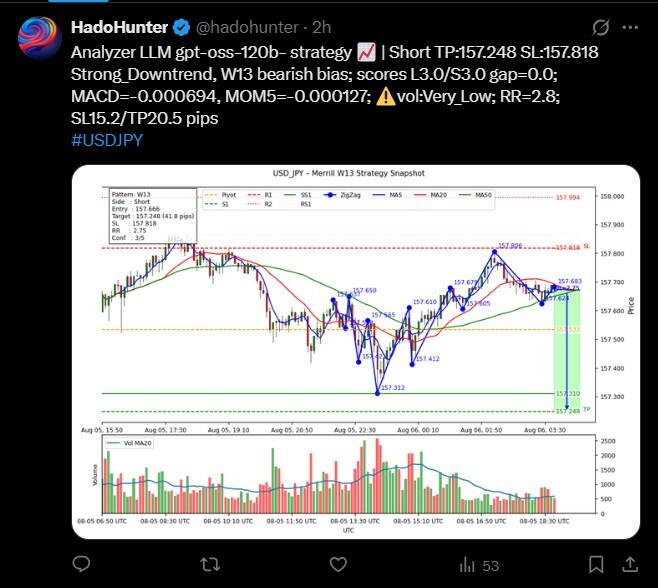
User @hadohunter expects USD/JPY to decline. Upward corrections are possible, but the author favors short positions.
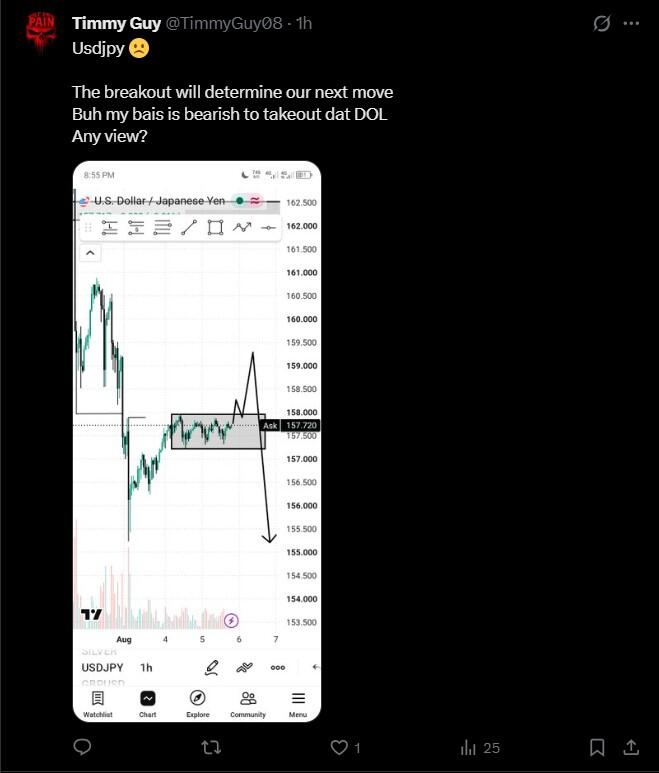
@TimmyGuy08 also remains cautious. He notes that the pair's next move will depend on whether it can break out of its current trading range. However, the main scenario points to further downside.
Overall, most traders and investors expect USD/JPY to decline in the short term. However, trading and investment decisions should be based on both technical and fundamental analysis, as well as up-to-date expert research.
USDJPY Price History
The USDJPY pair reached its all-time high of 358.4 JPY on 10.01.1971.
The lowest price of the USDJPY pair was recorded on 31.10.2011 and reached 75.57 JPY.
The chart below shows the USDJPY pair performance over the last ten years. Evaluating historical data is crucial for making accurate forecasts.
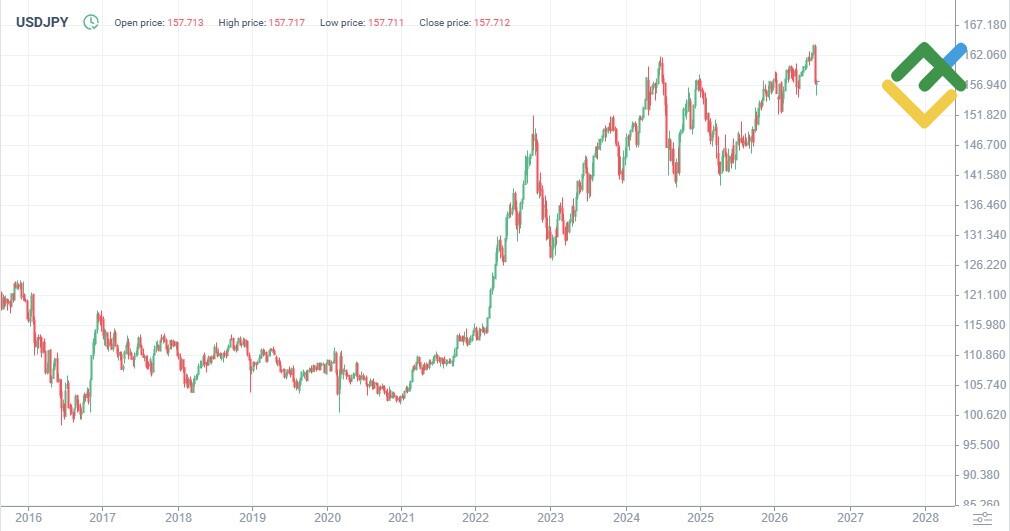
From 2020 to early 2025, the USDJPY exchange rate has experienced significant swings, influenced by global economic and political factors:
In early 2020, with the onset of the COVID-19 pandemic, the yen strengthened as a safe-haven currency, pushing the pair towards ¥102.00. However, with extensive stimulus measures in the US and a global economic recovery in 2021, the yen started to weaken, resulting in an upward trend for the USDJPY.
In 2022, US inflation began to increase rapidly, prompting the US Fed to tighten its monetary policy. This decision led to a further strengthening of the US dollar and propelled the USDJPY exchange rate to reach multi-year highs by the year's end. Meanwhile, the Bank of Japan's ultra-loose policy only exacerbated the situation.
In 2023, US inflation growth decelerated, but the Fed continued to elevate rates. The BOJ started to adjust its policy, allowing bond yields to rise, which resulted in a correction in the USDJPY pair.
In 2025, the USDJPY pair showed highly volatile but predominantly upward movement. After the yen weakened in the spring, the dollar gradually strengthened, and by the fall, the exchange rate had returned to the upper levels of the range. The increase was supported by the interest rate differential and expectations that the Fed would maintain its strict monetary policy. The pair remained sensitive to central bank actions and global economic shifts, which sparked elevated volatility in the market.
In January 2026, USDJPY stood at ¥156.67, before falling sharply to ¥152.27 by mid-February. By April, the pair had climbed to ¥160.47 amid geopolitical uncertainty, but by the end of the month, it had dropped back to ¥155.04. The uptrend subsequently resumed, and the pair is trading at around ¥158.05 in early August.
USDJPY Price Fundamental Analysis
Fundamental analysis of the USDJPY exchange rate is based on the assessment of macroeconomic indicators of the US and Japan. The key factors affecting the pair's performance include the interest rates of the Fed and the Bank of Japan and the geopolitical situation, among others. The combination of these factors determines the long-term trends of the USDJPY exchange rate.
What Factors Affect the USDJPY Price?
Interest rates. The difference in interest rates set by the US Fed and the Bank of Japan significantly affects the appeal of the USDJPY pair. High interest rates in the US make the greenback more attractive for investors, which leads to the appreciation of the USDJPY pair.
Economic indicators. Important economic data such as GDP, inflation, unemployment rate, and retail sales figures signal the state of the economy in both countries. Positive economic data from the US usually leads to a stronger US dollar, while negative data tends to weaken its value.
Geopolitical risks. Political instability, trade wars, and international conflicts can be harmful to the USDJPY exchange rate. During periods of uncertainty, investors often seek safety in more stable currencies, such as the Japanese yen, which causes the USDJPY pair to weaken.
Monetary policy. The decisions made by the US Fed and the Bank of Japan, including measures like monetary policy easing or tightening, significantly influence the USDJPY exchange rate.
Balance of trade. The difference between exports and imports of the US and Japan can also affect the USDJPY exchange rate. Countries with a large trade surplus usually have a stronger currency.
Market sentiment. General market sentiment and risk appetite can also influence the USDJPY exchange rate. During periods of optimism, investors tend to take risks and buy the US dollar, while during pessimistic periods, they prefer safer assets such as the Japanese yen.
More Facts About USDJPY
The USDJPY pair represents the value of the US dollar in relation to the Japanese yen and is among the most traded currency pairs globally, known for its high liquidity and volatility.
As a barometer of global market sentiment, the USDJPY pair reflects investor confidence. Typically, when investors are confident, they tend to buy the US dollar, leading to an increase in the pair's value. Conversely, when investors are apprehensive, they turn to the Japanese yen, causing the USDJPY pair to fall.
Notably, the USDJPY is a complex currency pair that is influenced by many factors. Thus, traders need to carefully analyze all available data before making any decisions. Understanding the relationship between these factors is the key to successful trading in the USDJPY market.
Advantages and Disadvantages of Investing in USDJPY
Investing in the USDJPY currency pair, as with any other asset, comes with certain advantages and disadvantages. Therefore, it is crucial to carefully weigh the pros and cons before making an investment decision.
Advantages
High liquidity. The USDJPY pair is one of the most traded currency pairs in the world, which ensures high liquidity and makes it easy to buy and sell currency at any time.
Volatility. The volatility of the USDJPY pair provides traders with opportunities to profit on both upward and downward movements.
Transparency. Data on factors affecting the USDJPY exchange rate is widely available, allowing traders to conduct fundamental and technical analyses.
Portfolio diversification. Investing in USDJPY can help diversify an investment portfolio and reduce overall risk.
Disadvantages
Heightened risk. The volatility of the USDJPY pair also means that investing in this currency pair involves a high risk of loss.
Influence of macroeconomic factors. The USDJPY exchange rate is influenced by many macroeconomic factors, such as interest rates, inflation, and geopolitical risks, which require traders to constantly monitor and analyze the market.
Requires knowledge and experience. Successful USDJPY trading demands in-depth knowledge of the currency market, as well as experience in technical and fundamental analyses.
Leverage risk. Using leverage can boost potential profits, but it can also increase potential losses.
Spread. The spread between the buy and sell price can reduce the profitability of short-term trades.
How We Make Forecasts
In order to forecast the USDJPY currency pair performance in the short and long term, it is essential to use a comprehensive approach that includes the following elements:
1. An in-depth fundamental analysis that involves:
analyzing expert forecasts from reputable analytical companies;
examining the US and Japanese economies, including economic growth rates, economic stability, GDP, interest rates, and inflation rates;
assessing current monetary policy, particularly monetary policy easing and tightening;
analyzing trade relations between the two countries, including the balance of exports and imports, existing trade agreements, and other relevant aspects;
studying geopolitical and macroeconomic risks that could affect the exchange rate.
2. Estimating prevailing market sentiment and public opinion expressed on social media and other platforms.
3. Technical analysis. The movement of currency pairs often follows certain cycles, and many factors are already factored into the current value. The price chart reflects not only statistical data but also the psychology of market participants. Technical analysis uses a wide range of methods and tools. The most effective and safe approach involves the complex use of candlestick analysis, chart patterns, and technical indicators. This method helps traders identify optimal moments to enter the market with minimal risk and determine potential profit-taking levels in advance.
Conclusion: Is USDJPY a Good Investment?
The outlook for USD/JPY depends on the investment horizon and the chosen strategy. Analysts have different views on the pair's future performance: some expect a moderate decline, while others see potential for long-term appreciation.
Forecasts for 2026–2030 vary considerably, reflecting a high degree of market uncertainty. USD/JPY could be influenced by decisions from the Fed and the Bank of Japan, interest rate trends, inflation, global economic conditions, and market sentiment.
USD/JPY may appeal to traders who are prepared to consider macroeconomic risks and regularly review their trading plans. Long-term forecasts should be viewed only as indicative scenarios, and decisions should take into account individual risk tolerance and financial goals.
USDJPY Price Prediction FAQs
The currency pair is trading at ¥155.951 as of 18.09.2026.
Analysts have mixed forecasts for USD/JPY. Some expect the pair to weaken gradually, while others anticipate further growth. In the long term, USD/JPY is projected to trade within a range of ¥144.00–¥202.50, reflecting significant market uncertainty.
USD/JPY forecasts for 2026 vary considerably. Some analysts expect the pair to decline in the second half of the year, while others forecast moderate growth. USD/JPY is projected to trade within a range of ¥144.00–¥167.21.
Long-term forecasts remain mixed. Some analysts expect USD/JPY to strengthen gradually, while others anticipate periods of decline followed by a recovery. Based on the forecasts reviewed, the pair is projected to trade within a range of ¥144.00–¥202.50 in the coming years.
There is no clear consensus. Analysts are divided, with some expecting USD/JPY to rise and others forecasting a decline. The actual exchange rate will depend on the monetary policies of the Fed and the Bank of Japan, inflation, and broader global economic conditions.
The outlook for the USDJPY pair is impacted by a range of factors, including the interest rates set by the US Fed and the Bank of Japan, inflation in both countries, geopolitical risks, the balance of trade, and the overall economic health of the US and Japan.
The economic backdrop has a direct impact on the USDJPY exchange rate. Federal Reserve and BOJ policy decisions, interest rate changes, and key economic indicators all help shape the pair's direction. For example, rate hikes in the US tend to strengthen the dollar. Global economic conditions can fuel market volatility.
USDJPY movements will be heavily influenced by Fed and BOJ rate decisions, inflation data, and GDP growth. Volatility may increase in response to geopolitical tensions, trade negotiations, and shifts in the global economy. Elections and market-moving political events deserve special attention.
Price chart of USDJPY in real time mode
The content of this article reflects the author’s opinion and does not necessarily reflect the official position of LiteFinance broker. The material published on this page is provided for informational purposes only and should not be considered as the provision of investment advice for the purposes of Directive 2014/65/EU.
According to copyright law, this article is considered intellectual property, which includes a prohibition on copying and distributing it without consent.