According to Kaizo Ueda's remarks, the BoJ may not raise interest rates, and the decision will depend on the conditions ahead of the regulator's next meeting. This scenario deprives the yen of an important advantage. Let's analyze the situation and develop a trading plan for the USD/JPY pair.
The article covers the following subjects:
Major Takeaways
- The Bank of Japan kept its policy rate at 0.75%.
- The inflation forecast was raised, while the GDP forecast was lowered.
- Kazuo Ueda refrained from signaling a shift toward tightening.
- Long positions on the USD/JPY pair can be opened if the price breaks through 159.7.
Weekly Fundamental Forecast for Yen
The Bank of Japan was the first major regulator to signal a hawkish stance. The odds of an overnight rate hike in April, ahead of the Policy Board meeting, were estimated at 3%; in June, they stood at 65%. A clear signal was needed, and BlackRock warned that Kazuo Ueda's miscommunication would cost the yen dearly. In fact, that is exactly what happened.
The USD/JPY pair briefly plunged below 159 after the BoJ revised its GDP forecast for the current fiscal year down from 1% to 0.5%, while raising its inflation outlook from 1.9% to 2.8%. At the same time, three Policy Board members voted in favor of increasing the overnight rate from 0.75% to 1%. With a growing number of hawkish voices, the question arises: why hasn't the yen strengthened more decisively?
USD/JPY Rate and Currency Interventions
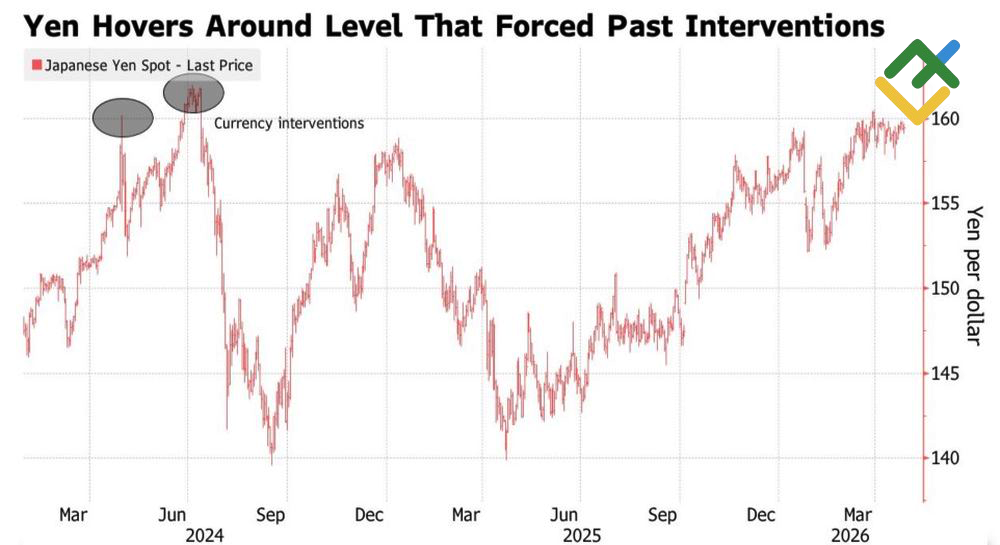
Source: Bloomberg.
Prior to the Bank of Japan meeting, the government issued a preemptive warning. Finance Minister Satsuki Katayama stated that her ministry was ready to intervene in the foreign exchange market at any time. It is working closely with the Americans and will not allow speculators to drive the USD/JPY exchange rate through the roof.
The government was clearly uncertain about how markets would react to the BoJ meeting and prepared for all possible outcomes, including a weakening of the yen. Such a scenario could arise if the BoJ governor's signals on future rate hikes failed to convince investors. In the end, that is exactly what happened.
In fact, Kazuo Ueda began on a strong note, stating that the risks of rising inflation outweigh those of an economic slowdown. He added that the BoJ could raise rates provided the economy avoids a recession amid rising prices. However, his remarks that the Bank of Japan might struggle to manage its economic forecasts unsettled investors. Previously, the central bank had tied any resumption of monetary tightening to achieving its inflation and growth projections.
Japan's CPI Change
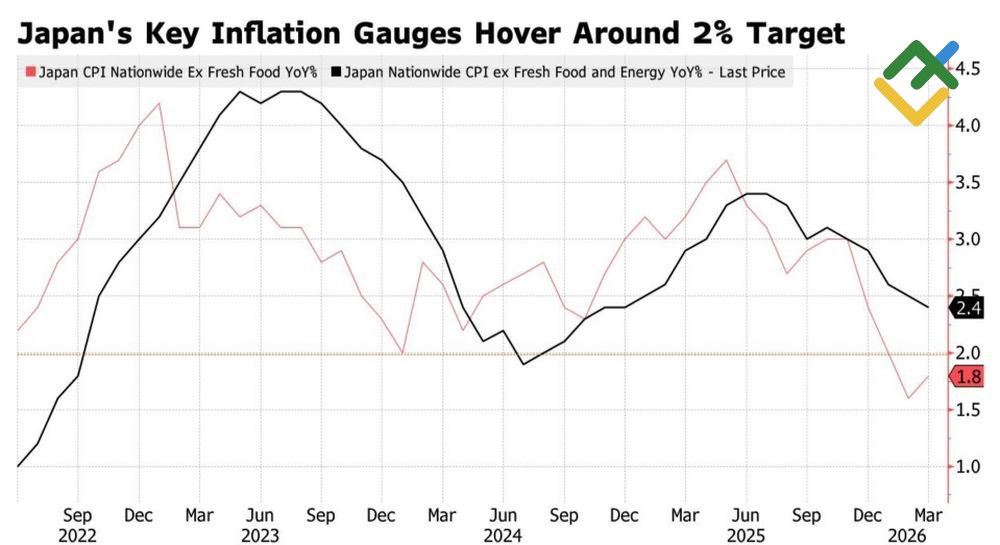
Source: Bloomberg.
The latest macroeconomic data from Japan was mixed. Consumer prices accelerated from 1.6% to 1.8% in March, exceeding Bloomberg analysts' forecasts. Core inflation rose to 2.4%.
At the same time, the longer the conflict in the Middle East lasts, the higher oil prices will climb, and the greater the likelihood of stagflation in Japan. In this connection, it will be incredibly difficult to make decisions on interest rates. Keeping rates unchanged in June would be a severe blow to the yen.
Weekly USDJPY Trading Plan
Speculators are caught between ambition and caution. They are willing to test the authorities' resolve to defend the 160 level, yet remain wary of potential intervention. If the USD/JPY pair breaks through the resistance level of 159.7, the pair may climb higher. The key question is where the government might step in. It is possible that officials will tolerate a move toward 161–162. For now, long positions can be considered on sharp pullbacks.
This forecast is based on the analysis of fundamental factors, including official statements from financial institutions and regulators, various geopolitical and economic developments, and statistical data. Historical market data are also considered.
Price chart of USDJPY in real time mode

The content of this article reflects the author’s opinion and does not necessarily reflect the official position of LiteFinance broker. The material published on this page is provided for informational purposes only and should not be considered as the provision of investment advice for the purposes of Directive 2014/65/EU.
According to copyright law, this article is considered intellectual property, which includes a prohibition on copying and distributing it without consent.