Verizon Communications Inc. (VZ) has always piqued investor interest due to its stability, dividend yield, and solid foothold in the telecommunications sector. As the 5G market emerges and demand for wireless technology and corporate services rises, it is crucial to take a nuanced approach to understanding the asset's pricing trends.
This article delves into #VZ's price forecasts for the years ahead, providing a thorough technical and fundamental analysis and identifying the key factors shaping Verizon's stock price. It also assesses market sentiment, provides a long-term trading plan, and discusses the outlook for investing in Verizon through 2050.
The article covers the following subjects:
- Major Takeaways
- VZ Real-Time Market Status
- VZ Stock Price Forecast for 2025–2026 Based on Technical Analysis
- Analysts' VZ Shares Price Projections for 2026
- Analysts' VZ Shares Price Projections for 2027
- Analysts' VZ Shares Price Projections for 2028
- Analysts' VZ Shares Price Projections for 2029
- Analysts' VZ Shares Price Projections for 2030
- Analysts' VZ Shares Price Projections until 2050
- Market Sentiment for VZ (Verizon) on Social Media
- VZ Price History
- VZ Shares Fundamental Analysis
- More Facts About VZ
- How We Make Forecasts
- Conclusion: Is VZ a Good Investment?
- Verizon Price Prediction FAQs
Major Takeaways
- The current price of VZ is $45.91 as of 03.10.2026.
- The VZ price reached its all-time high of $62.5 on 04.10.1999. The stock's all-time low of $7.32 was recorded on 27.12.1983.
- The company's primary rivals in the telecommunications sector are AT&T, T-Mobile, and other prominent industry leaders.
- Verizon holds a dominant position in the enterprise solutions and business services sector.
- The company's financial performance is influenced by macroeconomic conditions, interest rates, and the competitive landscape in the market.
- Institutional investors hold a substantial amount of Verizon shares.
- Most forecasts for the remainder of 2025 predict that the value of Verizon Inc. securities will rise to $43.97–$45.36. At the same time, some analysts argue that the asset's price may fall to around $41.09–$38.37.
- The outlook for 2027–2030 is mixed. According to some estimates, the VZ price will increase to $70.18–$75.79 by 2030, while conservative forecasts indicate a range of $24.13–$21.07.
VZ Real-Time Market Status
The VZ stock is trading at $45.91 as of 03.10.2026.
A comprehensive assessment of key metrics for Verizon (VZ) is essential for investors to make informed decisions. Key metrics include market capitalization, trading volume, and price change over a year. The company's market cap reflects the overall value of the company, while trading volume indicates investor engagement. Investors should also consider the stock's all-time highs and lows to gauge its historical volatility.
Metric | Value |
Market capitalization | $184.50 billion |
Trading volume (24 hours) | 7.963 million VZ |
Price change over the last year | 3.7% |
All-time high | $62.5 |
All-time low | $7.32 |
Shares outstanding | 4.216 billion VZ |
VZ Stock Price Forecast for 2025–2026 Based on Technical Analysis
Let's conduct a technical analysis of Verizon Inc. shares on the weekly chart to forecast their price movement for the coming year.
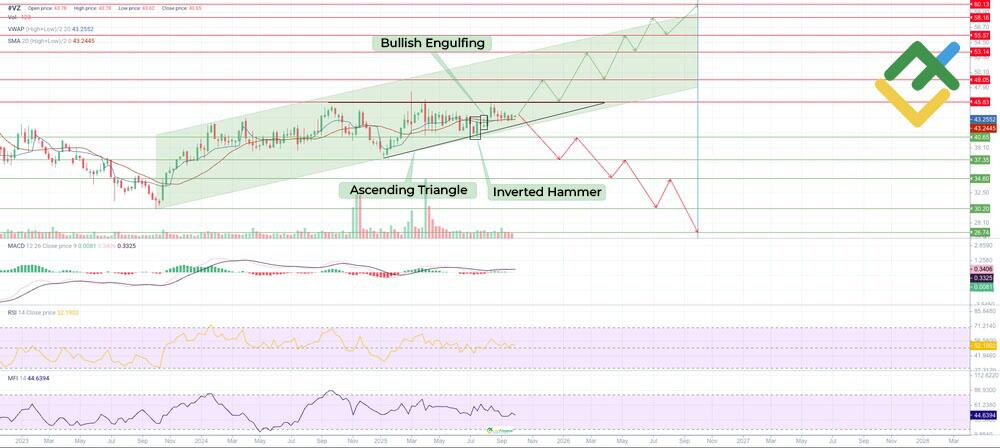
Since mid-August 2025, the price has been moving in a narrow sideways channel, ranging between 42.87 and 45.75. Currently, the asset is hovering at 45.91. Technical indicators and candlestick patterns provide different signals regarding further price movement:
- A large Ascending Triangle pattern is forming on the chart. The price is expected to break above its upper boundary of 45.83, with a potential target at 53.14 and higher. A Bullish Engulfing and Inverted Hammer candlestick patterns have emerged within the Triangle near the key support of 40.65. These patterns indicate that the asset is poised to grow and warn market participants of mounting bullish pressure.
- The MACD values are neutral, moving close to zero, demonstrating a lack of momentum.
- The RSI value is holding at 52, suggesting a neutral market condition.
- The MFI indicates that liquidity remains stable, with no significant inflow of capital into the asset.
- The VWAP indicator and the 20-day SMA are below the market price, pointing to a predominantly bullish sentiment.
The table below shows the projected values of Verizon Inc. (#VZ) shares for the next 12 months:
Month | Minimum, $ | Maximum, $ |
October 2025 | 43.02 | 45.48 |
November 2025 | 44.90 | 48.45 |
December 2025 | 46.28 | 49.31 |
January 2026 | 45.41 | 49.60 |
February 2026 | 49.10 | 52.78 |
March 2026 | 49.24 | 53.58 |
April 2026 | 48.74 | 52.78 |
May 2026 | 51.77 | 56.62 |
June 2026 | 51.41 | 57.48 |
July 2026 | 55.24 | 58.57 |
August 2026 | 54.95 | 57.63 |
September 2026 | 57.12 | 59.80 |
Long-Term Trading Plan for #VZ for 2025–2026
The technical analysis of the weekly #VZ chart has revealed key support and resistance levels that can be used in a trading strategy for the coming year.
Trading Plan for the Year
- The price will likely surge over the next 1–3 months.
- Key support levels: 40.64, 37.35, 34.60, 30.20, and 26.74.
- Key resistance levels: 45.83, 49.05, 53.14, 55.57, 58.16, and 60.13.
- Base long-term scenario: Open long trades above the key resistance of 45.83 with potential targets in the $49.05–60.13 range.
- Alternative long-term scenario: Open short trades below the key support of 40.64 with potential targets in the 37.35–26.74 range.
Analysts' VZ Shares Price Projections for 2025
Experts predict that VZ shares will grow moderately in the remaining months of 2025, amid strong demand for communications services and the expansion of the 5G network. Average analyst estimates are mixed, suggesting potential market volatility and the influence of external factors.
LongForecast
Price range in 2025: $40.05–$48.99 (as of 02.10.2025).
According to LongForecast, Verizon's price is projected to move in a moderate uptrend in the remaining months of 2025. The asset is expected to open at $44.23 in October and close at $ 45.36 at the end of the year, hitting a high of $48.99 in December.
Month | Open, $ | Min–Max, $ | Close, $ |
October | 44.23 | 40.05–48.34 | 43.96 |
November | 43.96 | 40.15–47.49 | 43.97 |
December | 43.97 | 41.73–48.99 | 45.36 |
Gov Capital
Price range in 2025: $36.98–$47.83 (as of 02.10.2025).
According to Gov Capital, the average VZ price may reach around $43.48 by the end of October 2025. In November and December, bearish momentum is expected to intensify, dragging the price down to $41.09.
Month | Minimum, $ | Average, $ | Maximum, $ |
October | 39.13 | 43.48 | 47.83 |
November | 38.38 | 42.65 | 46.91 |
December | 36.98 | 41.09 | 45.20 |
CoinCodex
Price range in 2025: $37.32–$43.50 (as of 02.10.2025).
CoinCodex anticipates that the average price of VZ will trade in the range of $42.23–$38.37 in the remaining months of 2025. The asset is expected to hit a high of only $39.41 at the end of the year, pointing to a potential downtrend.
Month | Minimum, $ | Average, $ | Maximum, $ |
October | 40.84 | 42.23 | 43.50 |
November | 37.72 | 39.47 | 42.27 |
December | 37.32 | 38.37 | 39.41 |
Analysts' VZ Shares Price Projections for 2026
Verizon is expected to further consolidate its position in the 5G market and introduce new services in 2026. These developments may boost the company's share price, as experts are particularly optimistic about its ability to generate significant revenue from 5G.
Note: The price ranges below reflect the expected volatility of the asset over a year. The minimum and maximum prices may not be displayed in the tables.
LongForecast
Price range in 2026: $39.38–$67.66 (as of 02.10.2025).
According to LongForecast, the VZ share price will stabilize at $43.07 in early 2026, reaching $50.83 by mid-year. The bullish trend will likely continue in the second half of the year, with the price climbing to $62.65 by year-end.
Quarter | Open, $ | Min–Max, $ | Close, $ |
I | 43.07 | 39.38–47.49 | 43.97 |
II | 43.97 | 42.58–54.90 | 59.83 |
III | 50.83 | 47.91–61.58 | 57.02 |
IV | 57.02 | 56.76–67.66 | 62.65 |
WalletInvestor
Price range in 2026: $39.82–$43.34 (as of 02.10.2025).
WalletInvestor predicts that Verizon shares will trade near $43.27 by early 2026 but may fall to $41.88 by mid-year. The bearish trend will likely continue, with the stock reaching $40.45.
Quarter | Open, $ | Close, $ | Minimum, $ | Maximum, $ |
I | 43.27 | 42.95 | 42.23 | 43.34 |
II | 42.94 | 41.88 | 41.66 | 43.12 |
III | 41.83 | 40.51 | 40.51 | 41.85 |
IV | 40.44 | 40.45 | 39.82 | 40.61 |
CoinCodex
Price range in 2026: $28.54–$43.72 (as of 02.10.2025).
CoinCodex projects a sharper decline in Verizon quotes in 2026. The average price is expected to fall to $40.34 by the end of Q2 and $30.12 by the end of Q4, reflecting a significant downward trend.
Quarter | Minimum, $ | Average, $ | Maximum, $ |
I | 38.74 | 41.86 | 43.72 |
II | 36.92 | 40.34 | 43.54 |
III | 30.84 | 32.49 | 41.02 |
IV | 28.54 | 30.12 | 31.46 |
Analysts' VZ Shares Price Projections for 2027
Some analysts predict that the VZ price may continue strengthening in 2027, supported by the expansion of 5G network coverage, the development of new technologies, and an increase in subscribers. However, other forecasts anticipate a significant decline in the share price.
LongForecast
Price range in 2027: $55.83–$85.91 (as of 02.10.2025).
LongForecast predicts mixed movement for the asset in 2027. The price is projected to reach $62.65 at the beginning of the year, advancing to $85.91 by the end of Q3. By year-end, the share price is expected to settle at $67.62.
Quarter | Open, $ | Min–Max, $ | Close, $ |
I | 62.65 | 56.10–71.03 | 64.14 |
II | 64.14 | 55.83–73.86 | 66.83 |
III | 66.83 | 66.83–85.91 | 73.96 |
IV | 73.96 | 60.31–83.29 | 67.62 |
WalletInvestor
Price range in 2027: $37.00–$40.53 (as of 02.10.2025).
According to WalletInvestor, the average price is expected to trade around $40.47 in early 2027, before plunging to $39.02 in Q2. The bearish momentum will likely continue until year-end, pushing the price down to $37.65.
Quarter | Open, $ | Close, $ | Minimum, $ | Maximum, $ |
I | 40.47 | 40.08 | 39.42 | 40.53 |
II | 40.12 | 39.02 | 38.85 | 40.29 |
III | 39.02 | 37.72 | 37.72 | 39.05 |
IV | 37.66 | 37.65 | 37.00 | 37.79 |
CoinCodex
Price range in 2027: $24.53–$33.54 (as of 02.10.2025).
According to CoinCodex, VZ's share price will hover around $29.92 at the beginning of 2027. Analysts predict that the price will slide to $26.85 during the first three quarters. In Q4, the stock is expected to fluctuate within a wide range of $24.53–$30.75, stabilizing at $30.10 by year-end.
Quarter | Minimum, $ | Average, $ | Maximum, $ |
I | 29.12 | 29.92 | 33.54 |
II | 27.40 | 28.45 | 31.70 |
III | 25.86 | 26.85 | 29.80 |
IV | 24.53 | 30.10 | 30.75 |
Analysts' VZ Shares Price Projections for 2028
A number of analysts predict a surge in Verizon's share price in 2028. This scenario may materialize if current trends persist and no negative factors emerge in the future.
LongForecast
Price range in 2028: $58.81–$79.50 (as of 02.10.2025).
LongForecast predicts that the asset will trade around $67.62 in early 2028. The price is expected to move in a bullish trend in the first half of the year, closing at $73.61 in June. In the second half of the year, the stock price will likely show mixed performance, stabilizing at $70.18 by the end of December.
Quarter | Open, $ | Min–Max, $ | Close, $ |
I | 67.62 | 60.67–72.34 | 66.98 |
II | 66.98 | 58.81–79.50 | 73.61 |
III | 73.61 | 60.17–78.31 | 70.11 |
IV | 70.11 | 59.01–75.79 | 70.18 |
WalletInvestor
Price range in 2028: $34.18–$37.71 (as of 02.10.2025).
According to WalletInvestor, the average VZ share price will trade at $37.69 in early 2028. The stock is expected to drop during the first half of the year, reaching $36.23 by the end of June. The downward bias will likely persist in the second half of the year, with the price plummeting to around $34.83.
Quarter | Open, $ | Close, $ | Minimum, $ | Maximum, $ |
I | 37.69 | 37.31 | 36.62 | 37.71 |
II | 37.42 | 36.23 | 36.05 | 37.47 |
III | 36.24 | 34.94 | 34.94 | 36.24 |
IV | 34.75 | 34.83 | 34.18 | 34.97 |
CoinCodex
Price range in 2028: $30.48–$35.92 (as of 02.10.2025).
CoinCodex suggests that the trading instrument will fluctuate between $30.48 and $34.13 in the first half of 2028, closing at $32.39 in June. Experts are more optimistic about Q3 and Q4, predicting a likely increase to $33.27–$34.70.
Quarter | Minimum, $ | Average, $ | Maximum, $ |
I | 30.48 | 32.15 | 33.78 |
II | 30.99 | 32.39 | 34.13 |
III | 31.15 | 34.70 | 35.87 |
IV | 31.70 | 33.27 | 35.92 |
Analysts' VZ Shares Price Projections for 2029
According to most forecasts, Verizon's share price will trade in a bearish trend in 2029. Innovation and competition are key factors that could impact the price.
WalletInvestor
Price range in 2029: $31.36–$34.90 (as of 02.10.2025).
WalletInvestor provides a pessimistic outlook for Verizon's share price in 2029. The average price is expected to reach $34.87 at the beginning of the year, tumbling to $33.41 by mid-year. The downward trend is expected to persist, with the price potentially falling to $32.04 by December.
Quarter | Open, $ | Close, $ | Minimum, $ | Maximum, $ |
I | 34.87 | 34.45 | 33.82 | 34.90 |
II | 34.58 | 33.41 | 33.23 | 34.68 |
III | 33.43 | 32.21 | 32.21 | 33.44 |
IV | 32.02 | 32.04 | 31.36 | 32.17 |
CoinCodex
Price range in 2029: $29.85–$37.21 (as of 02.10.2025).
According to CoinCodex, the average price of VZ will trade around $35.10 in early 2029. The asset is expected to decline during the year, declining to $34.23 by mid-year and to $30.75 by year-end.
Quarter | Minimum, $ | Average, $ | Maximum, $ |
I | 30.24 | 35.10 | 37.21 |
II | 33.32 | 34.23 | 36.40 |
III | 32.60 | 34.77 | 36.08 |
IV | 29.85 | 30.75 | 34.79 |
StockScan
Price range in 2029: $17.33–$31.17 (as of 02.10.2025).
StockScan foresees that VZ will exhibit diverse performance in 2029. The average price is expected to trade around $20.93 at the beginning of the year, increasing during the first three quarters. By the end of the year, the stock price may slump and settle at $21.61.
Quarter | Minimum, $ | Average, $ | Maximum, $ |
I | 18.20 | 20.93 | 24.60 |
II | 17.33 | 25.96 | 25.99 |
III | 23.88 | 28.28 | 30.76 |
IV | 20.76 | 21.61 | 31.17 |
Analysts' VZ Shares Price Projections for 2030
Analysts maintain a neutral outlook for VZ shares in 2030. Rising competition could reduce the company's market share and, in turn, put pressure on its stock value.
WalletInvestor
Price range in 2030: $29.58–$32.09 (as of 02.10.2025).
According to WalletInvestor, the average price of Verizon shares will trade at 32.07 at the beginning of 2030. The asset price is expected to gradually slide to $29.58 during the first three quarters.
Quarter | Open, $ | Close, $ | Minimum, $ | Maximum, $ |
I | 32.07 | 31.59 | 30.99 | 32.09 |
II | 31.72 | 30.59 | 30.41 | 31.87 |
III | 30.62 | 29.58 | 29.58 | 30.63 |
CoinCodex
Price range in 2030: $22.84–$34.96 (as of 02.10.2025).
CoinCodex forecasts that the average share price will trade at $33.36 at the beginning of 2030. The asset is predicted to trade in a downtrend during the year, reaching $32.27 by mid-year and $24.13 by year-end.
Quarter | Minimum, $ | Average, $ | Maximum, $ |
I | 30.98 | 33.36 | 34.96 |
II | 29.53 | 32.27 | 34.81 |
III | 24.47 | 25.84 | 32.81 |
IV | 22.84 | 24.13 | 25.17 |
StockScan
Price range in 2030: $15.52–$28.30 (as of 02.10.2025).
StockScan predicts a mixed trajectory for VZ's share price in 2030. The average price is expected to reach $20.91 at the beginning of the year, increasing to $26.10 by mid-year. In the second half of the year, a bearish reversal may occur, and the asset may plummet to $21.07.
Quarter | Minimum, $ | Average, $ | Maximum, $ |
I | 19.20 | 20.91 | 25.44 |
II | 19.81 | 26.10 | 27.11 |
III | 24.74 | 25.33 | 28.30 |
IV | 15.52 | 21.07 | 27.38 |
Analysts' VZ Shares Price Projections until 2050
Forecasting the share price over such a long horizon is highly challenging, given the unpredictable nature of technological innovation, regulatory changes, and macroeconomic conditions. Nevertheless, analyzing current trends and expert estimates provides a useful framework for understanding the company's potential and incorporating it into a long-term investment strategy.
CoinPriceForecast offers an upbeat outlook for VZ's long-term performance. According to experts, the stock may rise to $93.09 by 2035 and to $103.02 by 2037.
However, CoinCodex provides a gloomy forecast, predicting that the asset will hover around $16.71 by 2040 and fall to $8.17 by 2050.
StockScan also presents a negative scenario for VZ shares, forecasting a sharp decrease to $1.04 in 2040 and a gradual recovery to $21.76 in 2050.
Year | CoinPriceForecast, $ | CoinCodex, $ | StockScan, $ |
2035 | 93.09 | – | 8.37 |
2040 | – | 16.71 | 1.04 |
2045 | – | – | 18.75 |
2050 | – | 8.17 | 21.76 |
Market Sentiment for VZ (Verizon) on Social Media
Media sentiment reflects the opinions and emotions expressed by users about Verizon Inc. across posts, comments, and online discussions. Positive sentiment can boost the share price, while negative sentiment may cause it to fall, influencing investor decisions.
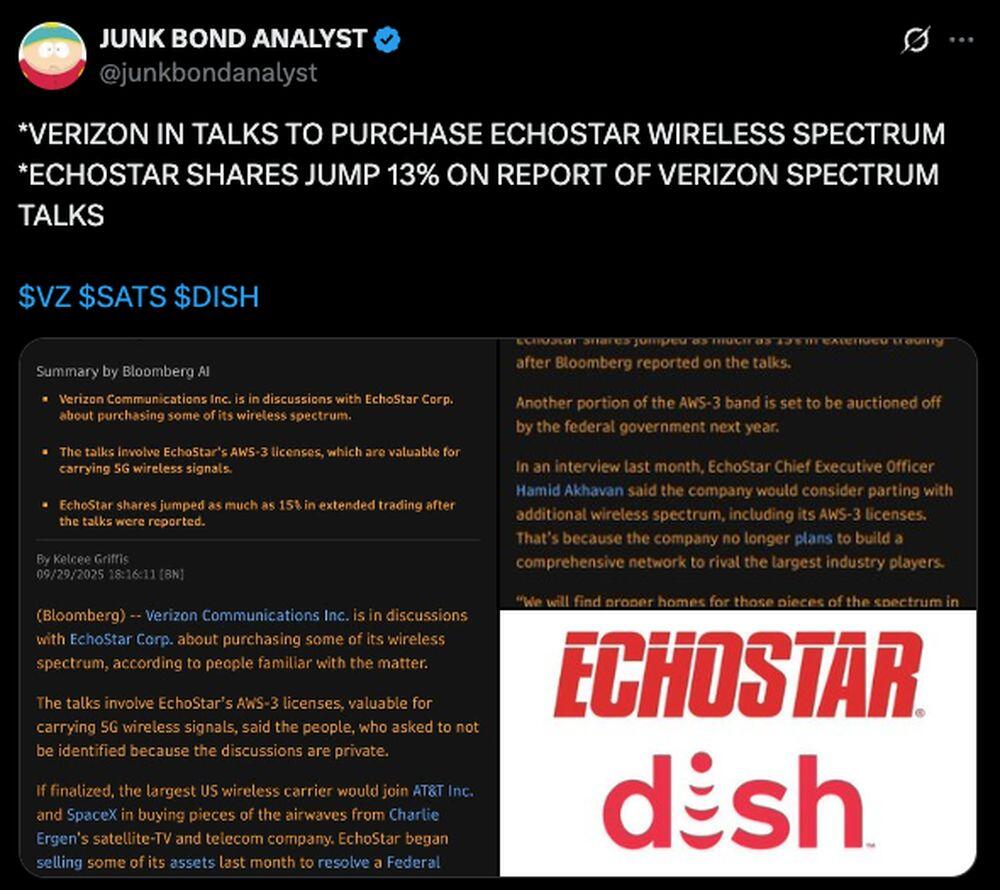
For example, a user @junkbondanalyst posts on X (former Twitter) the news that Verizon is negotiating to buy the American telecommunications company Echostar Wireless Spectrum. Such a partnership expansion may positively affect the value of VZ shares.
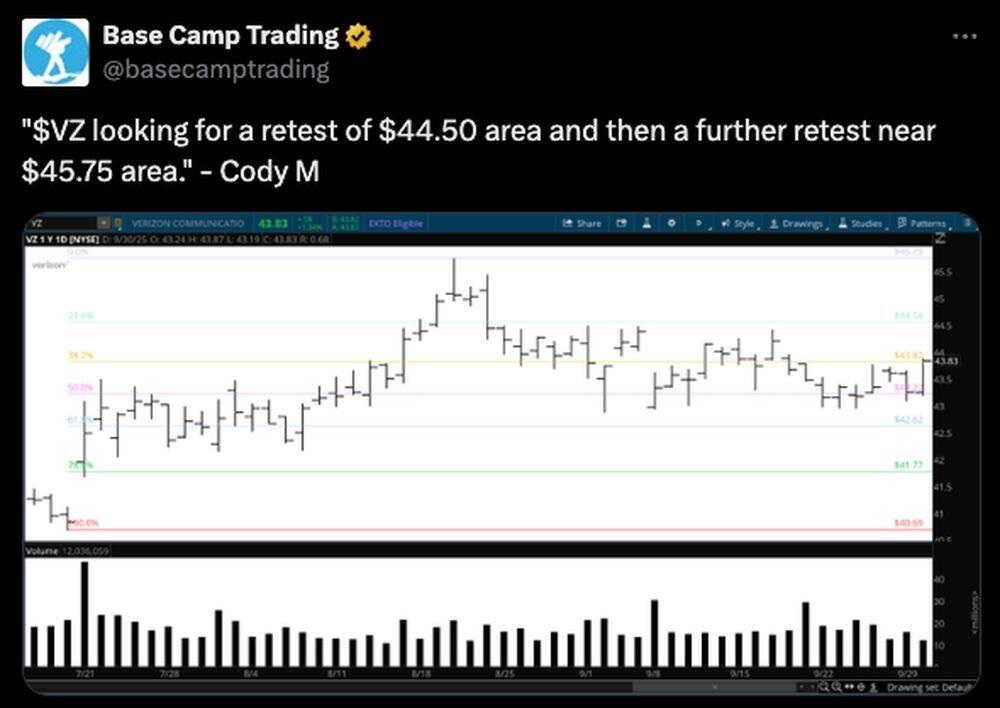
Independent trader @basecamptrading expects the price to retest the $44.50 level, followed by an increase to $45.75.

User @statusisdown highlights a major issue related to service disruptions experienced by many Verizon clients over the past month. Numerous social media users have expressed dissatisfaction with the company's performance and customer support, with some even considering switching to other providers.
The analysis of several posts on the X social network revealed that traders are generally optimistic about the future performance of VZ shares. However, recent declines in service quality may raise concerns about the company's future earnings and, consequently, its share value.
VZ Price History
Verizon (VZ) reached its all-time high of $62.5 on 04.10.1999.
The lowest price of Verizon (VZ) was recorded on 27.12.1983 when the stock declined to $7.32.
Below is a chart showing the performance of #VZ over the last ten years. In this connection, it is important to evaluate historical data to make predictions as accurate as possible.
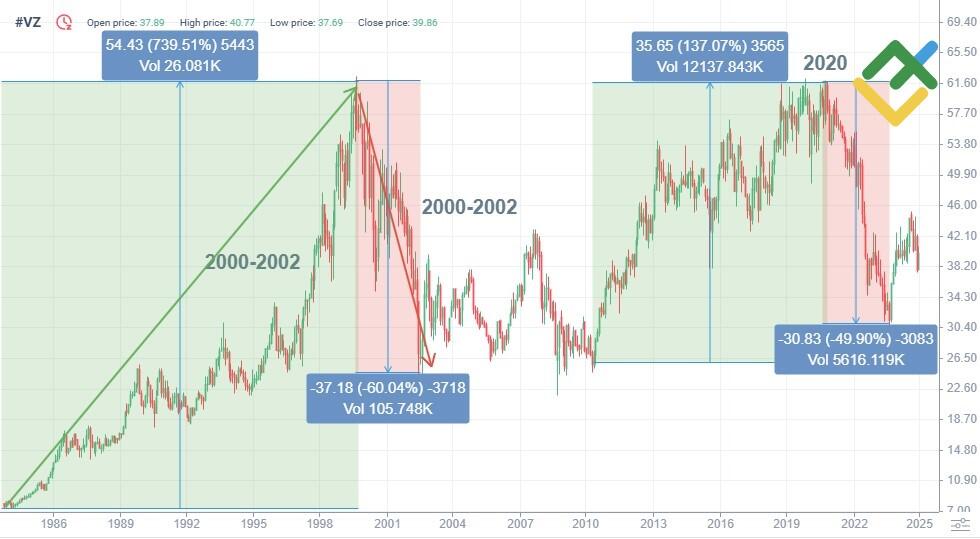
Verizon's price history illustrates the company's growth and the impact of economic factors on its stock price since its initial public offering (IPO) in 1983. The company's long-term growth can be attributed to the expansion of the telecommunications market and technological advancements.
In the early 2000s, Verizon's business strategy focused on aggressive expansion, including the acquisition of MCI and the development of its mobile division. However, the company's stock experienced a downturn due to the general decline in the telecommunications market after the dot-com boom. The financial crisis of 2008 led to a significant drawdown, but the subsequent introduction of 4G technology and expansion of internet services restored the company's position.
Verizon's stock has exhibited notable volatility in recent years, driven by investments in 5G networks and competitive pressures. The VZ market experienced significant pressure during the 2020 pandemic, but the surge in demand for internet services contributed to the company's resilience. The chart shows that despite temporary setbacks, Verizon emerges as a sound long-term investment.
VZ Shares Fundamental Analysis
A fundamental analysis of Verizon (#VZ) enables investors to assess the company's long-term prospects. The stock price is influenced by both macroeconomic factors and the company's financial statements. Verizon's status as one of the telecom sector behemoths ensures its long-term stability. However, the company is susceptible to factors such as fierce competition, technological shifts, and regulatory constraints, which could impede its growth trajectory.
What Factors Affect the VZ Stock?
- Financial indicators: revenues, profitability, returns, dividends, operating expenses.
- Technological breakthroughs: introduction of 5G, development of fiber-optic networks, investments in IoT.
- Competition: AT&T, T-Mobile and other carriers impact pricing of communication services.
- Macroeconomics: inflation rates, interest rates, economic growth.
- Regulatory developments: legislation, licensing, antitrust litigation.
- Investments and strategic partnerships: business expansion, acquisitions of new businesses.
- Market trends and demand: popularity of mobile services, Internet services, cloud solutions.
- Media sentiment: impact of news and reports on investor confidence, earnings reports.
- Debt load: level of corporate debt and management strategy.
- Dividend policy: stability of payments attracts investors.
- Return on investment in infrastructure.
More Facts About VZ
Verizon Communications Inc. (VZ) is a leading telecommunications company in the United States, with a history dating back to 1983 when Bell Atlantic was established. In 2000, following its merger with GTE Corporation, the company adopted its current name. Verizon offers a comprehensive suite of communications services, including mobile, fixed-line, Internet, and digital business solutions.
The company is a major player in the field of telecommunications technology, with a focus on 5G networks and fiber-optic infrastructure. In recent years, Verizon has made significant investments in cloud services, the Internet of Things (IoT), and cybersecurity.
The company's core businesses include enterprise business solutions, broadband internet services, digital entertainment, and mobile applications. It serves a diverse client base, including residential customers, large enterprises, government organizations, and technology startups. The company's financial stability and commitment to dividend payout have garnered the attention of long-term investors.
Advantages and Disadvantages of Investing in VZ
Investing in Verizon Communications Inc. (VZ) is a strategic decision that appeals to both long-term investors and short-term speculators. The company has a resilient business model and a consistent history of dividend payouts. However, there are also risks associated with industry competition and technological changes.
Advantages
- High dividend yield. Verizon's financial soundness is evidenced by its consistent dividend payments, which appeal to investors seeking stable returns.
- Strong market foothold. The company's market leadership in the US telecommunications sector positions it for growth.
- 5G technology. Verizon's strategic investment in 5G development signals a commitment to technological innovation, which can boost the company's stock.
- Long-term contracts. The company's long-term contracts with a loyal customer base and corporate clients ensure predictable cash flows, contributing to its financial stability.
- Diversification of services. Verizon's diversification of services, beyond mobile, including internet, digital solutions, and enterprise services, enhances its resilience and customer base.
- Low volatility. The #VZ stock is well-positioned to withstand significant market fluctuations.
Disadvantages
- High debt load. The company has a substantial debt load, which is related to the development of network infrastructure.
- Intense competition. Competition with major players such as AT&T and T-Mobile impacts Verizon's growth potential.
- Regulatory risks. The telecom sector is subject to regulatory changes, which introduce potential risks.
- Low growth rate. The company's growth rate is lower than that of some tech giants, which could be a limiting factor.
- Capital-intensive business. The financial commitment required for the ongoing modernisation of networks is significant.
- Macroeconomic landscape. The company's financial health is sensitive to broader macroeconomic factors, such as inflation and interest rates.
Verizon offers a reliable revenue stream for long-term investors through dividend payments. However, the company is facing challenges, including high competition, a substantial debt load and slow growth. Investors should carefully consider these factors when making decisions.
How We Make Forecasts
When forecasting the price of Verizon (VZ) stock, we implement a comprehensive approach that combines fundamental, technical, and market analysis.
- Short-term forecasts (up to 6 months) are based on technical analysis, news background, and market sentiment, with key indicators such as moving averages, support and resistance levels, and corporate reports being taken into account.
- Medium-term forecasts (from 6 months to 3 years) rely on technical and fundamental analysis, with the company's financial indicators such as revenue, debt load, business growth rate and investment in innovation providing a vital insight.
- Long-term forecasts (more than 3 years) involve a comprehensive evaluation of Verizon's strategic development, its position in the industry, digital transformation trends, and the impact of macroeconomic factors, including inflation, interest rates, and technological advancements.
This methodology considers both current market trends and global developments impacting Verizon stock.
Conclusion: Is VZ a Good Investment?
Verizon's stock shows moderate volatility, while the company maintains a steady record of paying dividends. These qualities make VZ an appealing choice for conservative investors. In addition, Verizon continues to expand its 5G network and invest in new technologies, strengthening its competitive edge and supporting long-term growth prospects. The company also benefits from a large customer base and extensive experience in the telecommunications industry.
However, analysts' forecasts point to mixed performance ahead. Therefore, it is crucial to consider the risks associated with changing market conditions and rising competition when investing in VZ or selecting it as a trading instrument on Forex. Ultimately, any decision to invest in VZ should be based on your own analysis and a clear understanding of your investment goals and risk tolerance.
Verizon Price Prediction FAQs
The current VZ stock price is $45.91 as of 03.10.2026.
The target price for the Verizon stock varies depending on the platform and the forecasting model. The current lowest and highest target prices are $48.40 and $56.00, respectively. These estimates reflect a moderate upside potential.
The decision to buy or sell Verizon shares hinges on your investment strategy and risk tolerance. At present, analysts generally recommend buying the stock, rating it as a steady asset.
Verizon share price predictions for 2026 suggest that the asset will range from $62.65 to $67.66. The estimates are probably driven by expectations of steady revenue growth from 5G and new services. Pessimistic forecasts indicate a decline to $30.12.
Over the next five years, Verizon shares are expected to grow moderately, amid 5G network expansion and the development of new business segments. The target price is $70.00–$75.00. In a negative scenario, the asset may plunge to $24.13–$21.07.
Forecasts for Verizon shares in 2030 diverge. Some experts believe that the price will climb to $80.00–$85.00 if the company adopts new technologies and solidifies its position in the market. Others, on the contrary, suggest that shares may tumble to $21.00–$24.00.
Verizon stock is a sound investment option for those seeking stability and consistent dividends. However, the company's growth potential is constrained. For investors prioritising long-term strategies, it remains a viable choice. It is crucial to evaluate the dividend yield and the company's debt load when assessing this opportunity.
Verizon is a consistently reliable dividend payer, with a yield that regularly outperforms the market average. This makes it an attractive option for investors seeking passive income opportunities. Long-term shareholders can benefit from a steady stream of payouts.
Price chart of #VZ in real time mode
The content of this article reflects the author’s opinion and does not necessarily reflect the official position of LiteFinance broker. The material published on this page is provided for informational purposes only and should not be considered as the provision of investment advice for the purposes of Directive 2014/65/EU.
According to copyright law, this article is considered intellectual property, which includes a prohibition on copying and distributing it without consent.