Monetary policy is a key to predicting currency rates
Many financial establishments quite accurately forecast GDP, inflation, unemployment rate and other macro-economic indicators, but fail in predicting currency rates. There is always emotional factor in the market; and the quotes a moving through the expectations and their meeting reality. A novice trader can easily get confused by economic calendar; especially since, the market response doesn’t often correspond to that, described in the textbooks on fundamental analysis. To understand it, one needs a system; and it is always based on central banks’ monetary policies.
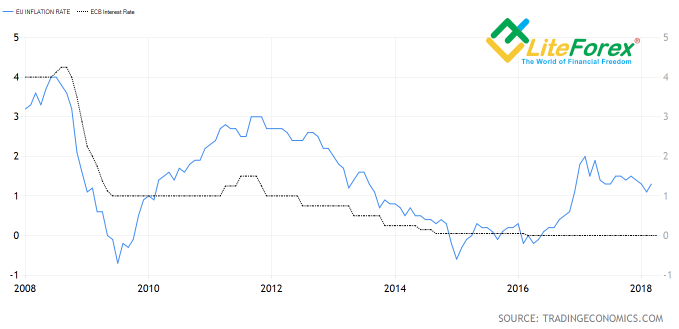
“Don’t play against the Fed”. Stock traders have known the phrase since the old times. Forex market is relatively young; however, no serious assets manager can afford ignoring central banks’ decisions. Monetary policy is based on need for managing inflation. Originally, the target is defined (in the developed countries, it is usually about 2%, or in the range of 2-3%). If the Consumer Price Index (CPI) or another indicator, being monitored, is below the target, the central bank applies monetary stimulus (expansionary monetary policy) to stimulate the country’s economy. It may include low (sometimes, even negative) interest rate, assets purchases (quantitative easing program (QE)), and other tools. A good example is the Eurozone, with its low inflation (1.3%) that makes the ECB hold on its refinancing rate (or minimum bid rate) at 0 per cent since 2014.
Dynamics of European inflation rate and ECB interest rate
Source: Trading Economics
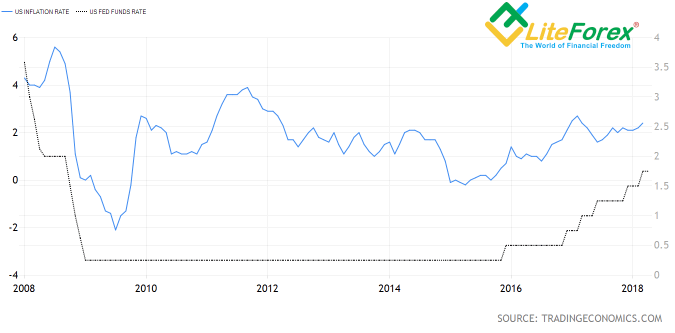
On the contrary, if the Personal Expenditure Index (PCE), monitored by the Fed, shows the signs of exceeding 2% target the central bank has to slow down its pace. Restrictive monetary policy or monetary restriction includes increasing the interest rate, balance sheet normalization through selling out assets and other tools.
Dynamics of the Fed funds rate and the U.S. inflation rate
Source: Trading Economics
Central bank’s monetary policy influences the country’s financial markets and its whole financial system, and often other countries as well. For example, the RBA Governor Philip Lowe claims that the Fed’s monetary restriction has resulted in Australia’s higher borrowing costs, and the country’s economy can’t afford that. An increase in the central bank interest rate raises the commodity prices (interest rate on loans and interest-bearing deposits), and vice versa.
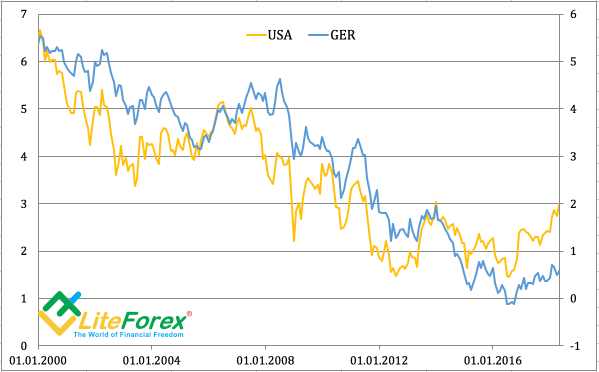
Simply put, if you are deciding between two banks, where to deposit your money, you’ll prefer the one that offers higher rates. If bank A hikes the interest rate and is willing to go on in future; and bank B has been holding low rate on for a long time is reluctant to make any change in its deposit policy, the choice is obvious. Large investors are as human as we are, only having larger capitals. They prefer more mobile securities, rather than bank deposits. For example, if the U.S. 10-year Treasury yields has increased up to 3% from 2.4% at the beginning of the years (60 basis points), and German’s bond yields – to 0.58% from 0.43% (15 bps), the first securities will be chosen. The capital will flow from the East (Europe) into the West (the USA), supporting the U.S. dollar.
Dynamics of the U.S. Treasury yields and German's bond yields
Source: Reuters
So, central banks’ monetary policies influence the bond rates and are a reason for the capital flow between the countries and regions. As bonds are denominated in different currencies, converting is needed to by them. Therefore, the U.S. 10-year Treasury yields growth up to the level of 3%, increases not only the demand for this type of assets, but the likelihood of EUR/USD correction as well.
P.S. Did you like my article? Share it in social networks: it will be the best "thank you" :)
Useful links:
- I recommend trying to trade with a reliable broker here. The system allows you to trade by yourself or copy successful traders from all across the globe.
- Use my promo code BLOG to get a 50% deposit bonus on the LiteFinance platform. Simply enter this code in the appropriate field when funding your trading account.
- Telegram chat for traders: https://t.me/litefinancebrokerchat. We are sharing the signals and trading experience.
- Telegram channel with high-quality analytics, Forex reviews, training articles, and other useful things for traders https://t.me/litefinance

The content of this article reflects the author’s opinion and does not necessarily reflect the official position of LiteFinance broker. The material published on this page is provided for informational purposes only and should not be considered as the provision of investment advice for the purposes of Directive 2014/65/EU.
According to copyright law, this article is considered intellectual property, which includes a prohibition on copying and distributing it without consent.