Hi everyone!
This article is for anyone who has heard a lot about advisor-based trading and is looking for an automatic trading system but suspects that it’s not all that simple. In this article, we will analyze the types of trading robots based on their algorithm. This article will be useful for understanding the operation of various trading advisors and their application in your trading strategy.
The article covers the following subjects:

Martingale advisors
Let's start with the most interesting category - the one that gently gives hope to the hearts and minds of novice traders who want to make money as quickly as possible and outwit the evil unpredictable market that can go up and down. This category is Martingale Expert Advisors. And, perhaps, one of its most famous representatives is the Forex Setka trader.

So what is Martingale? The point of this trading strategy is to buy in against the market.
When trading based on Martingale, if you’ve failed to guess the direction of the price movement, you don’t close the unprofitable position, but open a new one with a larger volume.
This process is also called position averaging, and here's why:
1st purchase - 1 kg of tomatoes at a price of 100 USD
2nd purchase - 2 kg of tomatoes at a price of 85 USD (we remember that the price is moving against us, i.e. down, and we open a new position with an increased volume):
2 x 85 = 170 USD
Therefore, the total volume of our buy positions = 1 kg + 2 kg = 3 kg
We spent on these 3 kg: 100 USD + 170 USD = 270 USD
Therefore, for each kilogram in this case we paid: 270 USD / 3 kg = 90 USD.
Hence the averaging. We bought 1 kg at 100 USD and 2 kg at 85 USD, which is the same as if we bought 3 kg at 90 USD at once.
Why do we do this? As we know, the market has ups and down, so we assume that sooner or later the price will roll back in the direction we need. Let's continue with our example of buying tomatoes.
Because we constantly buy more and more volume, when the price falls our average price will be lower and lower:
1st purchase - 1 kg for 100 USD.
2nd purchase - 2 kg for 85 USD.
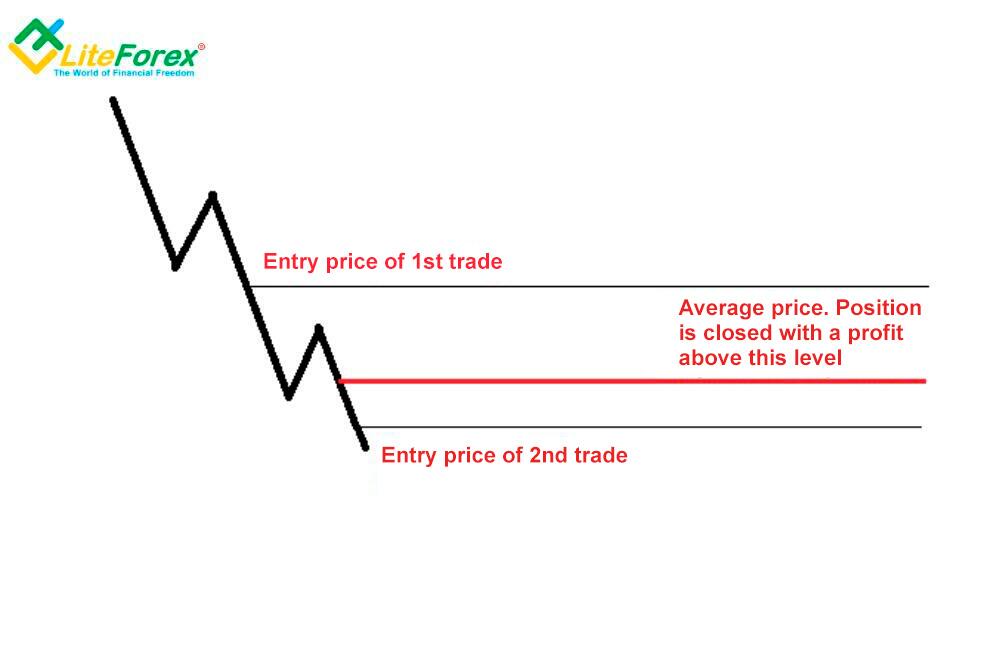
After 2 purchases, our average price is 90 USD, and the current price is 85 USD. So in order for us to make a profit, we need the price to grow above 90 USD. What if the price keeps going down and we buy more?
3rd purchase - 4 kg for 70 USD.
Average price = (1 * 100 + 2 * 85 + 4 * 70) / 7 kg = 78
4th purchase - 8 kg at 55
Average price = (1 * 100 + 2 * 85 + 4 * 70 + 8 * 55) / 15 = 66.
At the core, this is counter-trend trading, but in a cunning way, so to speak: we do not identify any level where a rebound is likely to happen. We simply take the market as it is and expect that this rebound will happen sooner or later. And when it happens, all we need is for the price to go a little in our direction (up in our example), literally just above the average price, and we will be in the green.
This sounds nice in theory, and at first glance it may even look like the Holy Grail of trading, but let's be objective and consider both the advantages and disadvantages of the Martingale trading system.
Benefits of Martingale Expert Advisors
1) Simple. We increase the lot against the movement -> we are waiting for a rollback -> the price has gone beyond the average price -> profit
2) Works great in flats
3) Works well in a volatile trend
4) With a certain skill in choosing an instrument and trading time, you can really (!) earn money with this system (more on that later).
Disadvantages of Martingale Expert Advisors
1) It works extremely poorly with recoilless (non-volatile) movements, which unpredictably happen sooner or later.
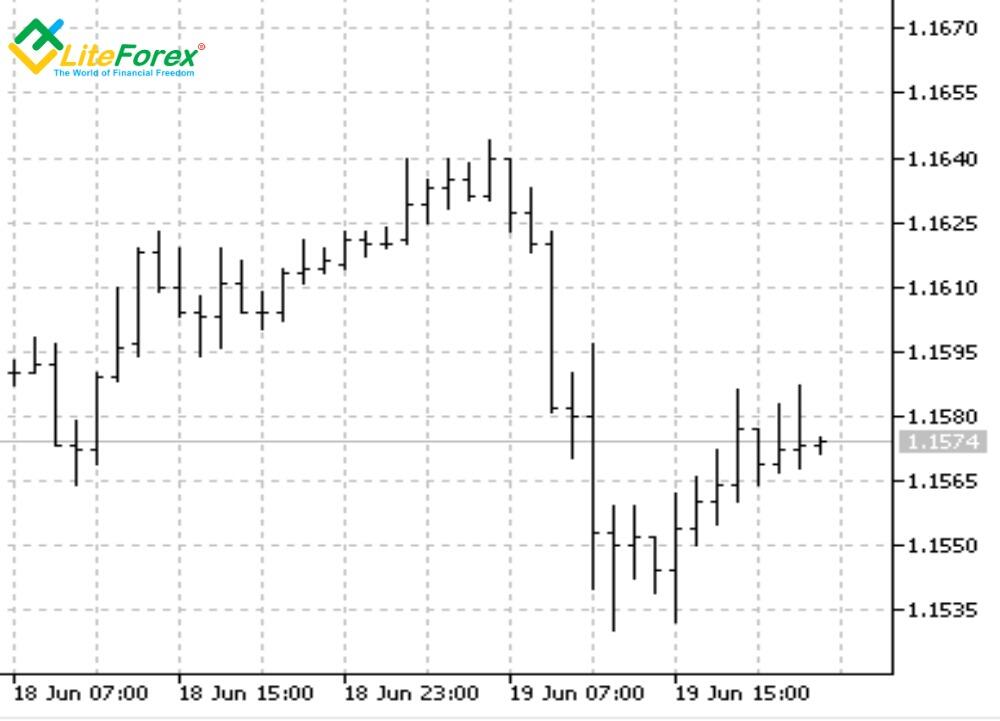
2) The rollback may not be enough for the price to go beyond your average price and therefore you will have to increase the position against the market again (see figure), and may lose the entire deposit.
3) The potential to win in each profitable trade is much less than the potential to lose due to the constant increase in the losing position. As you continue to top up, the risk increases to the entire amount of the deposit.
Sorry to disappoint those who thought that recoilless movements are rare: the point is not that they’re rare, but that sooner or later they will happen. And the problem is that no matter how much you have earned before, such a movement will eat up the ENTIRE deposit (because you have to constantly buy more and more in a losing position).
Let's say you are trading with a lot of 0.01 and you have chosen a 50 pip movement to take profits.
You will earn $0.5 on each trade. After making a profit 10 times in a row, you will earn $5. But if a recoilless movement follows, sooner or later a moment will come when you do not have enough deposit to open a new trade with a larger volume, and then Margin Call will follow.
I will also disappoint those who thought that they could know in advance when this most recoilless movement would occur and stop the advisor. Of course, you can try and your instinct may save you a couple of times, but this is nothing more than a guessing game, and neither you nor anyone else can 100% predict market movements in advance.
Can you make money with a Martingale-based trading advisor?
Yes, but this will require discipline and keeping your greed in check.
Below is an algorithm that you can use:
1) Make a small deposit for an amount you can afford to lose.
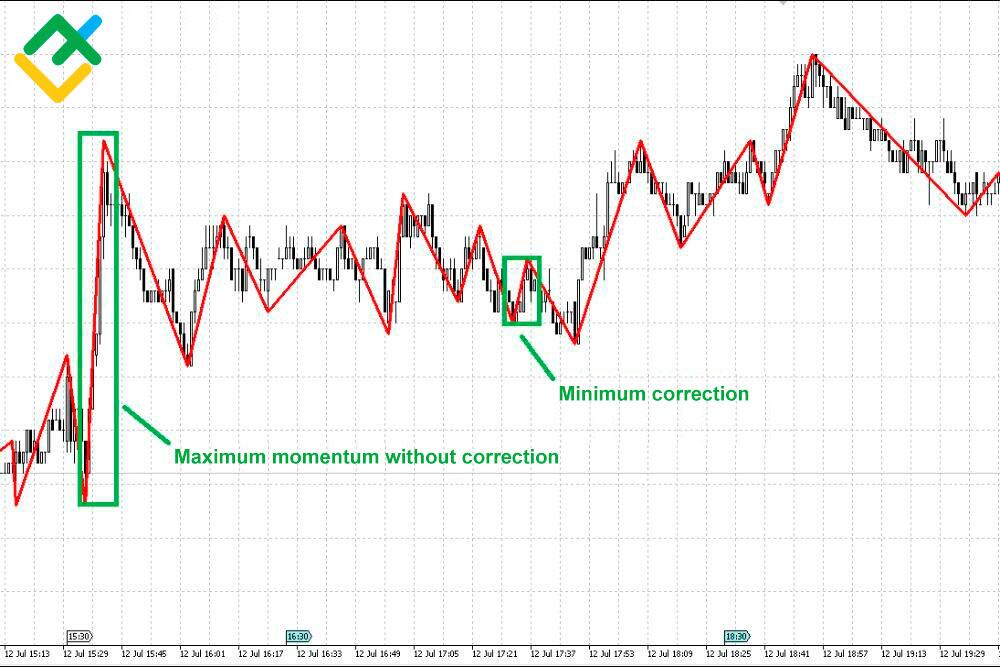
2) Study the maximum length of the latest recoilless movement and the length of the latest minimum rollback. To do this, go to the desired timeframe and run the ZigZag indicator on it with standard parameters:
The largest movement will be the recoilless momentum
And the smallest movement is the minimum rollback
Explanation: you run ZigZag not to search for entry points, but solely to collect information about the length of the momentum/rollback. It is the easiest way to do this. If you know an easier way, I will be glad if you mention it in the comments.
3) Note the spread on this currency pair.
4) Determine after how many points you will open a new order with an increased volume (let's call it a price step).
In the figure below, you can see how ZigZag plotted price movements on the M1 timeframe. I just selected the largest red line and the smallest red line.
Important: further we will consider the desired time (or session) for Martingale advisor trading. Keep in mind that you need to collect momentum and rollback data at the time you plan to trade with the EA.
It makes no sense to measure the maximum momentum in the Pacific session, if you plan to trade during the American session, in which even rollbacks will most likely be larger.
It also makes no sense to measure the minimum rollback in the European session and wait for it during the Asian session, during which the price passes such a distance on momentum.
In general, I hope you understand the general principle: measure what you’re planning to trade. Don’t give in to false fears, but we also don’t get caught up in illusions.
So can you make money with a Martingale-based trading advisor? Yes, but this will require discipline and keeping your greed in check.
Example:
Suppose the maximum momentum length was 120 pips, the minimum rollback length was 40 pips, and our spread was 2 pips.
Next, we need to use the value of the minimum rollback to close previously opened trades in profit. To understand further material, you need to know what the average price is in Martingale trading.
The average price is easier to explain with an example. Let's say you buy 1 kg of tomatoes for 100 USD, 2 kg of tomatoes for 70 USD, and 4 kg of tomatoes for 40 USD. As a result, you have a certain amount of tomatoes and have spent a certain amount of money on them. The average price is how much 1 kg of tomatoes cost you on average.
It's calculated as follows:
Spent: 1x100 + 2x70 + 4x40 = 400 USD (amount we spent in total on tomatoes)
1kg + 2kg + 4kg = 7 kg (amount of tomatoes)
400 / 7 = 57.4 USD (average price of each kilogram of tomatoes)
Thus, our costs would be the same as if we bought all 7 kg at a price of 57.4 USD each.
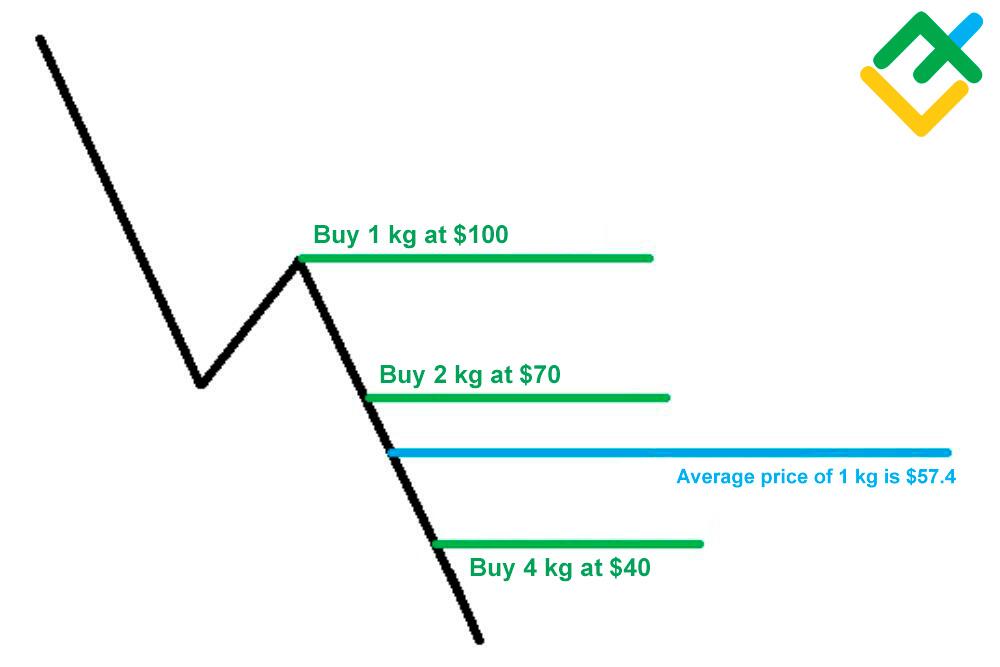
We can make a profit if the price in this example goes up and crosses the average price we paid for each kilogram. Then we can sell for more than we bought for.
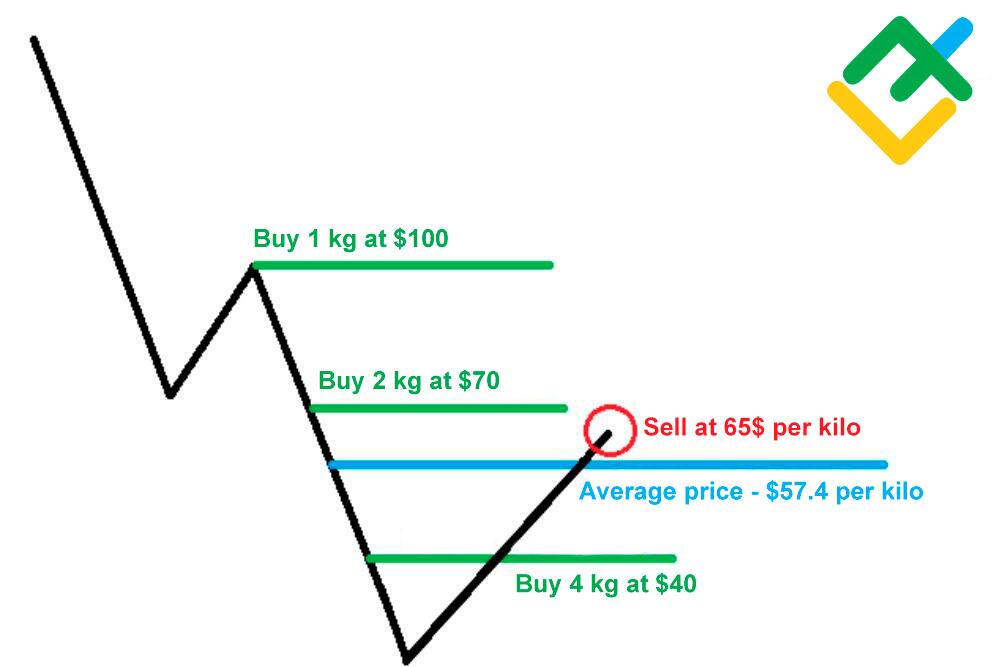
Let's look at the calculation: we spent 400 USD and purchased a total of 7 kg (average price is 57.4 USD per 1 kg).
If the price reaches 55 USD, our 7 kg will cost:
55x7 = 385 USD. Therefore, if we sell all the tomatoes at a price of 55 USD/kg (below the average purchase price), we will be at a loss.
In the event that the price reaches at least 58 USD per 1 kg (slightly higher than the average price), then our 7 kg will cost:
58x7 = 406 USD. Therefore, if we sell all the tomatoes at a price even slightly higher than the average, we will make a profit:
406 USD - 400 USD = 6 USD
And if the price generally goes up to 65 USD per 1 kg (as in the figure), then our 7 kg of tomatoes will cost: 65 x 7 = 455 USD. And the profit will be at 55 USD. I’m giving you this example on purpose so that you can catch a glimpse of greed in yourself. If, with a difference between profits of 6 USD and at 55 USD something stirred in you, this is it. Just keep that in mind and don't let it fool you.
Martingale Expert Advisor actually does not need to move beyond the average price significantly - closing with a profit usually occurs almost immediately because the purpose of the advisor is the regularity of profit and not its maximization.
Important: the goal of the Martingale system advisor is the regularity of closing trades with profit, and not profit maximization.
Returning to Forex, our goal is for even the smallest rollback to cover this average price of the positions we have opened as often as possible. This will just allow you to close them with a profit. How do you achieve this?
The average price of all trades we have opened is usually slightly closer than the price of the penultimate order. Let’s refer again to the figure above: the last order we opened was the purchase of 4 kg at a price of 40 USD. The penultimate one is the purchase of 2 kg at a price of 70 USD. And, as you can see, the average price is not far from 70 USD.
For simplicity of calculations, let's just accept the following condition: in order to make a profit, we need the price to go above the price of the penultimate order.
We opened the penultimate order at a price of 50, and the last one at 30 - we are waiting for the price to get above 50.
We opened the penultimate order at 1.2222 and the last one at 1.2220 - we are waiting for the price to get above 1.2222.
And so on.
Such a scheme is valid when we have the same price step, i.e. when we open orders at regular intervals. For example, every 10, 20, 150, or 1873 points.
Returning to our example (no longer with tomatoes, but with the foreign exchange market). Earlier, we found that our minimum rollback is 40 USD. So 40 USD is the maximum possible price move for us on this currency pair. If we make the price step larger, then with a minimal rollback (by those very 40 USD), the price simply will not reach the price of the penultimate order, and we will not close in profit.
You need to understand that a rollback on the Forex market is unpredictable and unaware of our existence. If we take all 40 points as a price step, the difficulty may arise in the following case:
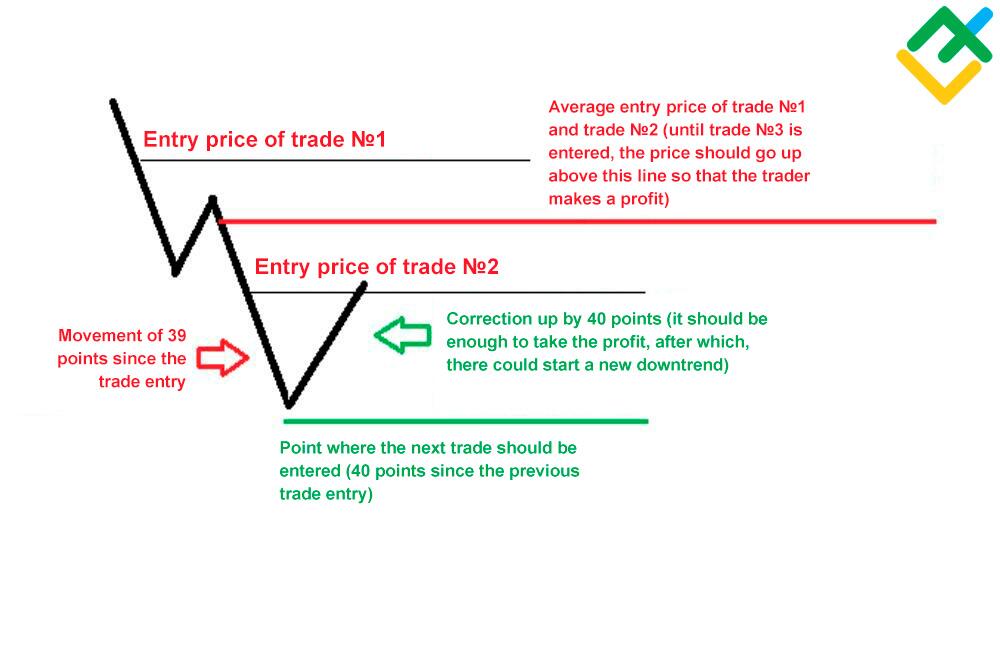
If the price goes further down by 39 points from the opening of the last order, then we don’t open the next order ( since we open every 40 points). And if, after going down by 39 points, the price then rolls back up by 40 points, we will not get any profit because technically it will simply grow above the opening price of the last order by 1 p. Moreover, from this moment on, it is quite likely that there will be another recoilless movement in the undesirable direction, and the chance to exit with a profit has already been lost.
So, to avoid such a scenario, we should take and divide the value of the minimum rollback by 2 and get 40 / 2 = 20 points. This will be our price step if the minimum rollback is 40 p.
In this case, in a similar scenario, the price may go below the last open order by only 19 points. And if a rollback starts from this moment, 40 points will be quite enough to close all our positions in profit.
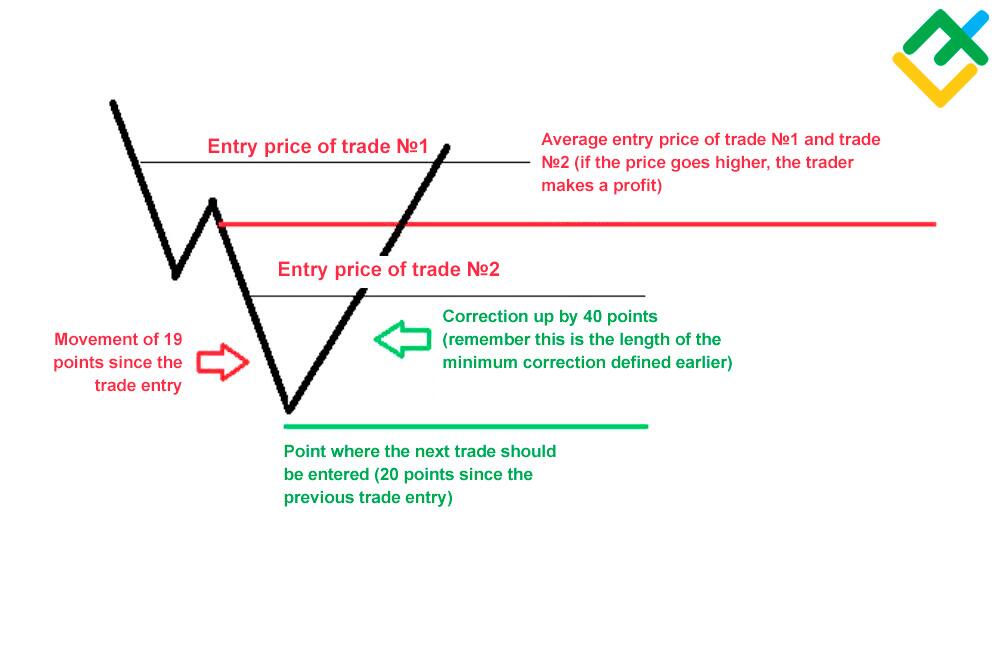
However, we forgot to take into account the spread, which exists on the Forex market as well as at currency exchange offices.
Therefore, we should take our minimum rollback equal to 40 points and subtract the spread from it, which we take as 4p (again, I take it with a margin, because it is significantly lower on popular currency pairs in liquid time). 40 - 4 = 36. Here we get a pure price movement, i.e. how much we can earn if we enter at the very beginning of it and exit at the very end of it.
Now, to avoid the incident described above, as a price step, you need to take half of this value, i.e. 36 / 2 = 18. This will be the actual price step for us, at which we will open a new order with an increased volume against the price movement.
Pure price movement is movement minus the spread. This is the maximum value that we can count on if we enter at the very beginning of it and exit at the very end of it.
4) It's time to calculate how big of a deposit we need for this entire operation.
The maximum size of the recoilless movement was, as we remember, 180 p.
A trader opens a trade against the price movement every 18 points. Thus, in the worst case (which is what we are starting from in the calculations), we need to make 120 / 18 = 7 trades before a potential rollback begins. Why 7? Because we are again considering the worst-case scenario, when we make the first trade right before the price moves against us. And after that, it goes to 120 points, where at every 18 points we manage to open 6 more trades.
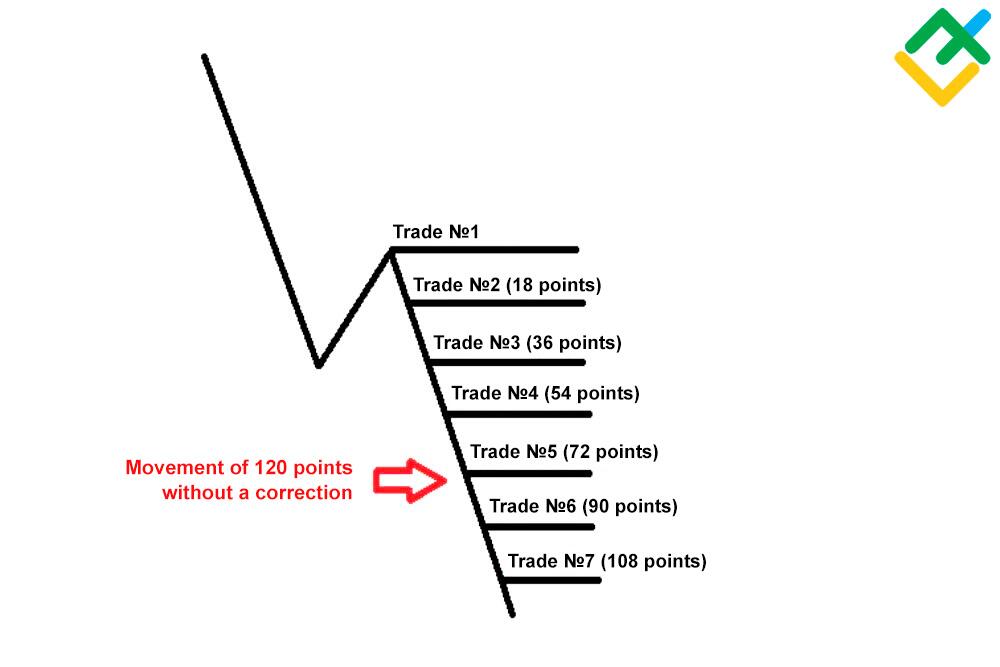
If we start buying from the smallest volume, the lots of our trades will be as follows:
Trade 1 - lot 0.01
Trade 2 - lot 0.02
Trade 3 - lot 0.04
Trade 4 - lot 0.08
Trade 5 - lot 0.16
Trade 6 - lot 0.32
Trade 7 - lot 0.64
If we add it all up, the total volume will be 1.27. You need a deposit size that will be able to withstand a drawdown of 18 points. As you can see in the figure, we opened the last order at the level of 108 p. Therefore, it is exactly 18 p that’s left until the maximum value of 120 p and that is how many points the trader’s deposit should be able to withstand in the worst case with the previously opened orders.
I’ll say this again: we can only operate with past data. They give us the opportunity to roughly assess the conditions in which we find ourselves: how the instrument tends to move, the nature of the movements, their approximate value. Therefore, on the one hand, no one is immune from an event in which the value of the last maximum recoilless movement will be broken. However, on the other hand, trading is first of all based on probabilities. And the best thing we can do is to prepare for the most unpleasant scenario as well as possible + study the conditions in which we’re trading. This will allow us to be alert but also avoid fits of fear expecting a 1,000p recoilless movement where the price very rarely moves 120p without a recoil.
So, the cost of a point with a volume of 1.27 lots = $11.1 As we remember, the calculation is based on the price of the penultimate order. So you will need to be able to sit out 40 p. Therefore, 11.1*40 = $444. Round it up to $450.
Therefore, the minimum deposit for such parameters will be $450. Keep in mind that in each profitable trade you will earn 18 points with a volume of 0.01 lot, i.e. about $1.8.
Again, do not get disappointed ahead of time if at the moment you do not have as much. The figures in the calculations are arbitrary and are given for understanding the calculation method itself. It is likely that you will find currency pairs with smaller recoilless movements, for which the deposit amount will be significantly less.
I'll try to answer the questions you might have right away:

Q: Why be so cautious? After all, the maximum movement may not come at all.
A: Imagine that we are calculating from a less-than-maximum movement (for example, the average value of the momentum), and it’s equal to 90 p. Imagine how you will feel if you lose your ENTIRE deposit on a 100 points movement. But if we had taken precautions then, the loss would not have occurred in both of these cases.
Q: So the profit is very small, and you risk losing everything! Does it even make sense to do it?
A: In my opinion, yes and no. This does not make sense if you are already an established trader with your own trading system. But it makes sense if you want to try your hand at automated trading. Of all the options for using the Martingale system, I suggest choosing the safest one. Because it is in this case that we reduce the risk of margin call to a minimum and calculate from risk rather than profit. Note that in the 2 rules of trading, the first one is "save your deposit" and only the second is "increase your deposit".
Q: Anything is possible in the market, so there is no guarantee that there will be an even bigger recoilless movement during a trade than there was before. And there is no guarantee that rollbacks will suddenly become smaller than what was previously considered minimal. Is this correct?
O: Absolutely. Nobody knows what will happen in the future. Maybe the movement will be larger. Or maybe smaller. Or maybe they won't change much at all. The only thing we can do is evaluate and take into account the risks based on what is characteristic for the chosen instrument.
If you have any other questions - leave them in the comments below the article.
Nobody knows what will happen in the future. The only thing we can do is evaluate and take into account the risks based on what is characteristic for the chosen instrument.
5) When we know how big of a deposit we need and what price step we will set, we need to understand how else we can play it safe.
In each series of trades we risk losing the entire deposit. So we need to keep the deposit at an absolute possible minimum.
Why? Because it is too much work to manually stop the advisor from opening new orders in case of a movement larger than the previously calculated maximum value. And if you let the advisor open another order in this case, margin call is all but guaranteed.
At this point, your greed may begin to whisper "if you open another order, a reversal may happen and then you will suffer no loss at all", but this is a bad option. Because, as discussed earlier, in trading you cannot know the future, you can only assess risks.
If you initially decided that you were ready to lose $450, then so be it. If your heart wasn’t in it though, then of course you will hope that it "is about to turn around". But it may not turn around and then you will lose $600 or $700. And if you continue, you can lose 1,000$ or 1,200$, much more than you were ready to lose initially. It’s a known fact that you absolutely need strict discipline to earn money.
In order to always have the lowest possible deposit, you need to regularly withdraw profit from it. Since we are playing it very safe, it’s likely that profits will gradually accumulate from small profitable trades. When the amount of profit reaches, for example, 1/4 of the deposit, you can withdraw it to another trading account and leave it there for now. From now on, you will know that in the worst case, you are not losing $450, but $335, because $115 is already in your other account and will not go anywhere.
In order to always have the lowest possible deposit, you need to regularly withdraw profit from it.
Then, when you’ve accumulated profit equal to your deposit ($450 in our case) - you can withdraw it and continue trading without the risk of losing anything.
If something still went wrong, and you lost your $450, don’t be upset because you were ready to lose it and knew what you were getting into. Martingale is not a joke. Besides, as we already know, this scenario is extremely rare (as far as it is possible to assess probability on financial markets). Its repetition in the near future is again extremely unlikely. So you can make another deposit in the amount of $450 (just in case - I’m not insisting on it but just know it’s an option).
In order to play it even safer, I recommend taking as large a sample as possible when estimating the magnitude of the maximum recoilless movement and the minimum movement with rollbacks. The timeframe in this case depends on your deposit: if you are ready to wait out movements of 1,000 points and catch rollbacks of 150, you can look at large timeframes like H1-H4. If your deposit is around what we considered in the example, M5-M15 or even M1 timeframes are better suited. I recommend in this case to evaluate the period of at least the last month. The longer the period, the more situations you will be prepared for and the more at ease you will be trusting such an advisor with your deposit. I will also remind you that you need to look at the trading session during which you are planning to trade.
I recommend taking as large a sample as possible when estimating the magnitude of the maximum recoilless movement and the minimum movement with rollbacks. The longer the period, the more situations you will be prepared for and the more at ease you will be trusting such an advisor with your deposit.
How Martingale advisors work
There is another little trick to using this kind of EA that the least greedy traders can apply. As we remember, the weak point of such Expert Advisors is the recoilless movements in the market.
“Undesirable situation No. 1” is a recoilless movement that makes the advisor open more and more orders. The deposit will eventually run out and margin call will happen.
"Undesirable situation No. 2" is choosing a currency pair or a timeframe where the price movements themselves (even if they give frequent rollbacks) are so long that you would need an enormous deposit to wait out drawdowns.
When trading with a Martingale advisor, you can encounter two types of undesirable situations:
- Recoilless movement (after all, we close trades with a profit on rollbacks)
- Long price movements (both momentum and rollbacks). For these conditions, you need a large deposit.
As an example, on lower timeframes, the pair will look like this:
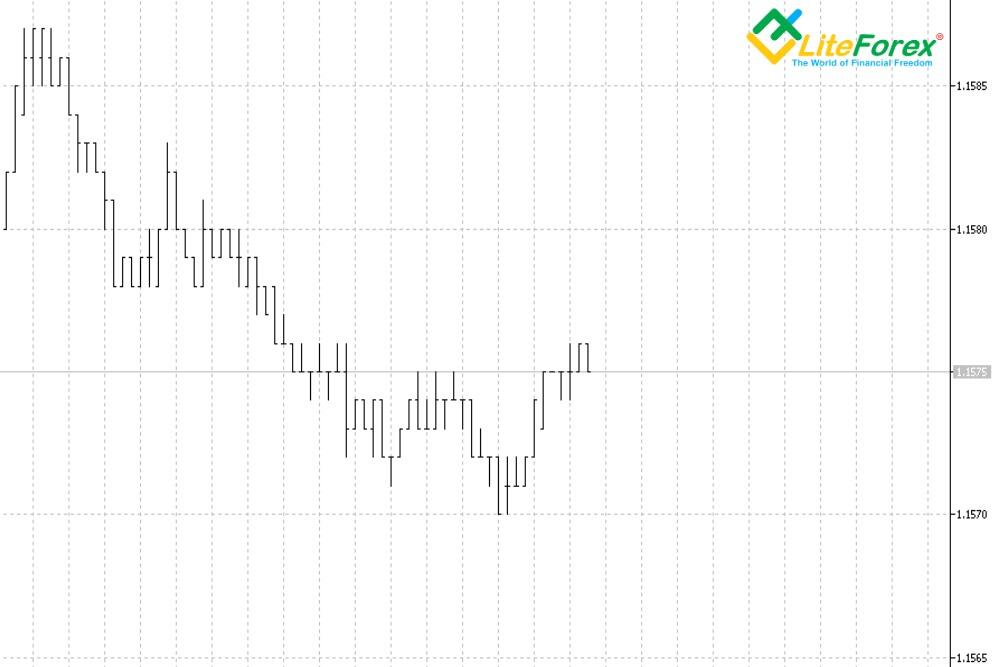
We see seemingly good momentum, but tiny rollbacks that are unlikely to pay off our trade.
And on higher timeframes, the pair looks like this:
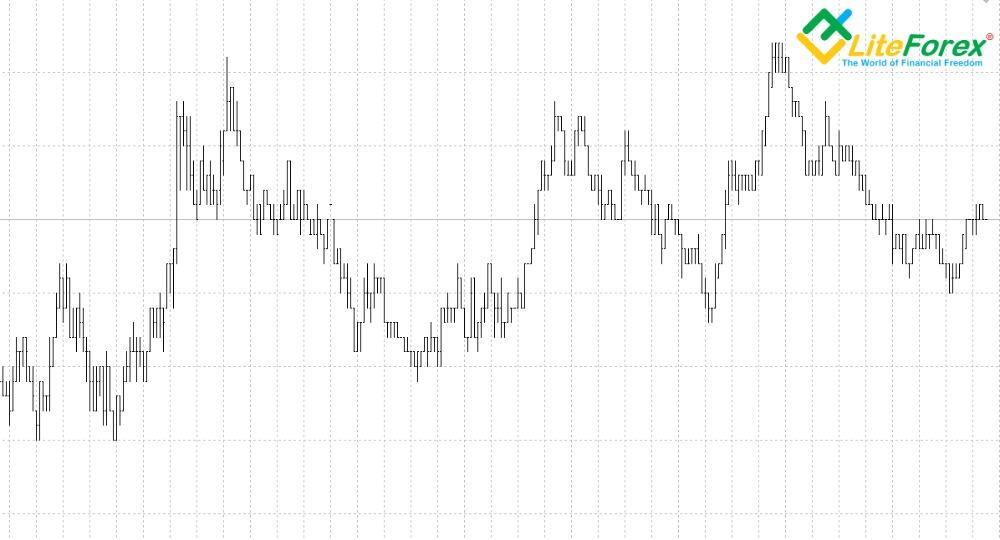
Here, on the contrary, we see good momentum and good rollbacks. But in this case, you will have to trade on higher timeframes, which means that the maximum momentum length can reach, for example, 500-600 p, and the minimum rollback is 160-200 p.
If we increase the price step, we pay for it with our deposit. Let's say we set the price step at 80 p (I will not take spread into account for simplicity).
In a movement of 500 p we will open 500 / 80 = 6 trades and plus 1 at the very beginning. When waiting out the drawdown after the 7th trade, we will need $11.1*160 = $1,776
From the point of view of risk management, our choice is low-volatility movements, ideally a flat (as in the 2nd figure).
We need movements where the price first goes in one direction for a small number of points, and then goes in the other direction, also for a small number of points. It should also be on lower timeframes.
1) We don’t need a large deposit to sit out rollback movements because they’re short.
2) We minimize the risk of a negative scenario even more effectively
3) We bring a bit of stability to making a profit (I’ll describe where to look for it just below) and with the right approach we can enjoy profit every morning
4) You can play a little with the price step by slightly reducing it in order to earn a little more in the future.
Important! It is strictly forbidden to play with the initial lot size! If you do this, you simply reduce the number of steps by 1 and thereby increase the probability of margin call.
Okay, so long movements are bad. Rare rollbacks are bad. Short movements are good. Frequent rollbacks are good.
An attentive reader will probably guess that we are talking about 2 scenarios:
1) Low volatility flat (when the flat is narrow compared to the rest of the price pattern)
2) Low volatility V-shaped reversal (when the price makes the letter “V” either from top to bottom or from bottom to top, and the reversal is small)
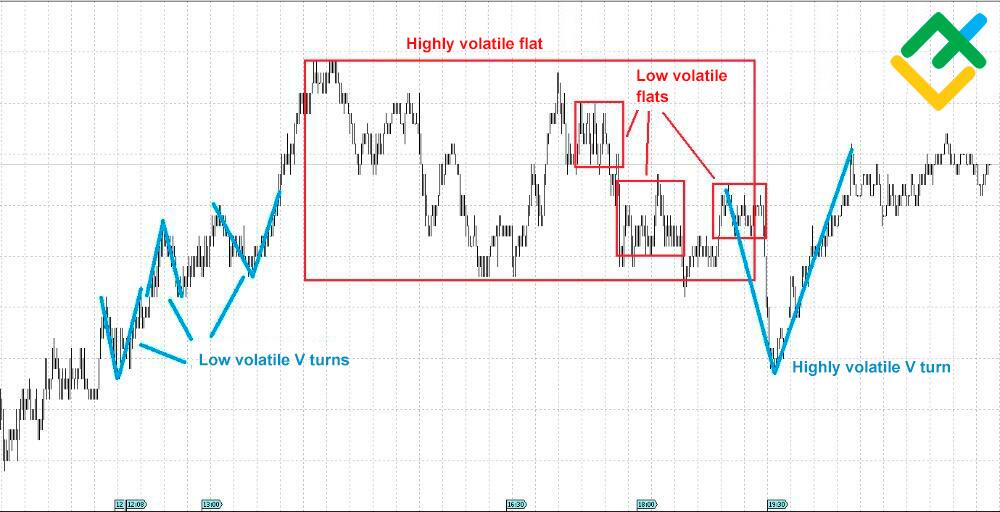
Let's look at volatility in more detail.
What do these scenarios have in common? Of course, the words "low volatility". Where do we look for low volatility? The question is incorrect. Because the question is not "where?", but "when?"
A brief dive into pricing in economics will show us that there are only 2 reasons for low price volatility:
- extremely large volumes of buyers and sellers;
- extremely small volumes of buyers and sellers.
In the first case, there are so many people trading the instrument that in order to push the price down by at least a couple of points, you need to buy an unrealistically large amount of *goods*, but there is simply no need for such a large purchase. For example, the S&P500 index.
In the second case, the price moves little because some usually popular instrument is traded by very few people. We are not talking about some Zimbabwean dollar, which is traded by 3 people all over the world - on the contrary, in case of rare instruments the price can rise or fall sharply because there is usually no one there to support liquidity. We however are interested in liquid instruments, which for some reason are not currently traded by a large number of people. This is our sweet spot.
There are only 2 reasons for low price volatility:
- extremely large volumes of buyers and sellers;
- extremely small volumes of buyers and sellers;
In order to fins an instrument suitable for the first option, we need information about volumes, which is not available on Forex, because the market is decentralized. I wanted to explain how to look for such instruments, but why bother when there is a much easier option.
In the second option, it is enough for us to know the active phases of any instrument we like. And run your advisor exactly when this activity is low (small movements, small rollbacks, small but stable profits).
We are interested in liquid instruments when they are traded by few (compared to the average value) people. And few people trade when most traders are sleeping (literally).
To use a Martingale Expert Advisor, we are looking for the time when FEW people are trading a LIQUID instrument (compared to the average value).
Let's look at the EUR/USD. We know that there are 4 trading sessions - Pacific, Asian, European, and American. Therefore, most action for this pair happens during the European and American sessions - that's when the largest trading volumes and the most serious price movements occur. Why? Because this currency pair contains both the euro (actively traded in the European session) and the dollar (actively traded in the American session). On the other hand, during the Pacific and Asian sessions, this currency pair will be calm.
Here is where our super-safety approach to automated trading can come into play.
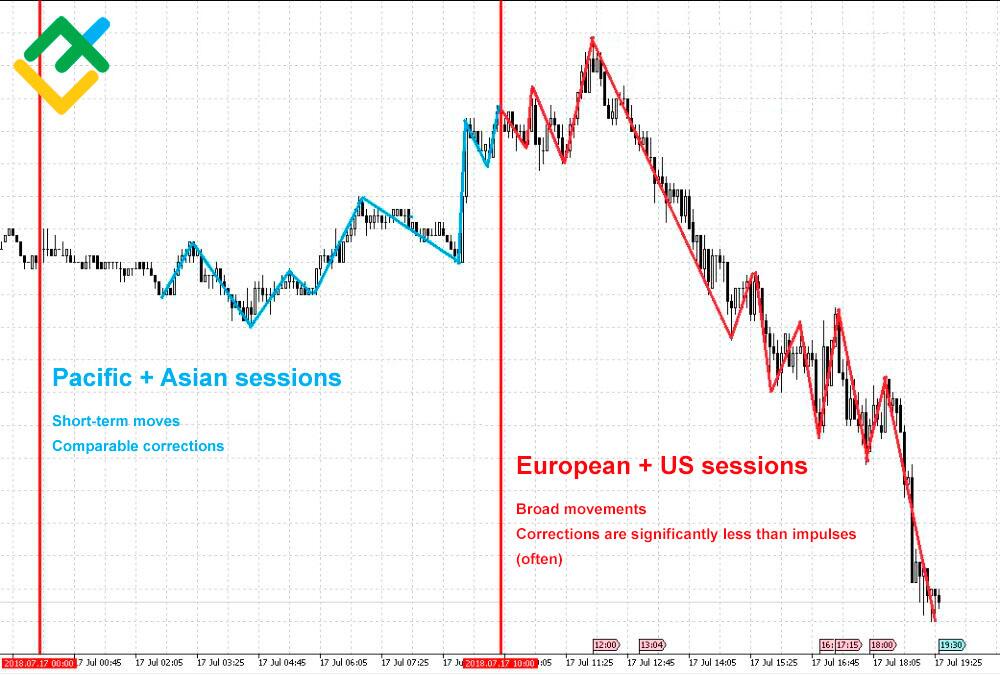
You can evaluate other currency pairs in the same way:
- USD/JPY will be chilling during the Pacific session (but not the European one, because there is a strong influence on the dollar due to the correlation with the EUR/USD),
- AUD/USD will be calm during the Asian session.
….and so on.
In order to keep things simple, I suggest we stick with the EUR/USD for the time being. Then, when you’ve gained some experience and started to understand what movements you should look for, you can open any chart of any currency pair yourself and find what time they usually occur.
If you look at the screenshot, you will see that in the overwhelming majority of cases, during the "market inactivity", the price behaves in exactly the 2 ways that we need:
1) Low volatility flat. Clarification: we are not talking about flats with a width of 4 p with a spread of 3 p. We are interested in more or less wide ones specifically for this trading time.
2) Low volatility V-shaped reversal - this is more interesting. It usually happens towards the end of the inactive phase. For example, in the EUR/USD, it often happens before/during the opening of the European session. This is usually explained by the fact that people set stop orders above the upper and lower borders of the flat, and they all get triggered - the price goes first in one direction, then in the other, so that both cunning buyers and cunning sellers get a loss.
Let's figure out what happened in the previous figure:
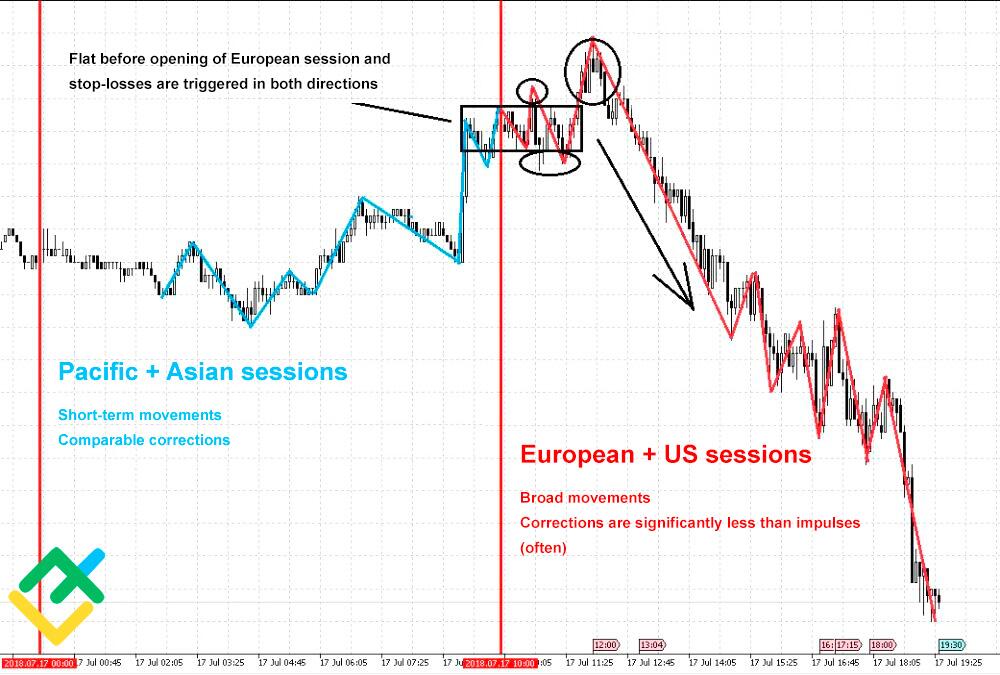
Here we see that the triggering of stop orders was rather late, and the main movement started later. This also happens. Trading is not an exact science.
Of course, no one knows if it really was a deliberate triggering of stop orders and why it happens in general, but that’s ok. It is enough for us to know that this happens quite often, and you can see it for yourself by rewinding the chart back.
Thus, during a low-volatility flat, we get an upward movement and a downward movement, which is exactly what we need: our advisor opens orders on one movement, and then closes them on the opposite movement.
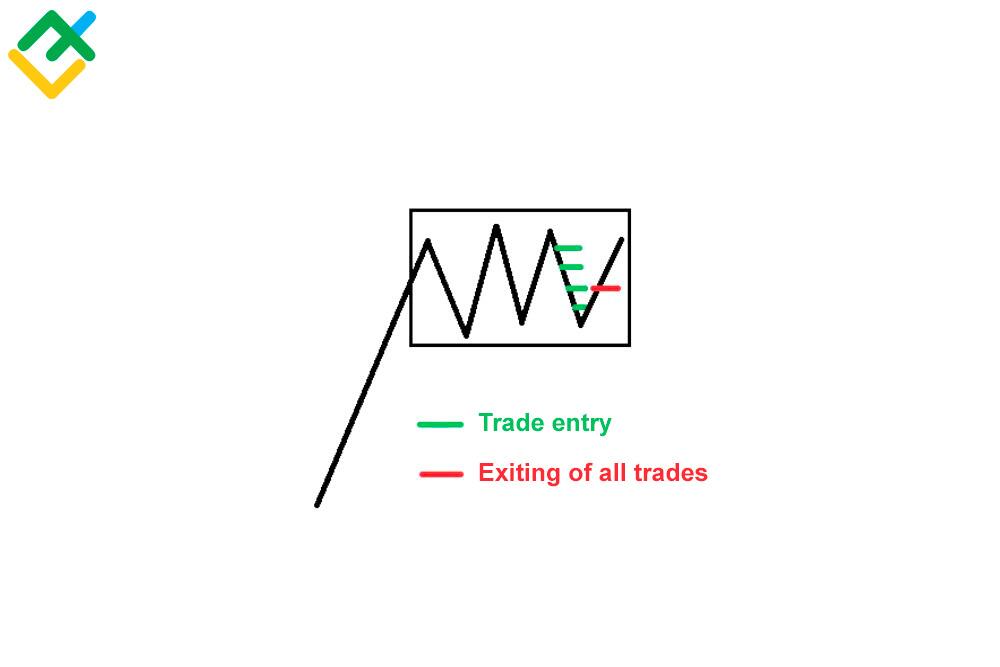
During the V-shaped reversal, the same thing happens - while one portion of the stop orders are being triggered, our advisor opens orders, and when the price goes in the opposite direction - the advisor closes them.
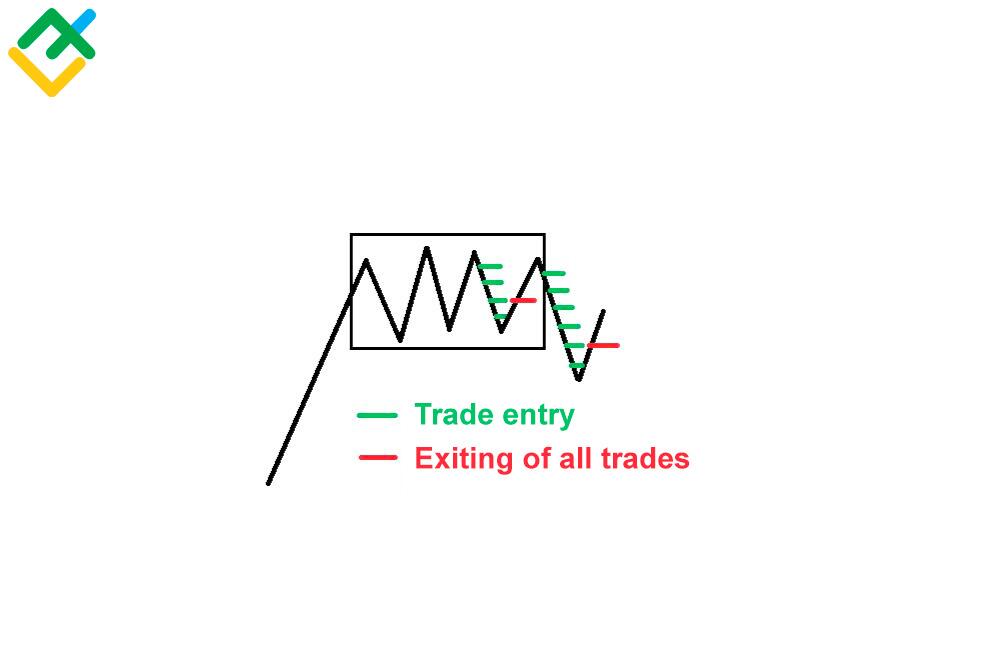
Therefore, in my opinion, a good option would be to simply turn on the advisor at the beginning of the INACTIVE phase. If by the end of it you have a profit, simply turn off the advisor. If, by the end of it, the advisor has opened and not yet closed orders, you can try waiting for the stop order triggering period and turn it off after making a profit (as in the figure above).
A good option would be to simply turn on the martingale EA at the beginning of the INACTIVITY phase:
- If by the end of it you have a profit, simply turn off the advisor.
- If, by the end of it, the advisor has opened and not yet closed orders, you can try waiting for the stop order triggering period and turn it off after making a profit.
Ideally, you should turn off the advisor immediately after the end of the market inactivity phase. Waiting for the triggering of stop orders is the last resort option if you haven’t taken profit yet. This is already trading in a period of high volatility, which means that the probability of a rollback movement increases, which in turn increases the risks. So it is safer not to expect that the triggering of stop orders will necessarily occur in both directions, because such a scenario is not guaranteed. For example, it can happen in one direction and then go off the rails. But for our purposes, ONE triggering of stop orders is enough for us to CLOSE positions with a profit and leave the market. Pay attention to the previous figure: to close the buy positions in profit, we only need a small upward movement (the closing of positions is indicated by a red dash). Therefore, there is no need to wait either for the price to approach the upper border of the flat, or, moreover, for the triggering of stop orders from above.
Let’s sum up what we’ve learned about Martingale advisors:
1) Only trade with amount that you can afford to lose;
2) Your balance should always have the lowest possible amount for trading and no more. Transfer the excess to another trading account.
3) Be sure to calculate the maximum recoilless movement and the minimum rollback. Use these data to calculate the price step and the amount of the deposit;
4) Your priority is low volatility flats and low volatility V-shaped reversals following them
5) Look for liquid instruments and trade them during periods of low activity
6) Don’t be greedy and leave the market on time.
The goal is a small but stable profit in understandable market conditions.
Short-term Expert Advisors: scalpers and pipsers
I combined them into one group because the essence of their trading is quite similar. The difference lies in the size of stop losses and take profits, which is also not significant.

For those of you who don't know, scalping isn't just about short-term trades. The essence of scalping is “cutting off the momentum" (which follows from the name), i.e. it’s an attempt to enter at the moment of the momentum’s inception and exit at the first sign of decay. At the same time, the momentum itself can be even on D1 and occupy 1,000 points. But in terms of advisors, scalpers are the traders who make short-term trades on small timeframes.
In terms of advisors, scalpers are the traders who make short-term trades on small timeframes.
The essence of short-term Expert Advisors can be described as follows: your trades will have a rather small stop loss, a rather small take profit, and there will be a lot of these trades.
Let's immediately go through the advantages and disadvantages of this approach.
Benefits of scalping advisors
1) Usually there is a clear trading algorithm that uses either indicators, or price levels, or Price Action patterns (these are certain candles that indicate a clear predominance of bullish / bearish sentiment at the moment). Let me clarify that "trading in channels" and "trading in a flat", which are often used by these advisors, are also classified as using price levels.
2) You can start with a super small deposit. You only need a small amount to open and hold trades.
3) With a non-greedy approach you will get minimal losses. You can use such an EA on a small deposit, and even in a bad scenario it will be very difficult to quickly lose it, even if all trades in a row are unprofitable (and this is extremely unlikely, just as 100% profitable trades). The only exception is if you are greedy and try to trade with such an advisor during the release of important news. See the "disadvantages" section to find out why this is not good.
4) With a greedy approach - you can enter in very large volumes even on a small deposit, and here's why:
Deposit - 20 $
Stop loss - 2 p.
Take profit - 4 p.
If you enter with a lot of 0.1 (and this is an extremely large volume for such an amount) and exit by stop loss, you will lose (drum roll) $2, and in the case you exit by take profit, you will earn as much as $4, which is 10% and 20% of the deposit, respectively. In one trade. Cool, yeah? But do not start imagining yourself on a yacht yet before we sort out the disadvantages.
Disadvantages of Expert Advisors for scalping
There are fewer of them, but they are significant.
1) Extremely large dependence on the spread. If your stop loss is 2p and your take profit is 4p, then you need a price move (4p+spread) to take profit, and to exit by stop loss, a 2p move or even a short-term spread widening by these 2p is enough.
Add to this the possibility of spread widening (if you are not working on an account with a fixed spread), and things can get sad.
2) Strong influence of slippages and requotes. Here we are talking about trading at a time when there is a high probability of an increase in the volatility of price movements. For example, it can be the release of important economic news, the opening of the European session, or the opening of the American session.
Let’s talk about why slippage occurs at all. Imagine the market not as a chart, but as a certain number of sellers and a certain number of buyers who, respectively, want to buy and sell goods at the prices they need.
For example, if you see a spread of 1.10-1.11 (numbers are arbitrary), this means that of all available sellers, the best price for you (as a buyer) is offered by the one who wants to sell at 1.11, and the rest want to sell the same product at a higher price . It’s like a farmer’s market. In the same way, the best buyer for you will be at a price of 1.10, and the rest will want to buy from you at a lower price. You can compare this to selling some item online: you put out an ad, all sorts of people call you, and you choose the one who bargains the least.
In the figure, the red rectangles show the orders of sellers, and the green rectangles indicate buyers. The numbers show the volume of orders: for example, 500 million euros are offered for selling at 1.11, and 800 million euros for buying at 1.09. “High popularity among traders” indicates that trading volumes are large, which means that the risk of slippage and requotes is minimal.
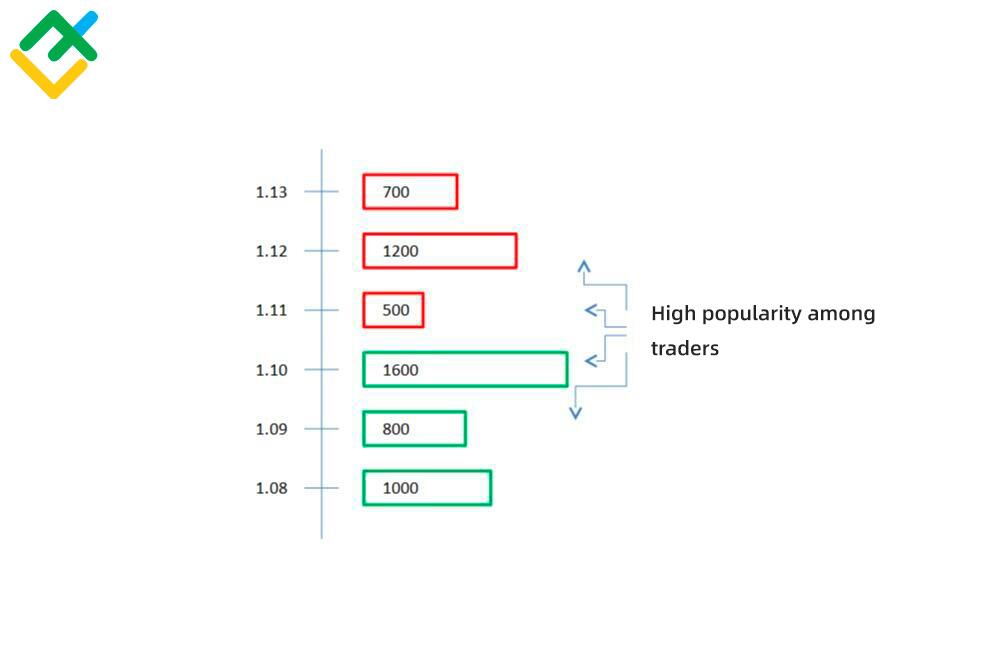
At the time of the news release (you can find the news calendar here: https://www.litefinance.org/trading/calendar/) or the opening of the European and American sessions, one of two things happens:
Option 1 - orders are moved away from the current price, forming a kind of liquidity vacuum.
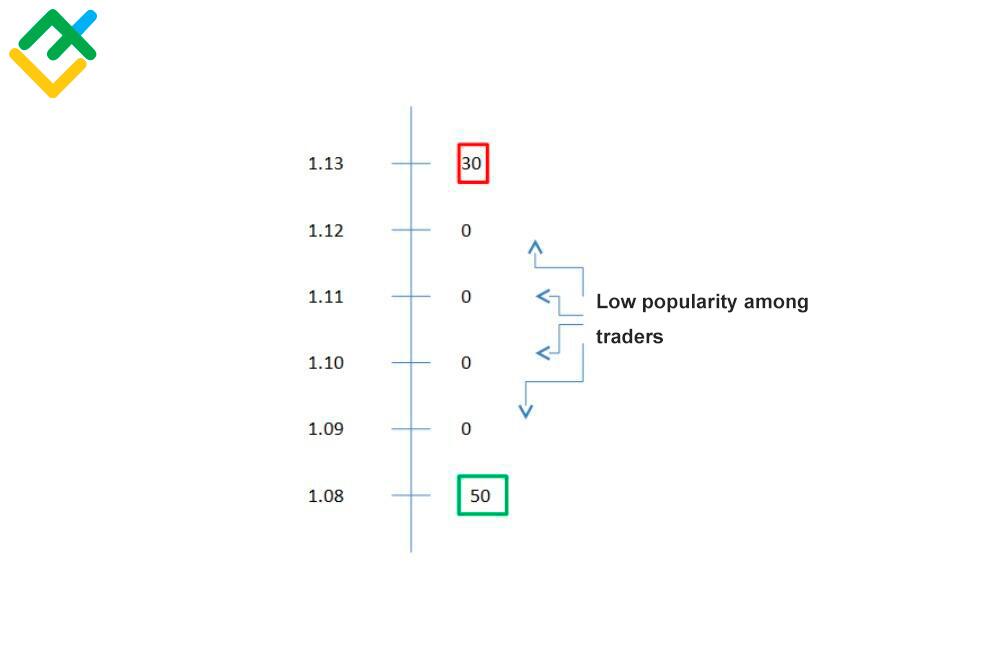
If earlier you could buy the product at 1.11, now you cannot buy it cheaper than 1.13 - at least there is something for sale at this price.
“Low popularity among traders” indicates that trading volumes are small, and at some prices there are no orders for buying and selling at all. It is better to refrain from trading this instrument during such a period.
Option 2 - a large volume comes to the market and sweeps all participants in one direction. The result is the same as above - before that you could buy at 1.11, but now you can only buy at 1.13, because all the sell offers at more interesting prices were bought out by this large buyer, and now there are none.
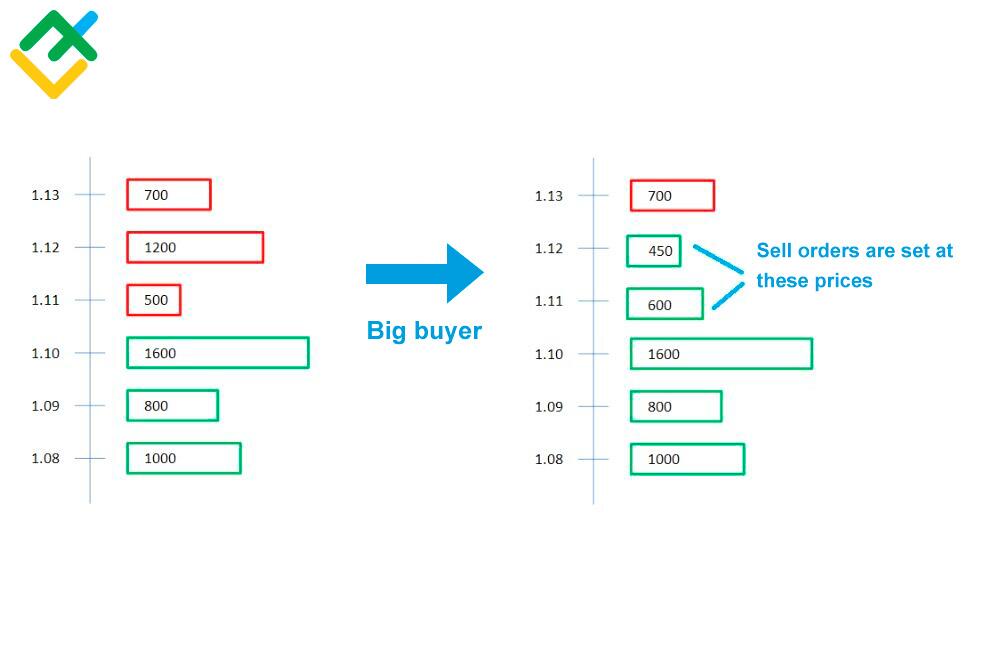
Perhaps someone will ask: "But why? There was no liquidity vacuum." That's right, but according to the rules of the financial markets, orders with a larger volume are given priority. If you and some large fund simultaneously send an order to the exchange, they will execute the fund’s order first at the best prices, and you will get the prices that will be available after. But don’t panic, we are traders because we can choose the best trading time for us - we don’t have to be in the market all the time.
According to the rules of financial markets, orders with a larger volume are given priority
Why do these things affect the work of the advisor? The EA places small stop losses and small take profits. Stop loss by type of execution is a market order. If you set a stop loss at 1.11 before the opening of the session, then at the opening of the session a fund with its large volume gets in front of you at the same price, your stop loss will not work at 1.11, but at the price available when this fund ends its position. In the picture above, your stop loss would be executed at 1.13 - you would be buying after the big participant from the nearest available seller.
So all the risk management calculated by you (for example, if out of 10 trades you get 5 unprofitable ones with a stop loss of 2 p each and 5 profitable ones with a take profit of 3 points each) becomes inapplicable to reality. Because in one trade with such slippage, your stop loss will not be 2 p (as you assumed and what you based your calculations on), but, for example, 5-10.

Using advisors for scalping
Let's summarize what we’ve learned about using trading robots for scalping and pipsing. It would be useful to repeat that when you entrust your money to an advisor, you definitely need to minimize risks. For piping and scalping, you need:
1) Quiet time for trading. The following periods are ideal for this:
- Asian and Pacific sessions. Look carefully at the spread of the instrument you are planning to trade. The spread should not be higher than in the daytime, otherwise it will affect your financial result too much (and if it exceeds the stop loss, it doesn’t even make sense to trade at all)
- European session lunch time. This is approximately 12.00-14.00 Moscow time. Still liquid time (i.e. small spread), but at the same time, as a rule, it has calm flat movements.
2) Liquid financial instruments. Here we are talking about the spread too. There is no point in pipsing or scalping with stop losses of 2p on a currency pair where the spread is 10p, for example.
Such major pairs as the EUR/USD and USD/JPY are perfect for this. You can trade the other majors too, but keep in mind that the spread is a little higher.
3) Most important tip: learn the algorithm based on which the pipser/scalper makes trades. You need this to assess stop loss and take profit values and, if necessary, adjust it according to your understanding of the market and / or current market conditions. For example, the spread may increase, but the volatility may also become higher. In this case, it would be advisable to increase the stop loss, let's say from 2 p to 4 p, and take profit - from 4 p to 8 p, without violating the essence of the trading system embedded in the advisor.
One of the most popular Expert Advisors in this category is the Wall Breaker. By the way, it can be used on higher timeframes as well.
Multicurrency Expert Advisors
In fact, this category of Forex trading advisors is complimentary to all the others. Any of the above types of advisors can be a multicurrency advisor.
Multicurrency Expert Advisors allows you to work with several currency pairs.

Due to the specific nature of Forex trading, most advisors are suited for currency pairs with the smallest spread, i.e. majors. It just makes no sense to increase trading costs by trading exotic currency pairs, where the spread will eat up half of your stop loss (at best). However, multicurrency Expert Advisors trade unusual combinations of currencies, such as EUR/JPY and AUD/CAD, etc.
Some traders say they don't like the major currency pairs and that they have one favorite currency pair among exotic currency combinations that moves in a clear and more predictable way and is better in general, and all these advantages seem to negate the higher spread. But, in my subjective opinion, this is a delusion: if at the moment the trader cannot successfully trade pairs with the best trading conditions but at the same time manages to trade a currency pair with worse trading conditions, then most likely that exotic pair is providing a good market situation for their strategy, which is not currently available on other currency pairs (and which will change sooner or later, and the results will become worse). Thus, the trader is trying to "get it while they can", but with this approach, earnings will never become stable, because there is no desire to deal with the market as a whole and adapt the strategy to all possible market conditions.
If you like the AUD/CAD or the like, I suggest you just select any such pair and compare its chart with the charts of the major currency pairs. After some time, you will most likely find a similar type of price movement among the major currency pairs, allowing you to save on the spread.
When using advisors, as mentioned earlier, our goal is to reduce risks. In this case, the less we pay for the transaction (opening-closing), the lower the risk of a negative result following the results of a series of transactions.
In my opinion, if you are trading with a robot, it is better to focus on pairs with the lowest spread.
When discussing multicurrency advisors, we should mention correlation.
Correlation is the similarity of the price behavior of one currency pair with the price behavior of another currency pair.
Let’s open the EUR/USD chart and the GBP/USD chart. Do they look similar? If yes, there is a direct correlation, i.e. when one pair grows, the other pair grows in a similar way.
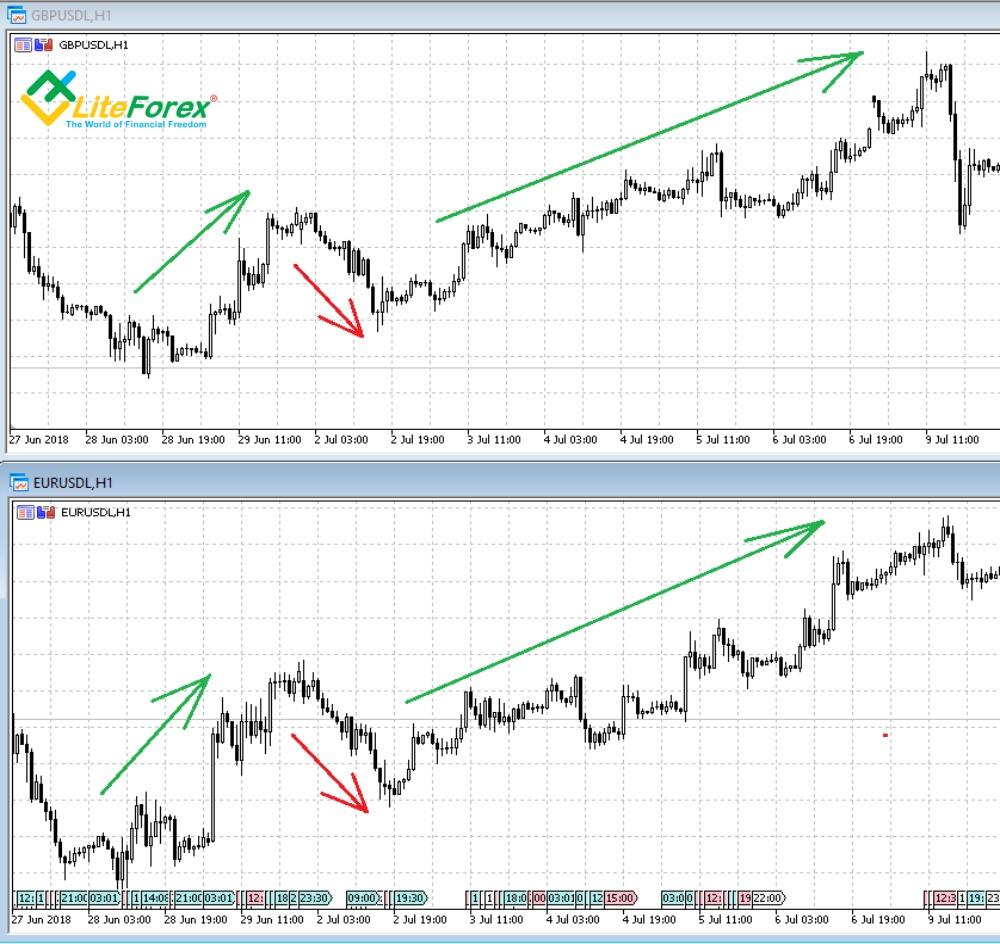
Now open the EUR/USD and the USD/CHF charts. Are they similar now? If they mirror each other, then we’re seeing the inverse correlation, i.e. one pair grows and the other pair falls, also in a similar fashion.
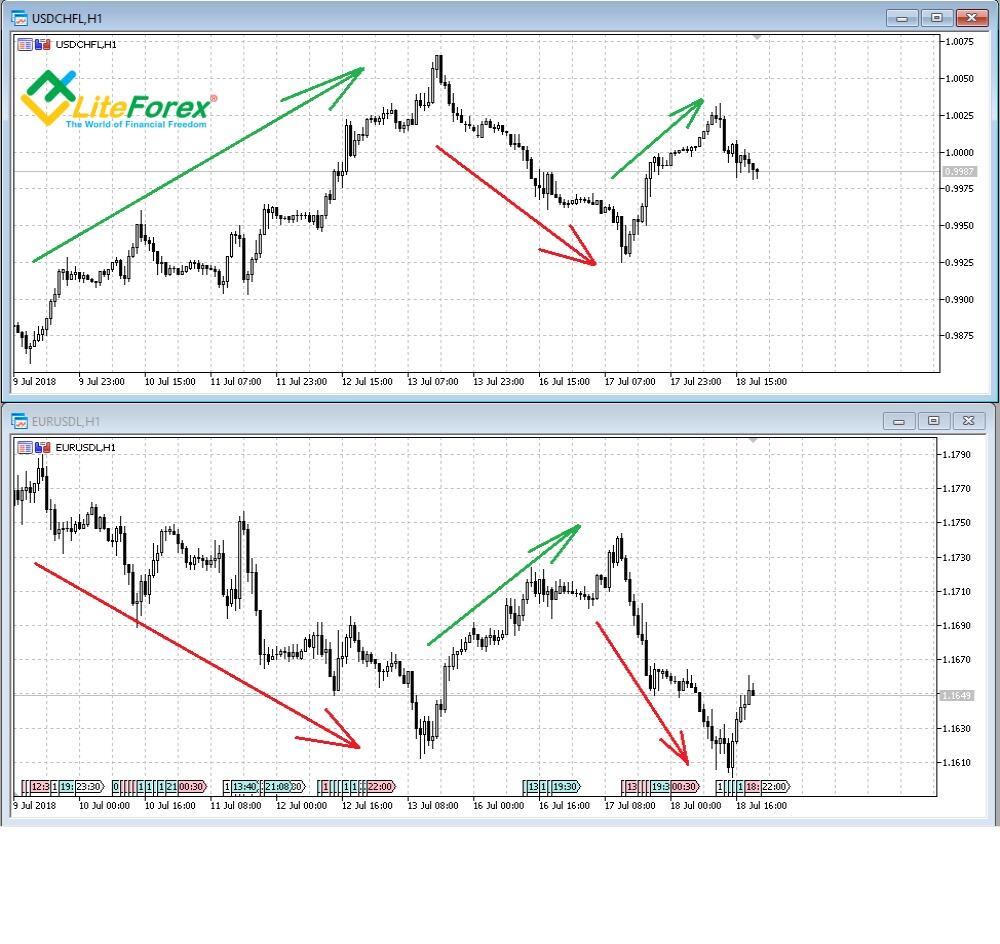
I can’t give any specific recommendations for determining how much of a direct or inverse correlation exists between currencies. You can simply determine this by eye, or you can use special indicators, like Overlay Chart, Ind_Correlation, or Pearson Correlation Indicator, which will tell you exactly how similar the currency pairs are.
Correlation is the similarity of the price behavior of one currency pair with the price behavior of another currency pair.
You need to remember a few things if you decide to turn on the multi-currency advisor at full capacity and use it on several currency pairs.
1) Once you have determined which pairs correlate with each other (this includes both direct and inverse correlation), before using a multi-currency Expert Advisor, you will need to filter out only those that are LEAST correlated (both direct and opposite).
If you use the EA on currency pairs with a direct correlation, then, roughly speaking, you will trade with an oversized lot (as if you are not trading 0.01 in EUR/USD and 0.01 in GBP/USD, but simply 0.02 in EUR/USD) because trades will be executed in a similar way due to the similarity of movements. If you use an advisor on currency pairs with an inverse correlation, the profits of the advisor in one pair will be offset by the losses of the advisor in the other pair, minus the spread on both currency pairs.
2) It is necessary to calculate risk management based on the number of traded currency pairs. If your deposit would be enough to trade 0.03 lot in one currency pair, when using the advisor on 3 currency pairs, you should set the volume of 0.03 lot / 3 currency pairs = 0.01. Because the load on your deposit will be triple (in this example).
Everything is again based on risk management:
1. assess your deposit;
2. divide it into several different (!) instruments;
3. select trading volume for each of them;
4. you’re all set.
One of the examples of multi-currency Expert Advisors is the Night Owl working during the Asian session. In my opinion, it’s exactly what you need for leisurely testing and gaining experience in automatic trading.
Now it's time to move into the gray area of advisors that brokers disapprove of, to say the least. We will talk about arbitrage advisors.
Arbitrage Advisors
This type of advisor exists, which means we need to talk about it. Use it at your own peril and risk. Personally, I would not recommend doing this, and I’ll explain why below.

Arbitrage advisors trade simultaneously with 2 brokers - a "fast" broker and for a "slow" broker. Sometimes one broker provides a price quote faster than another: for example, the price on Forex has increased from 1.0200 to 1.0210. One broker showed this change in 0.1 seconds, and the other in 0.3 seconds.
The purpose of an arbitrage advisor is to track this price change with the "fast broker" and go in the SAME DIRECTION with the slow broker BEFORE it catches up. It’s like you know for a fraction of a second where the price will go with the slow broker and are using this for your own profit. Sounds like a get-rich-quick scheme, right?
In order to take advantage of this type of advisors, you will need:
1. Extremely powerful computer and strong internet connection. Even a slight delay for any of these reasons makes it pointless to use these advisors because brokers also have quite significant capacities to deliver price quotes, and their goal is to reduce this delay as much as possible.
2. Lowest possible spread. The EA will open market orders. This means that if the fast broker’s price has changed by 1p, and the spread of the slow broker is 2p, then the position will be closed at a loss for you (see picture). Here are the solutions:
- Choose the account type with floating spread. Fixed spread accounts generally do not offer a sufficiently small spread. With a floating spread, it depends on the trading time - it narrows in the popular periods and expands in the illiquid times.
- Trade only during liquid times (when there are a lot of traders on the market, the spread is as narrow as possible). Forget about night trading. Liquid time is the first 2 hours of the European session and the first 2 hours of the American session (whoever finds and compares this time with their time zone is on the way to becoming a professional trader).
- Continuously monitoring news releases. As you know, during the news, the spread expands catastrophically. If the advisor decides to enter during the news (and it certainly will), the result may be a catastrophic loss for your deposit when the position closes. The situation is essentially the same as when trading in illiquid times. Remember - in order to make a profit, we need both a good entry into a trade and a good exit.
- You will need a special program that tracks both brokers and the work of the advisor. Usually, it is provided in combination with the advisor, and there are quite a lot of these programs, so you might want to research this. However, if you have any questions, leave a comment, we will try to figure it out together.
3. Testing, testing, and still more testing. Below I will list the conditions for testing the advisor:
- Liquid time (if the advisor does not work in the best conditions, you can immediately throw it in the trash).
- Time with medium liquidity (this is the European and American session in general, except for the first 2 hours, which are the most liquid). If it works - great, because this time will add variability and expand your earning opportunities.
- Night time (Asian and Pacific session). If you find a fast and slow broker that provides a narrow spread at night - this is paradise for this type of advisor. We just turn it on for the night, go to sleep, wake up and ideally see profit on your balance (if the spread conditions are really good).
- News time (important news with 3 stars).
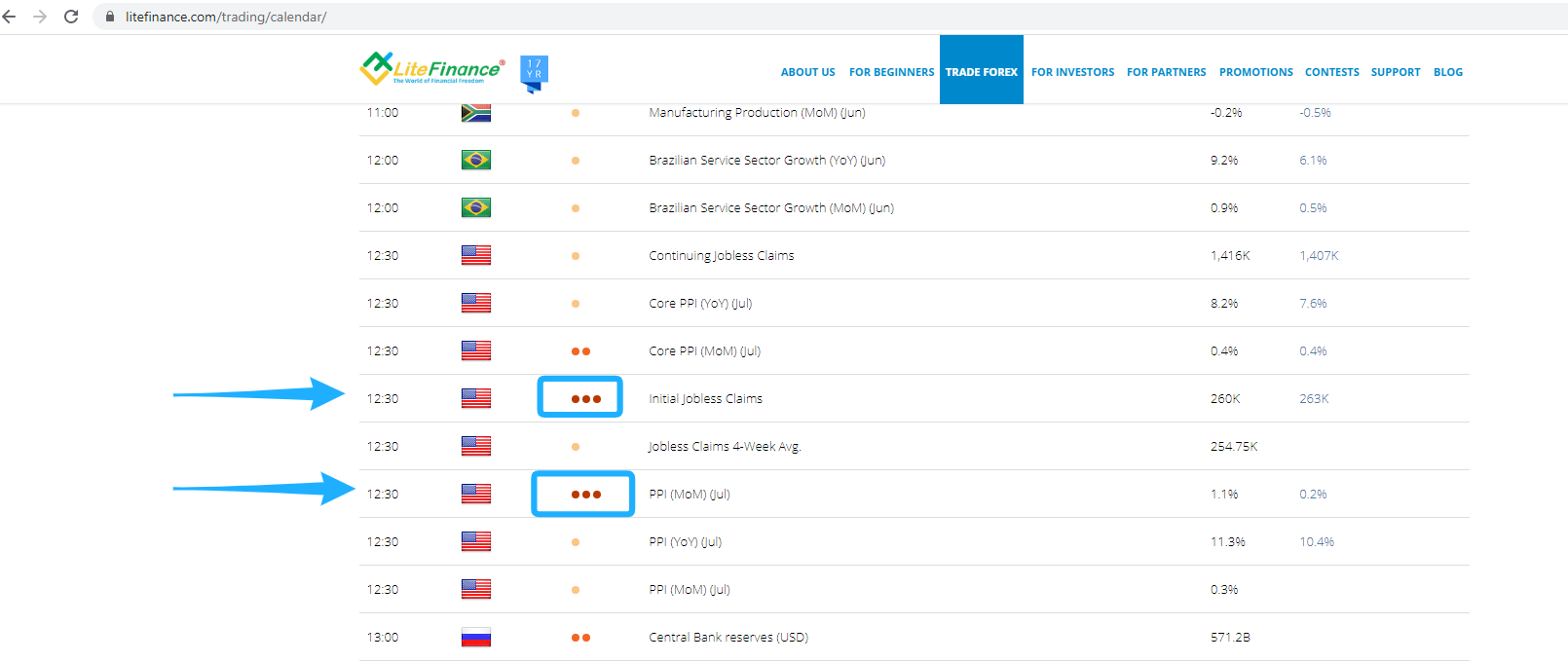
This is the most hardcore, but also potentially the most bountiful time. To be honest, I don’t think there are brokers that don't widen their spreads during the news, but you can still look. If you find it, this is paradise: movements during the news will be sharp and strong, and therefore, the delay can be significant + profit is much larger than the standard 1-3 p in liquid time.
To sum up, we take these conditions and test from top to bottom. If during some period the advisor fails - turn it off for this time in accordance with common sense.
Now the reverse side of the coin:
1. Of course, most of the cheats have long been revealed, and measures have been tested and implemented. The brokers that have been around for a long time are popular exactly because of the quality of services provided to clients, which involves the provision of quotes with minimal delay by having the best equipment. Therefore, in the current conditions, it is quite difficult to find a fast and a slow broker. Yes, there may be moments and periods when one broker is a little slower and another is a little faster, but you need to really look for those.
2. As a consequence of clause 1, a situation may arise where a fast broker and a slow broker can swap places. Here you need to check the properties of the advisor - whether it can work in 2 directions and adjust to such a situation or not.
3. The regulations of most brokers contain trading parameters aimed at preventing trading by arbitrage advisors, including:
- Restriction on the time of existence of an open position (as a rule, at least 1 minute). Arbitrage strategies, on the contrary, require an extremely short period of holding the position. So even if you can make a profit, your profitable trades may be canceled according to this rule.
- Restriction on the minimum take profit value. The trick here is that arbitrage strategies have extremely small take profit, unless, of course, you trade during news movements. But if most of your trades will be closed with a profit of around 1-2 points - most likely, they will also suffer the same fate of being canceled.
- A direct ban on the use of arbitration systems. I don't think we need any comments here.
4. There is also a technical side that can let you down even if you find generous brokers with the right difference between their quotes. For example:
- Requotes. If, for example, you send a buy order to a slow broker following an increase in the price of a fast broker, there is a chance that your trade with the slow broker will not have time to be executed. It works like this:
1. You send a buy order to the slow broker at 1.0200 because the fast broker’s price is already 1.0202;
2. While your order goes to the server of the slow broker, it receives a fresh quote at 1.0202;
3. Your order to buy at 1.0200 comes to the slow broker’s server. It cannot execute it at the price of 1.0200, because the current price is already 1.0202;
4. It offers you to execute your order at 1.0202, but the moment has already been lost;
To avoid this, as I wrote above, you need a powerful computer, superfast Internet connection and smart software, complete with an arbitrage advisor and a dealing center that has not figured out how to prevent this.
- Slippage. Arbitrage advisors tend to have very short stop losses (if any). If the advisor opens a position, for example, to buy at a price of 1.0202, placing a stop loss at 1.0200 (2 points), and at that time there is a strong downward movement in the market, the stop loss for the trade can turn out to be much larger (we discussed this mechanism in the paragraph about scalper advisors). Based on this, the entire risk management collapses: it will take a much larger number of profitable trades to recoup the result of such losses, the magnitude of which is basically unpredictable.
Again, it’s up to you, but I think it is easier and safer to use other types of advisors, given their diversity and legality. I understand that it’s tempting to cheat the system, so here you decide what is more important for you - a calm systematic study of the intricacies of earning on Forex or a get-rich-fast scheme with the risk of getting caught and not earning anything.
Trade Arbitrage Expert Advisor belongs to this class and, as mentioned earlier, it will require quite powerful equipment for its correct operation.
If the Expert Advisor types discussed above were for adventurous spirits so to say, their colleagues listed below are suitable for those who prefer calm and measured trading. I should note that there is no correlation between professional development and being an adventurer or a slow-tempered trader. History knows both successful scalpers and profitable medium- and long-term traders. As elsewhere, you, dear reader, should try everything and choose what is best for you.
For me, arbitrage is a pure cheating system, rather than honest trading. I do not support it, firstly, for ideological reasons, and secondly, because of the risk of being left with nothing but wasted time.
Trend Expert Advisors
The essence of the trend EA algorithm is quite simple - it opens a rather small (compared to the above types) number of trades in the direction of the trend. The catch is that there are still no clear objective parameters for determining the trend and its change. You can easily verify this by visiting any Forex forum.

As you understand, such Expert Advisors can be based on various ways of identifying the trend, so do not be surprised if the trend is still upward for you, but the Expert Advisor is already opening a sell trade. The most important tip is to understand the very mechanism underlying the Expert Advisor.
How trend advisors work
The essence of the trend EA algorithm is quite simple - it opens a rather small (compared to the above types) number of trades in the direction of the trend.
For example, a Forex robot can determine the direction of a trend in the following ways:
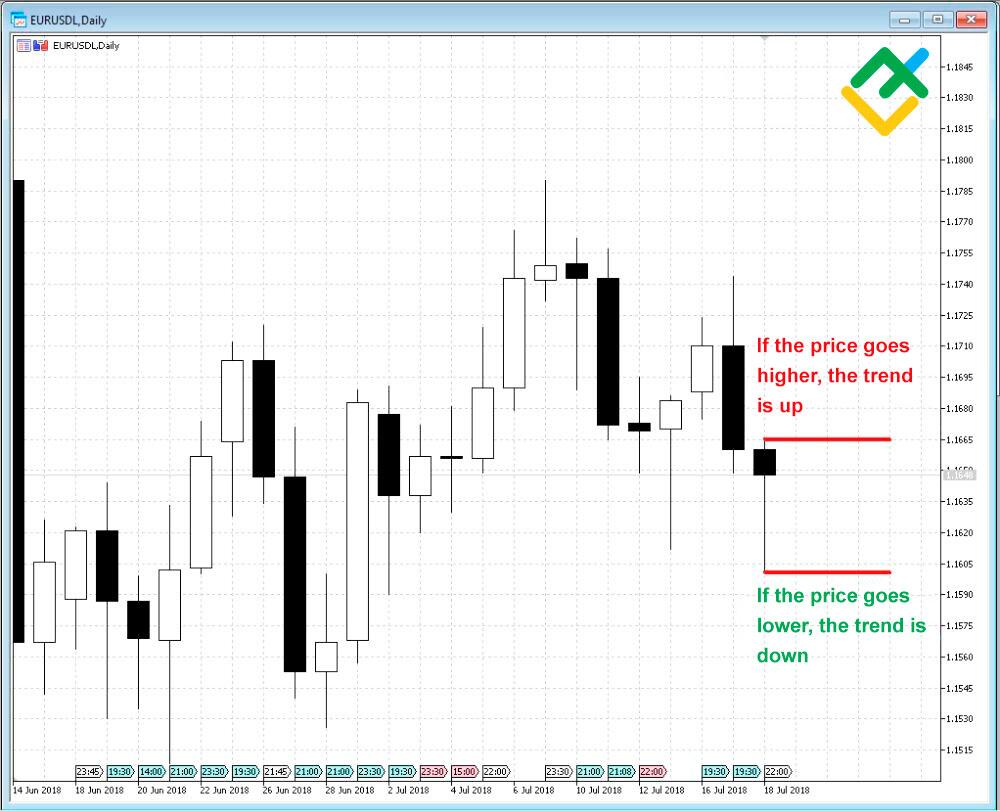
1. Breakout of daily high/low. For example, you have the bottom and top of the candle of the previous day. The top is 1.1000 and the bottom is 1.0800. If the price breaks through the top, the EA will assume that the trend is upward and will look for buying opportunities. If it breaks down - the advisor will see a downtrend and will look for opportunities to sell.
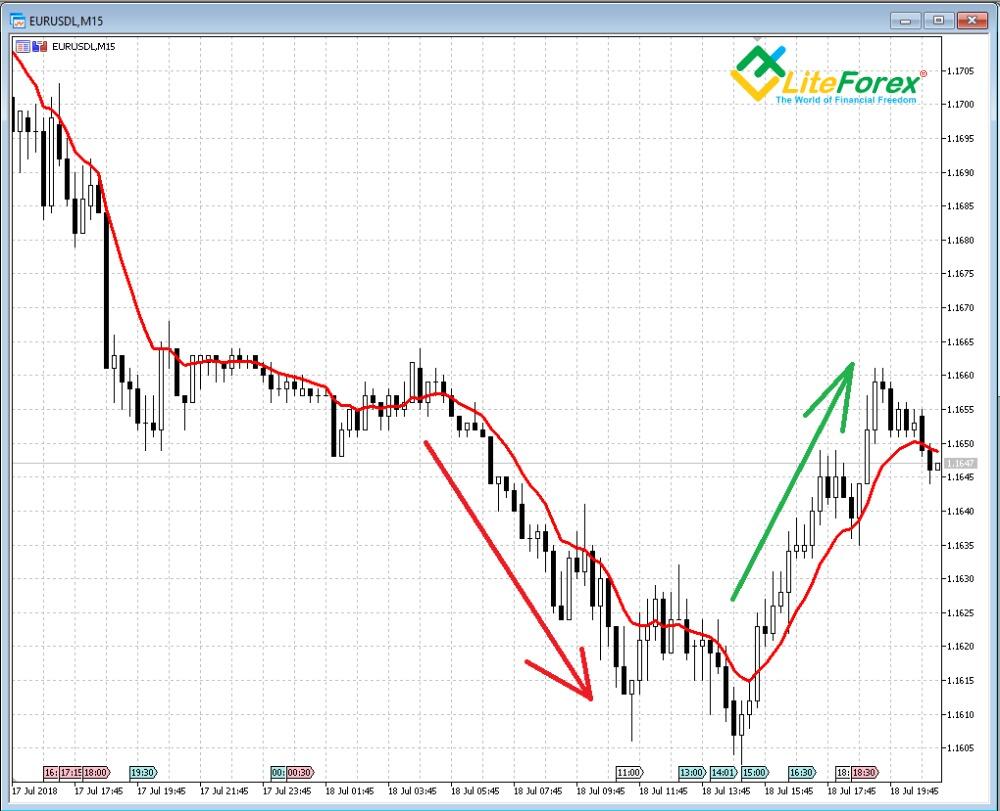
2. Using trend indicators. The essence is about the same: if the price is above the moving average - buy. If he price is below the moving average - sell.
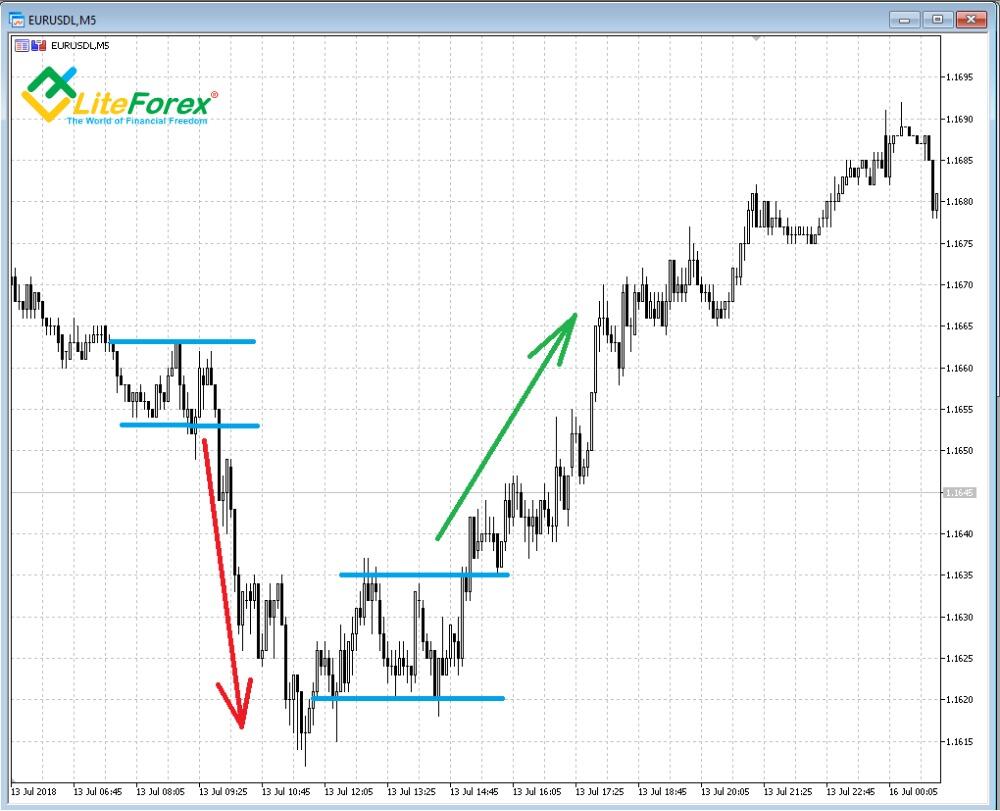
3. Using volatility indicators. If you do a little research on price charts, you can see that long trend movements are often preceded by the following situation: price movements become calmer (volatility decreases), and then the price shoots in this direction by a significant number of points (volatility increases).
Therefore, according to the advisor, the trend is going where the big movement has shot.
Recommendations for trading with trend advisors
As for the Forex trend advisors, there isn’t much to say. General recommendations are as follows:
1. Trading in volatile time (if intraday) and on liquid currency pairs (this is relevant for all advisors). In quiet periods and on illiquid assets, trading with these advisors will turn into a lottery: you will open a trade, place a stop loss and take profit, and wait. Either wait where it will explode at the opening of the European session, or wait until at least a couple more people come to the illiquid instrument to join those 3 people who are already trading it, and then, perhaps, the price will go somewhere. In my opinion, it just doesn't make any sense when there are good liquid instruments with powerful price movements and tight spreads.
2. Compliance with risk management. After testing the Expert Advisor with standard parameters and making sure that it works at least on historical data, calculate the lot size in such a way that the maximum series of losing trades does not eat up more than 20% of your deposit. Here is an example calculation:
Stop loss - 10 p
Take profit - 20 p
Maximum number of losing trades in a row - 8 trades
Our deposit is $400
20% of the deposit = $400 * 0.2 = $80 - this is how much we can lose on a series of losing trades
Now let’s calculate our maximum stop loss in dollars:
80$ / 8 trades = 1$ - this is how much we can lose in each trade.
Remember that our stop loss is 10 p. Therefore, the maximum value of 1 pip according to our risk management rules is:
$1 / 10 p = $0.1
This value of 1 pip corresponds to a volume equal to 0.01 lots. The calculation method is universal - you can simply fill in your numbers.
If, for example, your recommended pip value is less than $0.1, you need to:
- either increase the deposit,
- or test with a smaller stop loss,
- or try other stop loss and take profit parameters in the hope that the series of losing trades will be smaller (not 8, for example, but 6). But, I repeat, it makes sense to do this only if the EA showed profit on the test with standard parameters. If not, it's easier to throw it out and test another one than keep tinkering with parameters. You probably don’t have time to tinker with all the advisors.
It’s better not to increase the maximum % of the deposit dedicated to a series of losing trades - I understand that it sounds like it’s for wimps, but it’s scary to watch even 20% of your real money get eaten up, and even worse if it’s more. The point here is not willpower or the presence / absence of tolerance for stress, but mere practicality: there is no point in feeling anxious if you can avoid it.
Forex indicator advisors
Indicator EAs use indicator values in their algorithm to enter/exit the market. This algorithm can contain both standard indicators of your trading terminal and some original indicators, whose quirks you should learn in advance.
The indicator advisor can use indicators (Moving Average, Bollinger Bands, etc.) to identify the direction of the trend, and oscillators (for example, RSI, Stochastic, etc.), which help to enter on probable rollbacks or from the border flat, and various indicators of volumes, the beginning / end of trading sessions, and some other ones that I probably don’t know - there is quite a lot of space for creativity.
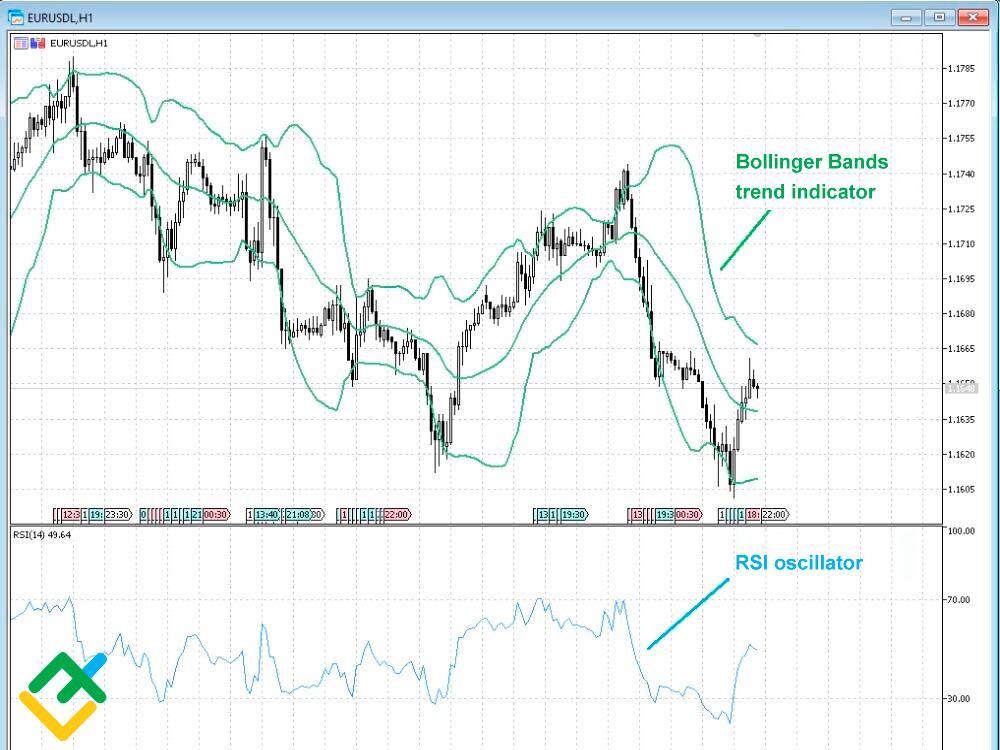
The entries of a signal-based advisor are characterized by the fact that it trades a certain market situation with clear parameters. For a novice manual trader (who, of course, understands the mechanism of the advisor), just watching such an advisor will be very useful for gaining trading experience. The cold-bloodedness of an advisor can be envied - it does not freak out from losing trades, it does not care that there were 2 or 5 losses in a row - it will not deviate from its rules and will methodically continue to make trades. Just by watching the trading of such an advisor, you will see how a professional trader trades and you will know what you are striving for.
Benefits of indicator advisors
1) In most cases, a simple and understandable algorithm for making: "the price crossed this, then it left such and such zone - I buy. If it is the other way around - I sell."
2) Diversity. A lot of indicators have been invented. And there are even more ways that they can interact with each other. In fact, you can choose an advisor that will suit you as much as possible based on your feelings - adjusted by the time of work, by the style of entry (on a rollback or on an increase in volatility), by direction (trend / counter-trend), by the degree of confirmation signal, etc. If you like research, there is much for you to explore.
In addition, if you decide to test such Expert Advisors, this is a great opportunity to get acquainted with the mechanisms of many indicators, as well as the ways they interact with each other. Based on this information, you may have some of your own developments for manual trading, which you will test later.
3) In most cases - a small number of trades (compared to the adventurous advisors). I classify this as an advantage because the trading result of such an advisor is easier to track and analyze. Of course, both with adventurous advisors and in more conservative ones, you can study the statistics, but if the advisor is slow, it will be much easier for you to track how much slippage affects its results, how it behaves during news, how it trades in a calm market, etc. It is easier to track this in real time than to study statistics. Knowing the approximate mechanism, you don’t have to look at the monitor all day - it is enough to understand at what moment the entry will be made.For example, if you know that the advisor will make a trade when crossing the moving average from bottom to top, and the price is now in a downtrend on the H1 timeframe, you know you can chill for a couple of hours.
A small number of trades will also have a positive effect on the emotional background of the trader - understanding that only 2-3 trades per day will be opened according to the calculated risk management rules relieves a lot of stress stress, which means that again you can do something something more useful than monitoring the EA’s work every minute.
Disadvantages of indicator advisors
1. Indicators will not adjust to a changing market. I'll give you an example. Let's say the advisor is guided by a simple crossing of the moving average (MA) with a period of 5:
- Price above MA - buy,
- Price below MA - sell.
And while the advisor can adjust to wider movements (for example, the candles grow from 10p to 15p), when the volatility of movements changes (there was a more directed market, but it became more flat - see the figure), the advisor will probably fail.
2. Signals from original indicators. Sometimes they have no description of their mechanism, and even based on the results of testing for a certain period of time, you still entrust your deposit to what is basically a black box. Of course, it is up to you to decide, but, in my opinion, this is quite a big risk, even if the test results are positive.
To summarize, the motto of the indicator advisor is "Quiet work, understandable mechanism." However, the user must understand that the indicator advisor in most cases is a temporary measure and after some time it will probably stop working. Therefore, an acceptable option would be to use it on a small deposit, and in case of making a profit equal to the initial amount of the deposit, transfer it to another trading account, allowing the advisor to risk only the earned funds.
As an option, I suggest trying the Breakthrough_BB Expert Advisor based on breaking through the boundaries of the Bollinger Bands indicator.
Non-indicator Forex Expert Advisors
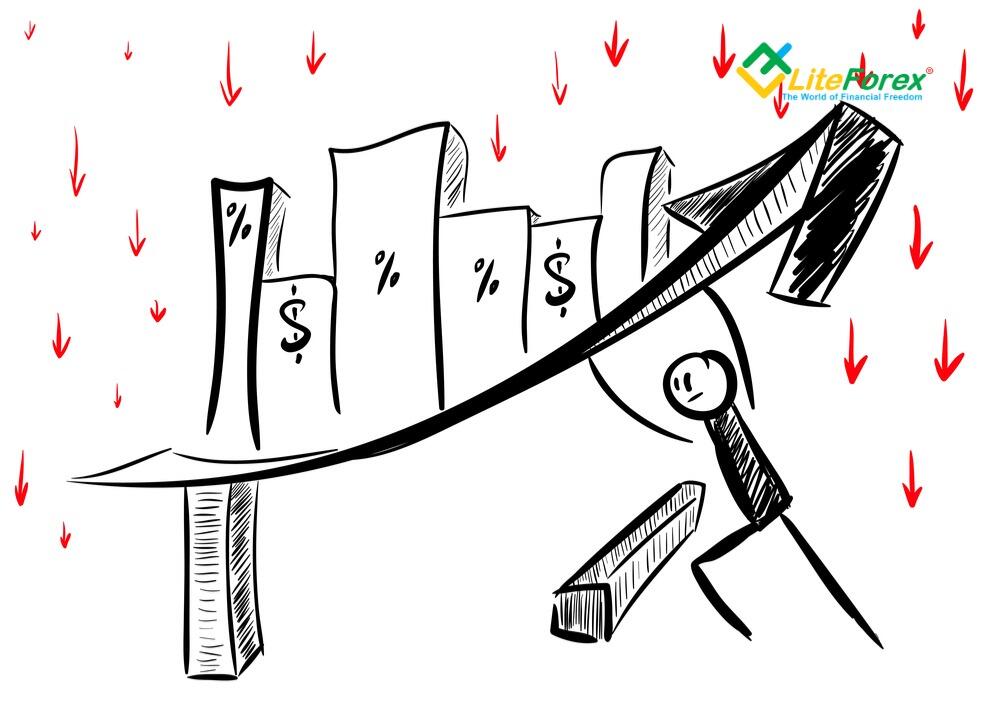
A non-indicator advisor uses either price formations (this can include both candlesticks, like a pin bar or absorption, and graphical patterns like flags, pennants, butterflies, etc.), or special trading time (for example, when a couple of minutes before the release of the news, a buy order is placed a little higher than the current price, and a sell order is placed a little lower). They are united by the fact that trading does not depend on the current trend direction, but is carried out according to the following scheme:
1. Price attenuation - some graphic pattern, a candlestick formation or just a flat (see figure) is forming,
2. Orders are placed on both sides: at the top - a buy order, at the bottom - a sell order. The exception is the candlestick formation. Here the order is placed only in one direction - where the formation itself shows (see figure),
3. We wait for the price to go in any direction, and we are behind it (see figure with 3 situations).
Now let's go in order:
Expert Advisors based on chart formations
There can be a fairly wide range of different patterns here, from the simplest ones mentioned above to those that the author of the article may well not know (you never know what new things have been invented in the last couple of hours).
For novice manual traders, such advisors are also a great option for learning - you can watch a cold-blooded advisor build patterns in real time. If you test several similar Expert Advisors (especially those based on the same graphic patterns), you will see that each author usually has a different way of understanding how this or that graphic pattern should be built and choose the option that suits you best.
Expert Advisors based on candlestick formations
The range of candlestick patterns is quite narrow - usually 3-5 most popular ones are used, so various horizontal or sloping price levels are often attached to these Expert Advisors.
I do not presume to judge in terms of efficiency, but in terms of training, this type of advisor is also an excellent option. Firstly, such advisors use the most high-quality candle formations for entry. Therefore, watching the work of such an advisor will teach you to automatically select only the highest quality candles from all candles, which can improve the results of your manual trading.
Expert Advisors based on the opening of trading sessions/news releases, etc.
The essence is the same again - during the calm market we place an order from above and an order from below and wait. These EAs are loved by novice traders because they are reminiscent of the Holy Grail of the market but also are very easy to use. Monitoring their work can also be useful, but only in order to see how quickly the nature of price movements can change on Forex (you can see this without an advisor).
The advantages of non-indicator Expert Advisors are the same as for indicator ones, but there is another very important one: non-indicator entries perfectly adapt to changing market conditions.
The triangle or flag will be the same in properties both with a candle size of 10p and with a candle size of 50p. If the movement becomes more directed, the patterns will simply be smaller in size. In a flat they will be bigger in size, but the essence of trading in both cases is the same.
The same goes for the timeless formations - a pin bar doesn't care if it's a flat or trend movement, and it doesn't matter if it covers 10p or 30p. The essence is the same.
News trading and trading at the opening of sessions is quite similar. We are just waiting for a strong price momentum in any direction. Yes, we are much more interested if the range is narrower before the momentum (then the risk is lower). But the essence, again, is the same - in wide movements, in narrow ones, in trend ones, or in flat ones.
Disadvantages of non-indicator Expert Advisors
1. Complicated parameters for those who are just starting to look closely at the advisors. Since the figure / candlestick pattern / flat width before the news will be different every time, you need to make sure the advisor does not set fixed stop losses and take profits, but really acts according to the situation.
If it doesn’t, it will be quite difficult to figure out the mechanism for setting stop losses/take profits as each time the advisor must calculate where to set the stop loss and take profit based on the current situation. So either ask the author or dive into the parameters. If you neglect the understanding of this, one day you might see a super-huge stop loss placed in an incomprehensible place for no reason at all.
If the EA still places fixed stop losses/take profits , we are returning to the disadvantages of indicator EAs, namely, to the fact that such an EA simply will not adapt to a decrease / increase in volatility or duration of price movements.
2. Technical flaws in order execution: slippage, requotes
Since in most cases Expert Advisors of this type make trades as if aiming for a breakout, the entry will be made by a market order. With a sudden expansion of the spread, you can get a completely different price than you expected, and this will lead to a violation of the risk management rules that we calculated based on a certain ratio of stop loss and take profit.
Recommendations for the use of non-indicator Expert Advisors
There are no special recommendations for the use of non-indicator Expert Advisors - risk management calculation is the same as in the case of trend Expert Advisors. The only difference is that you need to adjust the lot size to the current volatility, because getting a 50p stop loss and a 30p stop loss are two different things if you use the same trading volume. But the change in volatility cannot be predicted - it can be tracked only after everything has happened. The ATR indicator can help visualize it (see figure). If you see that it has increased, you can revise the traded lot down. If it has gone down, vice versa. Otherwise, everything is the same - test, identify the maximum series of losing trades, calculate the traded lot for a comfortable level of risk, launch it, forget it for a while and go about our business.
Summing up the results of the study of Forex trading advisor types
You should be aware that the approach to automated trading should not differ from the approach to manual trading - in order to make a profit, you still need to study the mechanism of your automatic assistants, test them for performance, take precautions with risk management rules for each type of advisors and only after that you can start using them. If the goal is to make a profit, you need to have a professional approach to automatic trading, and “thoroughness before speed” should become your main rule.

Some general recommendations for any type of advisors: I realize that few people listen to recommendations, but automatic trading is similar to moving into an apartment in a new building: at first all you have is bare walls - you can live, but you want more comfort. Then you buy a fridge (1st EA) after you have compared several refrigerators, of course. Then you buy a sofa (2nd advisor) - not the first one that comes across, but the one that is optimal in terms of price, quality, appearance and comfort. Then the table (3rd advisor), then the TV (4th advisor), and so on. Gradually, you furnish your new apartment the way you like. Is there a guarantee that you will continue to like the things you bought, or that you will not find better analogues? Absolutely not - you can easily change your fridge to a more powerful or larger one, or replace the TV with a better one. Did you know in advance that the refrigerator would no longer suit you or that the TV set would start acting up? Of course not - you act in the conditions that are in the present moment, and in THAT present moment (in the past), according to the test results, those things were the best option for you. It is also important that you don’t check your TV every day (is everything in order with the wires and the antenna connector?), and you are unlikely to check your desk all the time (did it crack while you were at work?). You just buy it and forget, and go about your business. Because you trust yourself and your choice.
Start trading with a trustworthy broker
This is all that I wanted to tell you about trading robots and automated trading. I hope that the article was useful and encouraging. Things may seem complicated at the time of reading, but in practice they are often quite intuitive.
However, if you still have questions I'm waiting for your comments. I will be happy to answer and give the necessary explanations. Also below in the comments I will give links to the advisors mentioned in this article.
Good luck with your trading!
The content of this article reflects the author’s opinion and does not necessarily reflect the official position of LiteFinance broker. The material published on this page is provided for informational purposes only and should not be considered as the provision of investment advice for the purposes of Directive 2014/65/EU.
According to copyright law, this article is considered intellectual property, which includes a prohibition on copying and distributing it without consent.