“A successful trader learns from the mistakes of others, a trader learns from his own, and a failing trader does not learn from anyone's.”

It's probably about time to tell a little about myself, or rather, about how I started my trading path on the foreign exchange market and the mistakes I made during that time. Why did I make those mistakes? How did I manage to avoid these mistakes afterwards? Which Forex trading mistakes cannot be avoided, if any? Is it even possible to trade on Forex without making any mistakes? I will try to give the most complete answer to these and many other questions in this article.
Common mistakes of Forex traders: introduction
The most popular topic on numerous forums devoted to trading on financial markets is probably what to do and what not to do. Numerous authors are trying to teach us how to trade to buy yachts and mansions. But the truth is 99% of these authors have never even traded with real money. There are countless examples of a novice opening a demo account, getting a deposit of 100,000 USD and starting to trade. After a week or even less, they decide to open a real account, but of course, they will not risk depositing any significant amount. And thus begins the story of countless losses on accounts with 10-15 dollars. Only a few decide to move to a new level over time - to deposit more than 1000 dollars. Then they run into the same trap and lose the deposit again. When you have 10 dollars on your account, you don't really care enough to think. But when the amount is significant and disappearing fast, it makes you wonder: “What am I doing wrong? After all, I did great on a demo account.” We start looking for what we are doing wrong. And when we (as we believe at that moment) find the reason, we want to share it with colleagues. Hence, the millions of articles online. Over time, when the deposit is gone, we try even harder to comprehend the process. But since it is difficult to figure it out (most often due to the banal lack of knowledge in this area), we begin to look for answers online. And there we come across articles and posts written by people just like us, but for some reason, we consider them much more experienced and believe their testimony. The circle closes, and the unexplainable process of losing money goes on indefinitely. Half of us can't stand it and leave trading once and for all, and the other half is divided further into two halves. Some quit practising and start philosophizing, create portals and forums and begin teaching novice traders how to earn money, although they... Well, you know. But the other half does not give up and continues the search. Sooner or later, the search brings results. After all, when there's a will, there's a way. And only after walking this initial path, they begin to see Forex trading more or less for what it is. Many make the decision to leave (this time, consciously), but some remain. And these few are the ones who can achieve results from the standpoint of their real personal experience. So if you want to succees, you have two options: spend quite a while and go through all the above on your own, or try doing a crash course. The word “try” is very important here, because there is only one way you can save time and gain experience - try not to make the mistakes someone else has already made. Unfortunately, there are very few those who actually managed it. So you can either go on your own or someone who says they did. If they did not, you will begin the journey again, losing precious time and money. But at least you tried.
Why did I write this introduction? So that each of you “tried” to make an informed choice at this stage. In my articles, I only talk about my path, never referring to the experience of someone else. In this article I will talk about the mistakes I made as a Forex novice and the ones I sometimes make even now. You, on the other hand, have to make a choice: trust me and use it, or close the tab and go your own way.
What you shouldn't do when trading on Forex
I will sort the selection of my mistakes by the degree of effect on the result and will offer my own solution to each mistake.
1. «I want it all right now»
Reason
This is probably the most common mistake, not specific to the Forex market, but very much applicable to everyday life. We are almost never willing to wait for anything. When entering the store, we are appalled by long lines. When ordering something online, we cannot wait for it to arrive. There's not much we can do about it, it's the psychology of human behaviour, and all people are like that. At the beginning of my path, like everyone, I set certain goals for myself. In the first years of my Forex trading, my goal was to earn 300,000 RUB per month. I was 20 years old. I will not even ask how many of you earn so much, I will ask if anyone has a similar goal. I don't think there are many. Where did this goal come from? I set it after attending a free introductory seminar at one of the Forex brokerage companies. I will not say which one – there are hundreds like this. After the goal was set, of course, I was not interested in a different result. Of course, they were kind enough to have told me what I had to do to earn so much on Forex. And I opened my first demo account. As far as I remember, it was for 5,000 dollars. Of course, I did not quite understand that 300,000 rubles are about 10,000 dollars, which means, my goal was to earn 10,000 dollars per month with 5,000 dollars on my account. You may chuckle now, I now. But at the time, I was very serious. I will tell you along the way what happened when I switched to real accounts. At that time it seemed to me that this was an achievable goal, especially since the trading terminal automatically set the recommended trade volume when opening a position. I should mention that the recommended leverage was much higher than even 1:100. Then you probably know it all from your own experience - trading without a plan, multiple trades at a time, most of them random. One of the first random trades brought a profit of about 2,000 dollars. This is when I decided that I had it, and started trading.
If we look at the situation with this mistake right now, it is even worse. There is a parameter of the average duration of trade, which in simple terms is the time that the average trader spends on a single trade. Let me remind you that trade is defined as an offset operation, i.e. buy/sell or open/close). In other words, it's the time from the opening of the trade to its closing. 5 years ago this period was a few hours. And now? 3-4 minutes! And it is reduced almost every day. I don't think I need to explain why. Everything is written above. The faster the information exchange, the less we want to wait. Since as I am an active teacher of this subject, I communicate daily with people in classes and at conferences and have my own statistics. So, if we take into account novice traders, out of 10 people asked the question: “How many trades do you make per day?”, 9 people will answer that they make more than 10. But each of them will say that you can't have it all at once. This means, subconsciously we understand that overestimated expectations are a mistake, but we still think “What if?”
Potential solution.
I would be lying if I told you there was a simple solution. This problem is a matter of psychology, and solving any psychological problem is very difficult. How did I solve this problem for myself? Let's say that I managed to solve it partially. Just as before, I really don't like to wait, like I really don't like queues in stores. But I can say with confidence that when making real trades on Forex, I do not give into haste. When entering a trade, for example, for a month, of course I want it to close with a profit tomorrow, but I understand that the probability of this is very small. So, my way of solving this problem is this: before entering any trade, calculate how much time it takes to complete the trade. I understand perfectly well that for 99% of you this task is essentially impossible. Many of you never even thought that the most important trading parameter is time. I will not try to describe how to calculate this parameter in details, because it is a fairly large amount of information (I might write an article about it later). I will only describe a number of parameters that must be considered in order to calculate the time roughly. So, the main parameter is the average daily volatility of the instrument. In simple words, this is the average number of points that, for example, the EURUSD currency pair passes in one trading day. This parameter is different for each pair. For example, for EURUSD, at the moment it is about 900 points. What does it tell us? This is supposed to give you an understanding of how far the pair can go in a day. This is about 400-500 points in one direction. So, if you want to get 3,000 points of profit from the trade - the probability that this will happen in 1 day is almost 0. I will say from experience that this is not even a week. This is only one of the parameters, but it is enough for a general understanding. So, you have assessed that your trade will be open approximately for a couple of weeks. And if you want to make a profit tomorrow or today, then this trade is simply not for you. Believe me, if you realize how long the trade will take, you will no longer want to close it after 5 minutes and be nervous because the price is not going in your direction right now.
2. Earning a lot from one of the first trades.
Reason.
This is actually not a mistake. This is just a coincidence. Again, I will give you favourite statistics collected as a result of communication with real people: it turns out that out of 10 novice traders who earn a lot from one of their first trades (no matter the reason), all 10 will lose their first deposit in the first month of work. I will say more, 7 of these ten cannot even take this profit. I’ll give you an example from my own experience. With a deposit of 3000 dollars, I made a profit of 1900 dollars in just an hour. I remember very well that it was a reaction to the news releases on EUR/USD. And at that moment, when I saw this profit, I could not even comprehend it. I didn’t even think about taking this profit and getting a break. Instead, I decided to wait for the pair to grow some more and bring me even more profit. You can guess what happened next – I lost the deposit.
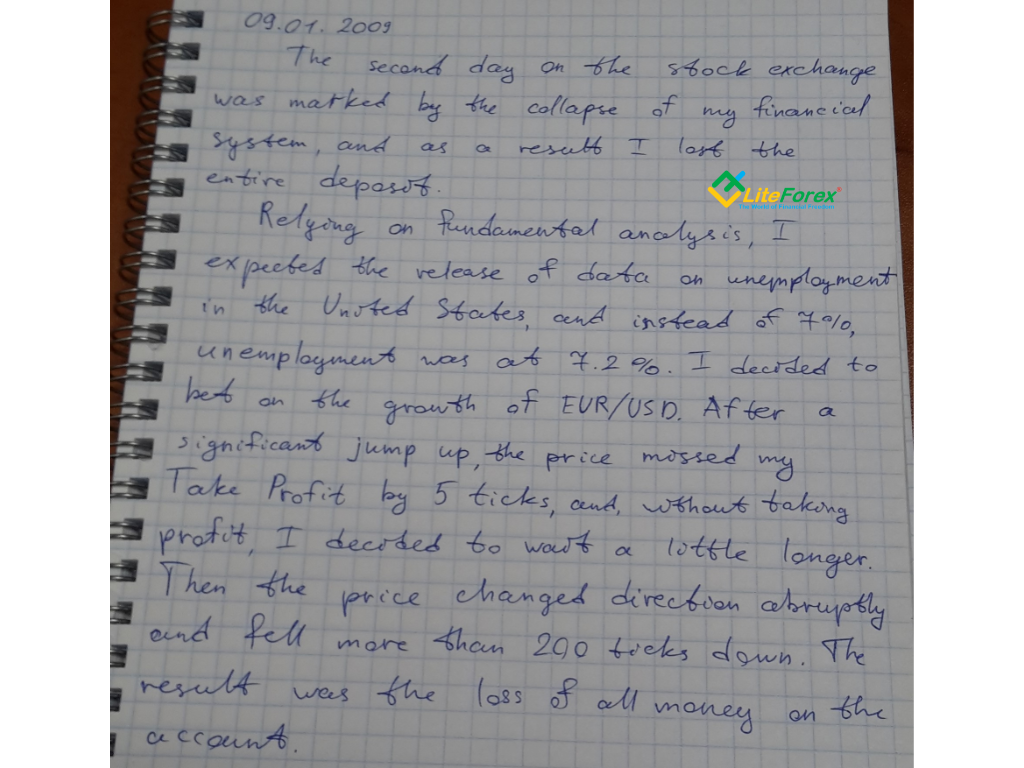
The image above is an excerpt from the page of my journal I kept at the time, where Russian-speaking readers can see how I responded to this event. I admit that then, under the influence of emotions, I lied a little about 5 points and Take Profit.
As I said, this is not a mistake. The mistake was not taking this profit. But in both cases, you will become confident that you can earn a lot, quickly and easily, which is a big mistake.
Potential solution
If I say that when you get a large profit, you need to close the trade immediately, take the profit, turn off the computer and stay clear of it for another week - I will be absolutely right. But I understand perfectly well that no one will ever do that. I myself will never do that. I will think that I deserve this and I will continue to work with my head high, thus making the mistake I try to teach my students to avoid. When people ask me why I make mistakes I teach people not to make, I answer: “I'm just a human, not a robot”. Many of you will immediately think: if a human makes mistakes, why not entrust the trade to robots, they have no emotions, and, consequently, make no mistakes. The answer is yes, robots have no emotions, but they make much more mistakes than people, because their program is written by people who often understand very little about financial markets, not to say about risk management.
3. Lack of experience
Reason
You can blame almost all your losing trades on this one. It may include low basic financial literacy among most traders, general lack of understanding of the processes occurring on the financial markets, ignorance of the basic principles of pricing, and much more. But I will try to be precise. In this paragraph, I will talk about the lack of experience in monitoring the course of trading. In other words, we do not know what to expect from the price next and are completely unprepared for movements that we have never seen before.
Absolutely all beginners who make their first steps on the financial market have to deal with this problem. We open the trading terminal - and everything is new for us. We see the price chart and see how this price moves. But we may have never seen what one trading day looks like on the D1 timeframe. Introductory courses taught us to watch how quickly the price jumps up and down - and this makes us amused and excited. We have never switched to large timeframes, because they are not very exciting. Nothing is jumping there but rather just standing still. Perhaps if we were taught on large timeframes, we would understand that the price can pass a lot of points quickly. But in those moments we didn’t even know about it. We made a lot of trades for a small number of points and believed that this would always be the case, and this is how the market goes. But when one candle in the chart was the size of the entire screen - it shocked us, and joy gave way to despair and hopelessness. Why am I writing about it so easily? I went through all this myself.
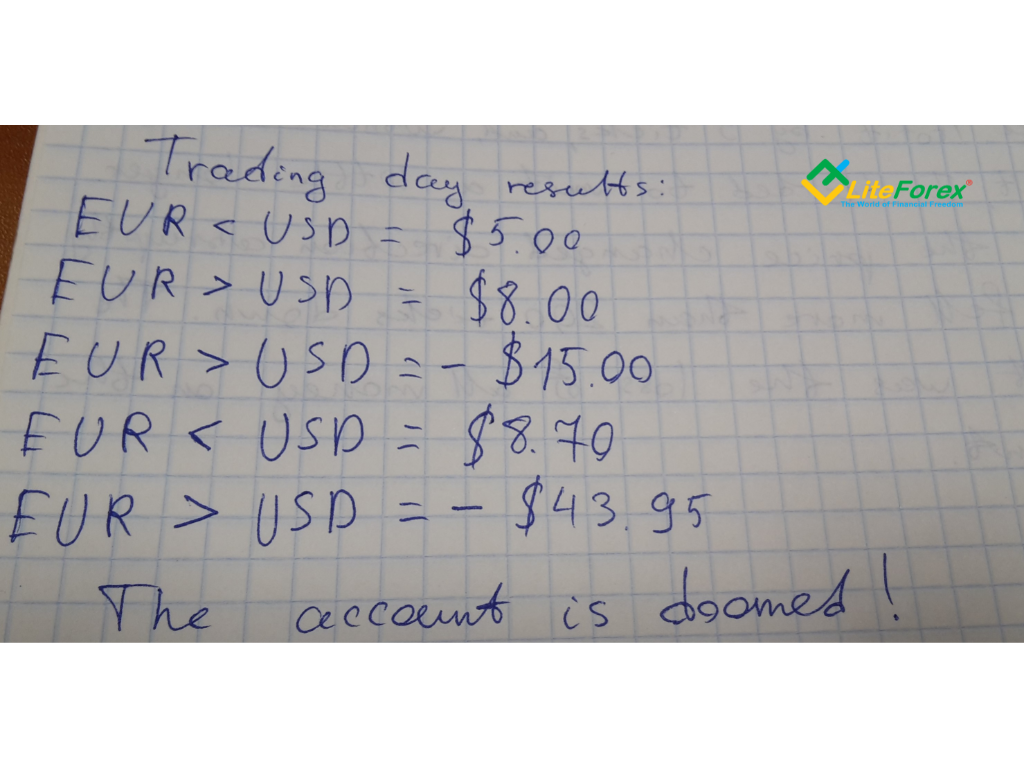
Above you can see another excerpt from my trading journal, which shows the moment when one price movement, which I could not even have tried to predict, destroyed my entire trading account. For English-speaking readers, I will translate the last phrase - “the trading account is doomed!”.
Potential solution.
In fact, the solution to this problem is very simple. It lies on the surface. You need to train and gain experience. Naturally, at the time I did not suspect that the solution was so simple, and continued to get caught in the same trap. Now I recommend the following to my students: you open small trading accounts (you can even open a cent account, where 10 dollars are a 1,000 on the terminal screen) and just watch how the market moves. Go to different timeframes, study how different price movements look at different time intervals. I understand perfectly well that no one will just sit and watch the price go. After all, we have so much knowledge and skills. Why just watch when time is money and you have to earn. This is why you open a live account, albeit small, and not a demo. You will keep in mind that this is real money, and you are risking it, and, therefore, you will also train your nervous system.
Reason.
All things considered, I consider the constant reading of the Internet resources and analytical articles to be my biggest mistake at the initial stage of studying the financial markets. Internet today is simply bursting with information about financial markets, especially the Forex market. Numerous gurus rush to share their “expert” opinion for mere pennies, sell all sorts of “super” trading strategies and hold seminars and masterclasses, which are absolutely useless from a practical point of view, where say nothing meaningful but only boast of their own supposedly successful trades. What else can we, beginners, do? Not much. Under the pressure of all this information, we give up and constantly listen, read, try to understand, thus moving farther and farther from the original goal. One of the visitors to my seminar once said that he had already lost count of how many seminars and training courses he had attended. I asked, “Why?”. He thought for 5 seconds and said: ”Well, it’s become a habit”. At the beginning of my journey, I listened to a huge number of different seminars, bought a whole bunch of CDs with training courses, and I read many analytical articles. And only after 5 years, I began to realize that all this is pointless and does not carry any practical use.
Potential solution.
Here is my slogan in the world of finance: Do not listen to anyone who says they understand your money more than you do. Do not read analyses, do not believe in trading signals that you have not developed yourself. Do not waste time reading what you can write yourself. Can you write an article like this from your experience? If you can, close this article. You have enough experience to earn yourself. Go ahead, practice and gain experience! Meanwhile, we will continue... After reading the slogan, you might have a logical question: “How can you learn to trade if you don’t read anything?” First, what you have already read until now will be enough for you. Secondly, you absolutely should read and learn. You just need to know what to read. I can give you a piece of advice. Modern literature on trading is not worth reading. 99% of this literature is written to make you start trading and spend your money faster. In addition, most books and textbooks published now are written by authors who lost their money on Forex and are trying to compensate for the losses even a little. Learn from those whose performance on Forex you can evaluate and see in reality. If someone tells you that they are a successful trader earning millions, but they live in a rented apartment... Well, you get the idea. Warren Buffett, Benjamin Graham, George Soros (damn him). Yes, some people in this list are not very decent, to put it mildly. But they are brilliant traders with publicly available and well-known statistics. Their success is no secret to anyone. In addition, each of them has published more than one book about their experience on the financial markets. This is the literature worth reading, only in books like these, you will find something to learn. Do not worry that they are mostly about the securities markets. Believe me, the pricing principles are the same in all markets. The most useful book for me was Security Analysis by Benjamin Graham.
4. Wrong idea of what you are doing.
Reason
This is another common cause of losses. In my experience, it was usually associated with strong emotional outbursts. Basically, these surges happen when you make a successful trade or a series of successful trades.
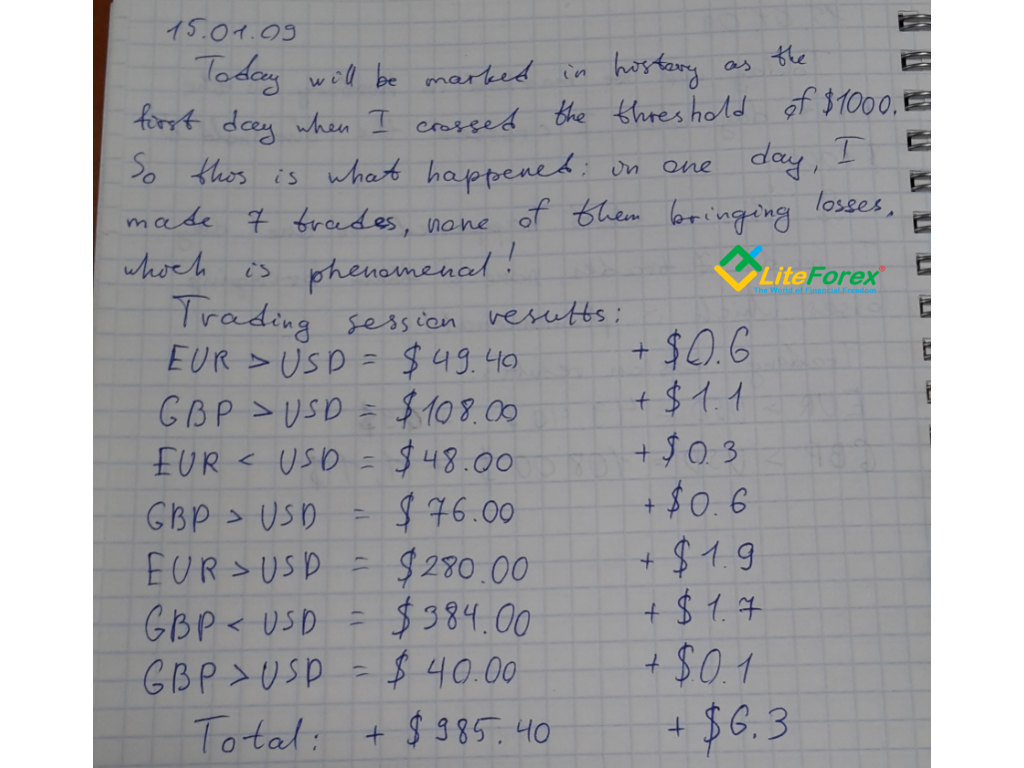
I’m showing you another excerpt from my journal, which will soon be 10 years old. Here is one of such series of successful trades. You can see even in the current frame what it resulted in. The last trade in the series is very different from the others. Can you notice why? Look at the amount of profit and the number of points of profit. 5 points are equivalent to 40 USD. This is a volume of 1 lot! The leverage I used then was close to 1:1000. The previous trades had a smaller lot. In other words, even then I believed that my system was indestructible. I was so wrong. It is now that I re-read these lines with a smile, but at the time I was serious and passionate. I will show you the end of this deposit a bit later. I had no idea what I was doing and what it might lead to. I was just in a state of euphoria and opened one trade after another.
Potential solution
The euphoria of successful trades will haunt you constantly, whether you have been on the market for 10 years or 10 days. It is just a chemical process in the human body. I will tell you more, your brain is absolutely indifferent to whether a trade is profitable or unprofitable. For it, it's just an emotion. So, there is only one solution: after a successful trade, leave the computer and distance yourself from the trading process for at least 5 minutes. Go to the store, spend some money. Get any other emotion not related to the market. This is not easy, this is why the solution is potential. But I managed to train myself to follow this rule, why can't you?
5. Faith in the Forex grail
Reason
Everyone knows this reason. Each of us at least once heard stories that someone has developed a trading strategy that makes a profit constantly. Either you were offered a trading robot that brings unimaginable profits, or you just woke up one day and realized that you had invented a brilliant strategy. At the beginning of my path, I must have come up with at least 10 such winning strategies.
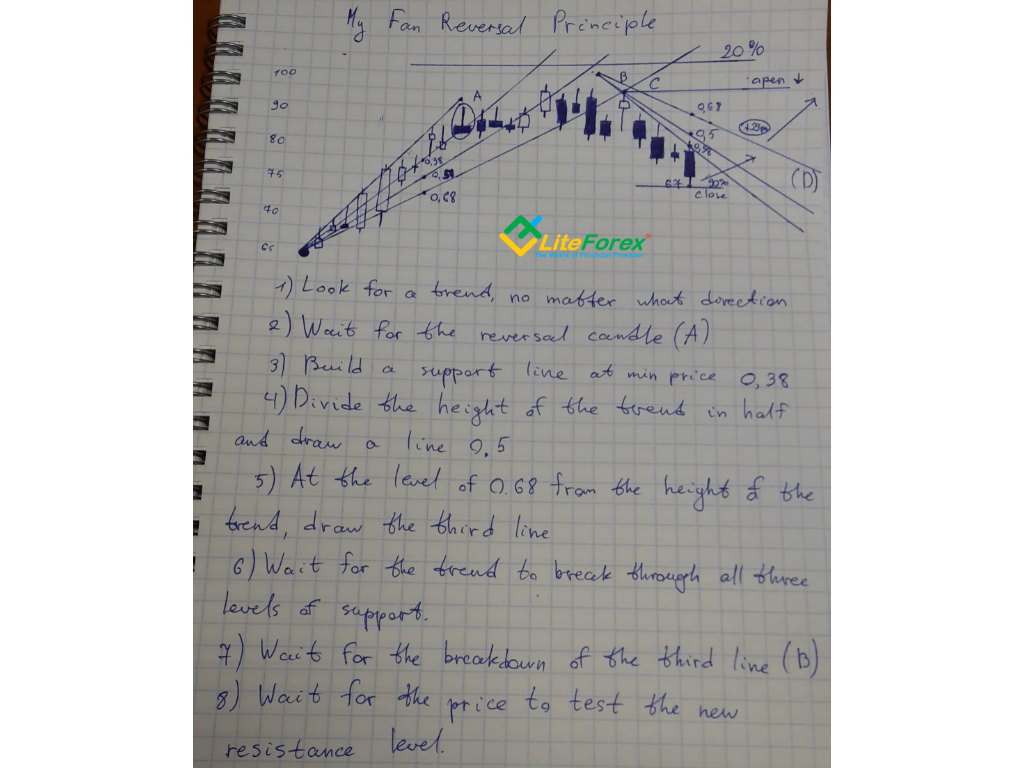
Above, you can see one of my grails. I called the strategy no less than Artemych Fan Reversal Principle. Yes, I was pretty confident then. I think many of you are now. But time passed, and the strategies changed and changed. One grail replaced another. And this process was endless until I realized how things really work.
Potential solution
Here is a fact confirmed by time and a lot of money: the Grail does not exist. Any trading strategy will work and make a profit. But only if you follow its rules unconditionally. This is a fact. On my journey, I tried hundreds of trading strategies. And you know what strategy I have used for the last 3 years? The basic trend change strategy. One of the main lessons I’ve learned is the simpler - the better! We will talk about this some other time.
6. Constant craving for making trades.
Reason
This is another psychological problem, one of the most common ones at that. But if some of the previous common Forex trading mistakes are not very self-evident, almost every one of us understands this problem, but we cannot do anything about it. Of course, we can say that this is not a problem, but rather a peculiar trading strategy, which involves opening a large number of trades. But this is self-deception. There is even an opinion of quite competent human psychology researchers, which explains the appearance of scalping strategies as this very thirst for constant opening of trades. As I said above, making any trade creates an emotion that causes satisfaction. We like this feeling and it is quite logical that the brain wants more. And we continue to open new and new trades, often completely unaware of why we do it.
Potential solution
Here we will go deeper into the subtleties of creating a custom trading method. What I’ll say next is part of my current trading strategy. So, the problem is again psychological, and therefore, it is almost impossible to neutralize. However, I found a possible solution for myself: you need to divide the funds on your trading account into two parts - the gaming and working funds. For me, the ratio of 90/10 in favour of the working funds is best. So, the working part solves the global task of making a profit and forming a global positive result, while the gaming part satisfies the needs of my insatiable brain, which constantly requires new emotions. As I said above, the brain does not care what kind of trade you have opened and for how much – what matters is that you opened it. Do you get what I'm doing? You can play with minimal lots, and even if all your gaming trades are unprofitable (and they most often are. I lose the gaming part of the deposit almost every month. I’m no scalping genius, but I create a positive result with the working part of the deposit), this does not affect the global result. It is important to restrain yourself, in case of loss of the gaming part of the deposit you cannot start biting off new pieces of the working part. I admit, at first, I did it, but then I was able to convince myself not to do it.
7. Too many open trades
Reason
All the problems I will talk about below have to do more with the technical process of trading. If you have been working on the market for some time, you have a trading strategy that you use. This strategy usually involves a certain number of trades. But I think everyone had a moment when the trading terminal window is not big enough to display all your open trades, and you have to use the scroll bar to see them. This problem is quite common. And it is a problem because you cannot say exactly how many trades you have open at the moment, how many are open for the same instrument, and, most importantly, why you opened this or that position. According to my personal criteria, a trade is justified and potentially effective only when I look at the chart of the instrument and within 5 seconds I can explain why I opened it. All trades that do not fit this criterion are subject to instant liquidation.
Potential solution
The problem is technical, so the solution will be technical too. This is how I trained myself to stop opening a bunch of unjustified trades: If you see that you have a lot of trades, or you cannot remember why you opened them, take a sheet of paper and write out every trades with all the parameters like in a terminal. Do not print, write them out with a pen or pencil. Believe me, you will be bored very soon. While you are writing out, you are solving several problems at once. First, you look at each trade individually and you may recall the reason you opened it. Second, you can filter them and maybe even close the ones you cannot explain. Third, sooner or later you will train yourself to control the number of open trades to avoid this procedure in the future.
8. Intraday trading
Reason
Now I will get a ton of angry comments from brokers, dealers and their minions. No wonder, I dared talk about the untouchable topic. I called a mistake something that brings profit to the bigwigs of the market. Nevertheless, it is. Name one person who actually makes money on forex day trading with documented evidence. There aren’t any. And no one in the world can convince there are. Why not? Because I refer to everything that happens in the market within the day as the Kingdom of the Market Maker. I think I don’t need to explain who a market maker is. It’s the person who makes the market. Quite self-explanatory. The main task of the market maker is to create a permanent game on the market: constant manipulation of quotations of instruments, in relation to the open positions (regardless of the position size) of players, in order to close these positions, and, consequently, take the commission, spreads, and swaps. Your position is closed, you open a new one, again giving away the commission, the spread, and so on. Intraday fluctuations make you close your positions, you open them again, and goes on and on. But if everyone moves to long-term deals, then how will they get the commission? The answer is simple: they never will move. Intraday trading is an industry, a huge industry that constantly feeds the consumer with trading signals, recommendations, scalping strategies, algotrading, etc. Let’s look at the recent fluctuations in the GBP/USD currency pair. Every day, the pair fluctuates by 1-2 figures. How many intraday traders lost their deposits? I also have positions on this pair, but these movements did not affect my trade in any way. I have global goals and objectives. Answer me this: how much commission, spread and swap do you pay to your broker every month? How many of you keep track of this? I think none. I also don’t. But I did a couple of times, and I saw enough.
Potential solution
I personally see this solution not as potential, but as the only possible: do not engage in intraday trading. This does not mean you have to forget about intraday trades. This means that your main financial results must be ensured by global operations. 9 out of 10 people who heard this from me answered immediately: “What can I earn at global intervals with my 100 dollars?” My answer is always: “Do you earn more by intraday trading?” Everyone thinks so, perhaps because do not quite understand the potential of leverage and forget about the minimum trading volume. I have a real example. Only this time it is an example of one of my students. With 143 USD on his trading account, in 27 trading days, he managed to take 317 USD of profit in just two trades. Can you achieve a similar result inside the day in the same amount of time? I think some can do it in a day. But can they keep it after 27 days? I don’t think so. Try to understand that the time interval does not affect the trading result. And you can never earn more with a large number of short trades than with one long-term trade. That is, of course, if you’ve been trading for more than a month.
9. Not understanding the need for protective orders
Reason
This problem has more to do with a lack of education. But it’s not that you don’t know why and how orders work. It’s about the very understanding of the meaning of these orders. Any of you can easily answer why do you need the Take Profit order or Stop Loss order? Are you sure you understand its meaning correctly? Yes, we know that it’s a profit lock. We know that this order closes our trade without our involvement. And when you set it, you know that even if you are not there to close the position, this order will do all the work for you. All this is true. But we never think that this order can serve as a psychological barrier. When we use this order constantly, we get used to the fact that the trade is closed without our participation. And now answer this: how many trades have you not closed in profit because the price missed your order by a mere penny? Lots. And I have too. Why? This does not happen because there is a conspiracy against us, and the market acts against us. This is because we get used to the mechanical process. We drive the market into our limits and wish it to stay within the limits we set. But it doesn’t work like this. The market is a chaotic mechanism that cannot be driven into limits. If you believe it obeys your rules, it will punish you.
Potential solution
This is how I solved this problem: I always set Take Profit! But this does not mean that you have to wait until the price reaches its level. I have several similar-sounding stories about this rule. Everyone likes easy money. This factor is important in the market. And if you get an opportunity, you shouldn’t ignore it: maybe this is your lucky day. I worked with my favourite currency pair GBP/SGD. Since the trades were long-term, they stayed overnight when I was away from my computer. By the way, I spend very little time watching the market, no more than an hour a day, almost always in the market. So, I had Fantastic Take Profits set for all the trades (Fantastic Take Profits are the orders set not where you think you should take profits, but just set at random, far from the current price, counting on chance). I woke up in the morning, opened the terminal and voila, something very unlikely happened. At night, there was a candle with a shadow of 8,500 points for this currency pair. The Fantastic Take Profit was at 6,700 points and it worked, taking profit. What are the odds? So after this incident, I always set Take Profit for each trade with no exceptions. Next rule: Do not use Stop Loss if its size is less than the average daily volatility of the trading instrument. It will just get swept away. If you set a loss limit, it must be justified. The probability that the stop loss signal you set with a size of fewer than 1,000 points will work before Take Profit is almost 100%. Why? I have already talked about this - the market maker.
10. Inability to think in percents
Reason
It took me oh so long to realize this problem. We are all used to count our money in the deposit, profits and losses, in dollars, i.e. in money. Remember my screenshots above, where I’m writing about profits and losses, I always talk about dollars. And do too. We get used to it. This creates certain problems during trading. In order to assess the potential movement of prices on the expected trade, we use points. Then we try to convert points to money. And what if the lot is not standard? This creates even greater problems in the calculations. Even if you figured it all out, opened the trade, earned some money and closed the trade. How do you evaluate the result? Suppose you had 1,000 USD of deposit, and after closing the trade you got a profit of 35 USD. How do you evaluate this result? The only way you can: 35 USD in relation to 1,000 USD is not much, to put it mildly. Especially if you’ve had this trade open for a week. You want more. It worked last time. You continue trading to get a more or less acceptable result. How much would be acceptable in relation to 1,000 USD? And in relation to 100 USD? None. This is not enough, you believe. Earning 500 USD with 1,000 USD deposit - now we’re talking. Now let's talk about the acceptable return on investment. Most of us know that investment returns are usually estimated as a percentage. Is the yield of 20% per annum a lot or a little? Those who have invested in a business or projects even once know that 20% per annum is an excellent return that you can only dream of. The yield of 20% per annum is about 1.7% per month. Now back to our 1,000 USD and absolutely unimpressive profit of 35 USD. This is 3.5% per week. Even if you stop trading until the end of the month, it is 3.5% per month, and therefore, 42% per year. Where else can you get such a return? If we’re talking about legal activities, then nowhere. Have you spent a lot of efforts to earn 35 USD with your 1,000 USD? Not really. We just do not know how to think in percents. We do not understand when to stop and what the profitability is acceptable.
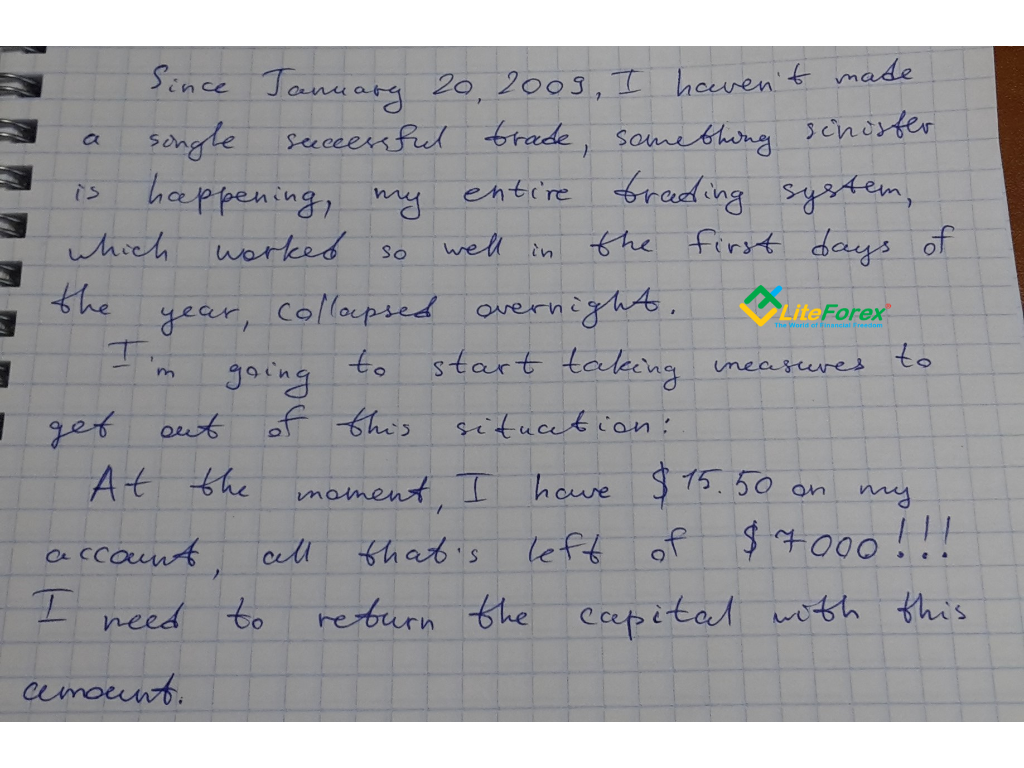
And here is the end of the super successful period of profitable trades I promised to show you. In just over a month, with 380 USD on my account, I managed to earn about 7,000 USD. This is approximately 1,842% of the profits. But I did not know it and did not realize it. The final result is in the screenshot. The account turned to dust in just 3 days.
Potential solution
The answer lies again on the surface: learn to think in per cent! Do not pursue large numbers, pursue only % of return. It does not matter how much you have on your account: 100,000 USD or 100 USD. If you want your 100 USD to turn into 1000 USD, this is only possible if you set yourself landmarks in %, and not in money.
Of course, I hardly managed to list all my mistakes. This is probably not even half. But I talked about the most important ones. I really hope that my experience will be useful to you. After all, remember the title of the article – a smart person learns from the mistakes of others.
P.S. Did you like my article? Share it in social networks: it will be the best "thank you" :)
Useful links:
- I recommend trying to trade with a reliable broker here. The system allows you to trade by yourself or copy successful traders from all across the globe.
- Use my promo code BLOG to get a 50% deposit bonus on the LiteFinance platform. Simply enter this code in the appropriate field when funding your trading account.
- Telegram chat for traders: https://t.me/litefinancebrokerchat. We are sharing the signals and trading experience.
- Telegram channel with high-quality analytics, Forex reviews, training articles, and other useful things for traders https://t.me/litefinance
Price chart of EURUSD in real time mode

The content of this article reflects the author’s opinion and does not necessarily reflect the official position of LiteFinance broker. The material published on this page is provided for informational purposes only and should not be considered as the provision of investment advice for the purposes of Directive 2014/65/EU.
According to copyright law, this article is considered intellectual property, which includes a prohibition on copying and distributing it without consent.