


It is a common misconception that all financial markets observe Saturday and Sunday as weekends. However, cryptocurrencies and binary options are still tradable during this time, and markets in the Middle East, along with some Forex brokers, continue to operate.
This article explores weekend trading, covering its advantages and disadvantages, available assets, and the most popular strategies. Discover whether weekend trading is suitable for you and learn how to boost your efficiency in the financial markets.
The article covers the following subjects:
Major Takeaways
Main thesis | Conclusions and key points |
Weekend trading | Weekend trading takes place on Saturday and Sunday in the financial markets. |
Markets available for weekend trading | During weekends, you can trade on the Middle East stock exchanges such as the Dubai Financial Market (DFM), the Tel Aviv Stock Exchange, and the Saudi Exchange or Tadawul, which is a stock exchange in Saudi Arabia. Some brokers also provide access to binary options and the Forex market. Besides, crypto markets are open seven days a week. |
The myth about trading halt during the weekend | With globalization and the rise of online trading, more and more assets become available on the weekend. |
Which brokers allow you to trade Forex on weekends | The most famous broker that allows trading over the weekend is IG Markets Australia. |
What assets can be traded on weekends | Available trading instruments include GBPUSD, EURUSD, and USDJPY currency pairs. FTSE, Germany 40, Wall Street, US Tech 100, and Hong Kong HS50 stock indices, as well as equity perpetual contracts, are also available. |
Weekend trading advantages |
|
Weekend trading disadvantages |
|
Key weekend trading strategies | The most popular ones are the gap trading and Bollinger Bands strategies. |
Additional trading strategies | The RSI 40–60 and the weekend MACD strategies are also useful. |
Weekend Trading: Markets and Assets
Financial market novices sometimes ask questions that can unsettle experienced traders. However, seemingly simple questions may require a more in-depth explanation. For instance, consider the concept of weekend trading.
About 15 years ago, any professional trader would have insisted that trading in the financial markets during weekends was impossible. However, thanks to the advancement of technology and the rise of crypto trading, we now have plenty of opportunities to invest on weekends.
Financial markets encompass various types, with the primary ones being the stock market, Forex currency market, commodity market, crypto market, and binary options. The stock, commodity, and currency markets remain closed during weekends due to the working schedule of stock exchanges and large banks, operating from Monday to Friday. Thus, there are no intermediaries available to process your trades during this time.
Dividends are also not paid on weekends and holidays when most financial institutions are closed. If the payment date occurs on a weekend, it is postponed to the next working day, as the dividend payment process requires bank transactions and administrative work that is only performed on weekdays.
Cryptocurrencies operate differently from traditional financial institutions. All transactions are conducted online, and the Internet operates around the clock. Unlike traditional markets, digital asset exchanges do not function as an intermediary. Instead, they directly connect buyers and sellers. With the blockchain mechanism, users can buy, sell, and transfer assets to each other from anywhere in the world automatically. This means that the cryptocurrency market is the most accessible financial market during weekend trading hours.
Binary options trading also has its own peculiarities. With the growing popularity of trading and the rise of cryptocurrencies, binary options have advanced to a new level, providing instruments with underlying assets that can be traded during weekends.
Besides, some brokers provide access to certain securities and stock indices such as the Tadawul Index, FTSE 100, and DAX on weekends. The most popular one is the Australian IG broker. Apart from stocks, you can trade popular Forex pairs such as EURUSD, GBPUSD, and USDJPY on weekends. Typically, you need to open a special brokerage account or choose an instrument with the Weekend indication. This will mean that an order to initiate a trade on the weekend will be different from an order set on a regular trading day.
The list of asset classes available during the weekend, either completely or with some restrictions, is provided below:
- Stocks, bonds, and stock indices. There is no official weekend day trading, but there are exceptions. Some Middle East exchanges offer trading with their own securities. Therefore, weekend trading is available through specialized brokers with a limited selection of financial instruments.
- Forex currency market. The market is closed on weekends, but you can trade with specialized brokers. The list of currency pairs is also limited.
- Equity Perpetual Contracts (equity perps). Some platforms offer equity perpetual contracts for trading on weekends. The availability of these instruments depends on the broker or exchange, and the list of underlying assets is usually limited.
- Cryptocurrencies. Weekend trading is conducted as usual, but there is low liquidity in most of the minor coins.
- Binary options. Platforms support weekend binary options trading for assets available on non-business days, such as cryptocurrencies and some stock indices.
Why Are Some Markets Closed?
All financial markets are divided into exchange and over-the-counter markets. Exchange markets facilitate the trading of stocks, indices, and commodities such as gold, oil, and gas. An order to buy or sell on these markets is processed through the exchange on which the issuer or underlying asset is listed. If the exchange is not closed on Saturday and Sunday, there is no one to process the order. Therefore, you will not be able to trade on the exchange on weekends.
However, there are some exceptions. On US holidays, trading in some stocks may continue on exchanges where they are listed. For example, on the HKSE (Hong Kong) stock exchange, liquidity is provided by participants on an active exchange, which significantly differs from regular weekday trading. Nevertheless, an investor can still purchase these stocks. Therefore, to trade shares on weekends, an investor simply needs access to multiple exchanges.
In the over-the-counter market, trading occurs on multiple global platforms simultaneously, ensuring uninterrupted liquidity flow around the clock. This includes both cryptocurrency and foreign exchange markets.
However, trading Forex on Saturday and Sunday is not possible. Firstly, the main suppliers of liquidity on Forex are the world's largest banks, which are closed on weekends. Additionally, the continuous flow of quotes provided by aggregators such as Bloomberg and Reuters, which are based in the USA and Canada, also ceases during the weekend, making transactions impossible.
At the same time, some brokers allow you to trade a limited list of currency pairs. Usually, such companies use ECN technology and provide liquidity in the so-called thin markets at the expense of clients' funds and their own capital. This creates certain risks for traders, such as high volatility and large gaps. However, this is how you can turn an inaccessible market into an accessible one.
Other instruments, including cryptocurrencies and binary options, provide regular trading conditions on weekends. However, trading activity and market liquidity on such platforms are notably reduced as crypto traders, like all market participants, require periods of rest. In the case of binary options, weekend trading is possible on instruments whose underlying asset is traded during this time.
Benefits of Trading During The Weekend
Weekend trading has a number of advantages. Let's take a closer look at some of them.
Strategy Implementation
Certain strategies are tailored for weekday trading, while others are more effective during the weekends.
For instance, Asian markets are different from markets active during the European or US sessions. After the American session closes in the Forex market, trading volume typically decreases, causing prices to move more slowly. During such periods, price fluctuations are minimal, and trading occurs within specific ranges. Weekend trading is similar to trading on Asian markets, with low volumes and prices trading within a confined range. This favors traders whose strategies are designed for low volatility, allowing them to apply these strategies to weekend markets as well.
More Trading Equals More Profit
The more trading opportunities a market offers, the greater the potential profit. Markets on a Saturday and Sunday can provide extra chances to make money, especially if opportunities are limited during the week. However, this is not always the case, as the market is much less active on weekends.
Hedging Opportunities
If you open trades from Monday to Friday and roll over them to the next week, it is important to consider the impact of events that occurred on weekends on your positions. To avoid the potential negative effects of news and to hedge the underlying trend, you can trade on the weekend and open trades on the same asset but in the opposite direction.
Greater Focus On Trading
Most people are swamped with tasks, leaving little time to focus on trading throughout the week. Therefore, weekend trading gives you a good opportunity to maximize your concentration and improve your performance.
Most people take a break on weekends, so they will not disturb you with work-related issues. The information flow slows down, and the places you usually visit during the week are closed. With fewer distractions on your day off, you can focus better on the trading system and concentrate on trading without the usual daily interruptions.
Flexibility
Some people find it difficult to trade on weekdays due to work or business commitments. As a result, they prefer to use their weekends to make extra money in the financial markets. This is particularly beneficial for beginners who are unable to leave their main job but are eager to learn about trading. In such cases, trading over the weekend becomes the only viable option.
Suitable Exchanges Availability
Some stock exchanges in the Middle East, such as the Dubai Stock Exchange (DFM), Tel Aviv Stock Exchange (TASE), Saudi Stock Exchange, and Doha Securities Exchange (QE), follow a trading calendar that differs from the standard one due to national specifics. Unlike most exchanges, these markets operate from Sunday to Thursday, allowing investors to trade even on Sundays. Weekend trading may be essential if you plan to trade securities in these markets.
Risks and Downsides
Despite its advantages, weekend trading also has significant drawbacks, making it unsuitable for some investors. An exception is equity perpetual contracts—such as #AAPLx, #AMZNx, #INTCx, and #AMDx—which are available for trading around the clock, including weekends.
Limited Instruments
On weekends, fewer trading instruments are available. Those who are used to trading popular assets such as AAPL, AMZN, INTC, or AMD will not be able to trade them on Saturday or Sunday because these stocks are not listed on exchanges that operate on weekends. The same applies to most commodity assets and currency pairs.
Inability To Trade On News
Weekend trading is not suitable for strategies that require consideration of significant news events and company reports when making decisions. Significant central bank announcements, financial statements, and major speeches predominantly occur on weekdays. However, if your trading system is based solely on technical analysis, then trading on Saturday or Sunday will be the same as investing on any other day.
Low Volume
During weekends, with major banks and investment funds closed, there is a noticeable absence of strong influencers on the quotes of currency pairs, stocks, gold, and oil. Even cryptocurrencies are traded less actively on the weekend because a significant portion of market participants are absent. Consequently, this lack of activity results in stagnant quotes, reducing opportunities for profitable trades. Additionally, higher commissions and wider spreads during these days make trading unprofitable for most assets.
Different Time Zones
For example, European traders can trade on the Middle East exchanges on weekends since they are situated in similar time zones. However, traders from the United States or Canada would need to get up in the middle of the night to align with the trading hours of these exchanges.
Limited Brokers
Many brokers lack the necessary client base to support weekend trading due to the requirement for minimum liquidity. In some cases, brokers may need to use their own funds to execute trades if a client's capital is insufficient, posing a significant risk. This risk is only justifiable for brokers with a large and diverse client base. Therefore, only major brokers can offer weekend trading to their clients, and not all of them do.
Some countries are more willing to trade at weekends than others, mainly due to their geographical location. For instance, the Australian market is relatively small, and the time zones do not coincide with most trading sessions. To compensate for this, Australian IG broker offers clients the chance to trade certain instruments on weekends.
Besides, brokers, such as Pocket Option, Nadex, and FXCM, offer weekend trading. Before you start trading on weekends, verify if this option is available with your broker.
High Volatility Risks
The high volatility in the market can be a double-edged sword. It can offer the potential for quick profits but also poses the danger of significant capital loss due to abrupt price movements. Margin trading, in particular, amplifies this risk by involving borrowed funds.
Over the weekend, when regular market participants are inactive, there can be significant differences between bid and ask prices. This situation leads to the formation of extremely large candles, which can soon be engulfed at the same speed. Sudden volatility can emerge when a major player enters the market. Many traders are unprepared for such rapid movements and may incur losses, especially if they are using leverage. Therefore, it is especially crucial to monitor your margins.
Weekend Trading Strategies
Weekend share trading requires special strategies, which consider increased volatility and changing volume during this period. Conventional strategies may struggle under these market conditions, but there are a few approaches that can be beneficial.
If you want to trade during weekends, you have to adapt weekday trading strategies for the weekend by making adjustments. For example, when using support and resistance levels, it is important to understand how to establish them on lower time frames. If you use oscillators, consider reducing their period or range for overbought and oversold zones. For example, you may set the RSI oscillator's overbought zone range to 60%–100% instead of 70%–100% and 0%–40% for the oversold zone. The indicator period can also be modified from 14 to 10. These adjustments are specific to each instrument and should be tailored accordingly.
In addition, you need to amend your strategy when trading cryptocurrencies. On weekends, the price is unlikely to break through the key levels, so it is essential to identify additional levels within the main ones.
Notably, weekend trading mainly involves day trading, where a transaction is opened and closed on the same day. Holding a position overnight during the weekend is generally discouraged as market conditions can deteriorate significantly from Saturday to Sunday, just as they can from Sunday to Monday.
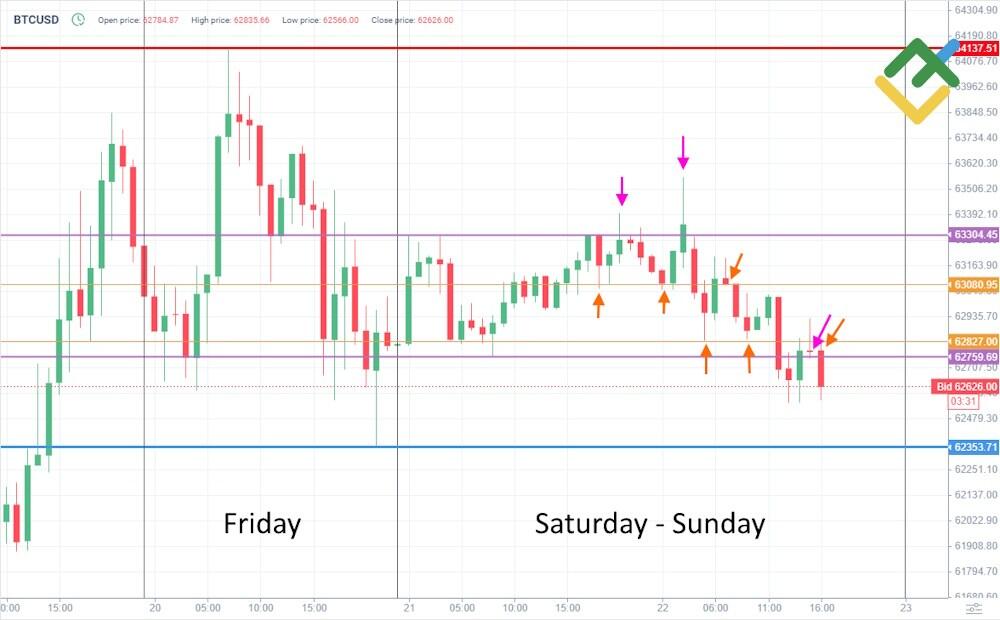
The screenshot above displays the BTCUSD chart. Key support levels, red and blue lines, are drawn along the Friday high and low. Additional support and resistance levels, which are purple lines, are drawn within these levels. Smaller orange levels are marked inside the purple levels. Let's observe the price performance using the additional levels found in Friday's trading range.
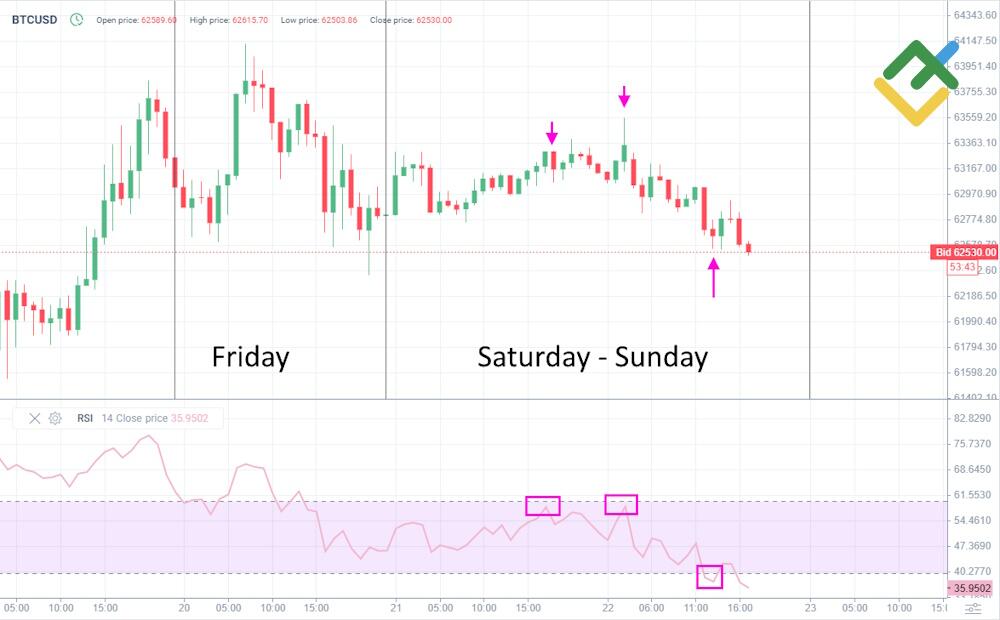
If you use the RSI or another similar oscillator, you can keep the indicator period the same but adjust the boundaries to 60 and 40 instead of 70 and 30. The screenshot below shows the potential trades identified on the Bitcoin chart using this approach:
To gain an edge in trading, staying updated with global events and following financial news aggregators like Bloomberg and Reuters is crucial. This allows traders to make informed decisions and act swiftly, either before or during news releases.
Life does not freeze on the weekend, and important events may occur at any time. For instance, significant political news such as presidential or parliamentary elections, opposition party victories in some districts, political upheavals, military conflicts, truce agreements, or trade deals between countries can occur. Natural disasters do not adhere to a schedule either, so it is crucial to monitor hurricanes, earthquakes, tsunamis, and flooding. Being aware of these events can prepare you for potential impacts on the financial markets when they open on Monday.
However, monitoring the news is not enough for successful trading. It is crucial to think analytically and form logical connections, like predicting the potential impact of a certain event on various aspects. Investing is not an easy process, but as you gain experience, you develop a deeper understanding.
It is crucial to stay informed about current events and think logically to safeguard your open position from unexpected price changes. This way, you can anticipate market movements and take necessary steps to protect your investment, avoiding being forced to close a trade by your broker. Additionally, it is crucial to have access to the right assets and markets, including those open on weekends.
Nowadays, many brokers offer the opportunity to trade via a mobile application, making the process much simpler. This allows you to initiate trades from anywhere, whether it is a weekday or the weekend. The key is to ensure that the broker offers the necessary instruments and indicators.
Weekend Gap Trading
Weekend gap trading or gap trading is perfect for the Forex and binary options market. A gap is simply a jump in prices. This happens when something or someone causes the market to surge to a higher or lower level, skipping intermediate prices. The strategy involves buying or shorting stocks with a price gap from the previous close.
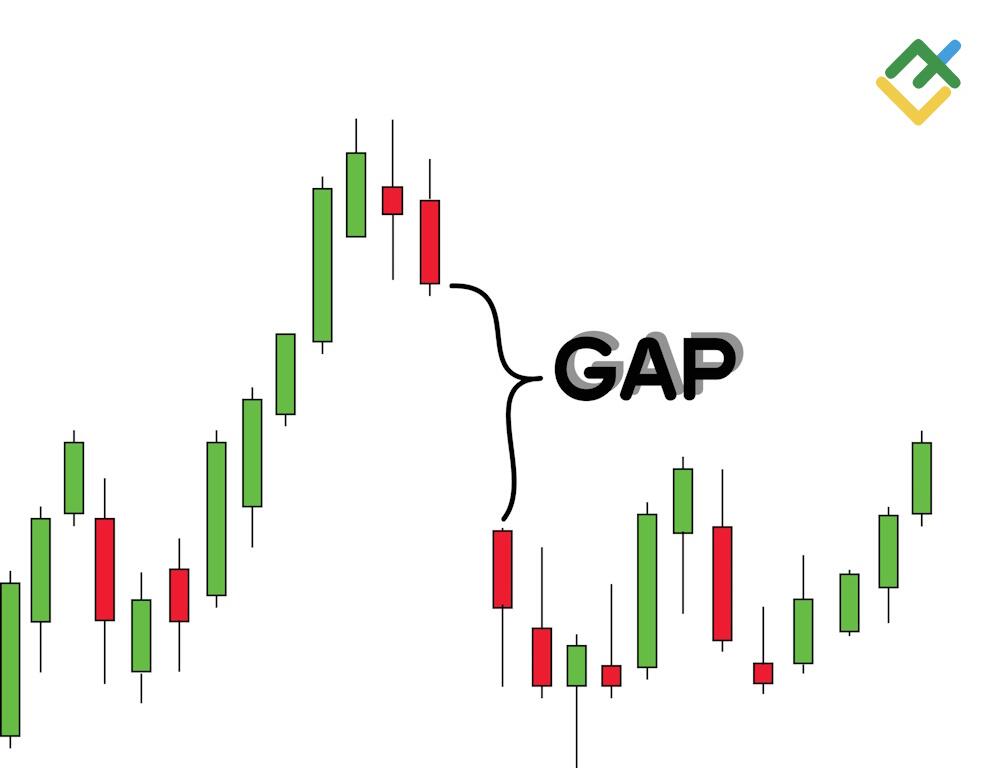
A gap can be caused by anything from new large trades to accelerated selling or buying by market participants. The key element for a gap to form is a substantial trading volume. However, major players stay out of the market on weekends, so even a smaller volume can cause a shift. Accordingly, a participant with moderate capital can act as a major player during the weekend, significantly influencing prices.
However, how can trades be made if the markets are closed? In fact, Forex does not close on weekends. Only the flow of quotes supplied by liquidity providers stops. Transactions can still take place between active participants because Forex is an over-the-counter market. Private transactions between large banks over the weekend are possible. Large companies can also spend their capital and exchange one currency for another. Ordinary people can go to banks and buy or sell currencies.
The actions mentioned above can influence the price of the asset, and this impact will be reflected on Monday's charts. Meanwhile, brokers who provide quotes over the weekend may already display this influence online due to active clients. Consequently, a gap can be created by multiple traders. When numerous people invest in the same direction, the market may experience a sharp rise. Most traders will then be unsure of what is going on. Often, they end up thinking the price has gone too high or too low. Thus, they try to profit from the apparent mistake by trading in the opposite direction.
If there are no objective reasons for a sharp rise or fall in the market, traders start to behave according to the following algorithm:
- Upwards gap → traders start selling → markets drop, and the gap closes.
- Downwards gap → traders start buying → markets rise, and the gap closes.
If gaps occur in low-volume markets, such as on the weekend, they will likely close.
How To Use The Weekend Gap Trading Strategy
In order to create a simple trading system, you need to know how gaps form and why they close. The gap trading strategy involves the following steps:
- Detect a price gap on a weekend day.
- Define the target. The market will try to close the price gap to the previous candlestick closing level.
- If the gap is upwards, make a short trade.
- If the gap is downwards, open a long trade.
If you anticipate the market hitting the target price soon, you might consider trading high/low options or opt for a one-touch option for potentially higher profits. Make sure to select an option with a price target inside the gap and an expiry date shorter than one period.
If you notice an unexplained gap in the market opening on Monday, and there are no significant events impacting the asset's price, you might consider employing a gap trading strategy.
Bollinger Bands Strategy
The Bollinger Bands strategy is another option for weekend trading. Bollinger Bands is a technical indicator consisting of a moving average and two standard deviations that show market volatility and potential support and resistance levels.
On weekdays, the price may break through the Bollinger Bands or stay away from them and trade near the midline. During weekends, the channel narrows due to lower volume, and the price often hits the upper or lower boundary of the range. If the price pierces one of the bands, it usually quickly moves back. In a sideways trend, which often occurs on Saturday and Sunday, the Bollinger indicator proves to be very useful.
Let's review the Bollinger Bands indicator in more detail:
- The upper band is the moving average plus twice the standard deviation, which acts as the resistance level.
- The lower band is the moving average minus twice the standard deviation, which acts as the support level.
- The middle line is a 20-period moving average by default. It can be either support or resistance, depending on whether the market is trading above or below it.
When the price touches these lines during the weekend, the market tends to reverse once it gets close to any of them. The upper and lower lines, which represent the channel's boundaries, are the most significant.
How To Use The Bollinger Bands Strategy?
The Bollinger Bands strategy involves the following steps:
- Select a tool and add the Bollinger Bands indicator to the chart.
- Wait until the price approaches the upper or lower band. To avoid wasting time, you can place the alert closer to the lines.
- Once the price reaches the upper or lower band, you can buy or sell. Consider short trades when the asset hits the upper band and long trades when it hits the lower one. Take profit can be set on the middle line. If you are confident that the price will move in the same direction, you can consider setting your take profit level on the opposite line.
- If the price breaks through the upper or lower line, you should wait for the price to move back into the range and then open a trade. This will be the best price.
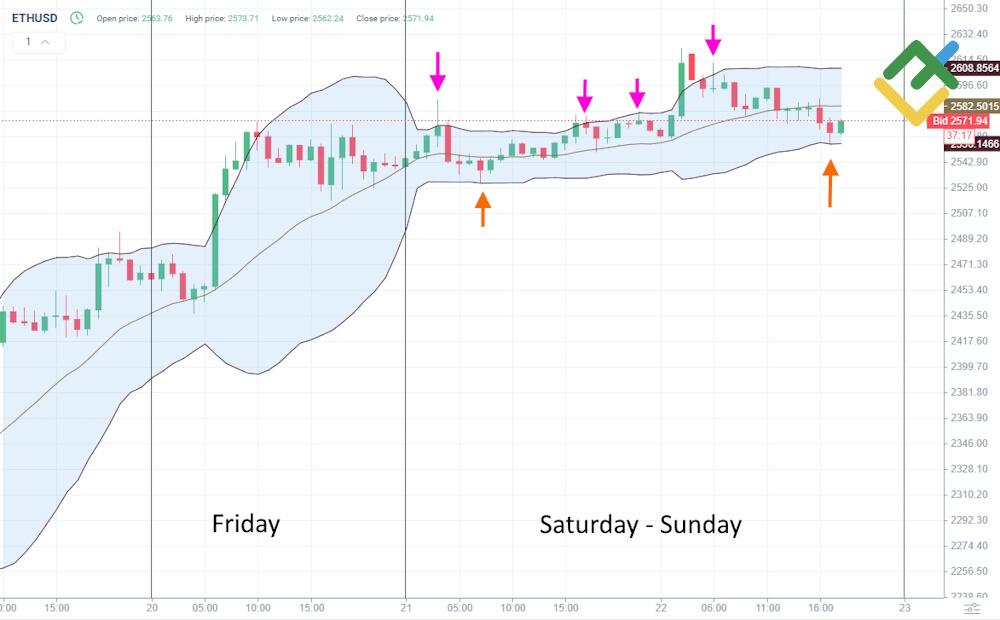
The screenshot above shows examples of implementing this strategy when trading the ETHUSD pair on weekends. Thus, investing in cryptocurrency during weekends can be a lucrative decision.
Since this strategy is easy to apply, and the Bollinger Bands indicator is available on most trading platforms, both novices and seasoned professionals can utilize this method.
Other Productive Weekend Strategies
There are alternative, less popular strategies for weekend trading. However, they require additional back-testing to understand the long-term performance statistics.
Moreover, a particular trading strategy should be adapted to the specific trading instrument. What may be effective for cryptocurrencies might not be as successful for Forex. Binary options also require unique strategies that differ from other trading approaches.
RSI 40–60
As the name suggests, this strategy is based on the Relative Strength Index (RSI) oscillator. The RSI is a technical indicator that gauges the speed and change of price movements to determine the overbought and oversold zones of an asset.
The key difference between this strategy and using the RSI on weekdays is the overbought and oversold zones. In the default settings, the overbought zone starts at 70% and above, and the oversold area starts at 30% and below. The strategy requires adjusting the RSI to the values of 60 and 40. Besides, there will be a slightly different approach to opening trades. Let's analyze the strategy in detail.
To go long:
- Wait until the RSI crosses and consolidates below the 40% level.
- Wait for the RSI line to return above the 40% level.
- Open a long trade.
- Close the trade when the indicator touches the 60% level.
- A stop loss can be placed below the nearest low.
To go short:
- Wait until the RSI crosses and consolidates above the 60% level.
- Wait for the RSI line to return below the 60% level.
- Open a short trade.
- Close the trade when the indicator touches the 40% level.
- A stop loss can be placed above the nearest high.
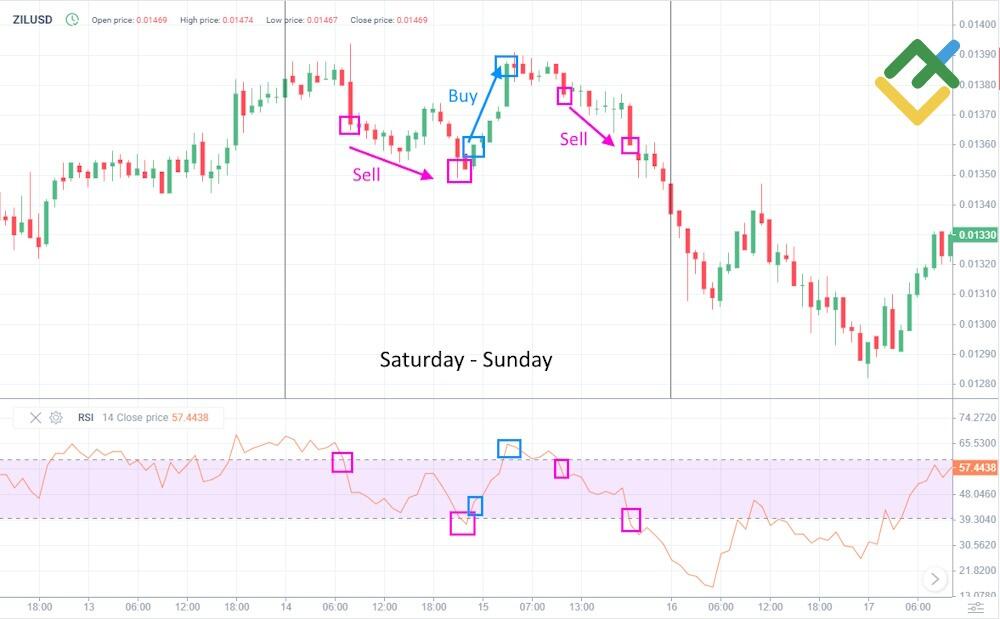
The screenshot above shows how this strategy is implemented on the ZILUSD pair. When the price decreases, and the RSI crosses the 60% line from above, a sell signal is formed. Conversely, when the indicator line crosses the 40% level from below, long trades should be opened. Once the indicative quote reaches the target level or a reversal signal emerges, the trade should be closed.
Weekend MACD
Another oscillator, which is also popular among traders on weekdays, shows effectiveness when trading cryptocurrency on weekends. Typically, on weekends, a majority of market participants take a break, and trading is mostly done by robots. Automated trading strategies utilize the same standard indicators and advisors but with some modifications and improvements. Such strategies act according to the rules, providing an extra edge to technical trading systems.
The MACD indicator, or Moving Average Convergence/Divergence, is a technical tool that shows the correlation between two moving average prices. It assists in identifying the trend's direction, momentum, and potential market pivot points. Let's apply this indicator using its standard settings.
To go long:
- Wait for the faster moving line to cross the slower one from below and for the histogram to change from red to green.
- Open a long trade.
- Close the trade once the histogram stops growing and declines after reaching the high.
To go short:
- Wait for the faster moving line to cross the slower one from above and for the histogram to change from green to red.
- Open a short trade.
- Close the trade when the histogram stops decreasing and starts to rise after reaching the low.
To confirm the end of the MACD histogram growth or decline, you can use two candlesticks instead of one.
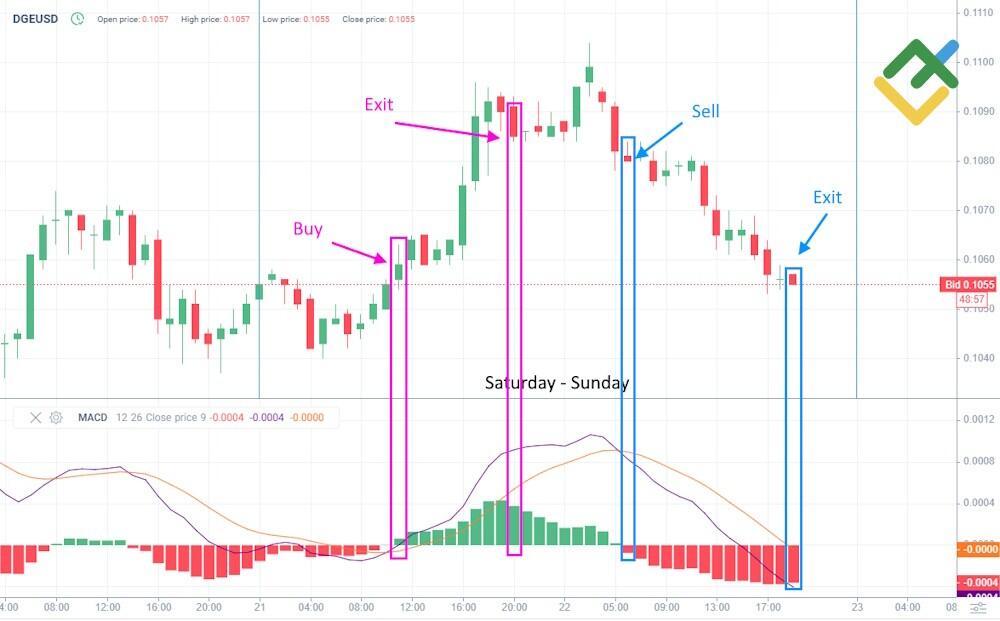
The screenshot above shows an example of applying the weekend MACD strategy on the Dogecoin instrument.
Summary
The weekend is another opportunity for traders to generate income. While the major players take a break, astute weekend traders can discover volatile markets worldwide and capitalize on them. Despite the closure of many exchanges and brokers, trading remains active in certain regions, notably in the Middle East. Additionally, you can engage in cryptocurrency trading, as it operates in a decentralized market.
When considering trading on weekends, it is crucial to adapt your strategy to different market conditions. Weekend markets exhibit distinct behavior, characterized by potential increases in volatility, accompanied by reduced liquidity and trading volumes. This can lead to frequent gaps, abrupt price jumps, and irregular candlesticks that appear seemingly out of nowhere. Your trading strategy should be poised to respond effectively to these conditions. To safeguard against a margin call, follow the money management and keep enough margin in your account. Furthermore, consider employing strategies specifically tailored for weekend trading, such as gap trading, the Bollinger Bands strategy, the RSI 40–60, and other relevant approaches.
If you want a break from trading, consider using this time to prepare for the upcoming week. You could dedicate this time to studying educational materials or utilizing a strategy tester to enhance your technical skills. It might be beneficial to outline a trading plan for Monday, engage in reading trading literature, explore educational resources, or simply unwind. Always keep in mind that your financial well-being depends on you as you determine when and how much to engage in various markets.
If you enjoyed the article and want to try weekend trading, LiteFinance offers you such an opportunity. You can trade more than 50 cryptocurrency pairs any day of the week. Register a demo account and test your strategy.
Get access to a demo account on an easy-to-use Forex platform without registration
Weekend Trading FAQs
Contrary to popular belief, trading on weekends is possible. Depending on your broker, you can trade Forex, cryptocurrencies, binary options, and equity perpetual contracts. However, the range of available instruments and trading hours can vary.
Weekend trading involves trading certain instruments on Saturday and Sunday. For example, stock exchanges in the Middle East follow a different schedule, operating from Sunday to Thursday. Cryptocurrency markets are also always available, while a limited number of instruments are available for trading on the Forex market during the weekend.
Weekend trading is limited to specific assets such as Middle East equities and cryptocurrency. Forex weekend trading is offered by a small number of brokers, and binary options can only be traded on assets available during these days.
Weekend trading is provided by IG Markets, Pepperstone, eToro, OANDA, XM, LiteFinance, and other companies. The availability of weekend trading varies depending on the asset class you wish to trade, be it currency pairs, stocks, cryptocurrencies, or binary options. Thus, the exact list of available instruments should be checked with the relevant broker.

The content of this article reflects the author’s opinion and does not necessarily reflect the official position of LiteFinance broker. The material published on this page is provided for informational purposes only and should not be considered as the provision of investment advice for the purposes of Directive 2014/65/EU.
According to copyright law, this article is considered intellectual property, which includes a prohibition on copying and distributing it without consent.